Table of Contents |
Attitudes differ in how they are structured, how strongly they are held, and the functions they serve, and these differences help explain why attitudes sometimes guide behavior and sometimes do not. However, attitudes do not influence behavior through a single process. Some evaluations involve conscious reflection and deliberate decision making, while others operate quickly and automatically, often outside of awareness. Building on this distinction, social psychologists propose that attitudes exist in two related but separate systems—those that can be consciously reported and those that influence judgments automatically—each shaping social behavior in different situations.
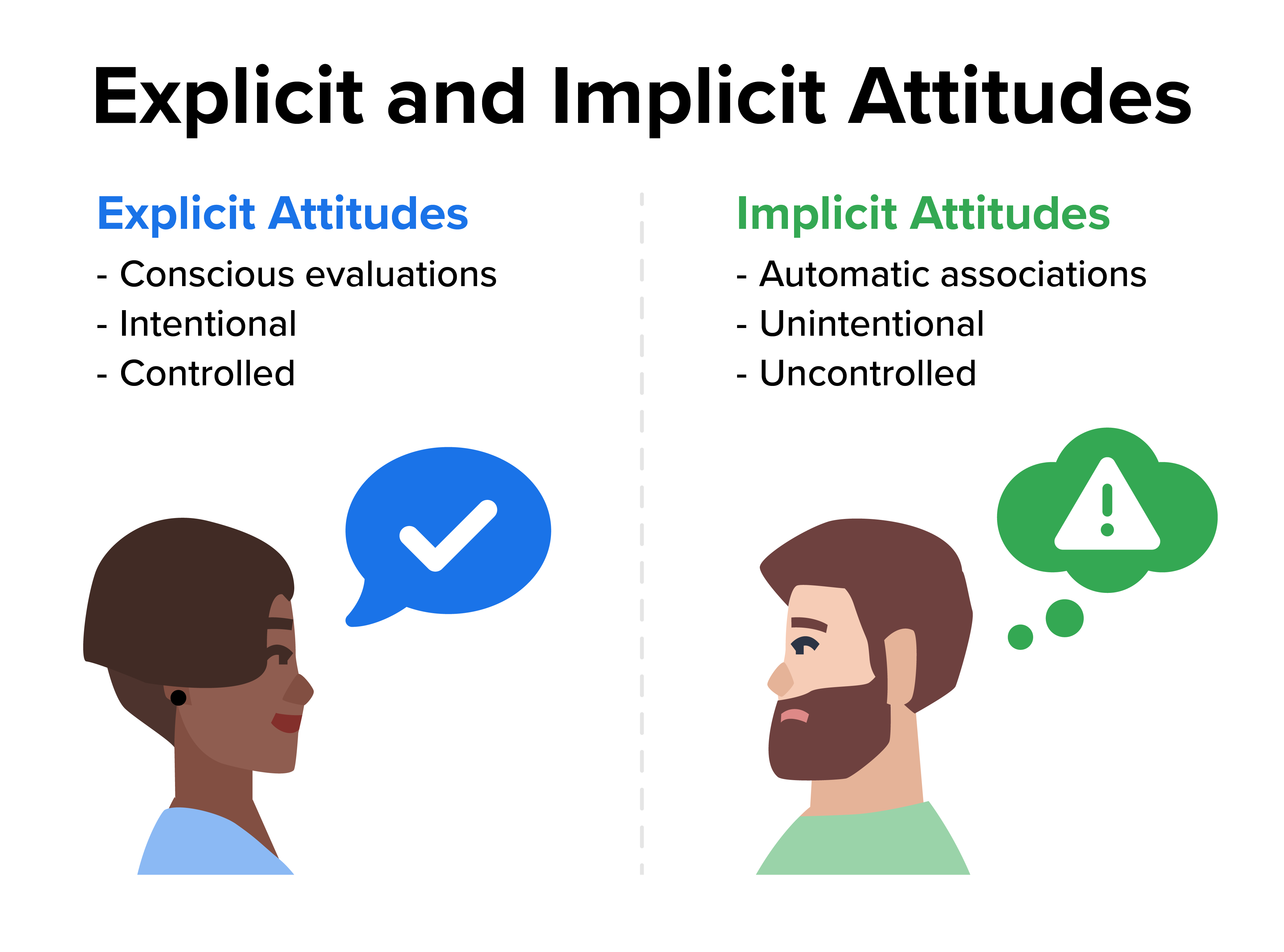
Explicit attitudes, as introduced in an earlier lesson, are conscious, deliberate, and controllable beliefs or evaluations. They are the thoughts people can report when asked directly, such as “I believe recycling is important” or “I oppose discrimination.” Explicit attitudes are shaped by factors such as personal values, careful reflection, and social norms. Because they operate within conscious awareness, individuals can typically explain the reasons behind these attitudes.
Explicit attitudes tend to guide behavior when people have the opportunity and motivation to think carefully, such as deciding which political candidate to support, choosing a college major, or forming a reasoned opinion after reading an article. In these situations, individuals can weigh information, consider alternatives, and align their actions with their stated beliefs.
Implicit attitudes are automatic, fast, and often unconscious associations. They reflect learned cultural associations, past experiences, and widely shared stereotypes, sometimes regardless of whether a person consciously rejects those stereotypes. Implicit attitudes can influence responses without conscious intention, and they often emerge as split‑second gut reactions.
These attitudes typically reveal themselves in low‑control behaviors, especially when a situation is ambiguous or decisions must be made quickly.
EXAMPLE
Importantly, implicit attitudes can coexist with explicit attitudes, even when the two contradict each other. A person may consciously endorse equality and fairness (explicit attitude) while still harboring automatic negative associations formed through years of exposure to biased cultural messages (implicit attitude). This dissociation helps explain why people do not always behave in ways that align with their consciously stated values.
Understanding the difference between implicit and explicit attitudes helps explain the following:
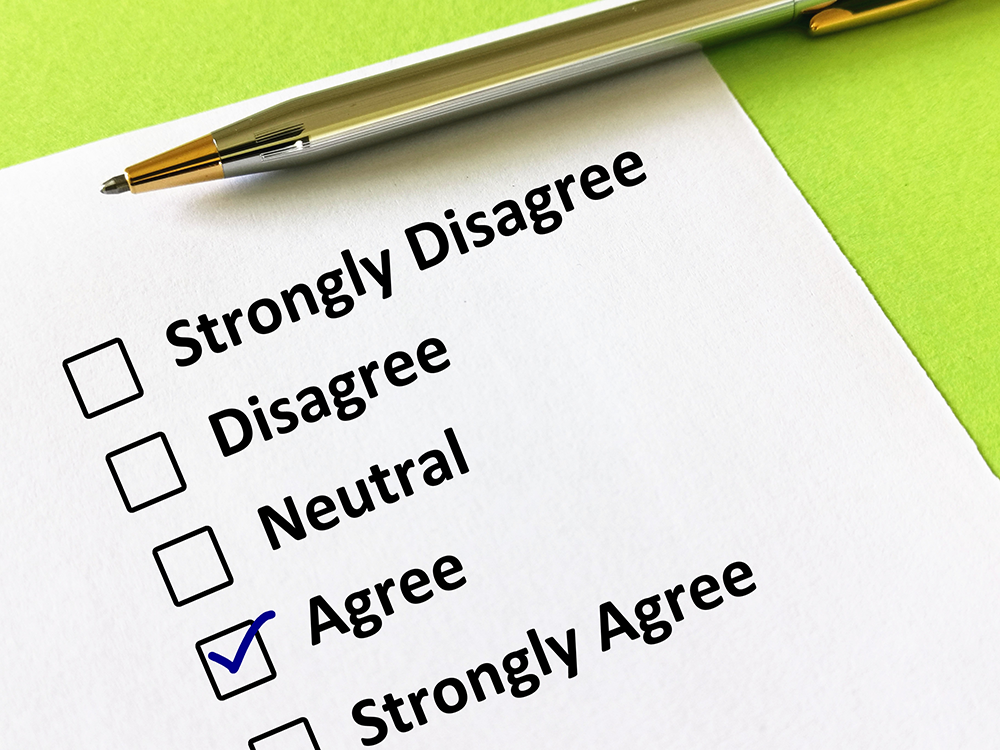
Because implicit and explicit attitudes rely on different psychological processes, researchers use different methods to measure them. Explicit attitudes are most often measured with self‑report scales, which ask people to directly state their evaluations. For instance, participants might read a statement such as “I feel comfortable interacting with people from different racial backgrounds” and indicate how much they agree using a Likert‑type scale (such as 1 = strongly disagree to 7 = strongly agree).
These measures are easy to use, relatively inexpensive, and often highly reliable, especially for nonsensitive topics like food preferences or hobbies. Self‑report scales work best when people are motivated to be honest and have enough awareness of their own attitudes to accurately report them.
To measure implicit attitudes, social psychologists typically use latency‑based tasks, which infer evaluations from how quickly and accurately people respond rather than from what they directly report. The most well‑known of these measures is the Implicit Association Test (IAT). In a typical race‑based IAT, participants rapidly categorize faces and words using two response keys, and faster pairings (such as associating White faces with positive words) are interpreted as reflecting stronger automatic associations. Because these responses occur quickly, they are thought to capture attitudes that operate outside of conscious control.
Other implicit measures include affective priming tasks, which examine how quickly people respond to positive or negative words after being briefly shown a related stimulus, or prime. Faster responses following certain primes suggest the presence of automatic positive or negative associations. Another method, the Go/No‑Go Association Task (GNAT), focuses on how accurately participants make “go” responses when specific concepts are paired with positive or negative meanings. Together, these tasks aim to reduce reliance on conscious reflection and instead capture automatic evaluative responses.
All attitude measures raise important questions about validity. For explicit measures, major concerns involve social desirability and self‑presentation, meaning that people may downplay socially disliked attitudes (such as prejudice) or exaggerate socially approved ones (such as concern for the environment). Researchers try to reduce these biases by ensuring confidentiality, using neutral wording, and including indirect questions.
For implicit measures, debate centers on what they actually capture and how stable they are over time. Research suggests that IAT scores show moderate consistency but can change depending on context, recent experiences, or comparison groups. This pattern suggests that implicit attitudes reflect flexible, context‑sensitive associations rather than fixed traits, helping explain why they sometimes differ from explicit reports.
| Method | Type of Attitude Measured | How It Works | Strengths | Limitations |
|---|---|---|---|---|
| Self-report scales | Explicit attitudes | Participants read statements (e.g., “I support recycling”) and rate agreement on numerical scales. |
|
|
| Implicit Association Test (IAT) | Implicit attitudes | It measures how quickly people categorize concepts (e.g., group + positive/negative words). Faster pairings imply stronger automatic associations. |
|
|
| Affective priming tasks | Implicit attitudes | A prime (e.g., an image or concept) appears briefly before a positive or negative word. Faster responses indicate positive associations; slower ones indicate negative associations. |
|
|
| Go/No‑Go Association Task (GNAT) | Implicit attitudes | Participants press a key (“go”) when concept–valence pairings match target categories and withhold responses (“no‑go”) otherwise. Performance reflects associative strength. |
|
|
Self‑report and latency‑based tools thus complement each other. Self‑reports provide direct access to people’s conscious evaluations, identity claims, and deliberate commitments, which are crucial for understanding voting, stated preferences, and explicit policy support. Implicit tasks offer a window onto automatic associations that might otherwise remain hidden, especially for socially sensitive topics like race, gender, and sexuality. Using both types of measures allows researchers to build a richer picture of how attitudes are structured and expressed.
A central question in attitude research is how closely implicit and explicit measures match each other. If both types of tests measured the same thing, they would show strong correlations. In reality, the relationship between implicit and explicit attitudes is usually only small to moderate. People tend to show stronger agreement between the two for less sensitive topics, like preferences for foods or sports. For socially sensitive topics, such as racial attitudes, the link is weaker. Theoretically, this happens because explicit measures capture what people consciously say they believe, while implicit measures pick up patterns in automatic, split‑second responses.
These two kinds of measures also differ in how well they predict behavior. Explicit attitudes are better at predicting thoughtful, deliberate actions, like choosing to sign a petition, support a policy, or join an organization, especially when people see the attitude as relevant and have time to think about it. Implicit attitudes tend to predict quick, less controlled behaviors, such as patterns in eye contact, physical distance, small speech errors, or rapid judgments in categorization tasks.
IN CONTEXT
Shooter Bias (Weapon Identification Task)
In some laboratory studies that examine rapid judgments, participants are briefly shown images of people along with objects such as tools, cell phones, or everyday household items. The task requires them to quickly decide whether the object is a weapon or a non‑weapon. When people hold stronger implicit biases, they tend to make more errors on this task. Specifically, they are more likely to mistakenly classify harmless objects as weapons when those objects appear alongside members of stigmatized groups.
What makes this finding especially important is that it often occurs even when participants score low on explicit measures of prejudice. In other words, someone can sincerely report egalitarian beliefs while still behaving in ways that reveal automatic associations outside of conscious awareness. These split‑second mistakes help demonstrate how implicit attitudes can shape perception and decision making in fast, high‑pressure situations, even when people are not intentionally acting on biased beliefs.
Overall, implicit and explicit attitudes are related but distinct. They often point in the same direction, but the times when they diverge are especially informative. When both are negative, prejudice is more likely to show up in both words and actions. When both are positive, interactions tend to be smooth and friendly. The most interesting and common pattern, though, is when people sincerely endorse egalitarian values at the explicit level but still show negative automatic associations on implicit tests.
Divergence between implicit and explicit attitudes matters because it helps explain why people’s words and actions don’t always match. In many Western countries, explicit prejudice has decreased as social norms have shifted; people are more willing to say they value diversity and oppose discrimination. However, implicit measures often reveal lingering negative associations toward groups that have historically been stigmatized, such as racial minorities, people with disabilities, or other marginalized communities. These automatic associations can show up in subtle behaviors.

EXAMPLE
In interracial interactions, individuals who report low prejudice but show stronger implicit bias may display small signs of discomfort, such as reduced eye contact, increased physical distance, or more speech hesitations. Their conversation partners often notice these cues and may feel less respected or more stereotyped, even if the verbal conversation seems polite. Over time, repeated experiences like these can shape feelings of trust and fairness.Implicit–explicit divergence refers to a mismatch between a person’s consciously reported attitudes and their automatic, implicit associations. This divergence often appears in applied settings such as health care and hiring.
EXAMPLE
Physicians or hiring managers may explicitly endorse fairness and equality, yet their implicit attitudes can still predict subtle differences in behavior, such as reduced warmth, less eye contact, or small changes in decision making. Although each effect may be modest, they can add up across repeated interactions and help sustain long‑term inequalities.To limit the influence of automatic biases, many organizations rely on strategies such as structured interviews, blind résumé reviews, and standardized evaluation procedures that reduce opportunities for subjective judgment.
At the individual level, becoming aware of an implicit–explicit divergence can be uncomfortable and may prompt self‑reflection. It is important to recognize that implicit attitudes often develop from repeated exposure to cultural images, messages, and norms rather than from deliberate prejudice or conscious beliefs. Even so, people can take steps to reduce the impact of these automatic associations by slowing down decisions, relying on clear standards, and deliberately aligning behavior with their stated values.
Implicit–explicit divergence is not limited to issues of prejudice. For instance, someone may consciously value healthy eating but still hold automatic positive associations with high‑calorie foods, making self‑control more difficult. Similarly, a person may fully believe that smoking is harmful while still associating cigarettes with relaxation or social connection. In these situations, changing explicit beliefs alone is often insufficient; lasting change is more likely when habits, environments, and automatic cues are also adjusted to support new behaviors.
Source: THIS TUTORIAL HAS BEEN ADAPTED FROM (1) OPENSTAX "PSYCHOLOGY 2E." ACCESS FOR FREE AT openstax.org/details/books/psychology-2e. (2) PENN STATE "SOCIAL PSYCHOLOGY." ACCESS FOR FREE AT psu.pb.unizin.org/socialpsychmethodsjmc948/chapter/introduction/. LICENSING (1 & 2): CREATIVE COMMONS ATTRIBUTION 4.0 INTERNATIONAL. ACCESSED BY JANUARY 2026.



