In this lesson, you will explore step four of the problem-solving process: implementing the best solution. You'll review some critical elements you need to consider before you begin implementation.
Specifically, this lesson will cover:
- Identify Critical Elements
- Take Action
1. Identify Critical Elements
You recognized a problem, generated potential solutions, and evaluated your solutions to find the best one. You're now at the fourth step of the problem-solving process—you're ready to implement the solution you chose.
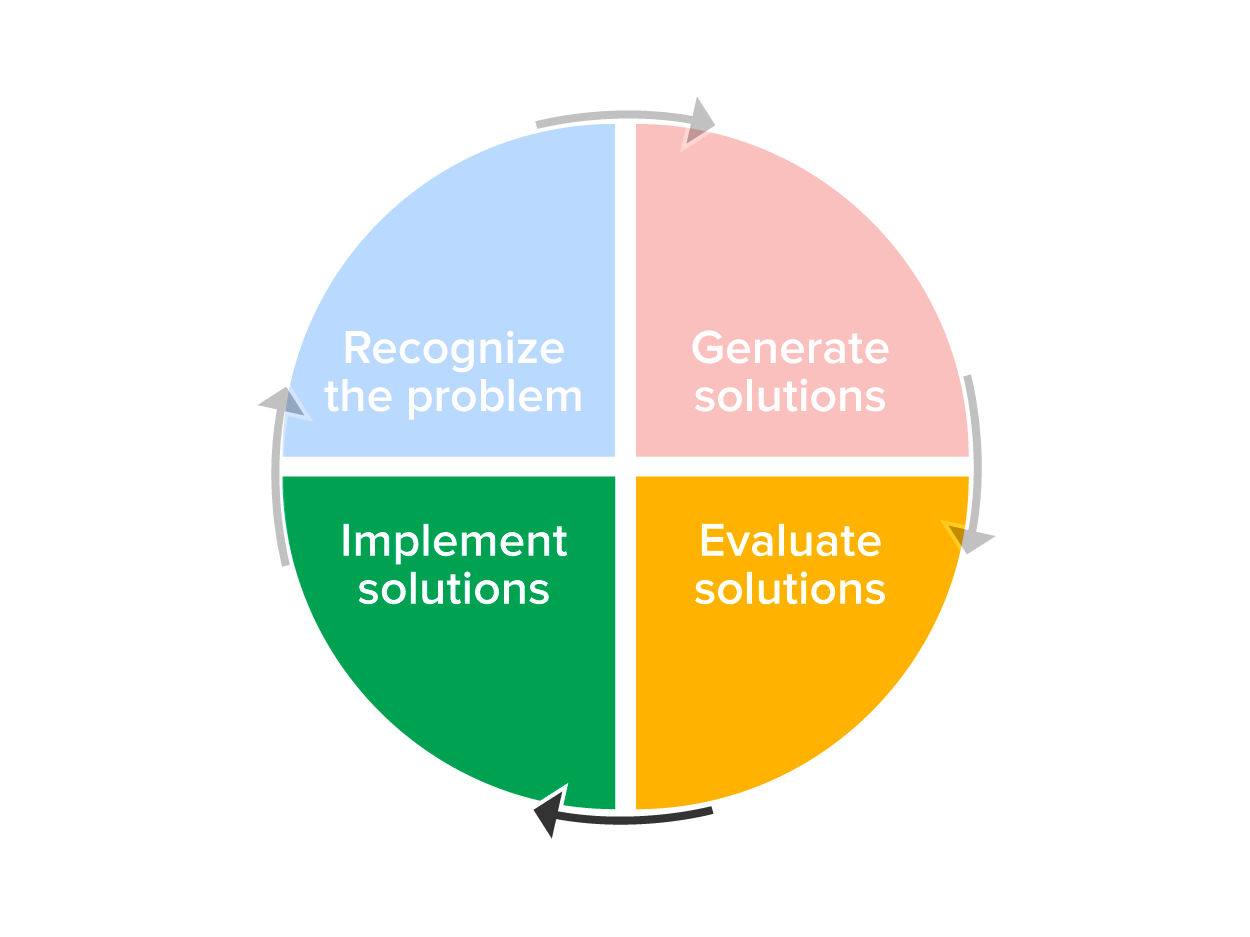
When you reach this point in the process, you will need to identify all the critical elements to put into practice. You'll need to consider questions like these before taking action on your solution:
- People: Who will need to be involved?
- Processes: How will you and others go about implementation?
- Products: What resources will you need to be successful?
People, or
stakeholders, are important to any plan. Stakeholders are both the people who help implement the plan and those affected by the plan. Regarding processes, you want to detail the steps needed to put your plan into action. You also need to establish follow-up steps to determine if your solution worked effectively or not. Lastly, determine what resources you or others will need to be successful. Will you need more equipment? Training? Additional technology? You want to be sure everyone involved has what they need to be successful.
-
Have you ever implemented a solution that did not work? Which of the three criteria listed above caused the issue? Could you have planned differently to have success?
-
-
- Stakeholder
- Anyone impacted by actions taken and the results they create.
2. Take Action
Once you have considered the people, processes and products involved, it is time to take action. Consider how you can use some key skills as you roll out your solution.
-
Initiative. You want to demonstrate that you are confident in your plan and abilities by taking that leap and putting your plan into action. Following the four-step problem-solving process will allow you to do this.
-
Communication. You want to ensure that all stakeholders are well-informed and that any messaging around your plan is clear and concise. This can cut down on misunderstandings and mistakes.
-
Results-Driven. You want to be confident that your solution is aimed at the root cause of the problem. You will know if you have achieved your desired results by gathering feedback and reflecting on outcomes during and after implementation.
Putting your plan into action involves some follow-up on your part. Once you take action, you will need to monitor how things are going. You want to solicit feedback from everyone involved to see if the solution is working. Do things seem to be heading in the right direction? Do any changes need to be made? Establishing formal and informal
feedback channels to obtain this information is critical.
-
EXAMPLE
Clarissa works as a receptionist at a dental office. Her office manager, Shantae, established some new rules around work breaks after employees missed several important calls from patients. Under the new rules, if Clarissa needs a break, she must find a fellow worker who can cover the phones. Shantae has asked to meet with Clarissa in two weeks to see how the new system is working. She also advised Clarissa to stop by her office before the meeting to discuss any issues that might arise.
Shantae provided a formal way to share feedback by setting up a meeting with Clarissa two weeks after the new procedure was implemented. She also allowed for a more informal feedback process by letting Clarissa know she could reach out to her anytime with issues. This helps Clarissa feel she is supported as she works to try this solution and it helps Shantae monitor things to see if she is actually achieving her results in a way that works for everyone.
As you receive feedback, you may find you need to use your agility skill to pivot and that is okay. Remember, the goal is to solve the problem at hand. If that means changing some things in the middle of the process, then that is what you want to do. The key is to keep your eyes on your desired results and note what is working along the way and what is not.
-
The steps in the problem solving process that you have now learned about are similar to the ones taken by sociologists who are studying social problems. When a sociologist wants to examine and address a social problem, such as ageism in the workplace, they find
scholarly resources that focus on the issue. They also write a
problem statement that can briefly explain the social problem and describe the particular challenges that make the problem a difficult one to solve.
While researching the problem, sociologists must think about where the social problem comes from and what can be done about it. They take the time to really understand how the social problem might be caused by
social factors and what
social action can reasonably be expected to reduce or eliminate that problem.
The results from social problems research are often used by activists to inform social movements and to influence social policies that can help to address those problems.
Now that you have learned about the steps involved in the problem solving process, you might consider what issues in your workplace would benefit from you putting your problem solving skills into practice. By using your initiative and innovation skills to identify work-related problems and implement effective solutions, you can increase your chances for career advancement in the future while being a results-driven problem solver in the present.
-
-
- Feedback Channel
- A way to collect thoughts or comments from others. Examples are email, phone calls, and face-to-face conversations.
- Problem Statement
- A brief, clear explanation of an issue that is being researched.
- Scholarly Resource
- A resource (such as a book or article) that has been written by an expert in a field and is usually reviewed by other scholars before being published.
- Social Factor
- Something circumstantial that can influence the way a person behaves and lives. Some examples of social factors include family size and structure, wealth and income, education, religion, and employment.
- Social Action
- Activity taken on by people or groups interacting with the intent to make positive change in society.
In this lesson, you learned more about the fourth step of the problem-solving process: implementation. You explored some key elements you need to consider as you prepare to take action. You need to know the people, processes, and products involved and ensure you have a way to reflect on progress toward your desired outcome.



