Use Sophia to knock out your gen-ed requirements quickly and affordably. Learn more
×

Impact of Price on Quantity Supplied/Demanded

Author: Sophia

what's covered
This lesson will cover the impact of price on the quantity supplied or demanded, reviewing how a change in price causes movement along a demand or supply curve. Specifically, this lesson will cover the following:

Table of Contents

1. Law of Demand: A Review

The law of demand is the inverse correlation between price and quantity, with all other variables being fixed.

For example, here is a demand schedule for Granny Smith apples outlining how many apples a consumer would purchase per week at various prices. At high prices, consumers do not want to purchase as many, while as the price falls, they want to purchase more.

Price of Granny Smith Apples Quantity of Granny Smith Apples Each Week
$2.00 0
$1.75 1
$1.50 2
$1.25 3
$1.00 4
$0.75 5
$0.50 6
$0.25 7
$0.00 8

When we plot the points on a graph, we can see the inverse relationship between price and quantity, illustrated by a downward-sloping demand curve.
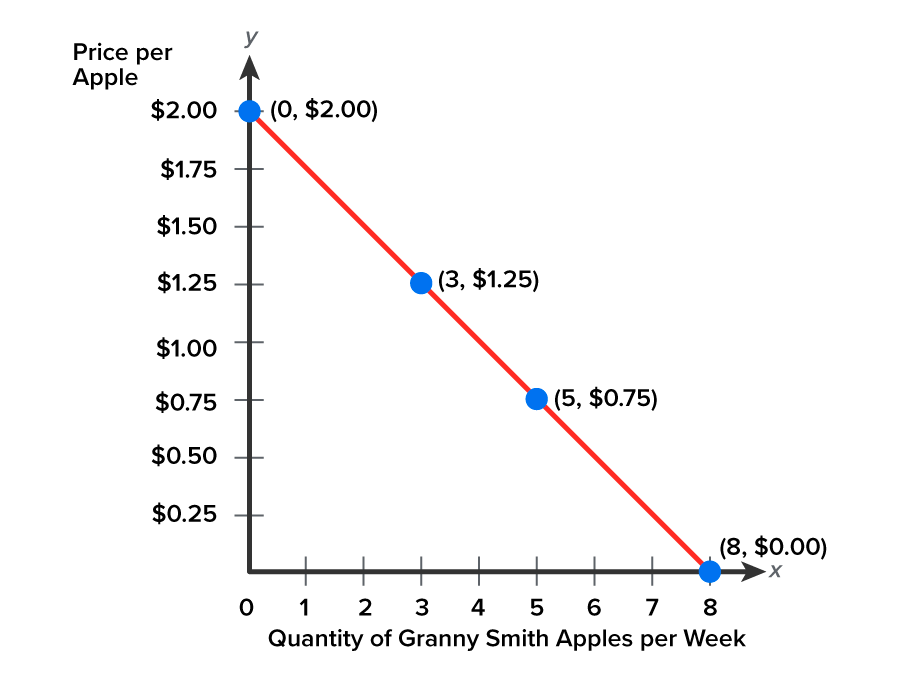
A graph with a demand curve depicting the inverse relationship between price and quantity. The horizontal x-axis represents the quantity of Granny Smith apples per week. This axis is divided into increments of 1, starting at 0 and ending at 8. The vertical y-axis represents the price per apple in dollars. This axis is divided into increments of 0.25 dollars, starting at 0 and ending at 2 dollars. A downward-sloping line, representing a demand curve, passes through these points: x equals 0 and y equals 2, x equals 3 and y equals 1.25, x equals 5 and y equals 0.75, and x equals 8 and y equals 0.

As the price of apples goes down, we buy more. As the price of apples goes up, we move along the curve to buy fewer apples.

Therefore, there is a negative relationship between price and quantity for demand.

hint
It is important to remember, though, that the idea of ceteris paribus, which means that everything else is held constant, applies in this situation. This assumes that only the price of Granny Smith apples has changed. Nothing else has changed, like the price of Gala apples, the price of oranges and bananas, or even a consumer’s income, because those things could certainly impact how many Granny Smith apples are purchased. We are only talking about buying more or less because the price of Granny Smith apples went up or down.

We refer to this as a movement along the curve as the price changes. As mentioned, as the price of Granny Smith apples drops, we buy more. This only involves a relationship between the two axes that comprise the graph—the price of Granny Smith apples and the quantity that is being purchased.

Therefore, we do not need a new demand curve. We simply move from one point to the next to show the price going up or down, which is why this is called movement along the demand curve.

hint
It is important to differentiate between a change in the quantity demanded and a change in demand itself. Often, people will make the mistake of inferring that since the price went up, demand went down. For demand to go down, this would require the whole curve to have a new relationship or for people to buy less at every single price, which is not the case here. Therefore, we say that as the price changes, it represents a change in the quantity demanded.

term to know
Law of Demand
The inverse correlation between price and quantity, with all other variables being fixed.


2. Law of Supply: A Review

The law of supply states that if the price of a good decreases, the quantity supplied decreases. The opposite would also be the case, meaning that as prices go up, the quantity supplied would also increase.

Again, using the same prices for apples, you can now see a different relationship between price and quantity.

Price of Granny Smith Apples Quantity of Granny Smith Apples Each Week
$2.00 7
$1.75 6
$1.50 5
$1.25 4
$1.00 3
$0.75 2
$0.50 1
$0.25 0

As the price goes down, the quantity these farmers are willing to produce falls because, at very low prices, the farmers likely cannot even cover their costs. As the price goes up, they have a greater incentive, ability, and willingness to supply, so the quantity supplied rises.

This represents a positive relationship between price and quantity for supply.
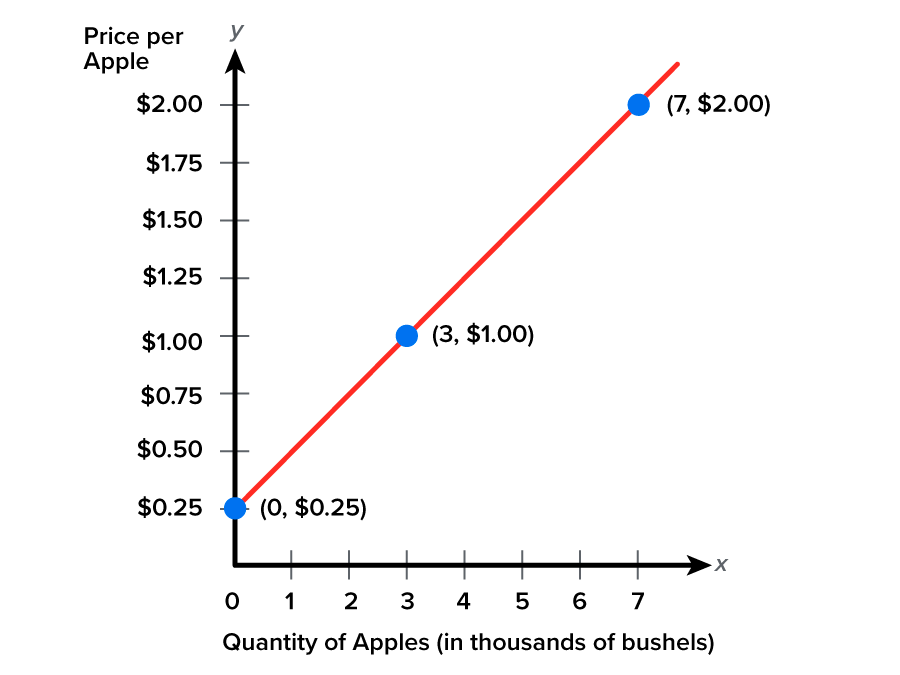
A graph depicting the positive relationship between price and quantity for supply. The horizontal x-axis represents the quantity of apples in thousands of bushels. This axis is divided into increments of 1, starting at 0 and ending at 7. The vertical y-axis represents the price per apple in dollars. This axis is divided into increments of 0.25 dollars, starting at 0 and ending at 2 dollars. An upward-sloping line, the supply curve, passes through the following points: x equals 0 and y equals 0.25, x equals 3 and y equals 1, and x equals 7 and y equals 2.

hint
Again, the concept of ceteris paribus applies here. As the price of apples falls, we can expect farmers to produce fewer apples. Some of them may not want to produce apples anymore because they cannot cover their costs. With ceteris paribus, we are holding everything else constant, assuming that only the price of apples has changed. We are not changing the price of their resources or inputs, such as land, labor, or capital. We are not changing the technology used, which impacts how easy or difficult it is for them to produce. We are only changing the market price of apples.

Again, a change in price will cause movements along the supply curve. As the price of Granny Smith apples increases, farmers want to supply more. This only involves a relationship between price and quantity, so we do not need a new curve. We simply move along the curve to see the new price and quantity combination.

hint
As the price goes up, the quantity supplied goes up, and as the price goes down, the quantity supplied goes down. We do not, however, say that the supply itself has changed.

term to know
Law of Supply
If the price of a good decreases, the quantity supplied decreases.


3. Finding Equilibrium

3a. At prices above $1.00: Qs > Qd

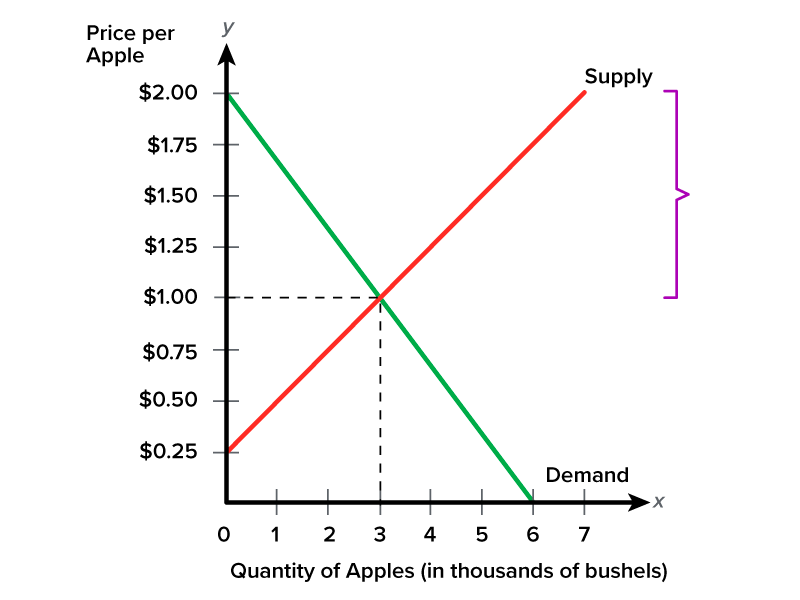
Now, if we look at these movements along the curve, you can see that at prices above $1 where these two curves converge, the quantity supplied exceeds the quantity demanded.

Price of Apple Quantity of Apples Supplied Quantity of Apples Demanded
$2.00 7,000 0
$1.75 6,000 1,000
$1.50 5,000 1,500
$1.25 4,000 2,000
$1.00 3,000 3,000
$0.75 2,000 4,000
$0.50 1,000 5,000
$0.25 0 6,000

A graph explaining the concept of equilibrium, the point at which the supply and demand curves intersect. The horizontal x-axis represents the quantity of apples in thousands of bushels. This axis is divided into increments of 1, starting at 0 and ending at 7. The vertical y-axis represents the price per apple in dollars. This axis is divided into increments of 0.25 dollars, starting at 0 and ending at 2 dollars. The demand curve starts at x equals 6, y equals 0 and ends at x equals 0, y equals 2. The supply curve starts at x equals 0, y equals 0.25 and x equals 7, y equals 2. These two curves intersect at x equals 3 and y equals 1, indicating that when the price of apples is 1 dollar, the quantity demanded is 3000, and the quantity supplied is 3000. Two dashed lines extend from the intersection point: one toward x equals 3 and another toward y equals 1. All the curves are represented by lines.
As the price goes down, the quantity supplied falls and the quantity demanded rises.

When that occurs, there is an incentive or a gap between the supply and demand curves.

In this case, there will be an incentive for grocers to lower the price. You may recall that as we lower the price, we simply move along the curve. We do not need a new curve.

So, as we lower the price, the quantity supplied would fall, the quantity demanded would rise, and they would meet in the middle.

If the price were too low, then there would be a gap, but the price is currently where the quantity demanded exceeds the quantity supplied, meaning that there are a lot of people buying but not a lot of people producing.

3b. At prices below $1.00: Qd > Qs

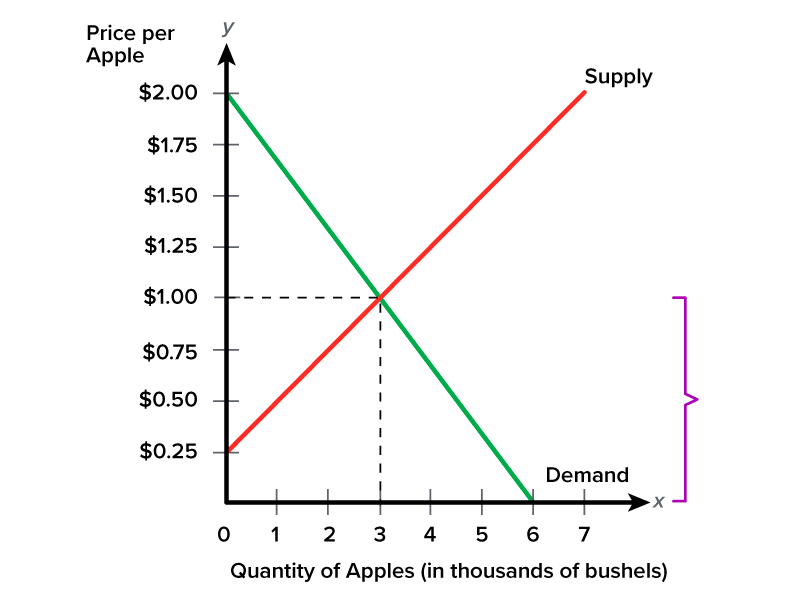
At prices below $1 where these two curves converge, the quantity demanded exceeds the quantity supplied.

Price of Apple Quantity of Apples Supplied Quantity of Apples Demanded
$2.00 7,000 0
$1.75 6,000 1,000
$1.50 5,000 1,500
$1.25 4,000 2,000
$1.00 3,000 3,000
$0.75 2,000 4,000
$0.50 1,000 5,000
$0.25 0 6,000

As price goes up, quantity supplied rises and quantity demanded falls.

As grocers raise the price, we see the quantity demanded fall and, at the same time, we see the quantity supplied rise—according to the laws of supply and demand—until we meet in the middle at equilibrium.

3c. At the prices of $1.00: Qs = Qd

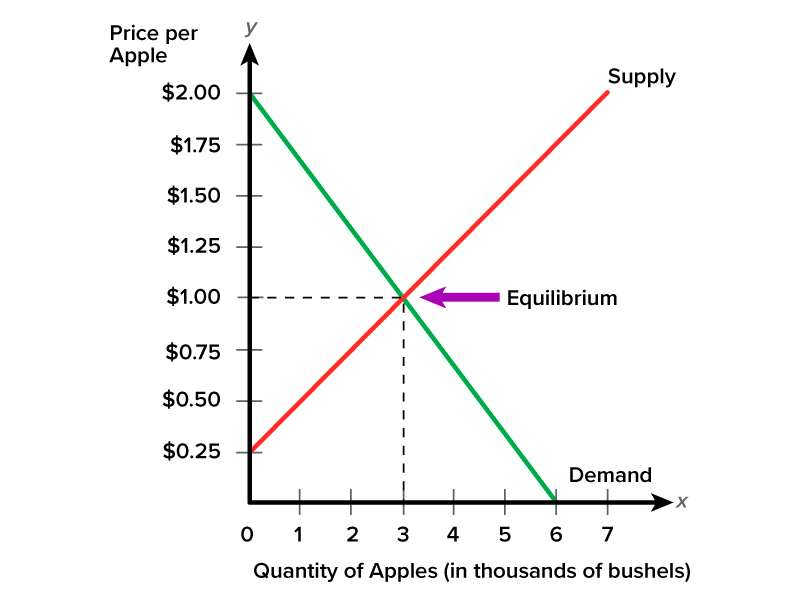
The equilibrium price is the only price where there is no tendency for change, and it is the only price that clears the market, where the quantity supplied equals exactly the quantity demanded.

Price of Apple Quantity of Apples Supplied Quantity of Apples Demanded
$2.00 7,000 0
$1.75 6,000 1,000
$1.50 5,000 1,500
$1.25 4,000 2,000
$1.00 3,000 3,000
$0.75 2,000 4,000
$0.50 1,000 5,000
$0.25 0 6,000

A graph and an accompanying table and text explaining the concept of equilibrium, the point at which the supply and demand curves intersect. The horizontal x-axis represents the quantity of apples in thousands of bushels. This axis is divided into increments of 1, starting at 0 and ending at 7. The vertical y-axis represents the price per apple in dollars. This axis is divided into increments of 0.25 dollars, starting at 0 and ending at 2 dollars. The demand curve starts at x equals 6, y equals 0 and ends at x equals 0, y equals 2. The supply curve starts at x equals 0, y equals 0.25 and ends near x equals 7, y equals 2. These two curves intersect at x equals 3 and y equals 1, indicating that when the price of apples is 1 dollar, the quantity demanded is 3000 and the quantity supplied is 3000. The intersection point represents the equilibrium point. Two dashed lines extend from the intersection point: one toward x equals 3 and another toward y equals 1. All the curves are represented by lines.
$1.00 is the equilibrium price.

Therefore, equilibrium is defined as the price and quantity pair at which supply and demand intersect; in other words, it is the price and quantity at which the market clears.

term to know
Equilibrium
The price and quantity pair at which supply and demand intersect—that is, the price and quantity at which the market clears.

summary
In this lesson, we reviewed the laws of supply and demand, focusing on the relationship between price and quantity. Remember, a change in price will only cause movement along the demand or supply curve, known as a change in the quantity demanded or quantity supplied. We also discussed finding equilibrium, which is the point at which supply and demand intersect or the price and quantity at which the market clears.

Source: THIS TUTORIAL WAS AUTHORED BY KATE ESKRA FOR SOPHIA LEARNING. PLEASE SEE OUR TERMS OF USE.


Terms to Know
Equilibrium

The price and quantity pair at which supply and demand intersect—that is, the price and quantity at which the market clears.

Law of Demand

The inverse correlation between price and quantity, with all other variables being fixed.

Law of Supply

If the price of a good decreases, the quantity supplied decreases.