Table of Contents |
Stakeholders are individuals or groups who care about or have an interest in a project. Therefore, stakeholder management is the process of identifying, analyzing, and engaging the people or groups who have an interest in, influence over, or are affected by a project, program, or organization’s activities. As a project manager, you will be managing stakeholders throughout the life of a project. We go through this process in project management so we are able to engage people who have an interest in our project. To do this, we follow the process of stakeholder management, which includes three main steps:
Once the stakeholders are identified, the stakeholders’ need analysis is conducted to evaluate their level of influence, interest, and potential impact on the project. This helps prioritize stakeholders and develop appropriate engagement strategies. You will learn about stakeholder analysis in the next lesson.
The results of this analysis are documented in a stakeholder register. A stakeholder register is a document used in project management to record detailed information about all project stakeholders. It includes key data such as stakeholder names, roles, interests, influence, impact on the project, and preferred communication methods. The stakeholder register is updated throughout the project lifecycle as new stakeholders are identified, or existing ones change in relevance.
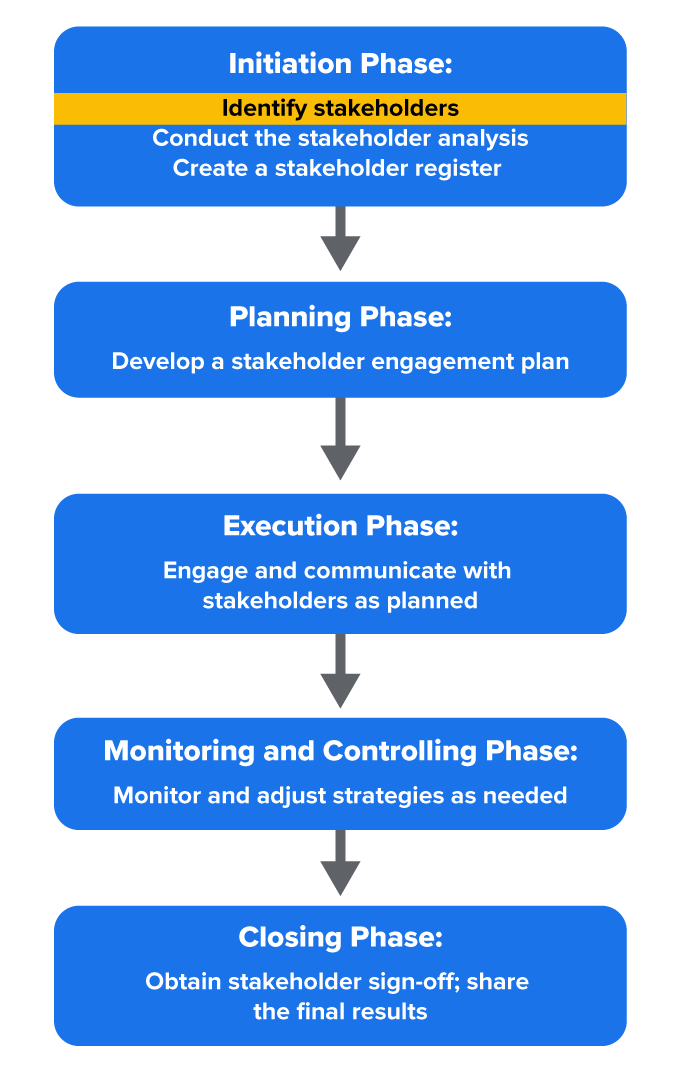
With this identification during the initiation phase, project managers can successfully manage stakeholders throughout the life of a project, including during the planning and execution phases.
Let’s first look at the different types of stakeholders we might want to identify and why we do it as project managers.
A project is considered successful when it achieves its goals and satisfies or surpasses the expectations of the stakeholders. They are directly involved in the project’s activities and stand to gain or lose something from its outcome.
EXAMPLE
If a project involves adding lanes to a highway, drivers who benefit from less traffic are stakeholders who are positively impacted. On the other hand, people living near the highway might be negatively affected by the noise during construction and the increased traffic noise and pollution afterward.While all stakeholders are important to a project, key stakeholders are those that are more heavily invested in the outcome and play a critical role in a project’s success. As a project manager, we must know who they are so we can better understand their needs and how to best communicate with them. Even if the project meets all its goals, if the stakeholders are unhappy, the project is considered unsuccessful. Therefore, the first step when considering stakeholders is to identify them. Stakeholders can be any of the following individuals or groups:
| Stakeholder | Role |
|---|---|
| Project sponsor | Provides funding and has ultimate accountability for the project’s success |
| Project manager | Oversees execution and is responsible for meeting project goals and timelines |
| Project team | Carries out the work and directly influences project outcomes |
| Top or executive leadership | Ensures the project aligns with organizational strategy and provides high-level support |
| Employees or people that work for the company | May be affected by the project’s outcomes, processes, or changes it introduces |
| Government | Enforces regulations, permits, and policies that the project must comply with |
| Suppliers | Provide necessary materials or services that impact project quality and delivery |
| Contractors | Perform specific tasks or services that contribute to the project’s completion |
| External or internal customers | Use or benefit from the project deliverables and influence project requirements |
| People in the community | May be impacted by the project’s environmental, social, or economic effects |
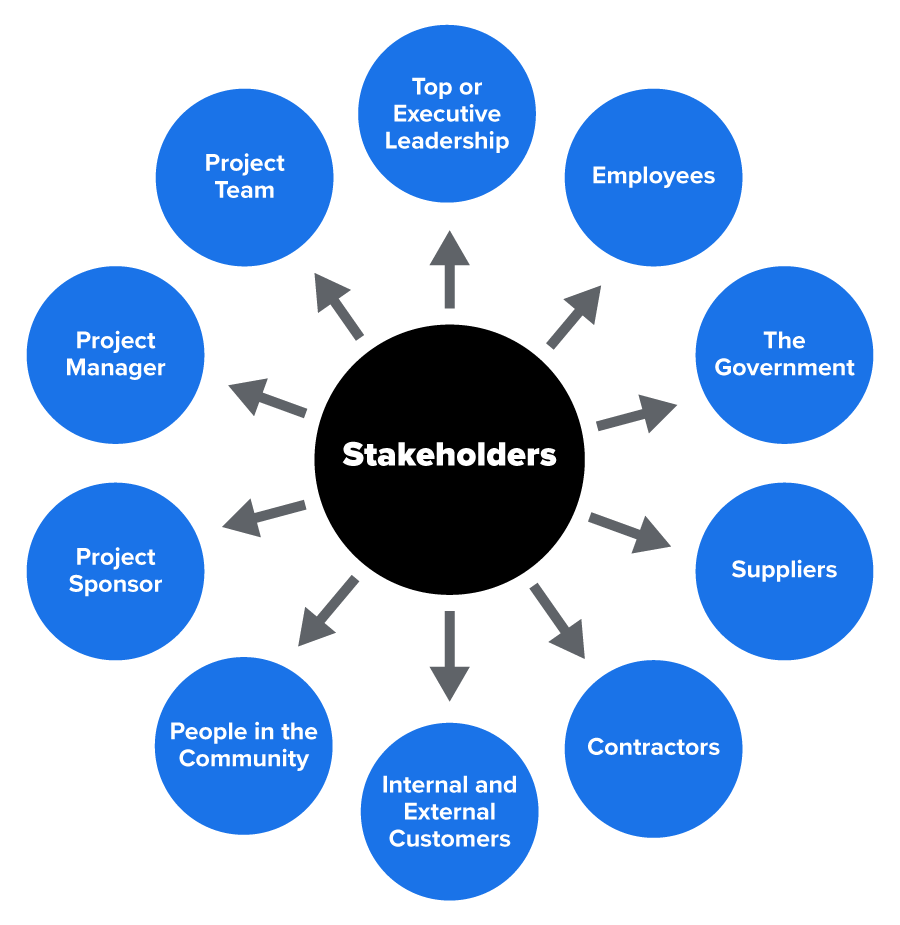
Project managers often have a challenging job because they have to work with people both inside and outside their organization. For instance, if a supplier from outside the organization is late in delivering critical parts, it can cause the entire project’s schedule to fall apart. This situation is made even more difficult because project managers usually do not have direct authority over these external people. They have to rely on communication and negotiation skills to ensure everything stays on track despite having limited control over these external factors. Let’s take a look at what is typically considered when identifying stakeholders in a project.
Now that you have an idea of the types of stakeholders, let’s look at each of them in a bit more detail and address how we can categorize and identify them. The importance of doing this now, during the initiation phase, is the fact we need to identify stakeholders first, which results in more understanding later regarding how to manage them and their needs.
An internal stakeholder is someone within an organization that is working on a project. This can include any stakeholder that works for the company, including top/executive management, the project manager, the project team, the project sponsor, internal customers, and employees/people that work for the company.
An external stakeholder is someone that cares about the project but does not directly work for the organization. This can include contractors, suppliers, and the government.
Let’s get into more details about the roles each of these stakeholders might be involved in. First, let’s look at the internal stakeholders.
The first internal stakeholder includes top management/executive leadership and may include the president of the company, chief executives, vice presidents, directors, and division managers. These people direct the strategy and development of the organization.
As a project manager, and as a stakeholder, you may be held accountable to these individuals, along with the project sponsor (who may be one of these individuals).
When a project is signed off by the project sponsor (who is also a stakeholder), you are likely to have top management support, which means it will be easier to recruit the best staff to carry out the project and acquire needed material and resources; also, visibility can enhance a project manager’s professional standing in the company. However, project failure can be quite dramatic and visible to all, and if the project is large and expensive (most are), the cost of failure will be more substantial than for a smaller, less visible project.
Some suggestions in dealing with top management are:
Here are some difficulties you may encounter in dealing with project team members:
If things go wrong on a project, it is nice to have an understanding and supportive boss to go to bat for you if necessary. By supporting your manager, you will find your manager will support you more often.
Your relationship with peers can be impeded by:
Early in the relationship, the project manager will need to negotiate, clarify, and document project specifications and deliverables. After the project begins, the project manager must stay tuned in to the internal customer’s concerns and issues and keep the customer informed.
Common stumbling blocks when dealing with internal customers include:
External customers are people or groups outside of your organization that buy your product or use your services.
EXAMPLE
It could be a client that’s hired your company to build a mobile app, or it might be a patient that seeks medical care at a hospital. In fact, by taking this course, you are an external customer of Sophia Learning—that is, we are creating a product for you to use.There are some industries that are highly regulated, and in those industries, the government and regulatory agencies would be an example of the government as an external stakeholder.
EXAMPLE
In a factory that produces plastics, the Enviromental Protection Agency (a government agency) would be considered a stakeholder because this government organization is concerned with hazardous materials and emissions.Another external stakeholder to consider would be suppliers. A supplier is a group or a person that provides materials needed for a project. They are important to consider because if a project is dependent upon getting materials, the project could be held up without good communication and relationships with the suppliers.
EXAMPLE
If you are managing a project that invloves building 25 new homes in a community, but your supplier is experiencing a lumber shortage, your project timeline or quality could be negatively impacted.There are times when an organization may not have the expertise or resources available in-house and work is farmed out to contractors or subcontractors. A contractor is an individual or a company hired to perform specific work or services for a project, usually under a formal agreement or contract. This can be a construction management foreperson, network consultant, electrician, carpenter, architect, or anyone who is not an employee. Identifying and managing contractors or suppliers requires many of the skills needed to manage full-time project team members.
Any number of problems can arise with contractors or subcontractors:

Finally, another example of an external stakeholder would be the people in a community. Depending on the type of project, people at large could be impacted by a project.
EXAMPLE
Large construction projects that impact traffic or projects that assist in improving community infrastructure, such as the building of parks.IN CONTEXT
Remember our day spa owner, Maria, who wants to develop a scheduling app for her business? This might look like the stakeholder list for this project. In this part of stakeholder management, we only identify the stakeholders, and later, we determine their interest and influence levels. Then, based on that information, we address their communication needs. We’ll be addressing that in the next tutorials, so by the end of this challenge, the entire table will be filled in.
Stakeholder Name/Group Role Internal or External Interest and Influence Communication Needs Maria Lopez Project sponsor Internal James Chen Project manager Internal Marketing department Content and branding support Internal IT contractors Technical support External Employees/staff Intranet users Internal Customers End users of a public website External Visual design agency Visual design contractor External Freelance web developer Web development External Community members Local public audience External
Now that you have an idea of the types of stakeholders and the ways to identify them, in the next lesson, we will look at the next steps, which include analyzing the stakeholders and creating a stakeholder register.
Source: THIS CONTENT HAS BEEN ADAPTED FROM PRESSBOOKS "NSCC PROJECT MANAGEMENT” BY ADRIENNE WATT. ACCESS FOR FREE AT https://pressbooks.atlanticoer-relatlantique.ca/projectmanagement/ LICENSE: CREATIVE COMMONS ATTRIBUTION 4.0 INTERNATIONAL



