Table of Contents |
Resource management is the efficient and effective deployment of an organization’s resources when they are needed. Such resources may include financial resources, inventory, human skills, production resources, or information technology (IT).
You recall completing the work breakdown structure (WBS) previously. While much of the work you did there was helpful for resource management, we dig deeper into the details here because we are actually taking each task and determining what specific resources are needed (human resources, equipment, and materials).
| Planning Phase Component | Addresses | Document | Document Purpose |
|---|---|---|---|
| Scope and scope management | Defining exactly what work is required (and what is not) to deliver the project’s objectives | Scope management plan | Outlines how the project scope will be defined, validated, and controlled to prevent scope creep |
| Work breakdown structure (WBS) and scheduling | Breaking the project deliverables into smaller, manageable components and estimating the time needed to complete each activity | WBS and schedule | The WBS breaks the project scope into manageable components, serving as the foundation for planning, estimating, and assigning work |
| Identify the resources needed | Determining the people, equipment, and materials required to complete project activities | Resource management plan | Created to document the type, quantity, and timing of resources so they can be acquired and managed effectively |
| Determine costs | Estimating the costs associated with the resources needed for the project activities | Project Budget and Procurement Management Plan | The project budget documents the costs of the project. The Procurement Management Plan documents goods and resources needed to be obtained for the project |
| Communication | Determining how project information will be shared among stakeholders (remember, you identified stakeholders during the initiation phase!) | Communication Management Plan | Created to ensure the right information is delivered to the right people at the right time using the right methods |
| Risk assessment and management | Identifying potential events that could impact the project, analyzing their likelihood and impact, and planning responses | Risk Management Plan | Created to record identified risks, their characteristics, and planned responses so they can be monitored and managed throughout the project |
In the realm of project management, processes, techniques, and philosophies for the best approach for allocating resources have already been developed.
EXAMPLE
Suppose we have an app developer who has been hired to help develop the app for 40 hr per week. We want to ensure they use all 40 hr for the project and aren’t waiting for others to get work done! Let’s also suppose we have a part-time contractor who is working 15 hr per week. Now, let’s take a look back at our spa app Gantt chart: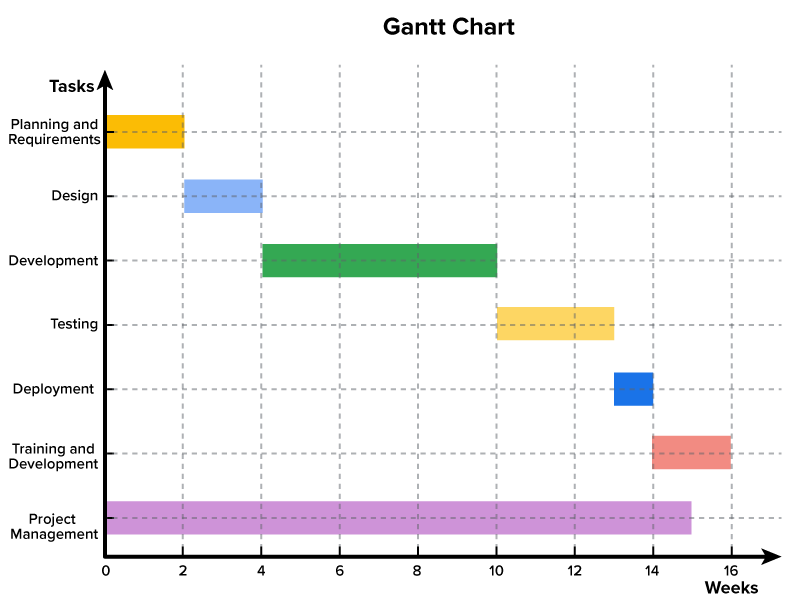
In addition, we want to ensure proactive resource planning, which means to develop plans to allocate and manage resources. This is usually done through a resource management plan, which we’ll address next.
A resource management plan lists each of the roles on the project and the responsibilities of these roles, along with the resources needed.
EXAMPLE
Our spa app development might have a human resource management plan that looks like this:| Resource | Type | Responsibility | Timeline / Allocation |
|---|---|---|---|
| Project manager | Human | Oversee project progress, budget, and scope | Full project duration |
| UI/UX (interface) designer | Human | Design app interface and user experience | Weeks 1–4 |
| Mobile app developers | Human | Develop iOS and Android apps | Weeks 2–10 |
| Backend developer | Human | Handle server, database, and API integration | Weeks 2–10 |
| QA tester | Human | Test app functionality and report bugs | Weeks 6–12 |
| Marketing specialist | Human | Plan launch campaigns, social media, and ads | Weeks 8–12 |
| Development tools | Technological | Xcode, Android Studio, and VS (Virtual Studio) Code | Full project duration |
| Collaboration tools | Technological | Jira/Trello and Slack | Full project duration |
| Cloud services | Technological | AWS or Firebase for hosting and database | Full project duration |
| Testing devices | Physical/tech | Smartphones/tablets for app testing | Weeks 6–12 |
| App development budget | Financial | Salaries, software licenses, and server costs | Full project duration |
| Marketing budget | Financial | Ads, social campaigns, and app store optimization (ASO) | Weeks 8–12 |
| Contingency funds | Financial | Reserve for unforeseen costs | Full project duration |
| Workstations | Physical | Laptops/desktops for team | Full project duration |
| Office space | Physical | In-person collaboration (if needed) | Full project duration |
| Peripheral equipment | Physical/tech | Devices for testing (smartphones, tablets, etc.) | Weeks 6–12 |
As you can see, each resource needed for the project is listed on the far left. Then, we put each of those resources into categories, such as human resources, technological, physical, financial, and physical.
Next, we note what the resource responsibility is, such as that of the project manager—their responsibility is to oversee the progress, budget, and scope. In the case of financial, physical, and technological activities, we simply describe what the resource will be. Finally, we note how long we expect to need that resource.
IN CONTEXT
Agile Connection
If you recall, Agile doesn’t focus on planning everything up front, unlike the Waterfall method (which is what we’ve been talking about), which plans resources from the start of a project. In Agile, resources, including human resources, are allocated in short cycles to make the process more adaptative. So, while the waterfall method would likely use a resource management plan, Agile wouldn’t.
Suppose you own a retail pet store called Murphy’s Paws. You have plans to completely remerchandise the store with new products and to decorate it for the holiday season. You believe this remerchandising will make it easier for customers to view products, which hopefully results in higher sales.

Here’s what your resource management plan might look like for this project. You know, however, you don’t have a lot of time for this project, so you hope to begin it on November 23 when the store closes at 5 p.m. and complete it by the time Black Friday occurs at 9 a.m. on November 25.
| Resource | Type | Responsibility | Timeline / Allocation |
|---|---|---|---|
| Store owner | Human | Draws a new layout of the store | Prior to day 1 |
| Store manager | Human | Oversees, approves, and coordinates tasks; directs setup | Days 1–3 |
| Store staff | Human | Move products, assemble fixtures, and install decor | Days 2–3 |
| Marketing specialist | Human | Prepares campaigns and launches holiday promotions | Days 2–3 |
| Content creator | Human | Take photos of completed displays for marketing | Day 3 |
| Decor materials | Physical | Purchase of props, signage, lighting, and banners | Prior to day 1 |
| Store Fixtures | Physical | Shelving, racks, display tables, and mannequins | Days 2–3 |
| Tools & equipment | Physical | Ladders, hooks, tape, and scissors | Days 2–3 |
| Photography equipment | Technological | Capture the final display visuals for social media posts | Day 3 |
| Budget: decor & materials | Financial | Budget set for props & signage | Spent prior to day 1 |
| Labor budget | Financial | Overtime/extra hours for staff | Days 2–3 |
| Marketing budget | Financial | Paid ads and social media boost | Days 2–3 |
| Contingency funds | Financial | Reserve for unexpected needs | Days 1–3 |
As you can see, as the owner, you must plan exactly what is needed for this project and when it will be needed. Having a resource plan can help ensure nothing is forgotten. For example, suppose it is Thanksgiving Day when the project occurs and you realize you didn’t purchase props! This would delay the whole project since printing businesses are probably closed.
SOURCE: THIS WORK IS ADAPTED FROM (1) PRESSBOOKS “NSCC PROJECT MANAGEMENT” BY ADRIENNE WATT. ACCESS FOR FREE AT WWW.PRESSBOOKS.ATLANTICOER-RELATLANTIQUE.CA/PROJECTMANAGEMENT/ AND FROM (2) SASKOER "PROJECT MANAGEMENT: A STRATEGIC APPROACH" by CARMEN REAICHE. ACCESS FOR FREE AT WWW.SASKOER.CA/STRATEGICPROJECTMANAGEMENT/. LICENSING (1 & 2): CREATIVE COMMONS ATTRIBUTION 4.0 INTERNATIONAL



