Table of Contents |
Ideation is the process of generating, developing, and communicating new ideas. It involves brainstorming, conceptualizing, and refining concepts to create innovative solutions or products. Once you have your idea, you can jump into visualization, which is the process of transforming a concept or idea into a visual. Visualization may involve creating images, diagrams, or animations to communicate a message or represent data. It involves transforming abstract concepts or data into visual formats to enhance understanding, insight, and decision making.
This process should be about pointing out a goal and then trying various visual solutions to reach that intended goal. One way to do that is by brainstorming. Brainstorming is a creative technique used to generate a wide range of ideas or solutions to a problem. It usually involves a group of people discussing and sharing spontaneous thoughts and suggestions without criticism or judgment, encouraging free thinking and the exploration of diverse perspectives.
A great strategy for brainstorming is called mind mapping. Mind mapping is a brainstorming process in which one constructs a web structure through a chain of associative ideas. A diagram is created with a central idea in the middle, branching out into related subtopics and details. This method helps in structuring thoughts, enhancing memory, and fostering creativity by visually connecting concepts.
Mind maps are very useful for brainstorming individually or as a group, summarizing information, thinking through complex problems, and presenting information in a format that shows the overall structure of a subject. Below is a good example of what that looks like. In this example, the mind map is a brainstorming technique for the creation of a podcast. Notice how the branching components are somewhat random, although related to the topic, much like a stream of consciousness revolving around a central idea.
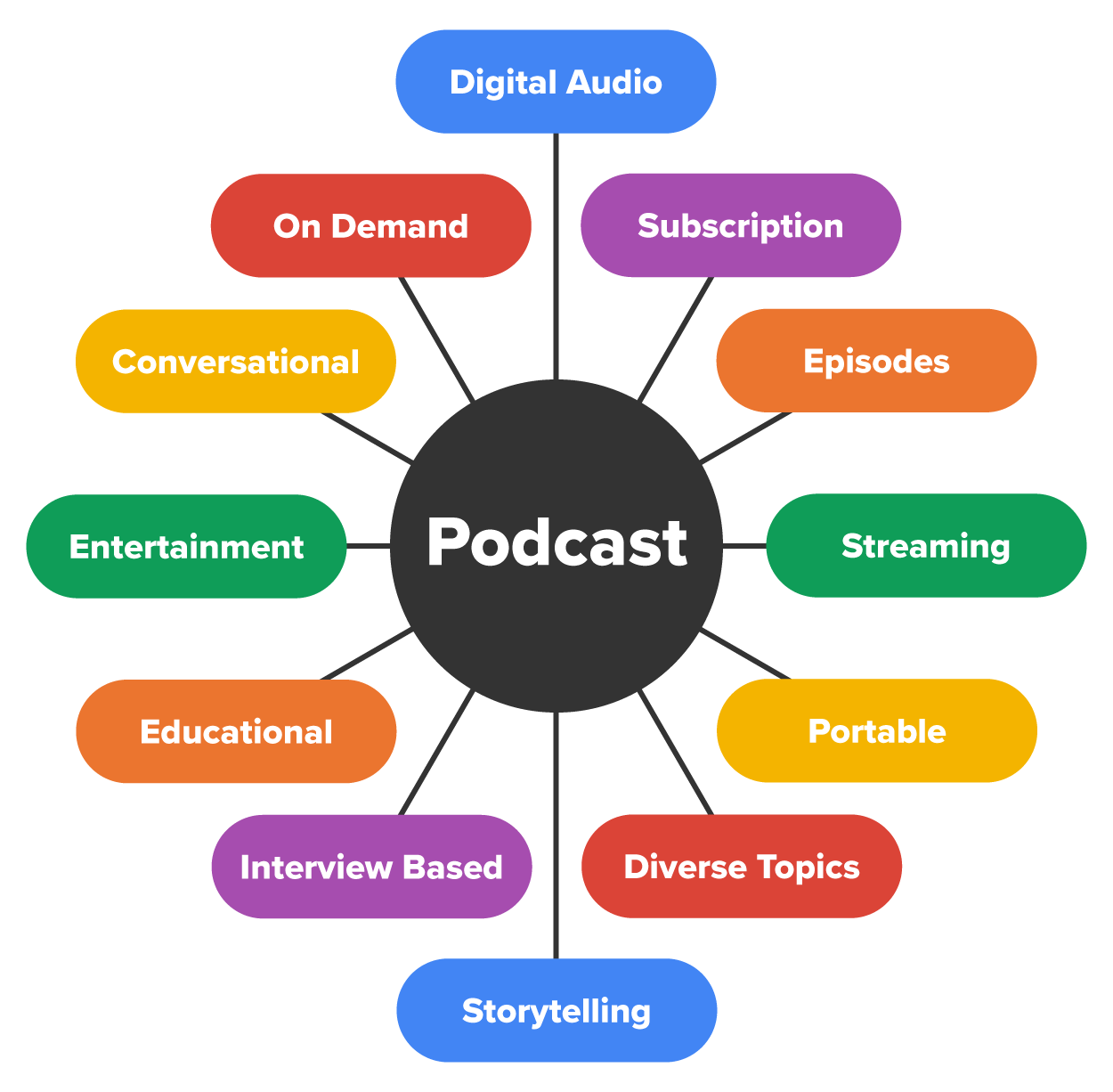
Note that mind maps can look very different. They can be informal constructions, quickly sketched on paper or written on a whiteboard, or they can be presented as highly polished infographics with a range of stylistic approaches. The point of the mind map is not the document’s visual theme or appearance, but the ideation generated from thinking about a central idea. Mind maps can get cluttered if you start to add lots of subdivisions.
Another brainstorming practice is the use of sticky notes. This may seem odd, especially considering its popularity among professional UI/UX designers, but using sticky notes for ideation is commonplace among design teams.

Sticky notes allow designers to present thoughts on small pieces of paper, continuing a rapid flow of ideas shared from person to person. This allows teams to look over small ideas while also presenting the big picture or scope of the project.
Because the nature of sticky notes allows designers to add or subtract items and thus filter their work, designers are free to add and remove ideas and continue building on existing ones. Sticky notes are a versatile tool used in brainstorming sessions to facilitate idea generation and organization. Sticky notes can be easily moved around, allowing for dynamic reorganization of ideas as the brainstorming session progresses. They enable multiple participants to contribute simultaneously, fostering a collaborative environment where everyone’s ideas are visible and can be built upon. Ideas can be grouped into categories or themes by clustering related sticky notes together. This helps in identifying patterns and commonalities. Sticky notes make it easy to visualize the flow of ideas and see the big picture. They can be arranged on a whiteboard or wall to create mind maps.
There's also the simple option of using a piece of paper or other material for thumbnail drawing. A thumbnail drawing is a small sketch technique designed to help the flow of ideas. Thumbnails are generally small and easy to sketch, so they can be used in the ideation process to visualize and explore different concepts rapidly. They are typically used for fast visualization, allowing designers to quickly sketch ideas focusing on the composition without requiring too much detail. Just like the other options, this is a fast and easy way to conceptualize and share an idea visually.
Source: THIS TUTORIAL WAS AUTHORED BY MARIO E. HERNANDEZ FOR SOPHIA LEARNING. PLEASE SEE OUR TERMS OF USE.



