Table of Contents |
Enhanced Interior Gateway Routing Protocol (EIGRP) is a classless, enhanced Distance-Vector Protocol that improves upon the legacy Cisco proprietary protocol, Interior Gateway Routing Protocol (IGRP).
EIGRP is referred to as a Hybrid Routing Protocol because it has characteristics of both Distance-Vector and Link-State Protocols. For example, EIGRP doesn’t send link-state packets like OSPF does; instead, it sends traditional distance-vector updates containing information about networks, and additionally the cost of reaching them from the perspective of the advertising router. But EIGRP has link-state characteristics as well in synchronizing routing tables between neighbors at startup and then sending specific updates only when topology changes occur. This makes EIGRP suitable for very large networks.
Another great feature of EIGRP is that it’s simple to configure and turn on like a Distance-Vector Protocol, but it keeps track of more information than a distance vector does. It creates and maintains additional tables instead of just one table as Distance-Vector Routing Protocols do. To determine the best path to each network, EIGRP uses bandwidth and delay of the line. EIGRP also uses bandwidth and delay when sending reliability, load, and the MTU information between routers, but it only uses bandwidth and delay by default.
The diagram below shows EIGRP’s neighbor table, topology table, and routing table.
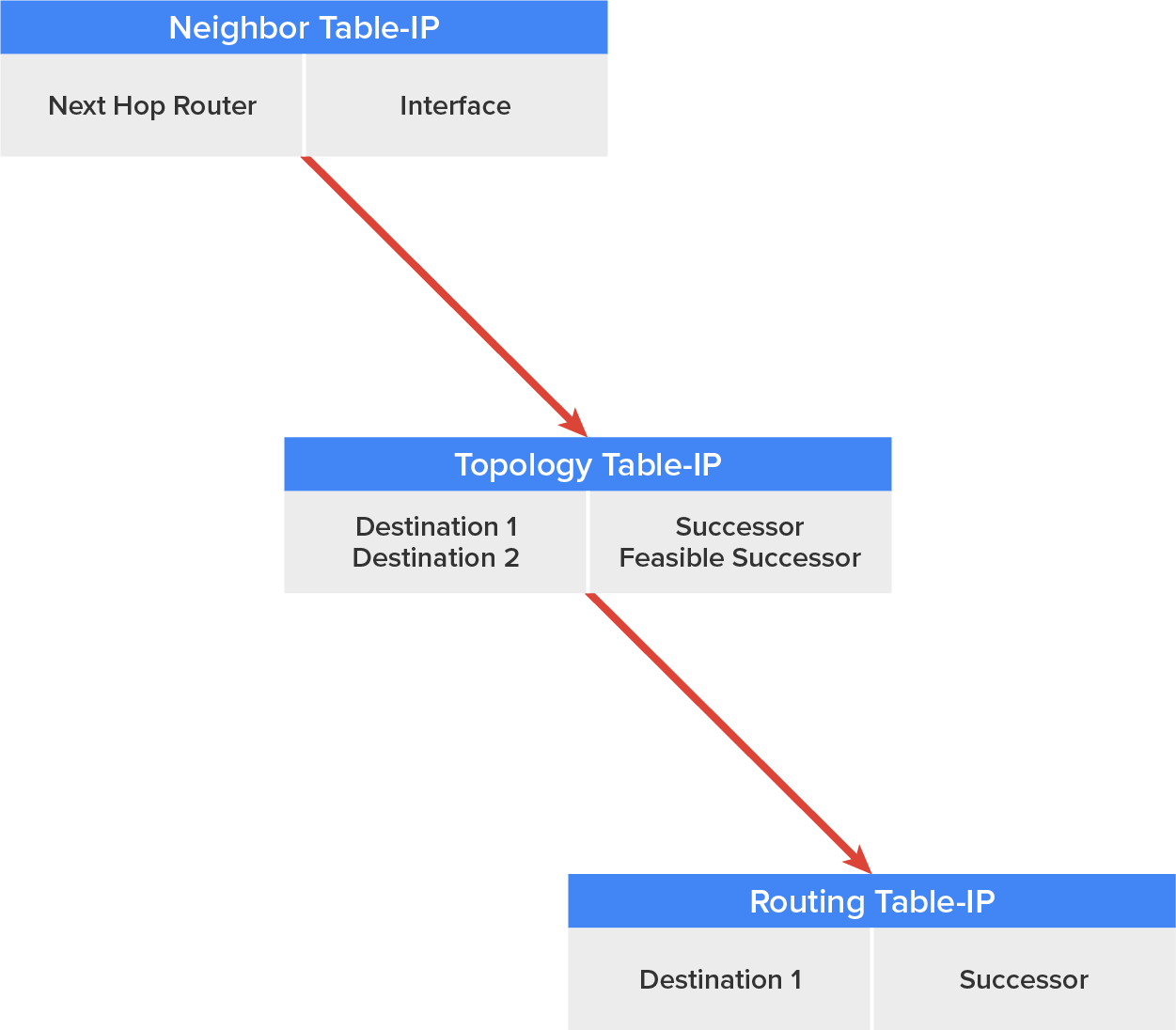
Each router keeps state information about adjacent neighbors. When a newly discovered neighbor is learned about on a router interface, the address and interface of that neighbor are recorded, and the information is held in the neighbor table and stored in RAM. Sequence numbers are used to match acknowledgments with update packets. The last sequence number received from the neighbor is recorded so that out-of-order packets can be detected.
The topology table is populated by the neighbor table, and the best path to each remote network is found by running Diffusing Update Algorithm (DUAL). The topology table contains all destinations advertised by neighboring routers, holding each destination address and a list of neighbors that have advertised the destination. For each neighbor, the advertised metric, which comes only from the neighbor’s routing table, is recorded. If the neighbor is advertising this destination, it must be using the route to forward packets.
A successor route (think successful!) is the best route to a remote network. A successor route is used by EIGRP to forward traffic to a destination and is stored in the routing table. It is backed up by a feasible successor route that is stored in the topology table if one is available.
A feasible successor is a path that is considered a backup route. EIGRP will keep up to six feasible successors in the topology table. Only the one with the best metric (the successor) is copied and placed in the routing table.
By using the feasible distance and having feasible successors in the topology table as backup links, EIGRP allows the network to converge instantly and updates to any neighbor only consist of traffic sent from EIGRP. All of these things make for a very fast, scalable, fault-tolerant routing protocol.
Border Gateway Protocol (BGP) is an External Routing Protocol (EGP) used between ASs that uses a sophisticated algorithm to determine the best route. Even though BGP is an EGP by default, it can be used within an AS as an Internal Routing Protocol (IGP). This is one of the reasons why BGP is referred to as a Hybrid Routing Protocol. Another reason they call it a hybrid is because it is often known as a Path-Vector Protocol instead of a distance-vector like RIP.
Because the internet’s growth rate shows no signs of slowing, ISPs use BGP for its ability to make classless routing and summarization possible. These capabilities help to keep routing tables smaller and more efficient at the ISP core.
BGP is used for IGPs to connect ASs together in larger networks, if needed, as shown in the diagram below.
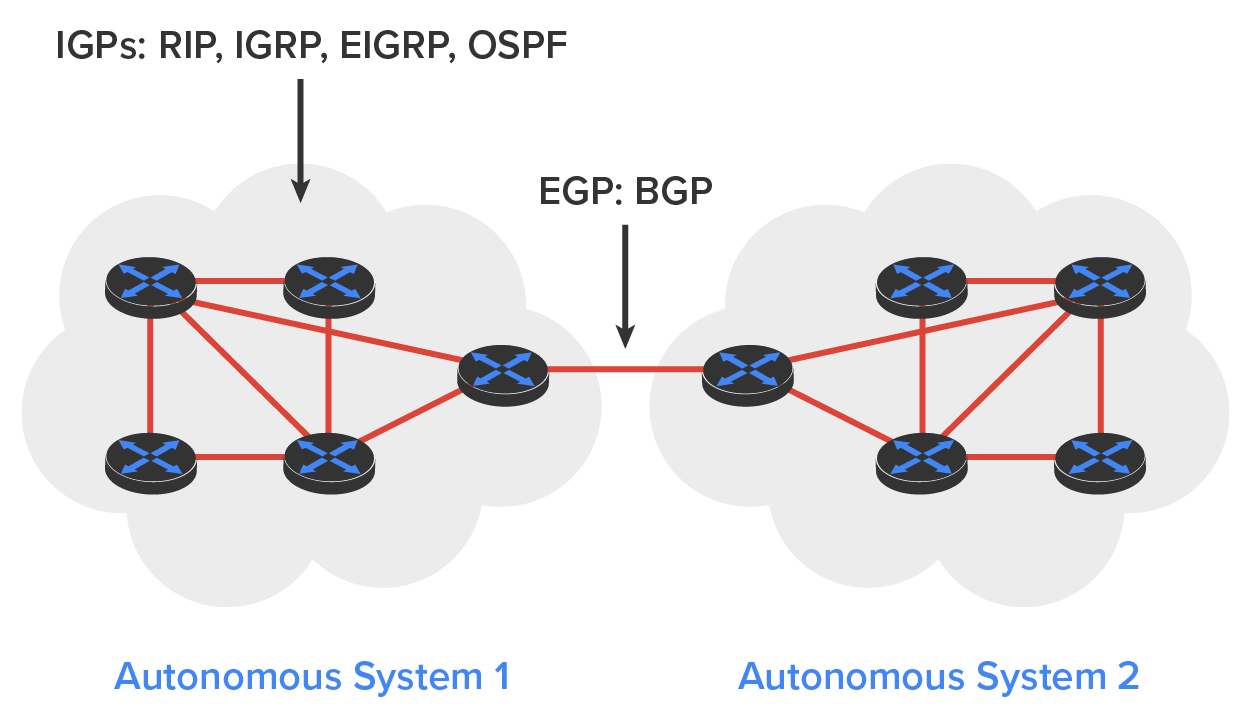
Very large private IP networks can also make use of BGP, typically by joining a number of large OSPF networks together. Because OSPF just cannot scale up enough to handle such a huge load, you would use BGP instead to connect the ASs together. BGP is also useful when multihoming a network for better redundancy, either to a multiple-access point of a single ISP or to multiple ISPs.
Internal Routing Protocols are employed to advertise all available networks, including the metric necessary to get to each of them. BGP routers exchange path vectors that give you detailed information on the BGP AS numbers, hop by hop (called an AS path), required to reach a specific destination network. Also, BGP doesn’t broadcast its entire routing table like RIP does; it updates a lot more like OSPF, which is a huge advantage. Also, the routing table with BGP is called a Routing Information Base (RIB).
BGP carries information like the network prefixes found in the AS and includes the IP address needed to get to the next AS (the next-hop attribute). It even gives you the history on how the networks at the end of the path were introduced into BGP in the first place, known as the origin code attribute.
All of these traits are what makes BGP useful for constructing a graph of loop-free ASs, for identifying routing policies, and for enabling us to create and enforce restrictions on routing behavior based upon the AS path.
Most of the routing protocols we’ve already discussed have been upgraded for use in IPv6 networks. Also, many of the functions and configurations that we’ve already learned about will be used in almost the same way as they’re used now. Knowing that broadcasts have been eliminated in IPv6, it follows that any protocols that use entirely broadcast traffic will not work with IPv6. The routing protocols that support IPv6 have updated names and capabilities.
Updated routing protocols that support IPv6 include RIPng (next generation), EIGRPv6, and OSPFv3. EIGRPv6 has protocol-dependent modules and a new one was added to it for the IPv6 protocol. OSPFv3, which is the third version of OSPF, has been upgraded to support IPv6.
The primary features of RIPng are the same as they were with RIPv2. It is still a Distance-Vector Protocol, has a max hop count of 15, and still has the same loop-avoidance mechanisms as well as uses User Datagram Protocol (UDP) port 521.
It still uses multicast to send its updates too, but in IPv6, it uses FF02::9 for the transport address. This is actually easy to remember because in RIPv2, the multicast address was 224.0.0.9, so the address still has a 9 at the end in the new IPv6 multicast range. In fact, most routing protocols get to keep a little bit of their IPv4 identities like that.
But of course there are differences in the new version. RIP routers keep the next-hop addresses of their neighbor routers for every destination network in their routing table. The difference is that with RIPng, the router keeps track of this next-hop address using the link-local address, not a global address. So just remember that RIPng will pretty much work the same way as with IPv4.
As with RIPng, EIGRPv6 works much the same as its IPv4 predecessor does—most of the features that EIGRP provided before EIGRPv6 will still be available.
EIGRPv6 is still an advanced Distance-Vector Protocol that has some link-state features. The neighbor-discovery process using hello packets still happens, and it still provides reliable communication with a reliable transport protocol that gives us loop-free fast convergence using DUAL.
Hello packets and updates are sent using multicast transmission, and as with RIPng, EIGRPv6’s multicast address stayed almost the same. In IPv4 it was 224.0.0.10; in IPv6, it’s FF02::A (A = 10 in hexadecimal notation).
The new version of OSPF continues the trend of the routing protocols having many similarities with their IPv4 versions. The foundation of OSPF remains the same; it is still a Link-State Routing Protocol that divides an entire internetwork or AS into areas, making a hierarchy.
Adjacencies (neighbor routers running OSPF) and next-hop attributes now use link-local addresses, and OSPFv3 still uses multicast traffic to send its updates and acknowledgments, with the addresses FF02::5 for OSPF routers and FF02::6 for OSPF-designated routers, which provide topological updates (route information) to other routers. These new addresses are the replacements for 224.0.0.5 and 224.0.0.6, respectively, which were used in OSPFv2.
Source: This content and supplemental material has been adapted from CompTIA Network+ Study Guide: Exam N10-007, 4th Edition. Source Lammle: CompTIA Network+ Study Guide: Exam N10-007, 4th Edition - Instructor Companion Site (wiley.com)



