Table of Contents |
Any discussion of needs that motivate performance would be incomplete without considering Abraham Maslow. Thousands of managers in the 1960s were exposed to Maslow’s theory through the popular writings of Douglas McGregor. Today, many of them still talk about employee motivation in terms of Maslow’s theory. Indeed, you may have seen this model before, especially if you’ve ever taken a sociology course.
Maslow was a psychologist who, based on his early research with primates (monkeys), observations of patients, and discussions with employees in organizations, theorized that human needs are arranged hierarchically. That is, before one type of need can manifest itself, other needs must be satisfied. For example, our need for water takes precedence over our need for social interaction (this is also called prepotency). We will always satisfy our need for water before we satisfy our social needs; water needs have prepotency over social needs. Maslow’s theory differs from others that preceded it because of this hierarchical, prepotency concept.
Maslow went on to propose five basic types of human needs. This is in contrast to the thousands of needs that earlier researchers had identified, and also fewer than Murray identified in his theory. Maslow condensed human needs into a manageable set. Those five human needs, in the order of prepotency in which they direct human behavior, are listed below.
| Human Need | Description |
|---|---|
| Physiological and Survival Needs | These are the most basic of human needs and include the needs for water, food, sex, sleep, activity, stimulation, and oxygen. |
| Safety and Security Needs | These needs invoke behaviors that assure freedom from danger (physical or emotional danger). This set of needs involves meeting threats to our existence, including extremes in environmental conditions (heat, dust, and so on), assault from other humans, tyranny, and murder. In other words, satisfaction of these needs prevents fear and anxiety while adding stability and predictability to life. |
| Social Needs | These needs reflect human desires to be the target of affection and love from others. They are especially satisfied by the presence of spouses, children, parents, friends, relatives, and others to whom we feel close. Feelings of loneliness and rejection are symptoms that this need has not been satisfied. |
| Ego and Esteem | Esteem needs go beyond social needs. They reflect our need to be respected by others and to have esteem for ourselves. It is one thing to be liked by others. It is another thing to be respected for our talents and abilities. Ego and esteem needs have internal (self) and external (others) focuses. An internal focus includes desires for achievement, strength, competence, confidence, and independence. An external focus includes desires to have prestige, recognition, appreciation, attention, and respect from others. Satisfaction of external esteem needs can lead to satisfaction of internal esteem needs. |
| Self-Actualization | Self-actualization is fulfilling one’s purpose and becoming everything that one is capable of becoming. Because people are so different in their strengths and weaknesses, and capacities and limitations, self-actualization needs vary widely from person to person. Unlike the other needs, the need for self-actualization is never completely satisfied. |
These are often modeled as a pyramid or triangle, with the more fundamental needs at the bottom and self-actualization, or fulfilling one’s abilities and realizing one’s purpose, at the top. According to his theory, people first direct their attention to satisfying their lower-order needs. Those are the needs at the bottom of the pyramid (physiological, safety, and security). Once those needs have been satisfied, the next level, social needs, become energized. Once satisfied, we focus on our ego and esteem needs. Maslow believed that most people become fixated at this level. That is, most people spend much of their lives developing self-esteem and the esteem of others. But once those esteem needs are satisfied, Maslow predicted that self-actualization needs would dominate. There are no higher levels in the pyramid, because self-actualization needs can never be fully satisfied. They represent a continuing process of self-development and self-improvement.
EXAMPLE
Suppose Rhea decides to take a course on pottery purely for personal enrichment. We can assume two things by this: First, we can assume Rhea has all other needs met, since she is focused on taking the course, and second, we can assume that after completing the course to fulfill self-actualization needs, she may decide to take another completely different course, such as painting. That is the nature of self-actualization needs; they are never completely fulfilled because as humans, it is in our nature to constantly attempt to learn new things and be constantly developing ourselves.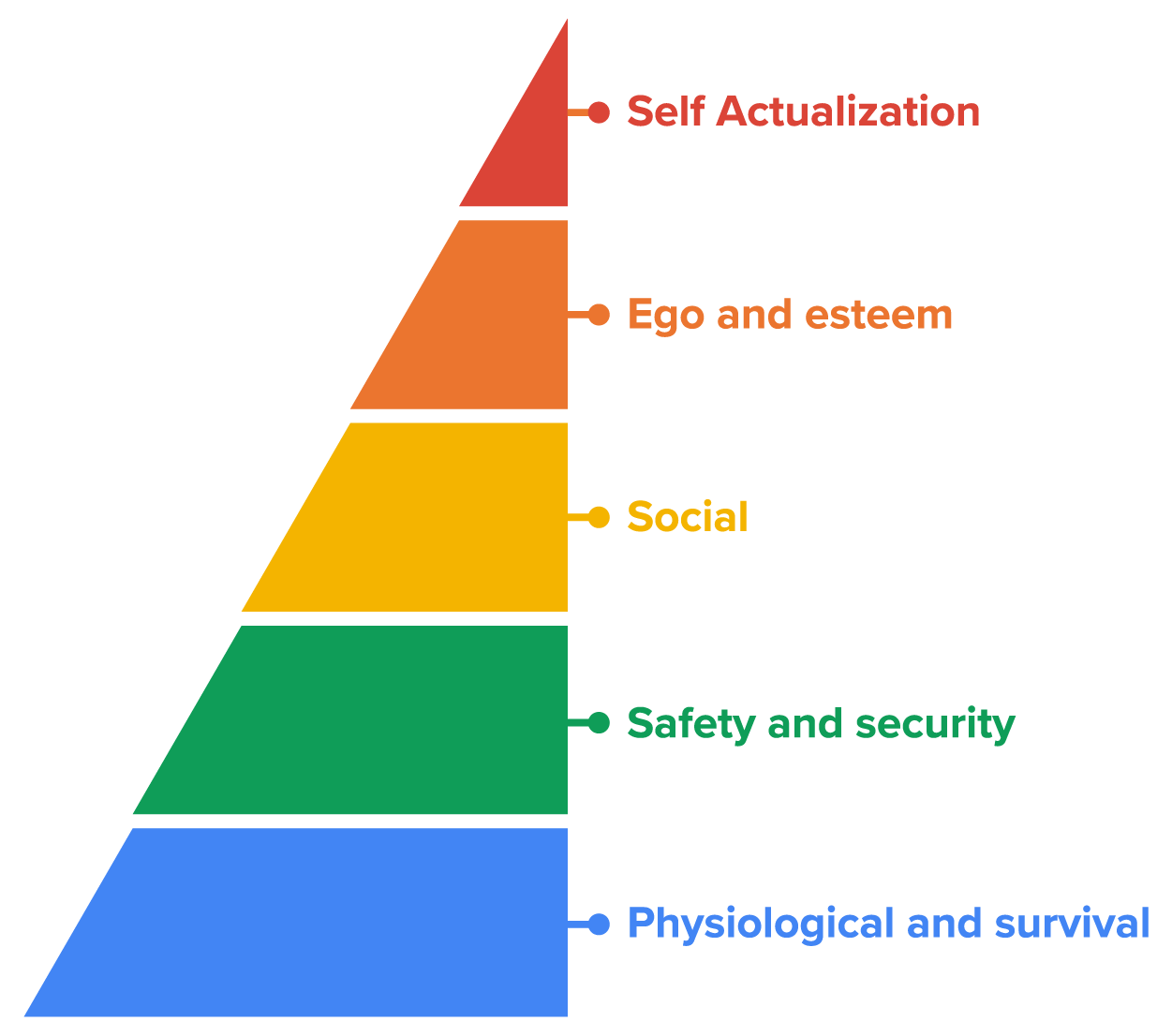
An overriding principle in this theory is that a person’s attention (direction) and energy (intensity) will focus on satisfying the lowest-level need that is not currently satisfied. Needs can also be satisfied at some point but become active (dissatisfied) again. Needs must be “maintained” (we must continue to eat occasionally). According to Maslow, when lower-level needs are reactivated, we once again concentrate on that need. That is, we lose interest in the higher-level needs when lower-order needs are energized.
EXAMPLE
Suppose you are in the process of taking an online course, and you’ve been reading and watching videos for an hour. At one point, you may need to get up to eat or have a drink of water. You might also take a few minutes to say goodnight to your children. You are shifting attention to physiological and social needs before you can effectively focus on meeting the self-actualization needs.Clayton Alderfer observed that very few attempts had been made to test Maslow’s full theory. Further, the evidence accumulated provided only partial support. During the process of refining and extending Maslow’s theory, Alderfer provided another need-based theory and a somewhat more useful perspective on motivation. Alderfer’s theory compresses Maslow’s five need categories into three: existence, relatedness, and growth (hence the name, ERG theory).
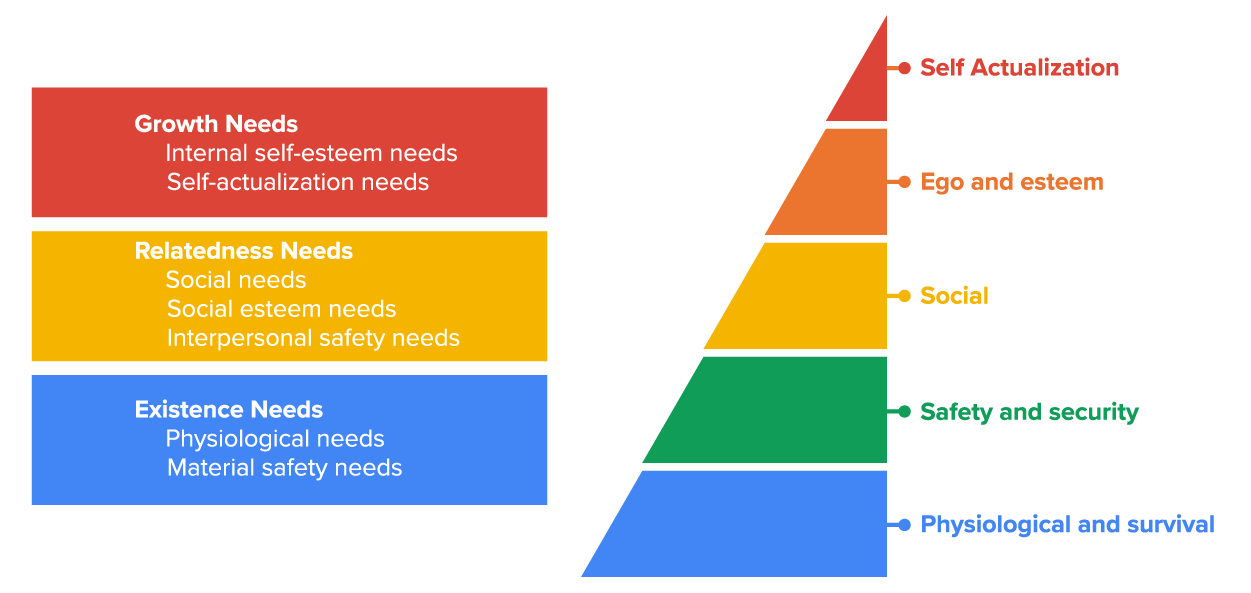
A more critical difference is attention to the dynamics between levels and the way they impact each other. Alderfer identified four components to describe these dynamics.
| Component | Description |
|---|---|
| Satisfaction Progression | This dynamic is parallel to the Maslow pyramid as a linear progression of meeting each set of needs in order of importance. As we increasingly satisfy our existence needs, we direct energy toward relatedness needs. As these needs are satisfied, our growth needs become more active. |
| Frustration | When we attempt but fail to satisfy a particular need, we are even more motivated to satisfy that need, unless we repeatedly fail to satisfy that need, which results in regression. |
| Frustration Regression | After we repeatedly fail to satisfy a particular need, we shift our attention to a previously satisfied, more concrete, and verifiable need. |
| Aspiration | The ERG model notes that, by its very nature, growth is intrinsically satisfying. The more we grow, the more we want to grow. Therefore, the more we satisfy our growth need, the more important it becomes and the more strongly we are motivated to satisfy it. |
Another major difference between Maslow and ERG theory is that Alderfer believed that the order of meeting needs is not fixed. Maslow believed you could only work on one level of needs at once, while Alderfer believed the order is not fixed, and that a strict progression of needs does not occur. Alderfer also believed that needs vary for each person, depending on their individual situation in life. For example, someone may put more emphasis on related needs at a certain period of their life, but then change to focus more on growth needs.
But how does this impact or aid in management decisions? Both theories suggest that to maximize employee motivation, employers must try to guide workers toward their full potential. Both theories also suggest that the employer should help employees satisfy lower-order needs first. For example, by providing adequate pay, safe working conditions, and cohesive work groups, employers help employees satisfy their lower-order needs. Once satisfied, challenging jobs, additional responsibilities, and prestigious job titles can help employees satisfy higher-order esteem needs. If there are motivation problems or rapid turnover at the bottom level of an organizational hierarchy, managers should ask: Are workers preoccupied with survival and unable to focus on higher challenges?
Maslow’s theory is still popular among practicing managers, and one advantage of it over other theories in this challenge is its familiarity. Organizational behavior researchers, however, are not as enamored with it because research results don’t fully support Maslow’s hierarchical notion, particularly the premise that the five levels are fixed and that people can only work on one level of needs at once, which many researchers believe to be false.
EXAMPLE
A notable challenge to Maslow’s model is that stressful, even highly threatening, situations can motivate people to satisfy needs in the higher levels of the pyramid. A familiar illustration of this is the way communities pull together in times of crisis; that is, the social needs are actually better met than they are in times when immediate survival is not at risk. Even self-actualization can be better met when basic needs are denied, which is why fasting and solitude are often part of religious and spiritual practices.On the other hand, there is some evidence that people satisfy the lower-order needs before they attempt to satisfy higher-order needs, and the suggestions like the ones above are both practical and ethical. Below is a list of ways that management can assure that employee needs are being met.
| Category | Examples |
|---|---|
| Growth Opportunities |
|
| Relatedness Opportunities |
|
| Existence Opportunities |
|
IN CONTEXT: QUENCHBLISS
So, how might a manager use these two theories to motivate employees? Recall Jestina, our soda distribution manager, and see how she might apply these two theories.
Suppose Jestina visits the center of operations in Mexico. She walks around the building and notices that even though it is summer, and it is hot out, many of her employees are wearing sweatshirts or jackets. Jestina then asks them why, and the employees say the building is always over-air-conditioned and too cold. With an understanding of these theories, Jestina sees that this issue impacts physiological needs (Maslow) and existence needs (ERG theory). She is concerned that since the employees are cold, it is hard for them to focus on their job. She adjusts the temperature in the building.
In another example of physiological and existence needs, Jestina knows that she must pay a fair wage to employees so they are able to purchase daily necessities for themselves and their families. If not, she knows they will be too focused on basic needs and may not be able to effectively turn their focus to doing a good job for the company.
Suppose a person comes to Jestina to complain that one of the other employees constantly makes rude comments to them, which makes them uncomfortable. Besides the potential legal ramifications, Jestina knows that this employee’s safety needs are not met (since they are being bullied), and therefore, they may not be able to focus. So, as a good manager, Jestina handles this to ensure it doesn’t happen anymore.
Often managers are not able to directly impact whether or not lower-level needs are met, but being aware of the physical environment, pay, and safety (both physical and emotional) helps managers meet their employees' physiological and safety needs (in Maslow's terms) and existence needs (in Alderfer's terms).
As Jestina considers esteem and social needs, as well as relatedness needs, there are a few things she can do here as well. For example, she might offer “employee of the month” awards to meet people’s esteem needs and offer “Fiesta Friday” events for her employees to get to know each other more personally and develop friendships at work. She might also create other team-building and social activities to not only help build rapport, but also to build relationships among workers, which help develop a sense of community to assist with social and esteem needs. She will praise any workers who perform “above and beyond” their immediate job duties.
Justina can even assess self-actualization and growth opportunities. Suppose she puts a proposal together to present to upper-level management where employees identify long-range goals, and the company can help them achieve those goals, such as providing tuition reimbursement, supporting travel for conferences, and providing mentorship.
As a result of understanding the levels of needs, Jestina is able to contribute to meeting employee needs and likely will get more engagement from the employees. It is important to note, however, a manager cannot meet all needs; for example, if someone has low self-esteem, Jestina can provide counseling and encouragement, but some issues are too deep-rooted and personal for an organization to fix. Indeed, anything more might be taken as an invasion of privacy.
Source: THIS TUTORIAL HAS BEEN ADAPTED FROM OPENSTAX "ORGANIZATIONAL BEHAVIOR". ACCESS FOR FREE AT OPENSTAX.ORG/BOOKS/ORGANIZATIONAL-BEHAVIOR/PAGES/1-INTRODUCTION. LICENSE: CREATIVE COMMONS ATTRIBUTION 4.0 INTERNATIONAL.



