Table of Contents |
Heredity involves more than the passing of genetic information from our parents. According to evolutionary psychology, our genetic inheritance comes from the most adaptive genes of our ancestors. The gene is considered the basic unit of inheritance. Genes are passed from parents to offspring. They contain the information needed to specify physical and biological traits. Most genes code for specific proteins, or segments of proteins, which have differing functions within the body (National Human Genome Research Institute, 2023).
Recall the nature versus nurture debate we explored in the first challenge of this unit. Heredity is the ‘nature’ aspect of the debate. It can help us better understand, to some degree, why some of our features such as height, weight, personality, health, etc. may be similar across family members.
To figure out the genetic contributions of this phenomenon, we need to take a step back and ask ourselves, where does this process take place initially? In other words, how and when is our genetic material born - at conception or at birth?
There are two types of sex cells or gametes involved in reproduction:
After the ovum, or egg, ripens and is released from the ovary, it is drawn into the fallopian tube and reaches the uterus in 3 to 4 days. It is typically fertilized in the fallopian tube and continues its journey to the uterus. At ejaculation, millions of sperm are released into the vagina, but only a few reach the egg and typically, only one fertilizes the egg. Once a single sperm has entered the wall of the egg, the wall becomes hard and prevents other sperm from entering. After the sperm has entered the egg, the tail of the sperm breaks off and the head of the sperm, containing the genetic information from the father, unites with the nucleus of the egg. As a result, a new cell is formed. This cell, containing the combined genetic information from both parents, is referred to as a zygote.
While other normal human cells have 46 chromosomes (or 23 pairs), gametes contain 23 chromosomes. A chromosome is a DNA molecule with part or all of the genetic material of an organism. Chromosomes are long threadlike structures found in a cell’s nucleus that contain genetic material known as deoxyribonucleic acid (DNA). DNA is the molecule that carries genetic information for the development and functioning of an organism.
The following illustration of a DNA molecule shows how DNA is made up of two linked strands that wind in a spiral resembling a twisted ladder, forming a helix-like shape. Attached to and joining the strands are a series of nucleotide base pairs: adenine (A), cytosine (C), guanine (G), or thymine (T). The two strands are connected by chemical bonds between the nucleotide base pairs. Notice that the nucleotide base pairs are combinations of either adenine bonded with thymine or cytosine bonded with guanine.
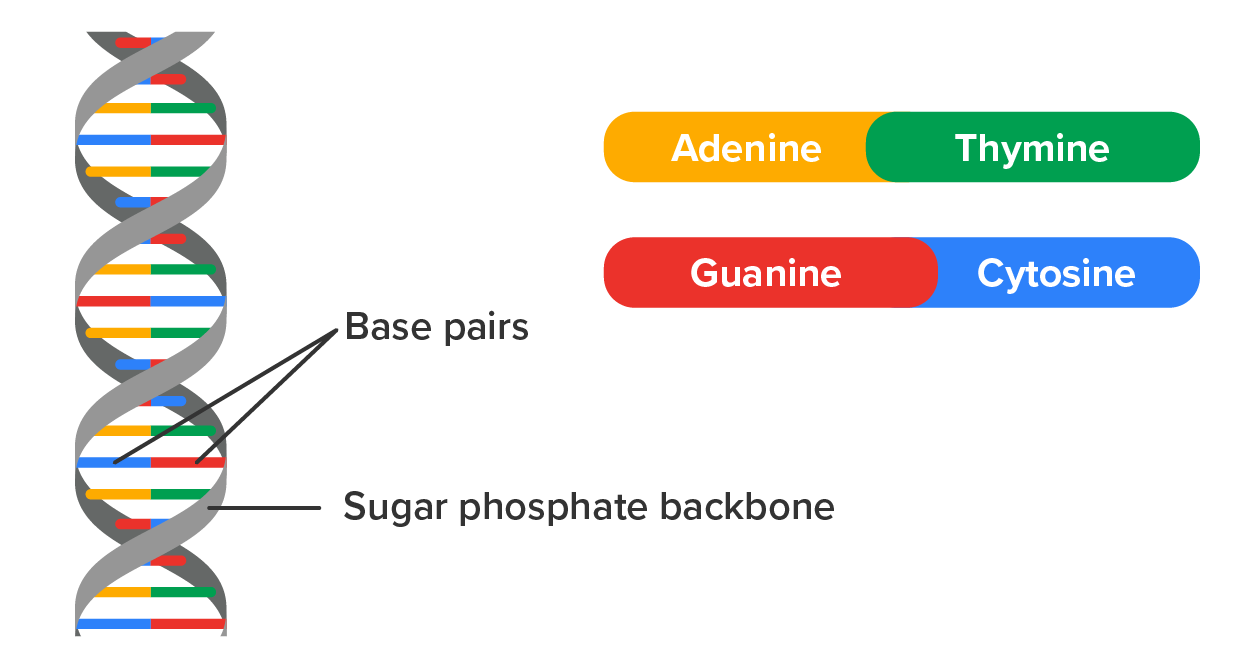
In a process called meiosis, segments of the chromosomes from each parent form pairs.
When a sperm and an egg come together, their 23 chromosomes pair up and create a zygote with 23 pairs of chromosomes. Therefore, each parent contributes half the genetic information carried by the offspring. The resulting physical characteristics of the offspring (called the phenotype) are determined by the interaction of genetic material supplied by the parents (called the genotype) as well as environmental factors.
As you see your reflection in the mirror you might question what determines whether or not genes are expressed? Maybe you have a gene for a certain eye color but then you end up getting a different eye color. Was it a coincidence? Actually, this is quite complicated. Some features follow the additive pattern, which means that many different genes contribute to a final outcome. Height and skin tone are examples. In other cases, a gene might either be turned on or off depending on several factors, including the gene with which it is paired or the inherited epigenetic markers.
Twenty-two of the chromosomes from each parent are similar in length to a corresponding chromosome from the other parent. However, the remaining chromosome, the 23rd pair, looks like an X or a Y.
Some potential parents have a clear preference for having a boy or a girl and would like to determine the sex of the child. Through the years, a number of tips have been offered for the potential parents to maximize their chances for having either a son or daughter as they prefer.
EXAMPLE
It has been suggested that sperm which carry a Y chromosome are more fragile than those carrying an X. So, if a couple desires a male child, they can take measures to maximize the chance that the Y sperm reaches the egg. This involves having intercourse 48 hours after ovulation, which helps the Y sperm have a shorter journey to reach the egg; douching to create a more alkaline environment in the vagina because sperm thrive under alkaline conditions; and having the female reach orgasm first so that sperm are not pushed out of the vagina due to the contractions that occur during orgasm.Today there is new technology available that makes it possible to isolate sperm containing either an X or a Y, depending on the preference. That sperm can be used to fertilize a mother’s egg. Preimplantation genetic diagnosis (PGD) can be used to select only embryos of the desired sex to be implanted during in-vitro fertilization (IVF). IVF is the joining of the egg and sperm outside of the body, in a lab petri dish. After the egg is fertilized in the laboratory, it is implanted in a woman’s uterus or frozen for future use. PGD is controversial and fertility centers and medical organizations discourage it if there is no real medical reason to select the sex of the child.
Genetic variation, the genetic difference between individuals, is what contributes to a species’ adaptation to its environment. In humans, genetic variation begins with an egg, several million sperm, and fertilization. The egg and sperm each contain 23 chromosomes, which make up our genes. A single gene may have multiple possible variations or alleles (a specific version of a gene), resulting in a variety of combinations of inherited traits.
Genetic inheritance of traits for humans is based upon Gregor Mendel’s model of inheritance. For genes on an autosome (any chromosome other than a sex chromosome), the alleles and their associated traits are autosomal dominant or autosomal recessive. In this model, some genes are considered dominant because they will be expressed. Others, termed recessive, are only expressed in the absence of a dominant gene. Some characteristics which were once thought of as dominant-recessive, such as eye color, are now believed to be a result of the interaction between several genes (McKusick, 1998). Dominant traits include curly hair, facial dimples, normal vision, and dark hair. Recessive characteristics include red hair, pattern baldness, and nearsightedness.
Sickle cell anemia is an autosomal recessive disease; Huntington disease is an autosomal dominant disease. Other traits are a result of partial dominance or codominance in which both genes are influential.
EXAMPLE
If a person inherits both recessive genes for cystic fibrosis, the disease will occur. But if a person has only one recessive gene for the disease, the person would be a carrier of the disease but would not have symptoms of the disease itself.In the example depicted in the table below, the normal (dominant) gene is referred to as “N,” and the recessive gene for cystic fibrosis is referred to as “c.” The normal gene is dominant, which means that having the dominant allele either from one parent (Nc) or both parents (NN) will always result in the phenotype associated with the dominant allele.
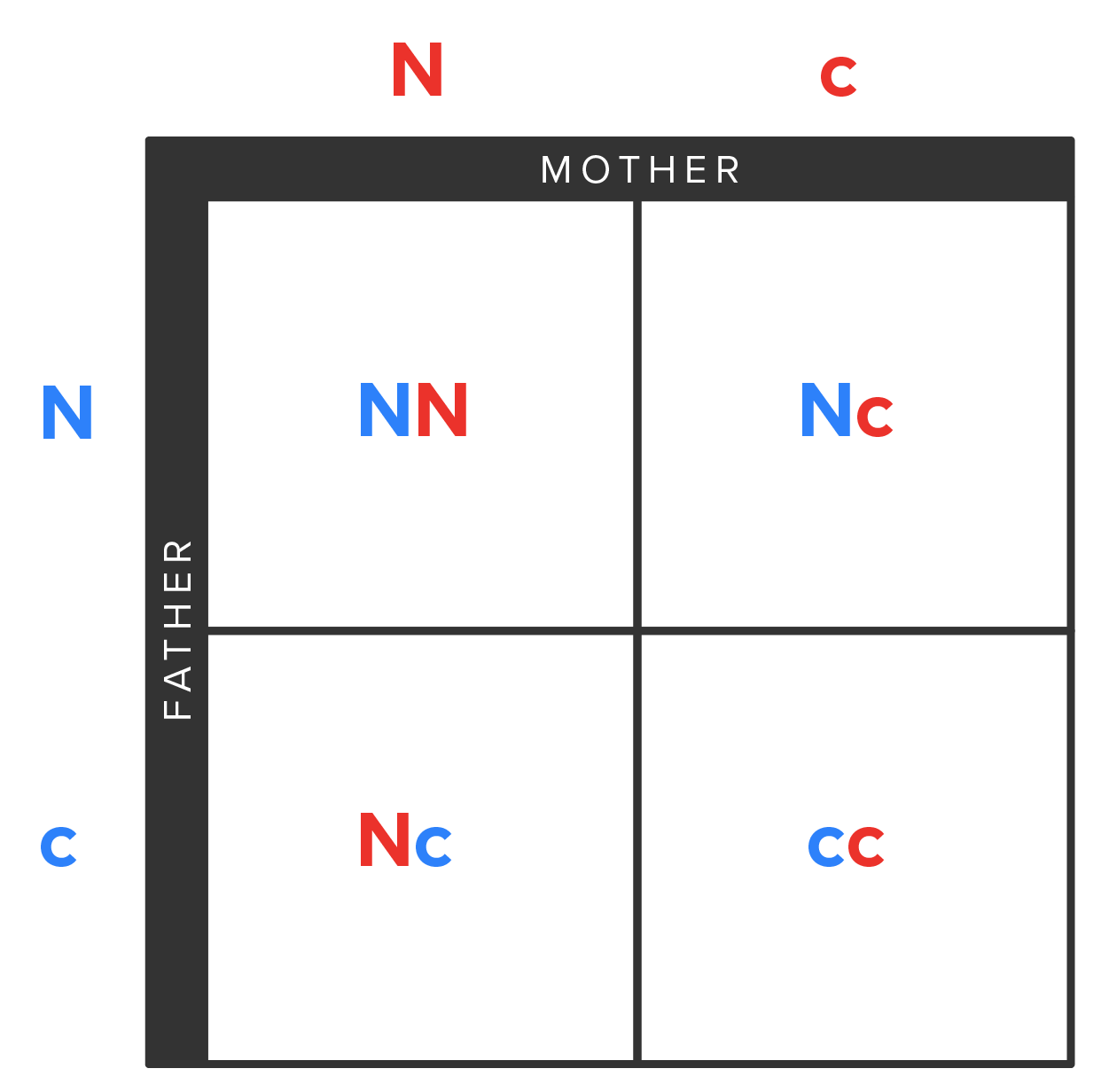
Where do harmful genes that contribute to diseases like cystic fibrosis come from? Gene mutations provide one source of harmful genes. A mutation is a sudden, permanent change in a gene. Many mutations can be harmful or lethal. Once in a while a mutation benefits a person by giving that person an advantage over those who do not have the mutation.
Recall the theory of evolution. It asserts that individuals best adapted to their particular environments are more likely to reproduce and pass on their genes to future generations. In order for this process to occur, there must be competition - more technically, there must be variability in genes (and resultant traits). This allows for variation in adaptability to the environment.
Source: THIS TUTORIAL HAS BEEN ADAPTED FROM LUMEN LEARNING'S LIFESPAN DEVELOPMENT. ACCESS FOR FREE AT https://courses.lumenlearning.com/wm-lifespandevelopment/. LICENSE: CREATIVE COMMONS ATTRIBUTION 4.0 INTERNATIONAL.
REFERENCES
Gould, J. L. (1997). Biological science. New York: Norton.
Green, E. (2023, January 20). Gene. National Human Genome Research Institute. Retrieved January 24, 2023, from www.genome.gov/genetics-glossary/Gene.
Mackon, N., & Fauser, B. (2000). Aspects of ovarian follicle development throughout life. Hormone Research, 52, 161-170.
McKusick, V. A. (1998). Mendelian inheritance in man: A catalog of human genes and genetic disorders. Baltimore, MD: Johns Hopkins University Press.



