You will recall that the heart is a remarkable pump composed largely of cardiac muscle tissue that is incredibly active throughout life. Like all other muscle tissue, cardiac muscle tissue requires a reliable supply of oxygen and nutrients, and a way to remove wastes, so it needs a dedicated, complex, and extensive coronary circulation. And because of the critical and nearly ceaseless activity of the heart throughout life, this need for a blood supply is even greater than for a typical cell. However, coronary circulation is not continuous; rather, it cycles, reaching a peak when the heart muscle is relaxed and nearly ceasing while it is contracting.
1. Coronary Arteries
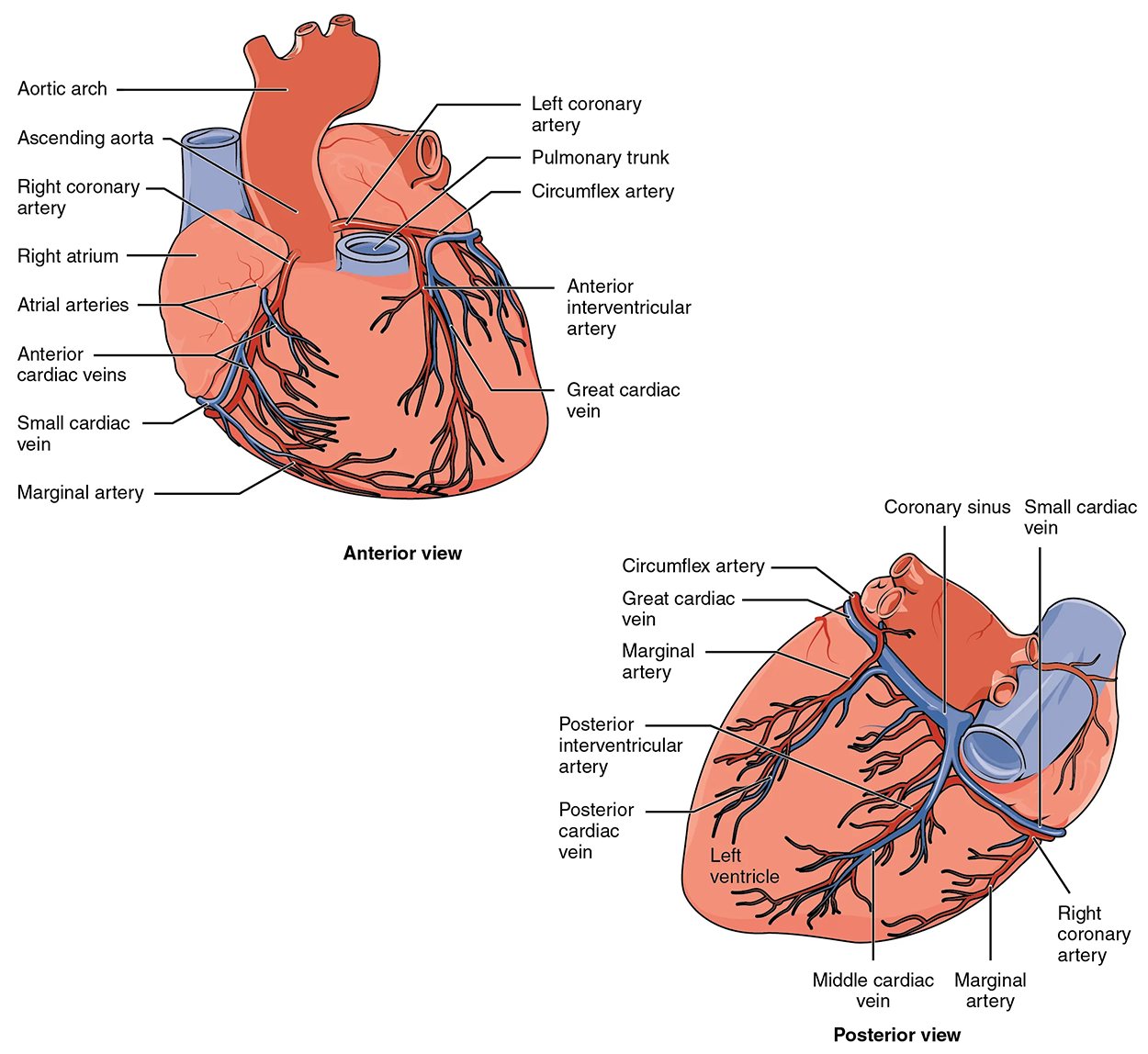
Coronary arteries are blood vessels that supply blood to the myocardium and other components of the heart. The first portion of the aorta after it arises from the left ventricle gives rise to the coronary arteries. The left coronary artery wraps around the left side of the heart while the right coronary artery wraps around the right side of the heart.
The left coronary artery distributes blood to the left side of the heart, the left atrium and ventricle, and the interventricular septum. This artery splits into two arteries. The circumflex artery arises from the left coronary artery and follows the coronary sulcus to the left. Eventually, it will fuse with the small branches of the right coronary artery on the posterior side of the heart. The larger anterior interventricular artery, also known as the left anterior descending artery (LAD), is the second major branch arising from the left coronary artery. It follows the anterior interventricular sulcus around the pulmonary trunk. One notable smaller branch of the circumflex artery is the left marginal artery which supplies blood to the left ventricle. Numerous other smaller branches interconnect with the branches of the posterior interventricular artery, forming anastomoses. An anastomosis is an area where vessels unite to form interconnections that normally allow blood to circulate to a region even if there may be a partial blockage in another branch. The anastomoses in the heart are very small. Therefore, this ability is somewhat restricted in the heart, so a coronary artery blockage often results in death of the cells (myocardial infarction) supplied by the particular vessel.
The right coronary artery proceeds along the coronary sulcus and distributes blood to the right atrium, portions of both ventricles, and the heart conduction system. Normally, one or more marginal arteries arise from the right coronary artery inferior to the right atrium. The right marginal arteries supply blood to the right ventricle. On the posterior surface of the heart, the right coronary artery gives rise to the posterior interventricular artery, also known as the posterior descending artery. It runs along the posterior portion of the interventricular sulcus toward the apex of the heart, giving rise to branches that supply the interventricular septum and portions of both ventricles.
Coronary Circulation - The anterior view of the heart shows the prominent coronary surface vessels. The posterior view of the heart shows the prominent coronary surface vessels.
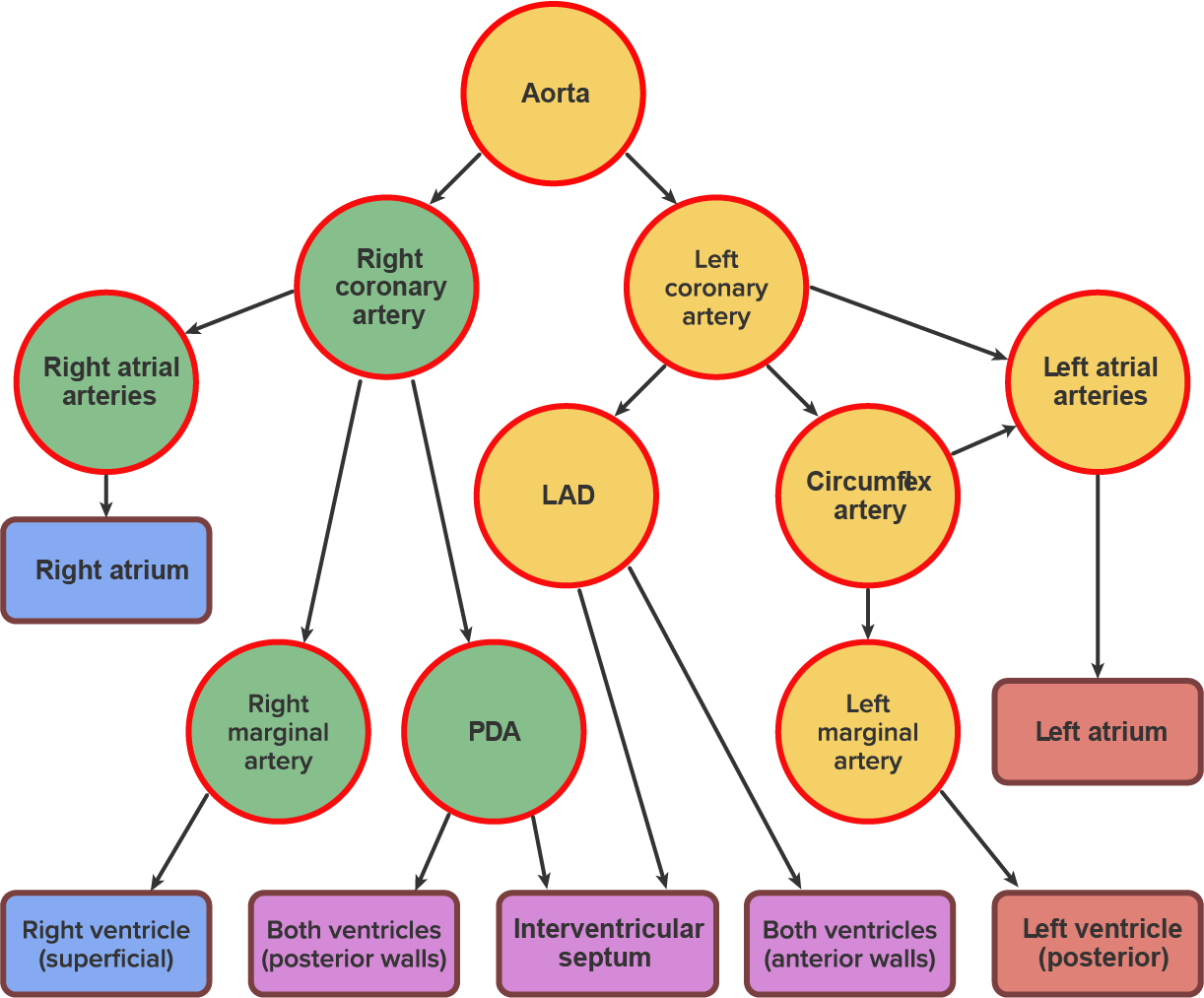
Coronary Artery Flowchart - Arteries (round, red-outlined circles) that supply parts of the heart (brown-outlined boxes) begin with the coronary arteries stemming from the aorta. Each subsequent artery from the coronary arteries then branches into other arteries or parts of the heart. The arteries on the left side of the heart are shaded in light yellow, while those on the right side are shaded in light green. Parts of the heart supplied exclusively by left heart arteries are shaded in light red, while those supplied exclusively by right heart arteries are shaded in light blue. Parts that are supplied by arteries from both sides are shaded in light purple. Abbreviations: LAD - Left anterior descending artery (also called anterior interventricular artery), PDA - Posterior descending artery (also called posterior interventricular artery).
Term Pronunciation Table
Term
Pronunciation
Audio File
Anastomosis
a·nas·to·mo·sis
terms to know
Coronary Artery
A blood vessel that supplies blood to the heart.
Left Coronary Artery
The blood vessel that supplies blood to the left side of the heart.
Right Coronary Artery
The blood vessel that supplies blood to the right side of the heart.
Circumflex Artery
A branch of the left coronary artery that follows the coronary sulcus.
Anterior Interventricular Artery
A branch of the left coronary artery that follows the anterior interventricular sulcus.
Anastomosis
The union of two blood vessels which allows alternative blood flow routes in case of blockage in another branch.
Marginal Artery
A branch of the left or right coronary arteries that supply the superficial portions of the ventricles.
Posterior Interventricular Artery
A branch of the right coronary artery that follows the posterior interventricular sulcus.
2. Coronary Veins
Coronary veins drain the heart and generally parallel the large surface arteries. The great cardiac vein can be seen initially on the anterior surface of the heart following the anterior interventricular sulcus, but it eventually flows along the coronary sulcus into the coronary sinus, a large diameter vein on the posterior surface which drains blood from the heart and returns it directly to the right atrium. The great cardiac vein initially parallels the anterior interventricular artery and drains the areas supplied by this vessel. It receives several major branches, including the posterior cardiac vein, the middle cardiac vein, and the small cardiac vein. The posterior cardiac vein parallels and drains the areas supplied by the marginal artery branch of the circumflex artery. The middle cardiac vein parallels and drains the areas supplied by the posterior interventricular artery. The small cardiac vein parallels the right coronary artery and drains the blood from the posterior surfaces of the right atrium and ventricle. The coronary sinus is a large, thin-walled vein on the posterior surface of the heart lying within the atrioventricular sulcus and emptying directly into the right atrium. The anterior cardiac veins parallel the small cardiac arteries and drain the anterior surface of the right ventricle. Unlike these other cardiac veins, it bypasses the coronary sinus and drains directly into the right atrium.
terms to know
Coronary Vein
A blood vessel that drains blood from the heart.
Great Cardiac Vein
A coronary vein that drains the area supplied by the anterior interventricular artery and flows into the coronary sinus.
Coronary Sinus
A large diameter vein on the posterior surface which drains blood from the heart and returns it directly to the right atrium.
Posterior Cardiac Vein
A coronary vein that drains the area supplied by the marginal artery branch of the circumflex artery into the coronary sinus.
Middle Cardiac Vein
A coronary vein that drains the area supplied by the posterior interventricular artery into the coronary sinus.
Small Cardiac Vein
A coronary vein that drains the area supplied by the right coronary artery into the coronary sinus.
Anterior Cardiac Vein
A coronary vein that drains the area supplied by the small cardiac arteries directly into the right atrium.
3. Heart Attack
Myocardial infarction (MI) is the clinical term for what is commonly referred to as a heart attack. A heart attack is the death (infarct) of cardiac muscle cells (myocardial tissue) due to the lack of blood flow (ischemia) and oxygen (hypoxia) to a region of the heart.
An MI often occurs when a coronary artery is blocked by the buildup of atherosclerotic plaque consisting of lipids, cholesterol and fatty acids, and white blood cells, primarily macrophages. It can also occur when a portion of an unstable atherosclerotic plaque travels through the coronary arterial system and lodges in one of the smaller vessels. The resulting blockage restricts the flow of blood and oxygen to the myocardium and causes death of the tissue. MIs may be triggered by excessive exercise, in which the partially occluded artery is no longer able to pump sufficient quantities of blood, or severe stress, which may induce spasms of the smooth muscle in the walls of the vessel.
In the case of acute MI, there is often sudden pain beneath the sternum (retrosternal pain) called angina pectoris, often radiating down the left arm in males but not in female patients. Until this anomaly between the sexes was discovered, many female patients suffering MIs were misdiagnosed and sent home. In addition, patients typically present with difficulty breathing and shortness of breath (dyspnea), irregular heartbeat (palpitations), nausea and vomiting, sweating (diaphoresis), anxiety, and fainting (syncope), although not all of these symptoms may be present. Many of the symptoms are shared with other medical conditions, including anxiety attacks and simple indigestion, so differential diagnosis is critical. It is estimated that between 22% to 64% of MIs present without any symptoms.
An MI can be confirmed by examining the electrical activity of the patient’s heart, as measured by an electrocardiogram (EKG). In addition, echocardiography or cardiac magnetic resonance imaging (cardiac MRI) may be employed. Common blood tests indicating an MI include elevated levels of creatine kinase MB (an enzyme that catalyzes the conversion of creatine to phosphocreatine, consuming ATP) and cardiac troponin (the regulatory protein for muscle contraction), both of which are released by damaged cardiac muscle cells.
Immediate treatments for MI are essential and include administering supplemental oxygen, aspirin that helps to break up clots, and nitroglycerine administered sublingually (under the tongue) to facilitate its absorption. Despite its unquestioned success in treatments and use since the 1880s, the mechanism of nitroglycerine is still incompletely understood but is believed to involve the release of nitric oxide, a known vasodilator, and endothelium-derived releasing factor, which also relaxes the smooth muscle in the tunica media of coronary vessels. Longer-term treatments include injections of thrombolytic agents such as streptokinase that dissolve the clot, the anticoagulant heparin, balloon angioplasty and stents to open blocked vessels, and bypass surgery to allow blood to pass around the site of the blockage. If the damage is extensive, coronary replacement with a donor heart or coronary assist device, a sophisticated mechanical device that supplements the pumping activity of the heart, may be employed. Despite the attention, development of artificial hearts to augment the severely limited supply of heart donors has proven less than satisfactory but will likely improve in the future.
MIs may trigger cardiac arrest (loss of heart activity; the heart stops pumping), but the two are not synonymous. Important risk factors for MI include cardiovascular disease, age, smoking, high blood levels of low-density lipoprotein (LDL, often referred to as “bad” cholesterol), low levels of high-density lipoprotein (HDL, or “good” cholesterol), high blood pressure (hypertension), diabetes mellitus, obesity, lack of physical exercise, chronic kidney disease, excessive alcohol consumption, and use of illegal drugs.
Term Pronunciation Table
Term
Pronunciation
Audio File
Myocardial Infarction
my·o·car·di·al in·farc·tion
terms to know
Myocardial Infarction
The death of cardiac muscle cells due to the lack of blood flow and oxygen to a region of the heart.
IN CONTEXT
Disorders of the... Heart: Coronary Artery Disease
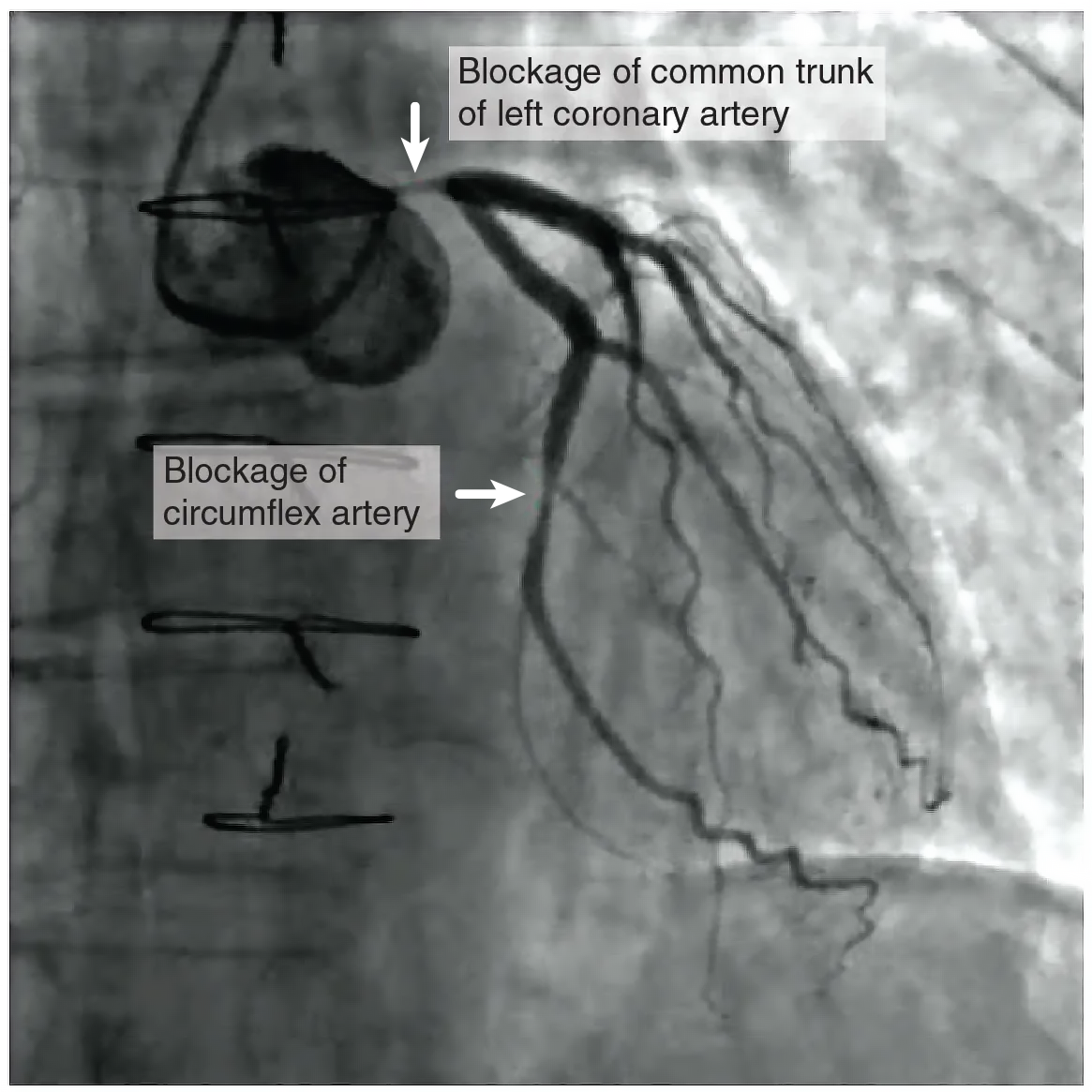
Coronary artery disease is the leading cause of death worldwide. It occurs when the buildup of plaque—a fatty material including cholesterol, connective tissue, white blood cells, and some smooth muscle cells—within the walls of the arteries obstructs the flow of blood and decreases the flexibility or compliance of the vessels. This condition is called atherosclerosis, a hardening of the arteries that involves the accumulation of plaque. As the coronary blood vessels become occluded, the flow of blood to the tissues will be restricted, a condition called ischemia that causes the cells to receive insufficient amounts of oxygen (hypoxia). The figure below shows the blockage of coronary arteries highlighted by the injection of dye. Some individuals with coronary artery disease report pain radiating from the chest called angina pectoris, but others remain asymptomatic. If untreated, coronary artery disease can lead to MI or a heart attack.
Atherosclerotic Coronary Arteries - In this coronary angiogram (X-ray), the dye makes visible two occluded coronary arteries. Such blockages can lead to decreased blood flow (ischemia) and insufficient oxygen (hypoxia) delivered to the cardiac tissues. If uncorrected, this can lead to cardiac muscle death (myocardial infarction).
The disease progresses slowly and often begins in children and can be seen as fatty “streaks” in the vessels. It then gradually progresses throughout life. Well-documented risk factors include smoking, family history, high blood pressure (hypertension), obesity, diabetes, high alcohol consumption, lack of exercise, stress, and high circulating levels of lipids in the blood (hyperlipidemia). Treatments may include medication, changes to diet and exercise, angioplasty with a balloon catheter, insertion of a stent, or coronary bypass procedure.
Angioplasty is a procedure in which the occlusion is mechanically widened with a balloon. A specialized catheter with an expandable tip is inserted into a superficial vessel, normally in the leg, and then directed to the site of the occlusion. At this point, the balloon is inflated to compress the plaque material and to open the vessel to increase blood flow. Then, the balloon is deflated and retracted. A stent consisting of a specialized mesh is typically inserted at the site of occlusion to reinforce the weakened and damaged walls. Stent insertions have been routine in cardiology for more than 40 years.
Coronary bypass surgery may also be performed. This surgical procedure grafts a replacement vessel obtained from another, less vital portion of the body to bypass the occluded area. This procedure is clearly effective in treating patients experiencing an MI but overall does not increase longevity. Nor does it seem advisable in patients with stable although diminished cardiac capacity since frequent loss of mental acuity occurs following the procedure. Long-term changes to behavior, emphasizing diet and exercise plus a medicine regime tailored to lower blood pressure, lower cholesterol and lipids, and reduce clotting are equally as effective.
summary
In this lesson, you learned about the blood vessels that supply the heart with blood. You first explored the coronary arteries that supply blood to the heart. You then explored the coronary veins which drain blood from the heart. Finally, you learned that a heart attack is the death of cardiac muscle cells due to the lack of blood flow and oxygen to a region of the heart.