Table of Contents |
No matter the context, a family planning a vacation, a community group organizing an event, or a corporate work team launching a new product, encountering problems is inevitable. These problems can be external or internal, but are often both. A team meets challenges, and the problem is compounded by internal disagreements about how to solve the problem; they may even disagree over whether it is a problem. The critical question that arises is not if a group will face challenges but how it will face them.
Without a plan for dealing with problems, the loudest voice in the room can dominate the discussion, a single, flawed idea can gain momentum without being properly vetted, and personal feelings can get entangled with professional opinions, leading to weak solutions and frustration. The is often a “quick fix” that allows the root cause to fester, ensuring the problem will eventually re-emerge.
For any group to solve problems effectively, it must operate on this foundation of positive team dynamics, the way that members interact with each other and work together.
| Quality | Explanation | Example |
|---|---|---|
| Psychological Safety | The shared belief that the environment is safe for interpersonal risk-taking. Team members feel free to identify problems, admit uncertainty, and suggest unconventional ideas without fear of embarrassment or punishment. | During a strategy meeting, a junior analyst admits she’s unsure about the assumptions behind a financial model. Her honesty prompts the group to recheck the data and uncover an error that could have derailed the project. |
| Constructive Conflict | The ability to engage in open, idea-focused debate that tests solutions from multiple angles. It ensures the team critically evaluates options rather than settling for quick consensus. | When faced with declining sales, the marketing and operations leads disagree about the cause. Their debate surfaces overlooked customer feedback data that leads to a more accurate diagnosis and effective plan. |
| Mutual Accountability | A culture in which members hold each other responsible for meeting commitments and maintaining problem-solving discipline. Everyone ensures the team follows through on solutions and lessons learned. | After solving a supply chain issue, team members agree on new communication protocols. When one person slips back into old habits, a peer reminds them of the new process, keeping the solution sustainable. |
While none of these concepts are new, nor are they core to any highly effective team, it is crucial for a leader to ensure the team maintains the norms that have already been established when challenges arise.
Even a team with excellent dynamics can flounder when presented with an unexpected problem and no clear answers. A systematic process can help by transforming a complex challenge into a manageable series of steps.
A framework provides the "what," a logical pathway from confusion to clarity, while the team dynamics provide the "how," the interpersonal operating system that allows the framework to function. Just as an effective team can flounder without a good plan, the best plan is useless in the hands of a dysfunctional team. A leader will have tools like this framework in their toolkit and will have cultivated the team dynamics to make it effective.
The system we will look at here is just one option, based on John Dewey's reflective thinking method, a process of analyzing experiences to gain understanding and improve decision-making.
This sequence is not a rigid set of rules but is instead a logical pathway that guides a group from confusion to clarity and, ultimately, to action.
| Step | Explanation | Example |
|---|---|---|
| 1. Define the Problem | The group clarifies exactly what issue needs solving. A precise, objective definition ensures that everyone is addressing the same target and prevents wasted effort on vague or emotional concerns. | A cross-functional team of managers, employee representatives, and HR professionals is formed to address low morale. They begin by describing a clear, measurable problem: “Employee engagement has declined over the last five years, as shown on satisfaction surveys.” |
| 2. Analyze the Problem | Members investigate the root causes, gathering data and applying critical thinking tools like the “Five Whys” (see below). This step relies on multiple perspectives to uncover the deeper systemic issues behind surface symptoms. | The team reviews employee surveys and applies the “Five Whys.” They discover that low morale stems from the absence of clear career paths, which in turn results from a lack of training and mentorship opportunities. This leads to a broad sense of what they need to do: provide those opportunities. |
| 3. Establish Criteria | The group agrees on objective standards that any solution must meet—covering budget, timeline, feasibility, and alignment with organizational values. These guardrails keep discussions focused and decisions fair. | The team sets criteria: the solution must cost under $20,000 in the first year, launch by Q3, be feasible within current staffing, and promote equitable access to development opportunities for all engineers. |
| 4. Generate and Evaluate Solutions | The team brainstorms freely, suspending judgment to encourage creativity, then evaluates ideas systematically using the agreed criteria. This combines divergent and convergent thinking for balanced decision-making. | Ideas range from hiring external trainers to creating an internal mentorship program. After scoring options against the criteria in a decision matrix (see below), the team selects the internal mentorship program as the most cost-effective and sustainable solution. |
| 5. Implement the Solution | The team develops an action plan with clear roles, responsibilities, milestones, and resource needs. Implementation turns strategy into concrete steps. | The HR representative drafts the mentorship framework, the engineering manager recruits mentors, and the team schedules a pilot program launch in early Q3. Progress is reviewed biweekly. |
| 6. Follow Up and Evaluate Results | The group monitors outcomes, compares results to the original problem definition, and adjusts as needed. This ensures continuous improvement and organizational learning. | After three months, the team reviews turnover data and finds a 10 percent reduction. Feedback shows improved engagement, but mentors request more structured resources. The team revises the program accordingly, completing the learning cycle. |
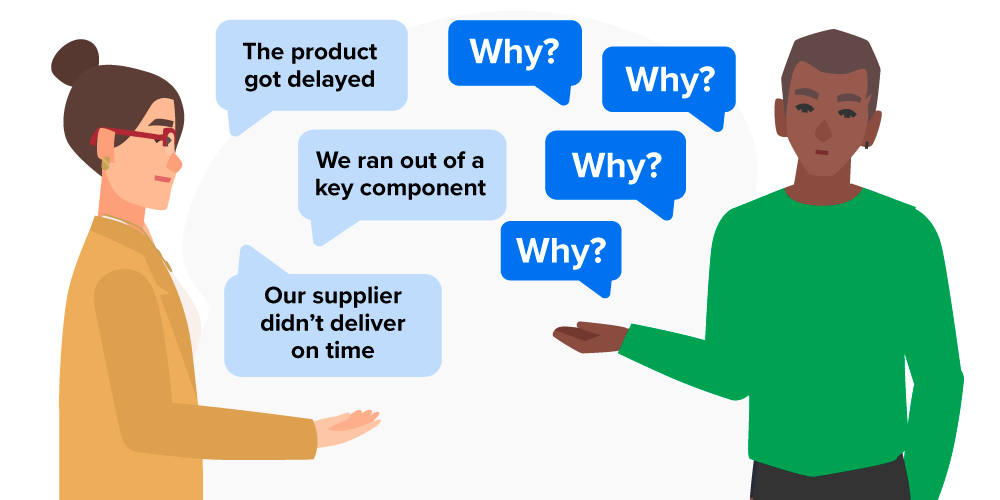
The “Five Whys” is a process for getting to the root of a problem. Each “why” question is posed in response to the previous question. The exact number varies, but striving for at least five encourages the team to analyze the problem more than if they settled for one or two.
EXAMPLE
The team addressing low morale has this discussion.You might see an end to the questioning when the “why” suggests a “why don’t we;” in this example, “Why don’t we create opportunities for future development.” You can stop when you reach an actionable step that is within the team’s control to address. You might also reach a stage where subsequent “why” questions no longer reveal new insights.
The team can help weigh options by first developing a decision matrix, a tool that shows how options compare based on objective criteria. They begin by determining criteria and how important each is. They can then score their options in each category and a scale of one to five. The score for each option is derived by multiplying the score in each cell by the percentage for that criterion and adding them up.
| Option | Cost (Weight: 25%) | Time to Implement (25%) | Equity (25%) | Sustainability (25%) | Weighted Total |
|---|---|---|---|---|---|
| External Training Consultant | 2 | 3 | 4 | 2 | 2.75 |
| Internal Mentorship Program | 5 | 4 | 5 | 5 | 4.75 |
| Online Course Reimbursement | 4 | 5 | 3 | 4 | 4.00 |
Following this seven-step process provides a powerful framework, but it is executed by humans, with all their inherent complexities, that might arise with even the most effective team dynamics. Without vigilance, several predictable barriers can derail even the most well-structured effort. Indeed, some emerge because a team has great interpersonal dynamics and they follow an effective structure.
| Problem | Explanation | Solution | Example |
|---|---|---|---|
| Groupthink | The tendency for cohesive groups to value unanimity over critical evaluation. Members suppress dissenting views to maintain harmony, creating an illusion of consensus and leading to weak or untested decisions. | Assign a devil’s advocate to intentionally challenge assumptions and ensure all ideas are critically evaluated before decisions are made. | During brainstorming, most members favor hiring an external consultant. When one engineer hesitates but stays silent, the leader designates her as the devil’s advocate for the next round. She questions the cost and long-term impact, prompting the team to re-examine other, better options. |
| Social Loafing | Some individuals reduce effort in a group, assuming others will pick up the slack. This undermines the analysis and implementation stages, as key tasks are neglected or delayed. | Build mutual accountability by making roles, responsibilities, and deadlines transparent. Use shared tracking tools so each person’s progress is visible. | During the analysis phase, team members assume HR will gather all exit interview data. When this causes delays, the leader assigns each member a specific research task and posts progress on a shared dashboard. Seeing everyone’s contributions increases effort and follow-through. |
| Analysis Paralysis | The team becomes stuck in over-analysis, delaying decisions out of fear of making the wrong choice. This stalls momentum and prevents progress. | Time-box discussions by agreeing in advance how long to spend on analysis or debate, then making a decision with the best available information. | The team debates endlessly between two mentorship platforms. To move forward, they agree to spend three days reviewing data and make a final decision on the fourth. This structured timeline restores progress and prevents further delays. |
| Overconfidence Bias | When teams experience early success or strong cohesion, they may become overly confident in their judgment, discounting data or feedback that contradicts their preferred view. This can distort both the “Analyze the Problem” and “Decide on a Solution” stages. | Build in structured reflection points where the team must justify assumptions with evidence and invite external review. | After piloting the mentorship program, the team assumes it will solve turnover across all departments. An HR analyst requests data from other units and discovers differences in needs. The team pauses to adjust its rollout plan. |
| Escalation of Commitment | Once a team has invested time or resources in a chosen direction, members may resist changing course—even when new evidence shows the plan isn’t working. | Use “premortems” (imagining the project has failed and asking why) and review checkpoints to create safe exits or course corrections. | Six months in, participation in the mentorship program drops sharply, but the team hesitates to admit it’s faltering. A scheduled mid-year review helps them see the issue early and revise their approach. |
| Process Myopia | Teams can become so focused on following the process “correctly” that they lose sight of the broader purpose or evolving conditions around them. This leads to efficient activity but ineffective outcomes. | Revisit the original problem definition periodically and confirm it still reflects the team’s environment and goals. | The team continues refining mentor pairings even after turnover stabilizes, missing signs that onboarding, not development, has become the new challenge. A quarterly review realigns their efforts to emerging priorities. |
Source: Adapted from Communication for Business Success on Lard Bucket under Creative Commons 3.0.