Rather than start with urine formation, we will start with urine excretion. Urine is a fluid of variable composition that requires specialized structures to remove it from the body safely and efficiently. Blood is filtered, and the filtrate is transformed into urine at a relatively constant rate throughout the day. This processed liquid is stored until a convenient time for excretion. All structures involved in the transport and storage of the urine are large enough to be visible to the naked eye. This transport and storage system not only stores the waste, but it protects the tissues from damage due to the wide range of pH and osmolarity (solute concentration) of the urine, prevents infection by foreign organisms, and for the male, provides reproductive functions.
1. Urethra
The urethra transports urine from the bladder to the outside of the body for disposal. The urethra is the only urologic organ that shows any significant anatomic difference between males and females; all other urine transport structures are identical.
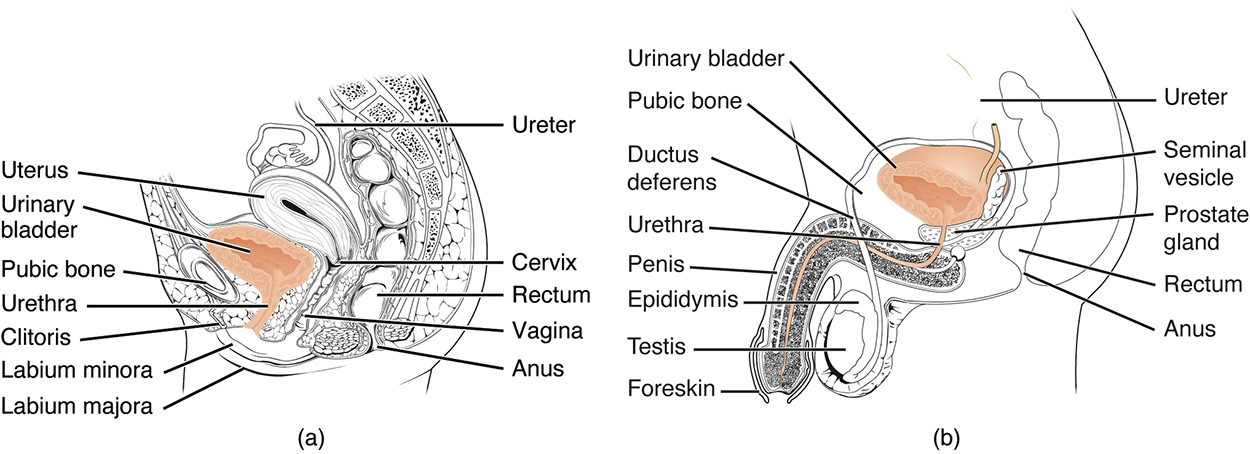
Female and Male Urethras - The urethra transports urine from the bladder to the outside of the body. This image shows (a) a female urethra and (b) a male urethra.
The urethra in both males and females begins inferior and central to the two ureteral openings forming the three points of a triangular-shaped area at the base of the bladder called the trigone (Greek tri, triangle). Trigone is the root of the word “trigonometry,” which is the branch of mathematics that addresses the functions and applications of angles. The urethra tracks posterior and inferior to the pubic symphysis. In both males and females, the proximal urethra is lined by transitional epithelium (the same as in the bladder), whereas the terminal portion is nonkeratinized (it does not contain the protein keratin, which helps form hair, nails, and the epidermis), stratified squamous epithelium. In the male, pseudostratified columnar epithelium lines the urethra between these two cell types. Urination is regulated by an involuntary autonomic nervous system-controlled internal urinary sphincter, which consists of smooth muscle, and an external urinary sphincter below it, which consists of voluntary skeletal muscle.
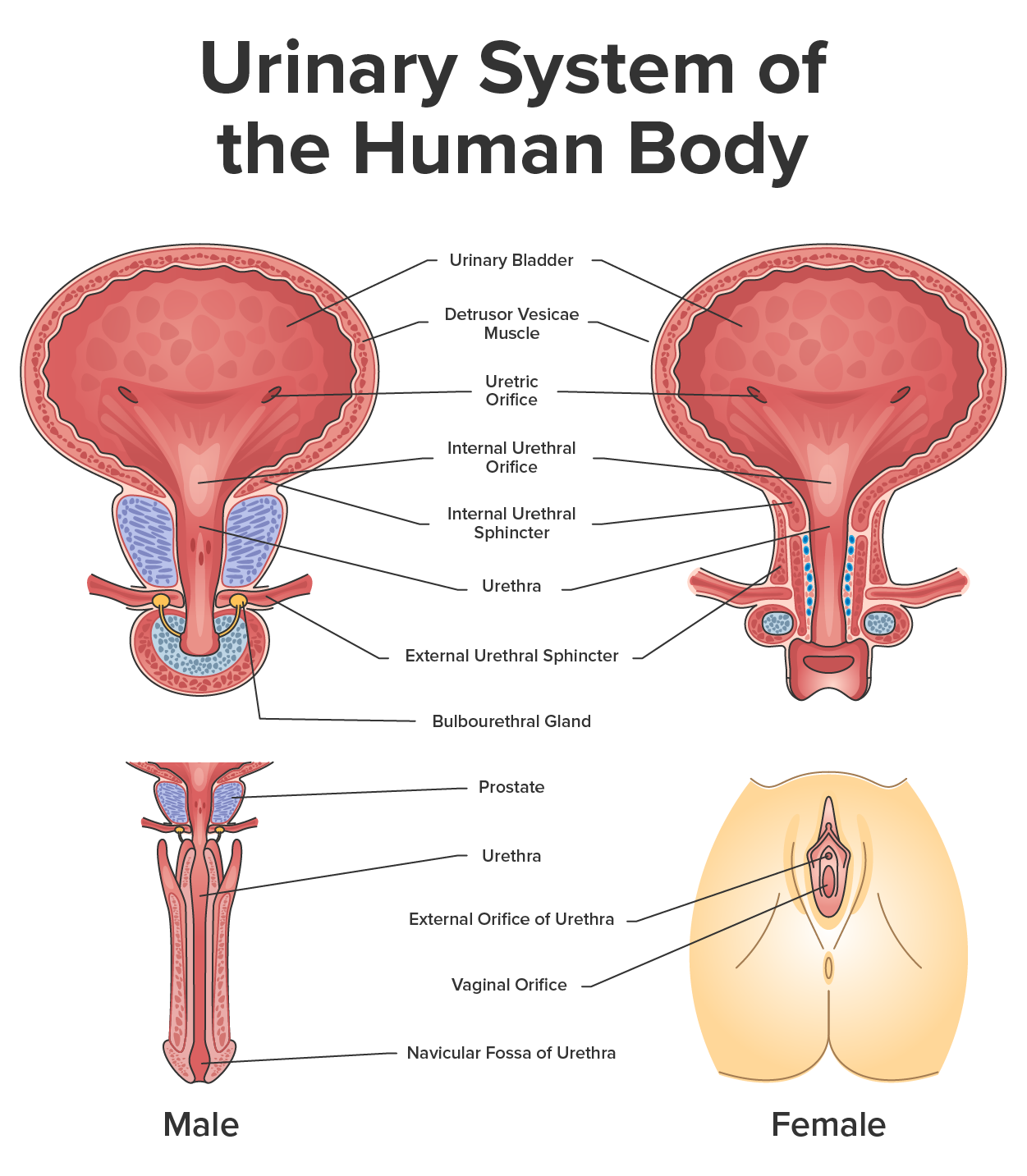
Another View of the Urinary System of Males and Females.
1a. Female Urethra
The external urethral orifice is embedded in the anterior vaginal wall inferior to the clitoris, superior to the vaginal opening (introitus), and medial to the labia minora. Its short length, about 4 cm, is less of a barrier to fecal bacteria than the longer male urethra and is the best explanation for the greater incidence of urinary tract infections (UTIs) in females. Voluntary control of the external urethral sphincter is a function of the pudendal nerve. It arises in the sacral region of the spinal cord, traveling via the S2–S4 nerves of the sacral plexus.
1b. Male Urethra
The male urethra passes through the prostate gland immediately inferior to the bladder before passing below the pubic symphysis. The length of the male urethra varies between people but averages 20 cm in length.
The male urethra is divided into four regions:
Preprostatic urethra
The preprostatic urethra is very short and incorporated into the bladder wall.
Prostatic urethra
The prostatic urethra passes through the prostate gland. During sexual intercourse, it receives sperm via the ejaculatory ducts and secretions from the seminal vesicles. Paired Cowper’s glands (bulbourethral glands) produce and secrete mucus into the urethra to buffer urethral pH during sexual stimulation. The mucus neutralizes the usually acidic environment and lubricates the urethra, decreasing the resistance to ejaculation. Sexual reproduction and these associated terms will be discussed in more detail in future lessons.
Membranous urethra
The membranous urethra passes through the deep muscles of the perineum, where it is invested by the overlying urethral sphincters.
Spongy or penile urethra
The spongy urethra exits at the tip (external urethral orifice) of the penis after passing through the corpus spongiosum. Mucous glands are found along much of the length of the urethra and protect the urethra from extremes of urine pH. Innervation, which refers to the supply of nerves, is the same in both males and females.
Term Pronunciation Table
Term
Pronunciation
Audio File
Urethra
ure·thra
Trigone
tri·gon
Sphincter
sphinc·ter
terms to know
Urethra
The organ that transports urine from the bladder to the outside environment.
Trigone
The area at the base of the bladder marked by the two ureters in the posterior–lateral aspect and the urethral orifice in the anterior aspect oriented like points on a triangle.
Internal Urinary Sphincter
Smooth muscle at the juncture of the bladder and urethra; relaxes as the bladder fills to allow urine into the urethra.
External Urinary Sphincter
Skeletal muscle that must be voluntarily relaxed to void urine.
summary
In this lesson, you learned about the role of the urethra in transporting urine out of the human body. Specifically, you explored the urethra, which transports urine from the bladder to outside of the body, and you compared the female urethra and the male urethra.
Skeletal muscle that must be voluntarily relaxed to void urine.
Internal Urinary Sphincter
Smooth muscle at the juncture of the bladder and urethra; relaxes as the bladder fills to allow urine into the urethra.
Trigone
The area at the base of the bladder marked by the two ureters in the posterior–lateral aspect and the urethral orifice in the anterior aspect oriented like points on a triangle.
Urethra
The organ that transports urine from the bladder to the outside environment.