Table of Contents |
Most businesses must develop a global vision if they are to remain competitive at home. Even if companies do not intend to sell goods and services overseas, chances are they must work with overseas companies for raw materials, manufacturing, and other processes. Therefore, having a global vision means:
As you can see from the table below, the economies of the United States and other countries depend heavily on international trade:
| Country/ Region | Total Exports (2023) | Total Imports (2023) | Trade Balance | Services Trade Share of Global Exports | Services Trade Share of Global Imports |
|---|---|---|---|---|---|
| United States | $3.05 trillion | $3.83 trillion | –$773.43 billion deficit | 16.7% | 13.7% |
| European Union | €2.4 trillion (2022) | Data not specified | €174 billion surplus (services) | 25.2% | 23.4% |
| China | $3.38 trillion | $2.56 trillion | $824 billion surplus | 4.6% | 5.5% |
Two essential components of international trade that allow countries to obtain goods and services they cannot produce efficiently while selling those they specialize in are:
EXAMPLE
The United States imports electronics from Asia and oil from the Middle East to meet consumer needs and support industrial activity (U.S. BEA, 2024).Imports can benefit a country’s economy by increasing consumer choice and encouraging competition, although excessive dependence on imports can also lead to trade shortfalls.
Exporting, on the other hand, involves selling domestically produced goods and services to other countries, generating revenue and supporting economic growth. It allows businesses to expand their markets beyond national borders, achieve economies of scale, and create jobs.
EXAMPLE
Countries like China and Germany have built robust economies through strong export sectors, especially in manufacturing and technology (U.S. BEA, 2024).Governments often support exports through trade agreements and financial incentives, as a healthy export sector can improve a nation’s trade balance and strengthen its currency. Together, importing and exporting drive globalization and interdependence among economies, making trade a powerful tool for development and innovation.
The difference between the value of a country’s exports and the value of its imports during a specific time is the country’s balance of trade. A country that exports more than it imports is said to have a favorable balance of trade, called a trade surplus. A country that imports more than it exports is said to have an unfavorable balance of trade, or a trade deficit. When imports exceed exports, more money from trade flows out of the country than flows into it. The balance of trade impacts a country’s economic stability, currency value, and employment levels.
IN CONTEXT: The U.S. Trade Deficit
The United States has historically run a trade deficit, meaning it imports more goods and services than it exports. In 2023, the U.S. trade deficit was approximately $773 billion, a reflection of strong domestic demand for foreign products like electronics, machinery, and oil. The United States is a major importer, especially from countries like China, Mexico, and Canada, and while it exports a significant amount—such as aerospace equipment, agricultural products, and technology—it still buys more than it sells.
This persistent trade deficit has sparked ongoing debate about its long-term impact on the economy, manufacturing sector, and national debt. While some view the trade deficit as a sign of economic weakness, others argue it reflects a healthy consumer-driven economy with access to a wide range of affordable goods. The U.S. dollar’s status as the world’s reserve currency also plays a role—it encourages foreign investment in U.S. assets, which helps finance the deficit. However, critics point out that a long-term imbalance can erode domestic industries and increase reliance on foreign production. Policymakers have tried various strategies, from tariffs to trade agreements, to rebalance trade, but the United States continues to grapple with how to support domestic growth while remaining globally competitive (World Bank, 2024).
One might argue that the best way to protect workers and the domestic economy is to stop trade with other nations and keep the flow of imports and exports within our borders. But how would we get resources like cobalt and coffee beans? The United States simply can’t produce or manufacture some products at the low costs we’re used to. Nations—like people—are good at producing different things.
EXAMPLE
You may be better at balancing a ledger than repairing a car. In this case, you benefit by “exporting” your bookkeeping services and “importing” the car repairs you need from a good mechanic.Economists refer to the specialization in products, resources, or services as an “advantage.” A country has an absolute advantage when it can produce and sell a product at a lower cost than any other country or it is the only country that can provide a product.
EXAMPLE
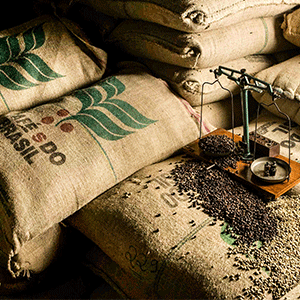 Suppose that the United States has an absolute advantage in air traffic control systems for busy airports and that Brazil has an absolute advantage in coffee. The United States does not have the proper climate for growing coffee, and Brazil lacks the technology to develop air traffic control systems. Both countries would gain by exchanging air traffic control systems for coffee (U.S. Census Bureau, 2024).
Even if the United States had an absolute advantage in both coffee and air traffic control systems, it should still specialize and engage in trade. Why? The reason is the principle of comparative advantage, which says that each country should specialize in the products that it can produce most readily and cheaply and trade those products for goods that foreign countries can also produce most readily and cheaply. This specialization ensures greater product availability and lower prices.
EXAMPLE
 India and Vietnam have a comparative advantage in producing clothing because of lower labor costs. Japan has long held a comparative advantage in consumer electronics because of technological expertise. The United States has an advantage in computer software, airplanes, some agricultural products, heavy machinery, and jet engines (U.S. BEA, 2024).
Thus, comparative advantage acts as a stimulus for trade. When nations allow their citizens to trade whatever goods and services they choose without government regulation, free trade exists. Free trade is the policy of permitting the people and businesses of a country to buy and sell where they please without restrictions.

The opposite of free trade is protectionism, in which a nation protects its home industries from outside competition by establishing artificial barriers such as tariffs and quotas, which we will discuss later.
Global trade offers several significant advantages that contribute to economic development and consumer benefits:
Some countries put protectionist policies in place in an attempt to shield their country from trade because of the advantages and disadvantages of global trade that you’ve seen in this section. As a result, there are several trade barriers that should be considered.
International trade is carried out by both businesses and governments—as long as no one puts up trade barriers. In general, trade barriers keep firms from selling to one another in foreign markets. The major obstacles to international trade are:
EXAMPLE
 Even though raising beef in the relative warmth of Argentina may cost less than raising beef in the bitter cold of Siberia, the cost of shipping the beef from South America to Siberia might drive the price too high. Distance is thus one of the natural barriers to international trade.
A tariff is a tax imposed by a nation on imported goods. It may be a charge per unit, such as per barrel of oil or per new car; it may be a percentage of the value of the goods, such as 5% of a $500,000 shipment of shoes; or it may be a combination.
Protective tariffs make imported products less attractive to buyers than domestic products. The United States charges protective tariffs on products like solar panels, in an attempt to support U.S. manufactures against foreign competition.
IN CONTEXT: The Tariff Debate
Congress has debated the issue of tariffs since 1789. The main arguments for tariffs include the following:The main arguments against tariffs include the following:
- Tariffs protect infant industries. A tariff can give a struggling new domestic industry time to become an effective global competitor.
- Tariffs protect U.S. jobs. Unions and others say tariffs keep foreign labor from taking away U.S. jobs.
- Tariffs aid in military preparedness. Tariffs should protect industries and technology during peacetime that are vital to the military in the event of war.
- Tariffs discourage free trade, and free trade allows the principle of competitive advantage to work more efficiently.
- Tariffs raise prices, thereby decreasing consumers’ purchasing power.
Besides tariffs, there are nontariff barriers to trade that may be imposed. One type of nontariff barrier is the import quota, or the limits on the quantity of certain goods that can be imported. The goal of setting quotas is to limit imports to the specific amount of a given product. A complete ban against importing or exporting a product is an embargo. Often, embargoes are set up for defense purposes.
EXAMPLE
The United States has a complete embargo on Cuba (and has since 1962), due to concerns with its politics. In January 2025, the United States redesignated Cuba as a state sponsor of terrorism, which expanded the restrictions.Government rules that give special privileges to domestic manufacturers and retailers are called buy-national regulations. One such regulation in the United States bans the use of foreign steel in constructing U.S. highways. Many state governments have buy-national rules for supplies and services.
In a more subtle move, a country may make it hard for foreign products to enter its markets by establishing customs regulations that are different from generally accepted international standards, such as requiring bottles to be quart size rather than liter size or requiring certain labeling restrictions.
EXAMPLE
The European Union has restrictions on hormone-treated beef, citing health and safety concerns. Although this ban is framed as a health measure, it impacts beef imports from the United States, since this is a common practice (European Commission, 2023).Source: THIS CONTENT HAS BEEN ADAPTED FROM OPENSTAX "INTRODUCTION TO BUSINESS". ACCESS FOR FREE AT openstax.org/details/books/introduction-business. LICENSE: CREATIVE COMMONS ATTRIBUTION 4.0 INTERNATIONAL. Accessed by May 2025.
REFERENCES
European Commission. (2023a). EU trade in services – Facts and figures. policy.trade.ec.europa.eu/analysis-and-statistics/statistics_en
European Commission. (2023b). Global EU trade in services – Main trading partners. policy.trade.ec.europa.eu/analysis-and-statistics/statistics_en
U.S. Bureau of Economic Analysis. (2024a, June 24). International transactions. www.bea.gov/data/intl-trade-investment/international-transactions
U.S. Bureau of Economic Analysis. (2024b, August 23). Activities of U.S. multinational enterprises, 2022. www.bea.gov/news/2024/activities-us-multinational-enterprises-2022
U.S. Census Bureau. (n.d.). U.S. international trade in goods and services (FT900). www.census.gov/foreign-trade/Press-Release/current_press_release/index.html
World Bank. (2024). Exports and imports of goods and services (% of GDP) – United States. data.worldbank.org/indicator/NE.EXP.GNFS.ZS?locations=US



