Table of Contents |
Behavioral genetics is the scientific study of how genes and environments combine to generate behavior. Behavioral geneticists studies how individual differences arise in the present through the interaction of genes and the environment.
Behavioral geneticists study human behavior. They often use twin and adoption studies to research questions of interest.
As you may recall, you learned about the epigenetic framework in the first Challenge of this Unit. The term epigenetic has been used in developmental psychology to describe the impact the environment and our experiences on gene expression. It is the result of an ongoing, bi-directional interchange between these two factors.
Developmental psychologists Gilbert Gottlieb and Erik Erikson have contributed to this field in various ways. Gottlieb suggests an analytic framework for the nature versus nurture debate that recognizes the relationship between the environment, behavior, and genetic expression (Gottlieb 1998; 2000; 2002). This bi-directional relationship suggests that the environment can affect the expression of genes just as genetic predispositions can impact a person’s potentials. Likewise, environmental circumstances can trigger symptoms of a genetic disorder.
EXAMPLE
A person genetically predisposed for type 2 diabetes may trigger the disease through poor diet and little exercise.Erikson also wrote of an epigenetic principle in his 1968 book Identity: Youth and Crisis. He emphasized that we develop through an unfolding of our personality in predetermined stages, and that our environment and surrounding culture influence how we progress through these stages. This biological unfolding in relation to our socio-cultural settings is done in stages of psychosocial development, where “progress through each stage is in part determined by our success, or lack of success, in all the previous stages” (Erikson, 1968).
In many human families, children’s biological parents raise them, so it is very difficult to differentiate whether children act like their parents due to genetic (nature) or environmental (nurture) reasons. Nevertheless, despite our restrictions on setting up human-based experiments, we do see real-world examples of nature vs. nurture at work in the human sphere - though they only provide partial answers to our many questions.
Another option for observing nature versus nature in humans involves twin studies. To analyze the nature-nurture interaction using twins, we compare the similarity of monozygotic and dizygotic pairs.
Monozygotic (one egg identical) twins occur when a single zygote or fertilized egg splits apart in the first two weeks of development. The result is the creation of two separate but genetically identical offspring. About one-third of twins are monozygotic twins. Consider these facts:
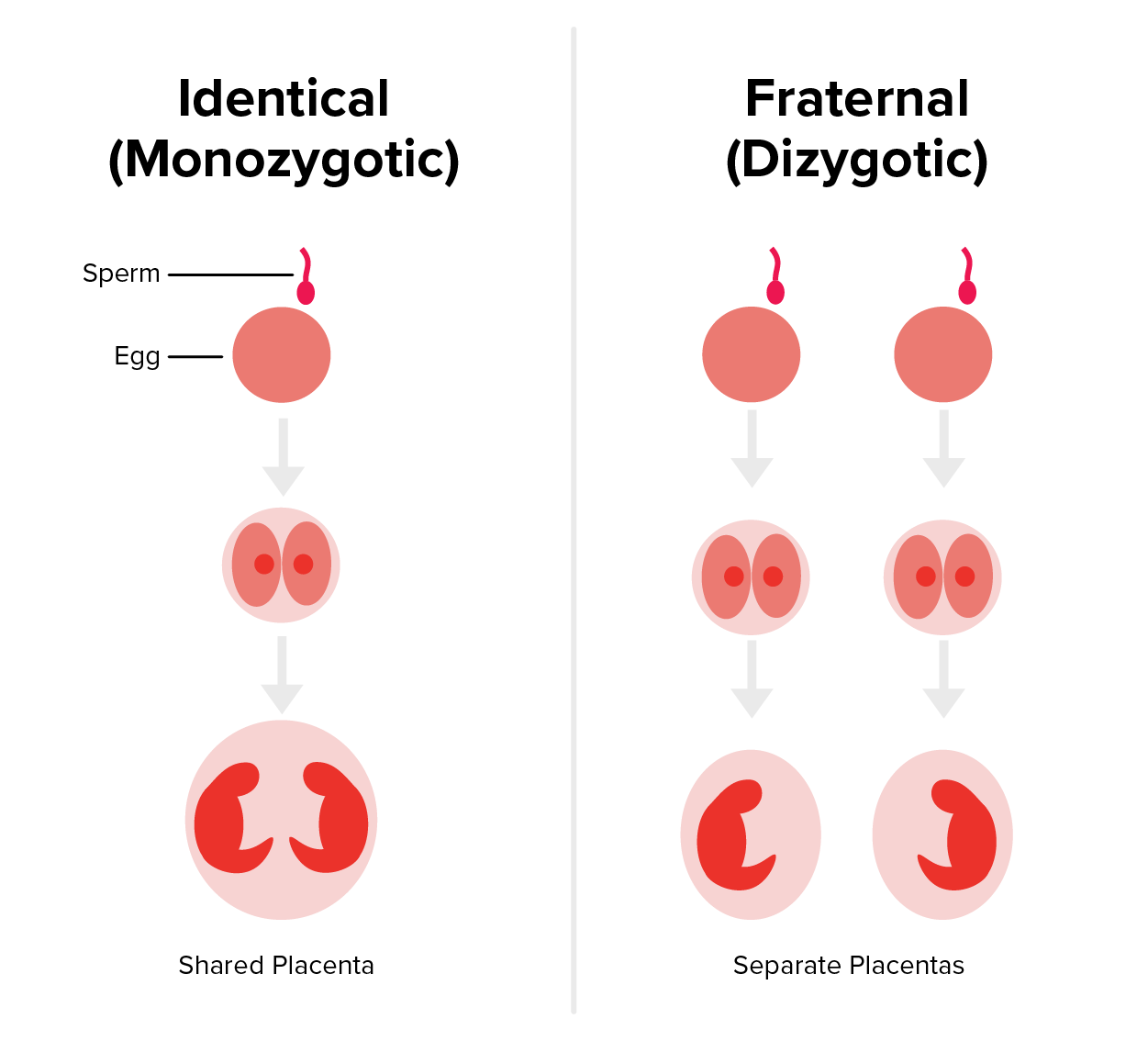
Monozygotic twins can be categorized into four types depending on the timing of the separation and duplication of cells. The categorization of monozygotic twins depends on various types of chorionicity (the number of placenta) and amnionicity (the number of amnions or inner membranes that encircle the fetus).
Monozygotic twins are a result of when and how the fertilized egg divides. This is known as placentation (the formation or arrangement of the placenta in a woman's uterus). The following diagram shows four ways monozygotic twins are formed, depending on the timing of the separation and duplication of cells.
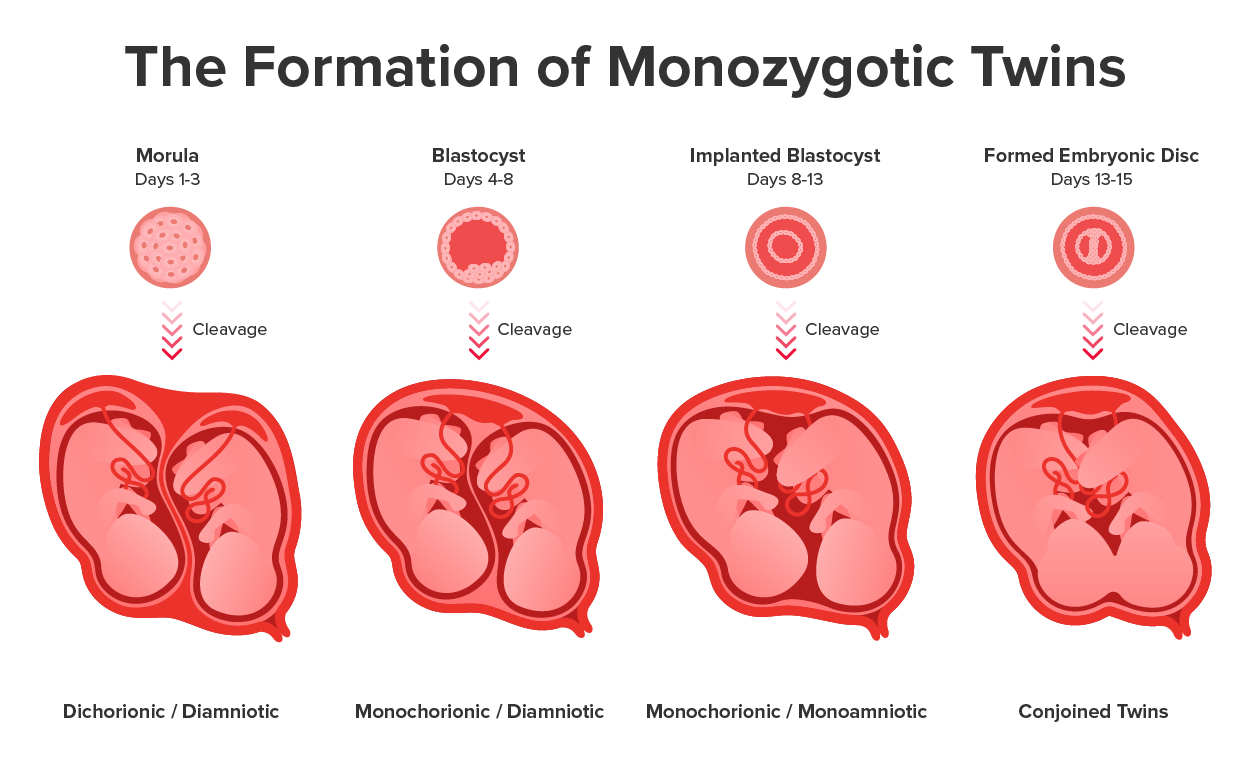
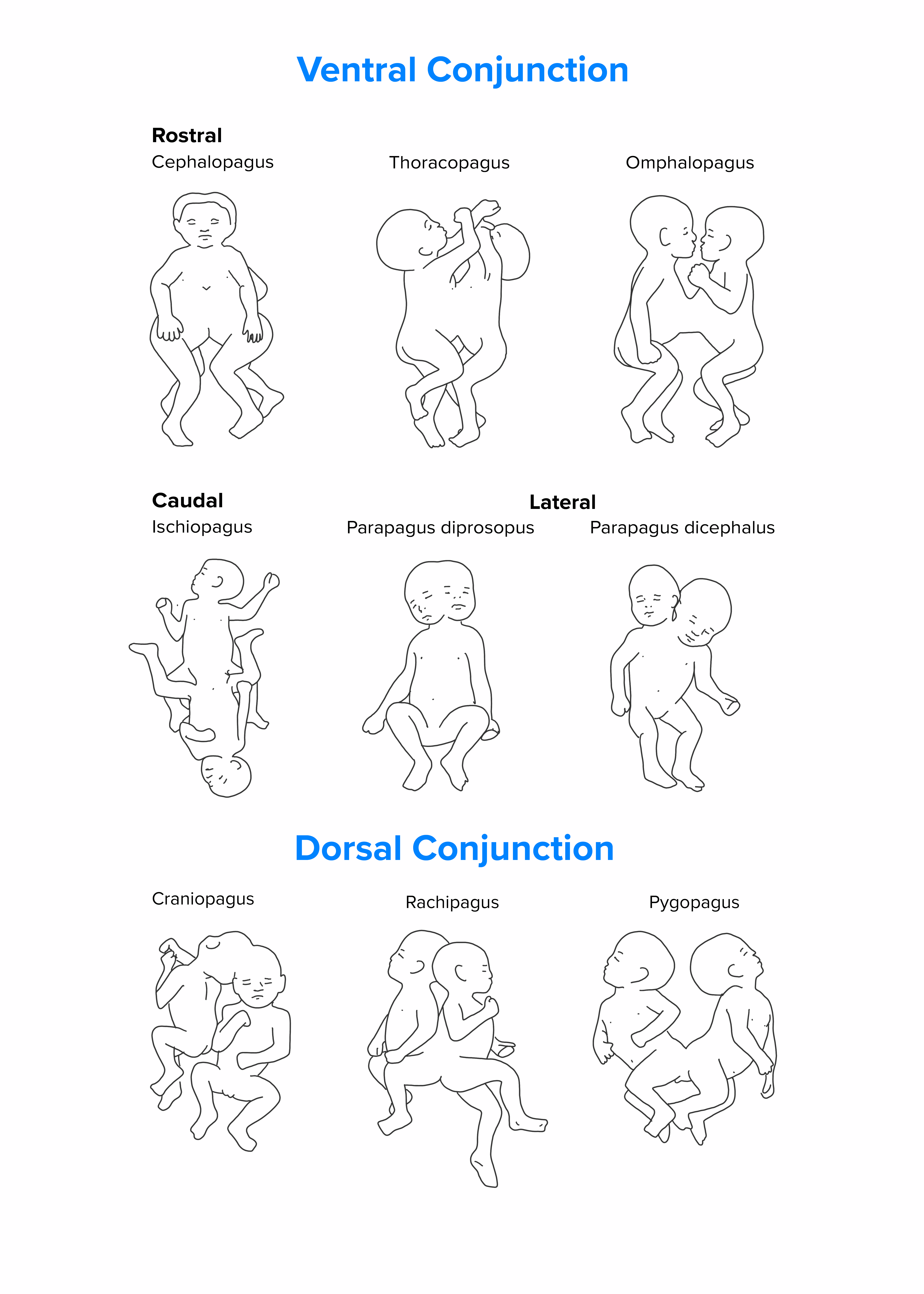
Conjoined twins are monozygotic twins whose bodies are joined together during pregnancy. This occurs when the zygote starts to split after day 12 following fertilization and fails to separate completely. This condition occurs in about 1 in 50,000 human pregnancies, however, actual incidence is estimated at 1 in 250,000 births (Spitz, Kiely, & Pierro, 2018).
Most conjoined twins are now evaluated for surgery to attempt to separate them into separate functional bodies. The degree of difficulty rises if a vital organ or structure is shared between twins, such as the brain, heart, pelvis, or liver.
Researchers suspect that as many as 1 in 8 pregnancies start out as multiples, but only a single fetus is brought to full term because the other fetus has died very early in the pregnancy and has not been detected or recorded. Early obstetric ultrasonography exams sometimes reveal an “extra” fetus, which fails to develop and instead disintegrates and vanishes in the uterus. There are several reasons for the “vanishing” fetus, including it being embodied or absorbed by the other fetus, placenta or the mother. This is known as vanishing twin syndrome. Also, in an unknown proportion of cases, two zygotes may fuse soon after fertilization, resulting in a single chimeric embryo, and, later, fetus.
Let’s now look at how nature and nurture apply through twin studies, using the features of height and spoken languages. Unsurprisingly, identical twins are almost perfectly similar for height. The heights of fraternal twins, however, are like any other sibling pairs: more similar to each other than to people from other families, but hardly identical. This contrast between twin types gives us a clue about the role genetics plays in determining height.
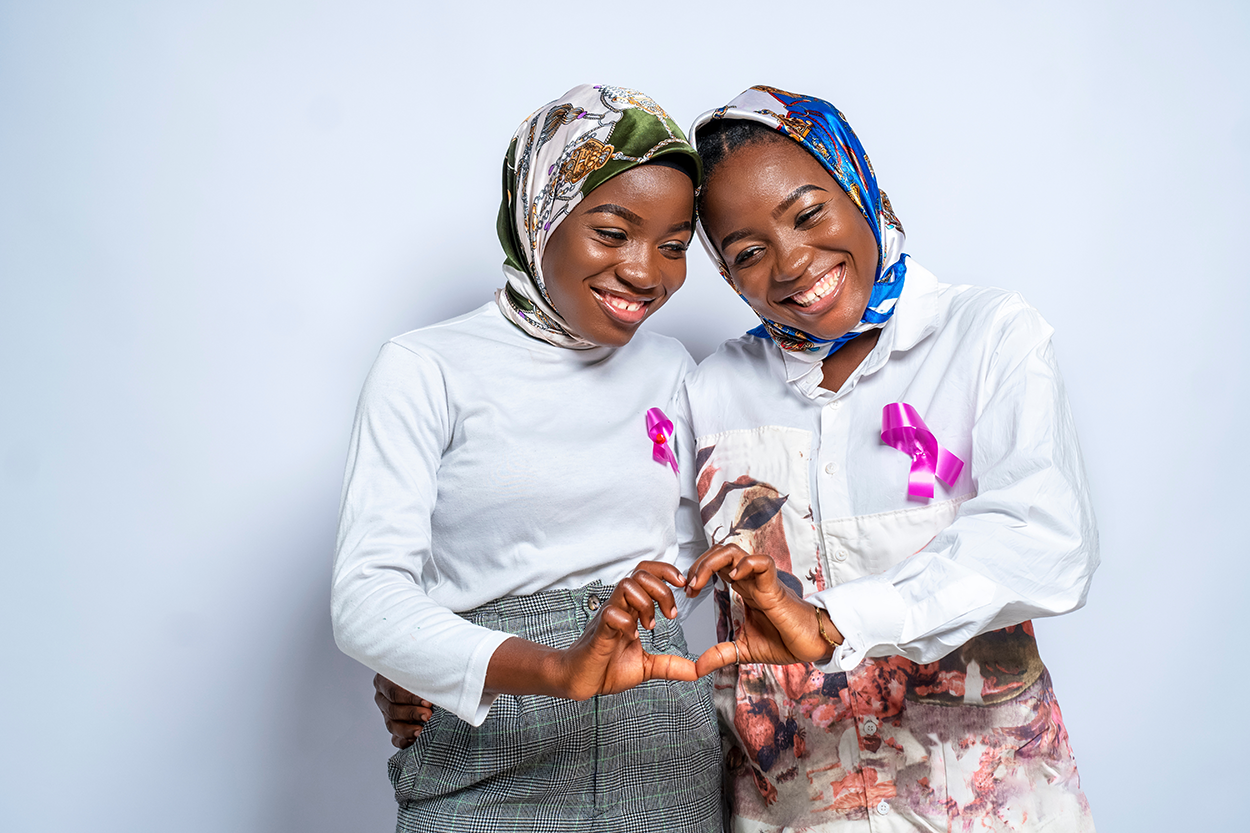
Now consider spoken language. If one identical twin speaks Spanish at home, the co-twin with whom she or he is raised almost certainly does too. But the same would be true for a pair of fraternal twins raised together. In terms of spoken language, fraternal twins are just as similar as identical twins, so it appears that the genetic match of identical twins does not make much difference.
IN CONTEXT
Twin studies and adoption studies are two instances of a much broader class of methods for observing nature-nurture called quantitative genetics—the scientific discipline in which similarities among individuals are analyzed based on how biologically related they are. We can do these studies with siblings and half-siblings, cousins, and twins who have been separated at birth and raised separately (Bouchard, Lykken, McGue, Segal, & Tellegen, 1990). Such twins are very rare and play a smaller role than is commonly believed in the science of nature–nurture (Plomin, DeFries, Knopik, & Neiderhiser, 2013).
It would be satisfying to be able to say that nature-nurture studies have given us conclusive and complete evidence about where traits come from, with some traits clearly resulting from genetics and others almost entirely from environmental factors, such as child-rearing practices and personal will; but that is not the case. Instead, everything has turned out to have some footing in genetics. The more genetically-related people are, the more similar they are - for everything: height, weight, intelligence, personality, mental illness, etc.
Source: THIS TUTORIAL HAS BEEN ADAPTED FROM LUMEN LEARNING'S LIFESPAN DEVELOPMENT. ACCESS FOR FREE AT https://courses.lumenlearning.com/wm-lifespandevelopment/. LICENSE: CREATIVE COMMONS ATTRIBUTION 4.0 INTERNATIONAL.
REFERENCES
Bortolus, R., Parazzini, F., Chatenoud, L., Benzi, G., Bianchi, M. M., & Marini, A. (1999). The epidemiology of multiple births. Human Reproduction Update, 5, 179-187.
Bouchard Jr, T. J., Lykken, D. T., McGue, M., Segal, N. L., & Tellegen, A. (1990). Sources of human psychological differences: The Minnesota study of twins reared apart. Science, 250(4978), 223-228.
Erikson, E. H. (1968). Identity: Youth and crisis. New York: Norton.
Fucic, A., Aghajanyan, A., Druzhinin, V., Minina, V., & Neronova, E. (2016). Follow-up studies on genome damage in children after Chernobyl nuclear power plant accident. Archives of toxicology, 90(9), 2147-2159.
Gottlieb, G. (1998). Normally occurring environmental and behavioral influences on gene activity: From central dogma to probabilistic epigenesis. Psychological Review, 105, 792-802.
Gottlieb, G. (2000). Environmental and behavioral influences on gene activity. Current Directions in Psychological Science, 9, 93-97.
Gottlieb, G. (2002). Individual development and evolution: The genesis of novel behavior. New York: Oxford University Press
McGue, M., & Lykken, D. T. (1992). Genetic influence on risk of divorce. Psychological Science, 3(6), 368-373.
Plomin, R., Corley, R., DeFries, J. C., & Fulker, D. W. (1990). Individual differences in television viewing in early childhood: Nature as well as nurture. Psychological Science, 1(6), 371-377.
Spitz, L., Kiely, E., & Pierro, A. (2018). Conjoined twins. In Rickham's Neonatal Surgery (pp. 457-474). Springer, London.
Newton, R. (2022, October 28). 2.2 genetics and Heredity. Human Growth and Development. Retrieved February 9, 2023, from pressbooks.pub/mccdevpsych/chapter/2-2-genetics-and-heredity/
Lazzara, J. (2020, June 26). Genetics and prenatal development. Lifespan Development. Retrieved February 9, 2023, from open.maricopa.edu/devpsych/chapter/chapter-2-genetics-and-prenatal-development/



