In the previous lesson, you learned about the four steps of the problem-solving process.
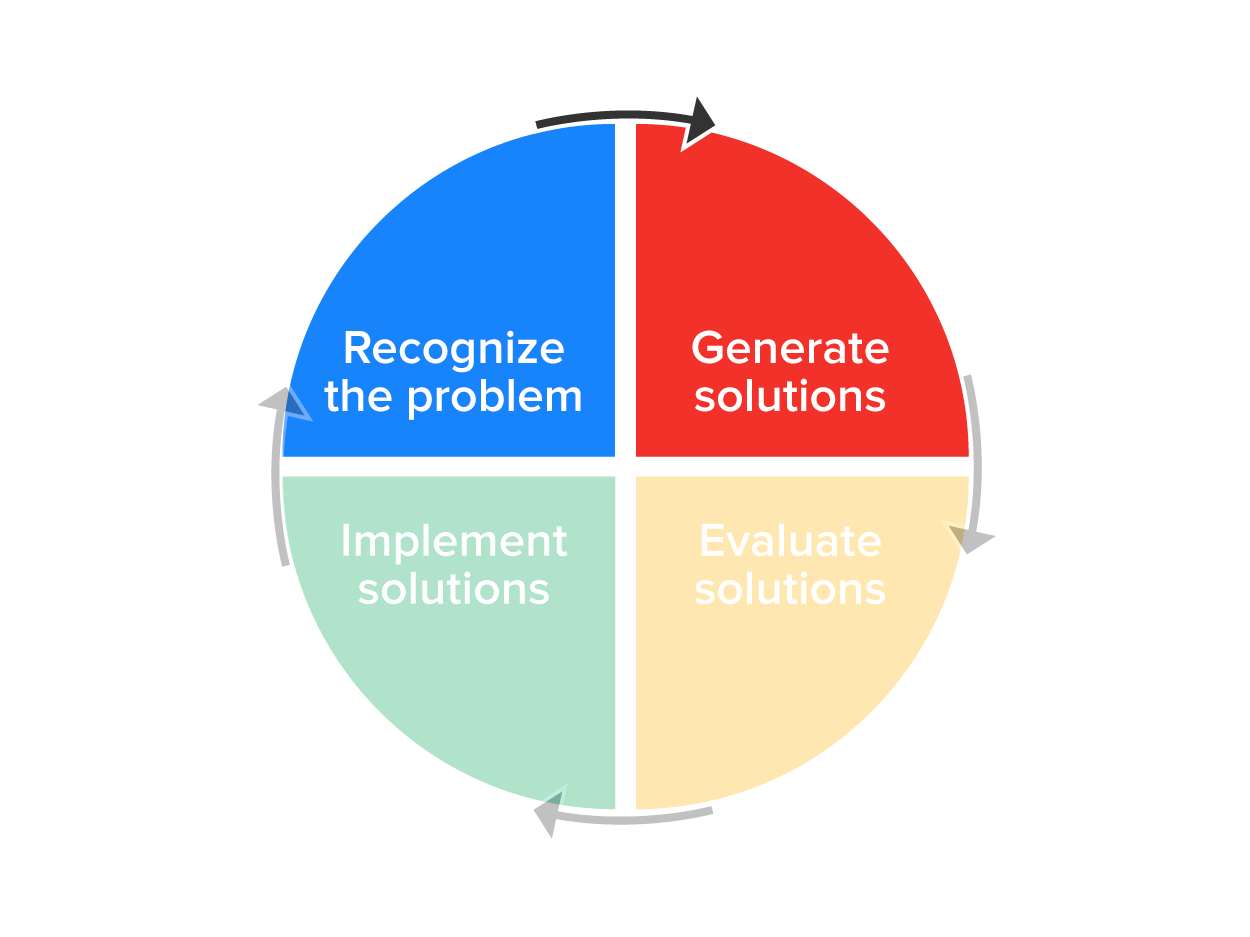
Once you recognize you have a problem, it is time to start thinking about potential solutions. This second step of the process is all about brainstorming to come up with as many potential solutions as possible. During this stage, it is important that you use your self- and social awareness skill to avoid shutting down valid ideas prematurely.
When it comes to generating solutions, there are things you want to do and things you want to avoid. Paying attention to both is equally important to ensure you work toward the best possible solutions.
There are many ways you can brainstorm and come up with ideas. One acronym that can help you in this process is DOVE:
Defer judgment: List any and all ideas. Write everything down.
Offbeat or original: Try to come up with out-of-the-box ideas and solutions.
Vast number: List as many ideas as possible.
Expand or elaborate: Be more specific about each item listed, but do not evaluate any ideas at this stage.
You want to keep these key points in mind whether you are working on a problem yourself or as part of a group. It is also useful for both personal and professional problems.

EXAMPLE
Cara was tasked with finding a way to cut $500 from the budget for her company's annual holiday party. She immediately thought she could just change the type of food she was ordering, but then she remembered her supervisor was particular about the menu. She asked two of her colleagues to meet her to discuss potential solutions. They met in the conference room and used the whiteboard to capture their thoughts. They set a time limit of 15 minutes to share as many ideas as they could. They ended up with a list of 15 options. They spent the next 30 minutes adding details to make sure each idea was clear to everyone. At the end of the 45 minutes they had enough detail to move to step three of the problem-solving process - Evaluation.DOVE is just one example of how you can approach brainstorming. You can find more ideas if you search “brainstorming techniques” on the Internet. The main goal is the same in all cases: to generate as much as you can without judging or thinking too much about what it would look like once put into practice. Be creative and make sure you use some method so you have a visual of everything you come up with.
No matter which technique you use, there are some general rules you want to keep in mind as you work:
Groupthink is a theory that was developed by social psychologist Irving Janis in 1972 and it states that groups with members who are overly concerned with conformity have poor judgment when it comes to decisions made by that group. In other words, the group makes faulty decisions because the members are so intent on reaching a consensus that they don’t voice their doubts or dissenting opinions (Janis, 1972). When it comes to groupthink situations, people go along with the group’s decision even when they don’t agree.
The problem with groupthink is that the decisions made under those circumstances ignore important information and are—at the very least—less than ideal. For example, consider a jury panel that has people from the same backgrounds. If that jury panel is sequestered for a murder trial and there is a great deal of pressure within the group to reach a unanimous verdict soon so that everyone can go home, then groupthink is more likely to occur. The consequences of groupthink in that situation are serious for the person who is on trial because the decision that is being made is not likely to be based on rational judgment.
Having diversity in group settings reduces the likelihood of groupthink happening. That is because the group members with different backgrounds and beliefs can bring unique and creative ideas that will benefit the decision-making process of the group.
REFERENCES
Janis, I. L. (1972). Victims of groupthink: A psychological study of foreign-policy decisions and fiascos. Houghton Mifflin.



