Table of Contents |
If you recall, the key idea about gains from trade is that trade allows countries to enjoy more of both goods being traded and allows them to move beyond their previous resource and productivity constraints.
Both goods can be produced at the lowest opportunity cost, which is the sacrifice made by choosing one value over another, or the value of the foregone opportunity.
We decide who produces what based on comparative advantage, which deals with this concept of opportunity cost, or what we give up.
EXAMPLE
Whenever the United States decides to devote resources like land, labor, and capital to produce textiles, we give up the opportunity to use those resources to produce something else, such as cars. Therefore, what is given up is our opportunity cost.Comparative advantage, then, is essentially the advantage conferred to a country because of one good’s production relative to another.
When countries specialize in the goods or services for which they have the lower opportunity cost—meaning they enjoy a comparative advantage—then both countries benefit.
EXAMPLE
If the United States decided to devote its resources to producing textiles instead of cars, we would give up a lot more in terms of cars than Mexico would, considering the technology and the skill level of our workforce compared to that of Mexico. In this case, Mexico would enjoy the comparative advantage in textiles because it does not give up as much when it devotes its resources to textile production. The United States, then, would enjoy the comparative advantage in cars.Theoretically, free trade benefits all countries. However, not everyone agrees.
There are a variety of arguments that have been presented in the media for trade barriers (which we will cover in another section), such as the following:
Remember, the basis for free trade is that both nations benefit when specializing in whatever they enjoy the comparative advantage in.
For instance, in our previous example, we decided that the United States should produce cars because it gives up fewer textiles when it does that and Mexico should produce textiles because it gives up fewer cars.
However, the advantages and gains from trade were calculated based on scenarios assuming the full employment of resources in both nations.
Full employment is defined being as equal to the point at which an economy exhibits a natural rate of unemployment, usually around 5%. It occurs when the economy is at its long-run supply capacity.
A production possibility frontier (PPF) shows the maximum combination of two goods that can be produced when an economy’s resources are being utilized.
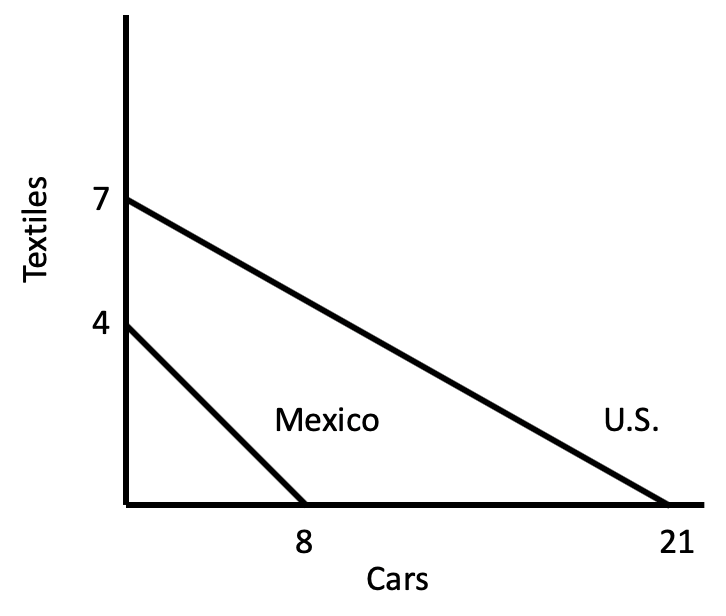 alt=The line graph illustrates the production possibility frontier or PPF for the maximum
combination of cars and textiles that can be produced in Mexico and the United States if they use all
their resources. The x-axis represents the number of cars that can be produced, and the y-axis
represents the number of textile items that can be produced. The PPF curve for Mexico indicates
that it can produce a maximum combination of 4 textile items and 8 cars. The PPF curve for the
United States indicates that it can produce a maximum combination of 7 textile items and 21 cars.]
alt=The line graph illustrates the production possibility frontier or PPF for the maximum
combination of cars and textiles that can be produced in Mexico and the United States if they use all
their resources. The x-axis represents the number of cars that can be produced, and the y-axis
represents the number of textile items that can be produced. The PPF curve for Mexico indicates
that it can produce a maximum combination of 4 textile items and 8 cars. The PPF curve for the
United States indicates that it can produce a maximum combination of 7 textile items and 21 cars.]
The x-intercept shows how many cars can be produced when all resources are devoted to car production. In this case, it is 21 for the United States or 8 for Mexico.
The y-intercept shows how many textiles can be produced with a specialization in textiles—again, seven million in the case of the United States or four million in the case of Mexico.
This PPF, then, shows a trade-off. It shows how many of one good we have to give up when we want one more of the other good.
EXAMPLE
For every one textile that the United States decides to produce, it gives up the ability to produce three cars. Why does it give up three cars? Because we are assuming that resources are fully utilized and fully employed, so if it wants to produce one more textile, it will need to take resources out of cars and put them into textiles.However, what if the United States were in a recession? This would be represented by a production level somewhere inside the curve where it is not actually producing a maximum combination.
This means that some resources are unemployed and the economy is operating at less than its capacity.
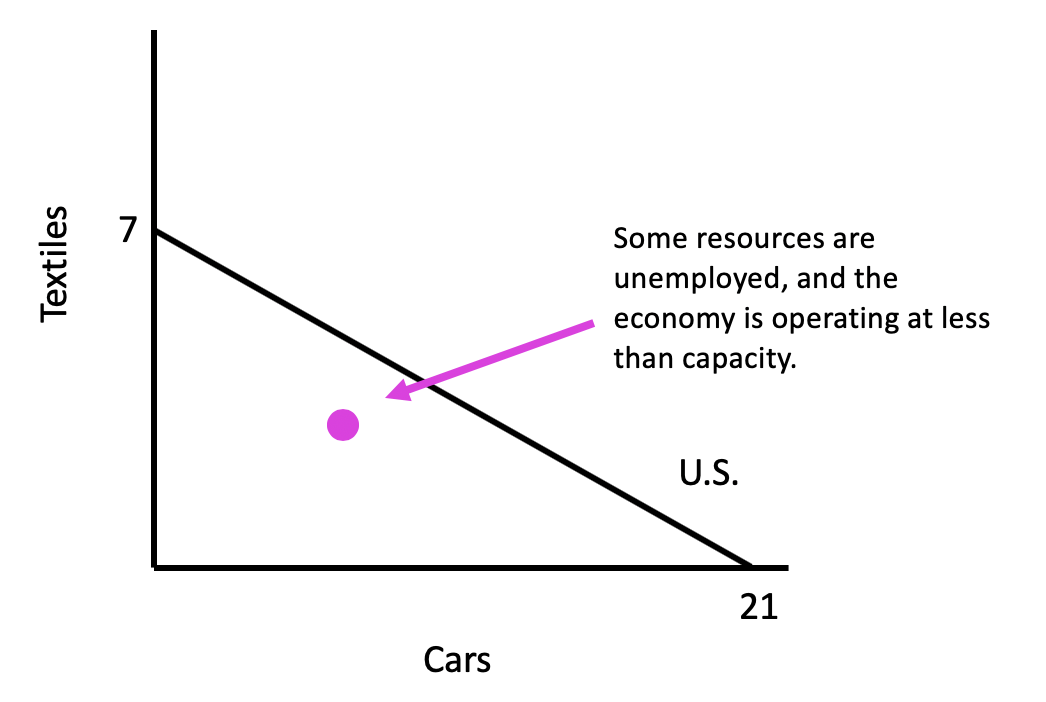
So, if the United States switched from focusing all resources on the production of cars back to the production of textiles, it could utilize currently unemployed workers and other resources.
In a way, then, it would not have to give anything up; there is no opportunity cost. This particular trade-off situation is void because, with unemployment, we do not have to give anything up to produce textiles. There are people who want jobs and do not currently have them.
In this case, producing textiles domestically could actually raise the United States’ GDP now.
Remember, unemployment is measured as the percentage rate of the number of individuals that would like to work and are an active part of the labor force to the number of individuals that comprise the active labor force.
So, if we have people who are unemployed, are not being utilized, and want to work, we can employ them if we start producing textiles.
Since the idea of comparative advantage no longer applies, this situation presents an argument for a nation to set up trade barriers, which we will cover next.
Trade barriers focus on protecting a domestic industry from competition. They are defined as the barriers to free-market pricing set in place to confer an advantage to a country.
EXAMPLE
Taxes and subsidies count as trade barriers.| Trade Barrier | Purpose |
|---|---|
| Taxes | Placed on imported textiles to make them more expensive, enticing people to buy domestically |
| Subsidies | Provide domestic producers with payments to give them an advantage over foreign competition |
| Quotas | Restrict the amount of foreign textile imports allowed (i.e., implement a quantity ceiling) or the maximum amount allowed to be imported |
Are trade barriers good or bad? Well, there is much disagreement on the topic, but most people can agree that when an economy is fully employed, trade barriers are unnecessary and counterproductive. In keeping with the theories of comparative advantage and gains from trade, note the following:
Critics, though, point out that trade barriers still have some issues.
Source: Adapted from Sophia instructor Kate Eskra.



