We’ve described leaders as “people-oriented” and managers as “task-oriented.” Another way to consider leadership is relationship-oriented. In this tutorial, we explore how to apply interpersonal theories to the workplace to build stronger professional relationships. Specifically, this tutorial will cover:
Leaders are expected to cultivate strong, collaborative teams, so understanding how relationships are built is essential. In this tutorial, we will consider three theoretical models to better understand how relationships are built over time.
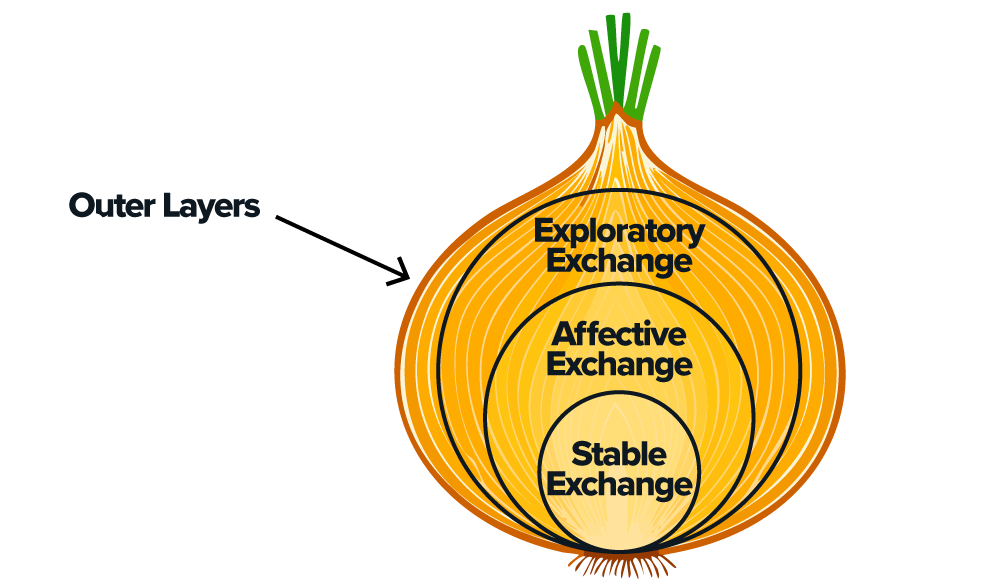
The first is Social Penetration Theory, developed by psychologists Irwin Altman and Dalmas Taylor in 1973, which describes how relationships deepen over time through the exchange of information, from surface-level details to more personal thoughts and feelings. This is also called “onion theory” as a metaphor for how relationships deepen over time. Just as you peel back the layers of an onion, relationships expose new layers as they develop, moving from superficial details on the outer layer to more personal thoughts and feelings in the inner core. For a leader, this theory is a tool for intentionally building rapport and trust, moving beyond surface-level interactions to create meaningful connections with their team.
reflect
Consider your spouse, partner, or a close friend. Think of the key moments when your relationship deepened or your bond became stronger. You will probably remember times when you learned or revealed more about yourself, perhaps things like past trauma that you usually don’t talk about. Social Penetration Theory suggests that this self-disclosure is crucial to building a bond.
term to know
Social Penetration Theory
A theory that describes how relationships deepen over time through the exchange of information, from surface-level details to more personal thoughts and feelings.
1a. Layers of Personality
Altman and Taylor emphasized that personality can be visualized as concentric layers.
Outer layers include surface information such as demographics, routine habits, or casual opinions.
Intermediate layers reflect social attitudes, political beliefs, goals, or emotions that shape someone’s perspective.
Core layers contain deeply held values, self-concept, and private fears or vulnerabilities.
Peeling inward involves increasing intimacy; remaining at the surface reflects limited connection.
1b. Breadth and Depth
Altman and Taylor described these layers in terms of breadth and depth; here, the onion metaphor doesn’t fully work because intimacy is not just about depth, but the breadth of shared information and disclosure.
Breadth is the number of topics covered. For example, coworkers may talk about sports, food, and weekend activities without revealing anything highly personal. Over time, they will know more about one another, such as their hobbies outside of work, places they’ve lived, and the names of their children and pets. This is still superficial information, but the sheer breadth of knowledge about someone suggests a more meaningful relationship.
Depth is the degree of closeness. Moving from “I like baseball” to “My father taught me to play before he passed away” illustrates increasing depth.
There are cases where you might have depth of knowledge without breadth of knowledge, such as other people in a support group. Real relationships expand when both breadth and depth increase.
1c. Stages of Relational Development
Altman and Taylor proposed a series of stages that typically unfold:
Orientation: superficial small talk; cautious and rule-governed.
Exploratory affective exchange: broader topics, casual emotions, and opinions begin to appear.
Affective exchange: more personal matters are discussed; relational comfort allows humor, affection, and even conflict.
Stable exchange: rare but possible, this stage involves complete openness and spontaneity, where both partners can anticipate each other’s reactions.
EXAMPLE
When a new analyst joins the team, she starts with polite, surface-level conversations about the job and office norms (orientation). As weeks pass, she and a colleague share light opinions about work styles and weekend plans (exploratory affective exchange). Later, they confide frustrations and encourage one another through challenges (affective exchange).
think about it
Imagine you have been at a job for a while, and a new employee immediately expresses their frustrations or other affective exchanges. You would probably be uncomfortable, even if you agree, because the person is breaching social norms.
terms to know
Orientation
Initial stage of a relationship with superficial small talk; cautious and rule-governed.
Exploratory Affective Exchange
People explore broader topics, casual emotions, and opinions begin to appear.
Affective Exchange
The stage where more personal matters are discussed; relational comfort allows humor, affection, and even conflict.
Stable Exchange
This stage involves complete openness and spontaneity, where both partners can anticipate each other’s reactions. Rarely appropriate to workplace relationships.
1d. Reciprocity and Risk
Disclosure is generally reciprocal; people tend to match one another’s level of openness. Early on, this reciprocity builds trust and sets the pace for further exchange. But disclosure carries risks: if someone reveals too much too quickly, without equivalent return, it can create discomfort or leave the person vulnerable. Cultural expectations, role boundaries, and situational norms influence how disclosure unfolds and when deeper layers are appropriate.
IN CONTEXT: Peeling Back the Layers
Imagine you are a new team leader tasked with building collaboration. Social Penetration Theory suggests that trust develops through gradual self-disclosure.
Outer Layers: Early on, you share light personal details like weekend activities and hobbies, showing approachability and encouraging reciprocity.
Exploratory Exchange: As trust grows, you reveal your work values and leadership philosophy, anchoring the team in a shared narrative.
Affective Exchange: Later, you may disclose challenges or past mistakes, balancing vulnerability with professionalism and inviting openness in return.
Stable Exchange: While full transparency is rarely appropriate at work, deep trust allows colleagues to be candid, admit errors, and process crises together without fear.
As trust is established over time, the need for immediate reciprocity may lessen, as both parties feel secure that the other will be there for them. If a colleague shares that their family struggled financially when they were a child, you’re less likely to respond (especially if you had a comfortable childhood). For a leader, this means you can’t rush the process. Remember, building relationships is a marathon, not a sprint.
term to know
Reciprocal/Reciprocity
In interpersonal relationship, the ideas that disclosure comes as a series of equal exchanges.
2. Uncertainty Reduction Theory (URT)
Another key interpersonal communication theory that's essential for leaders is Uncertainty Reduction Theory. Developed by Charles Berger and Richard Calabrese, this theory explains how we use communication to reduce the feelings of anxiety and discomfort we experience when we encounter people we don't know. The core idea is simple: we are motivated to reduce this uncertainty, and we do so by asking questions and seeking out information. This process is crucial in the workplace, especially when new team members join or when a team is navigating change.
reflect
Think about the last time you started a new job or joined a new team. You probably had dozens of questions: What's my boss like? What are the unwritten rules here? How do my coworkers handle conflict? All these questions stem from a natural desire to reduce uncertainty. As a leader, you are in a powerful position to either increase or decrease this uncertainty for your team. When you are transparent and approachable, you help team members quickly feel comfortable and secure.
People reduce uncertainty by observing, asking questions, and being prompted to ask questions.
While you can read the employee manual or watch orientation videos, it is harder to get a sense of all the unwritten social rules of a workplace. URT categorizes the less formalized part of uncertainty reduction in three ways:
Passive information seeking is watching how people interact and behave in a group. This will give you a sense of the social dynamic, whether it is a place where communication is more formal or informal.
Active information seeking involves trying to get information from someone other than the person you are interested in.
Interactive information seeking is a direct conversation, which is often the most effective way to reduce uncertainty. This is where a leader's communication skills become key.
Successful leaders understand that uncertainty is a major source of stress for their teams. When people are unsure about their roles, expectations, or the stability of the organization, their performance and morale can suffer.
You can help new staff members move from uncertainty to confidence by ensuring they have opportunities for all three of the strategies for reducing uncertainty.
Support passive information seeking by inviting them to lunch or another casual outing, where they can observe staff interactions, or inviting them to meetings in which they don’t have an immediate role, allowing them to better understand both the logistics and the culture of the company.
Support active information seeking by inviting someone to be their guide; not necessarily a “mentor” in the professional sense, but somebody who is generally available to field questions ranging from “Where is the gym?” to “What happens if I’m late with the time report?”
Support interactive information-seeking: Finally, you can use scheduled one-on-one time to invite questions that aren’t directly related to job tasks and performance.
In times of great organizational uncertainty, like a merger or a shift in company strategy, a leader's transparency is more important than ever. By communicating openly about the reasons for the changes, what to expect, and how the team will be supported, you lower anxiety and build trust. This isn't about having all the answers but about being honest about what you know and don't know. When you model this kind of open communication, you empower your team to ask questions and seek clarification, creating a culture of trust and psychological safety.
terms to know
Uncertainty Reduction Theory
A relationship theory focused on how people reduce anxiety as they get to know new people.
Passive Information Seeking
Reducing uncertainty through observation.
Active Information Seeking
Reducing Uncertainty by asking questions.
Interactive Information Seeking
Reducing uncertainty in a more intentional format where you are prompted to ask questions.
3. Interdependence Theory
A third core concept about building relationships is Interdependence Theory, developed by Harold Kelley and John Thibaut in the 1950s. It examines how people evaluate their interactions through patterns of mutual dependence, where each person’s actions and choices affect the other’s outcomes. While a leader can apply strategies of disclosure or uncertainty reduction, Interdependence Theory acknowledges that success also depends on variables outside the leader’s control—such as the other person’s level of commitment, expectations, and perception of alternatives. This perspective underscores that building strong relationships is not a one-sided effort, but an ongoing negotiation shaped by both parties. It also reminds leaders that they can only do so much and should let followers dictate the depth of their relationship to colleagues.
IN CONTEXT
Maria, a manager, invests time in building a rapport with two new team members. Jordan responds warmly, sharing career goals and personal challenges, and over time, their relationship grows into trust and mutual support. Alex, however, remains distant despite Maria’s consistent efforts. When Maria asks more directly about Alex’s needs, she learns that cultural differences and job insecurity make him hesitant to grow close. Maria assures Alex that he is well-liked by his colleagues and that he is part of their long-range plans, but she also accepts that her relationship with him may remain formal and distant.
term to know
Interdependence Theory
A theory of social relationships that focuses on patterns of mutual dependence.
summary
In this tutorial, we examined three theories of interpersonal relationships that can be helpful to leaders in building effective teams. Together, these three theories offer managers practical insight into how workplace relationships form and evolve. Social Penetration Theory highlights that people have layers of personality. It takes time for people to grow comfortable revealing the breadth and depth of their interests and experiences. Leaders can approach the stages of relational development with intentionality, respecting that relationships are built on reciprocity and risk.
Uncertainty Reduction Theory is geared more towards the beginning of relationships, reminding leaders to reduce ambiguity early on by being clear, consistent, and approachable, and ensuring that new staff have a chance to observe and to obtain information about the workplace culture indirectly and directly.
Interdependence Theory underscores that even with a good strategy, relationship outcomes depend on the other person’s commitment and expectations.
All three theories emphasize that relationships are built step by step and that success requires both intentional effort and respect for the other person’s level of engagement.
Source: THIS TUTORIAL WAS AUTHORED BY SOPHIA LEARNING. PLEASE SEE OUR TERMS OF USE.
References:
Altman, I., & Taylor, D. A. (1973). Social penetration: The development of interpersonal relationships. Holt, Rinehart & Winston.
Berger, C. R., & Calabrese, R. J. (1975). Some explorations in initial interaction and beyond: Toward a developmental theory of interpersonal communication. Human Communication Research,1(2), 99–112. doi.org/10.1111/j.1468-2958.1975.tb00258.x
Kelley, H. H., & Thibaut, J. W. (1978). Interpersonal relations: A theory of interdependence. Wiley.
Terms to Know
Active Information Seeking
Reducing Uncertainty by asking questions.
Affective Exchange
The stage where more personal matters are discussed; relational comfort allows humor, affection, and even conflict.
Exploratory Affective Exchange
People explore broader topics, casual emotions, and opinions begin to appear.
Interactive Information Seeking
Reducing uncertainty in a more intentional format where you are prompted to ask questions.
Interdependence Theory
A theory of social relationships that focuses on patterns of mutual dependence.
Orientation
Initial stage of a relationship with superficial small talk; cautious and rule-governed.
Passive Information Seeking
Reducing uncertainty through observation.
Reciprocal/Reciprocity
In interpersonal relationship, the ideas that disclosure comes as a series of equal exchanges.
Social Penetration Theory
A theory that describes how relationships deepen over time through the exchange of information, from surface-level details to more personal thoughts and feelings.
Stable Exchange
This stage involves complete openness and spontaneity, where both partners can anticipate each other’s reactions. Rarely appropriate to workplace relationships.
Uncertainty Reduction Theory
A relationship theory focused on how people reduce anxiety as they get to know new people.