Use Sophia to knock out your gen-ed requirements quickly and affordably. Learn more
×

Forecasting the Income Statement

Author: Sophia

what's covered
In this lesson, you will learn how to forecast a company’s income statement by projecting future revenues and expenses. You’ll explore how each section of a pro forma income statement is developed and used to estimate profitability. Specifically, this lesson will cover:

Table of Contents

1. Pro Forma Income Statement

Forecasting begins with developing a pro forma income statement. Creating a pro forma income statement involves projecting a company’s income and expenses over a future period, typically for budgeting, planning, or investment purposes. They also support strategic decision making by allowing businesses to evaluate the potential financial impact of initiatives such as launching new products or expanding into new markets.

hint
Pro forma, Latin for “as a matter of form,” is a method of calculating financial results using projections or presumptions.

EXAMPLE

Let’s use Leyla, the owner of a cafe, to illustrate this. Below, you will find Leyla’s income statement from the previous year.
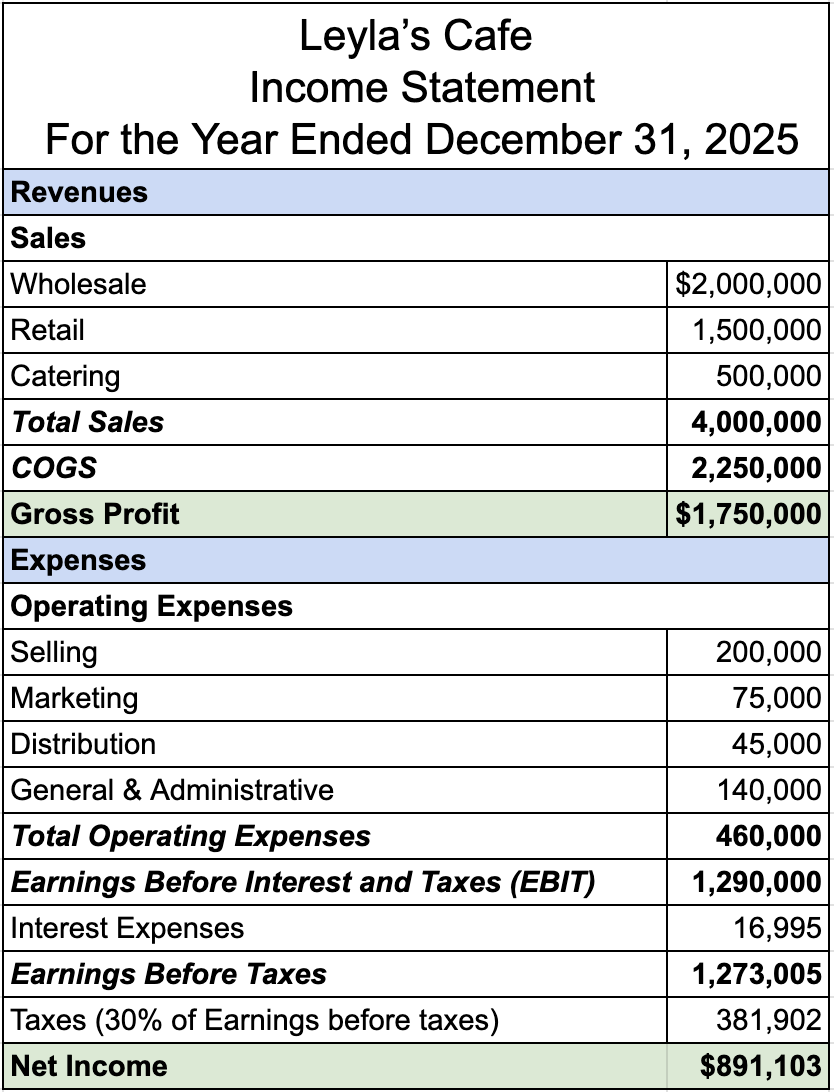
A financial statement of a company titled ‘Leyla’s Cafe, Income Statement, For the Year Ended December 31, 2025’. Under Revenues, Sales includes Wholesale that equals $2,000,000; Retail that equals 1,500,000; and Catering that equals 500,000. Total Sales equals 4,000,000. Cost of Goods Sold (COGS) equals 2,250,000. Gross Profit equals $1,750,000. Under Expenses, Operating Expenses include Selling that equals 200,000; Marketing that equals 75,000; Distribution that equals 45,000; and General and Administrative that equal 140,000. Total Operating Expenses equal 460,000. Earnings Before Interest and Taxes (EBIT) equals 1,290,000. Interest Expenses equal 16,995. Earnings Before Taxes equal 1,273,005. Taxes (30% of Earnings Before Taxes) equal 381,902. Net Income equals $891,103.
  View this spreadsheet in Google Docs

term to know
Pro Forma Income Statement
A financial statement of a company’s estimate of how it plans to convert its revenue into net income.

1a. Revenue Forecast

The starting point for a pro forma income statement is the sales/revenue forecast. Historical data is used as a base and adjusted for expected growth, seasonality, or market changes.

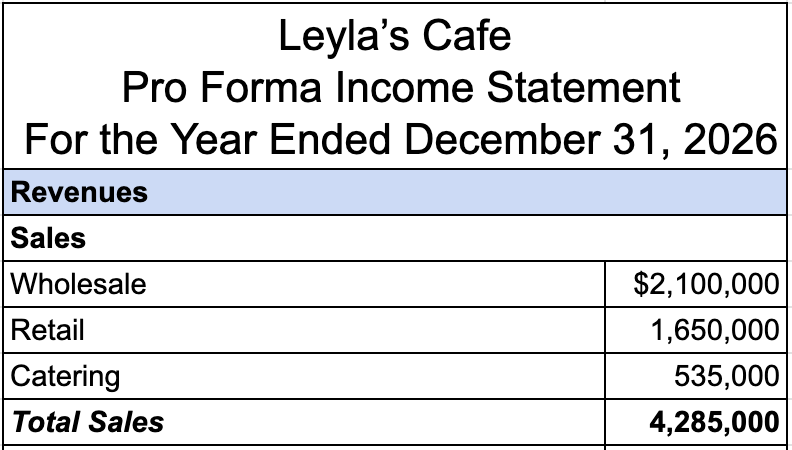
Leyla’s business is growing, and she predicts her wholesale sales will increase by 5%, her retail sales will increase by 10%, and her catering sales will increase by 7%.

Using last year’s totals, Leyla calculates the following:

Predicted space Wholesale space Sales equals Last space Year ’ straight s space Wholesale space Sales cross times 1.05 space left parenthesis last space year ’ straight s space revenue plus 5 percent sign space increase right parenthesis
Predicted space Wholesale space Sales equals $ 2 comma 000 comma 000 cross times 1.05 equals $ 2 comma 100 comma 000

Predicted space Retail space Sales equals Last space Year ’ straight s space Retail space Sales cross times 1.1 space left parenthesis last space year ’ straight s space revenue plus 10 percent sign space increase right parenthesis
Predicted space Retail space Sales equals $ 1 comma 500 comma 000 cross times 1.1 equals $ 1 comma 650 comma 000

Predicted space Catering space Sales equals Last space Year ’ straight s space Catering space Sales cross times 1.07 space left parenthesis last space year ’ straight s space revenue plus 7 percent sign space increase right parenthesis
Predicted space Catering space Sales equals $ 500 comma 000 cross times 1.07 equals $ 535 comma 000

Predicted space Total space Sales equals Predicted space Wholesale space Sales plus Predicted space Retail space Sales plus Predicted space Catering space Sales
Predicted space Total space Sales equals $ 2 comma 100 comma 000 plus $ 1 comma 650 comma 000 plus $ 535 comma 000 equals $ 4 comma 285 comma 000

hint
Total revenue is the sum of the forms of all of Leyla’s revenue streams.

1b. Cost of Goods Sold

The next item to be forecast is the cost of goods sold, or COGS. This is the inventory cost of the goods that a business has sold. It includes all costs to purchase and convert inventory to sell. If a business sells physical goods, other costs like freight, labor, and allocated overhead may be incurred.

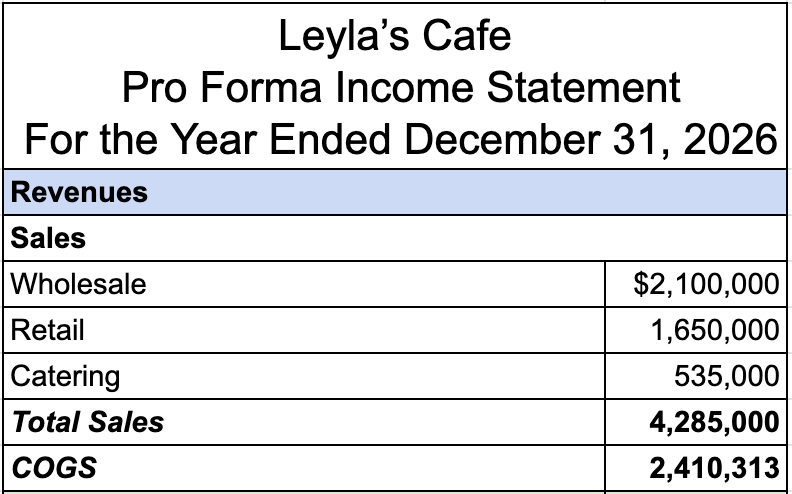
Last year, Leyla’s cost of goods sold was $2,250,000 and was 56.25% of her total sales. If she applies the same percentage to her predicted sales, she can forecast her cost of goods sold for next year.

Predicted space COGS equals Predicted space Total space Sales cross times Cost space of space Goods space Sold space percent sign space from space prior space year
Predicted space COGS equals $ 4 comma 285 comma 000 cross times 0.5625 equals $ 2 comma 410 comma 313 space left parenthesis rounded space to space the space nearest space dollar right parenthesis space

1c. Gross Margin

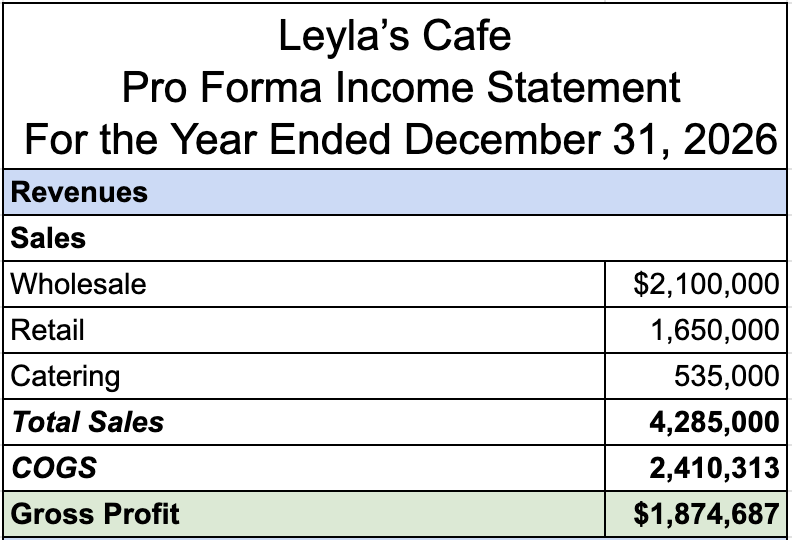
Once the cost of goods sold is calculated, Leyla can calculate her gross margin. Gross margin represents what is left of the revenues after all costs of goods have been subtracted. To determine gross profit, subtract cost of goods sold from total sales.

Predicted space Gross space Profit equals Predicted space Sales – Predicted space Cost space of space Goods space Sold space space space
Predicted space Gross space Profit equals $ 4 comma 285 comma 000 – $ 2 comma 410 comma 313 equals $ 1 comma 874 comma 687

1d. Operating Expenses

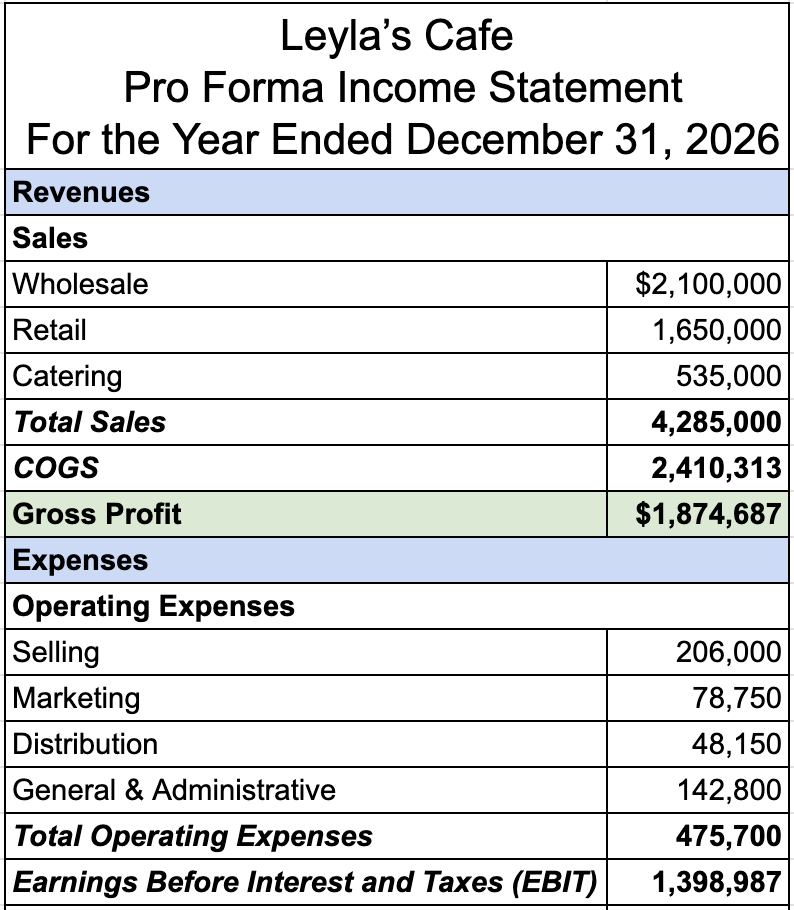
Next, an estimate must be made for operating expenses. Depreciation and amortization on fixed assets should also be deducted, along with research and development costs. Leyla’s cafe does not have any depreciation or amortization, but she does have expenses for selling, marketing, distribution, and general and administrative items.

Leyla expects the following increases in expenses:

  • Selling expenses to increase by 3%
  • Marketing expenses to increase by 5%
  • Distribution expenses to increase by 7%
  • General and administrative expenses to increase by 2%
Predicted space Selling space Expenses equals Prior space Selling space Expenses cross times 1.03
Predicted space Selling space Expenses equals $ 200 comma 000 cross times 1.03 equals $ 206 comma 000

Predicted space Marketing space Expenses equals Prior space Marketing space Expenses cross times 1.05
Predicted space Marketing space Expenses equals $ 75 comma 000 cross times 1.05 equals $ 78 comma 750

Predicted space Distribution space Expenses equals Prior space Distribution space Expenses cross times 1.07
Predicted space Distribution space Expenses equals $ 45 comma 000 cross times 1.07 equals $ 48 comma 150

Predicted space General space and space Administrative space Expenses equals Prior space straight G & straight A space Expenses cross times 1.02
Predicted space General space and space Administrative space Expenses equals $ 140 comma 000 cross times 1.02 equals $ 142 comma 800

Total space Predicted space Operating space Expenses equals Predicted space Selling space Expenses plus Predicted space Marketing space Expenses
plus Predicted space Distribution space Expenses plus Predicted space General space and space Administrative space Expenses
Total space Predicted space Operating space Expenses equals $ 206 comma 000 plus $ 78 comma 750 plus $ 48 comma 150 plus $ 142 comma 800 equals $ 475 comma 700

After deducting the operating expenses from the gross margin, Leyla is left with her earnings before interest and taxes (EBIT).

Recall that EBIT is equal to gross profit minus total operating expenses:

EBIT equals Gross space Profit minus Total space Operating space Expenses space space space
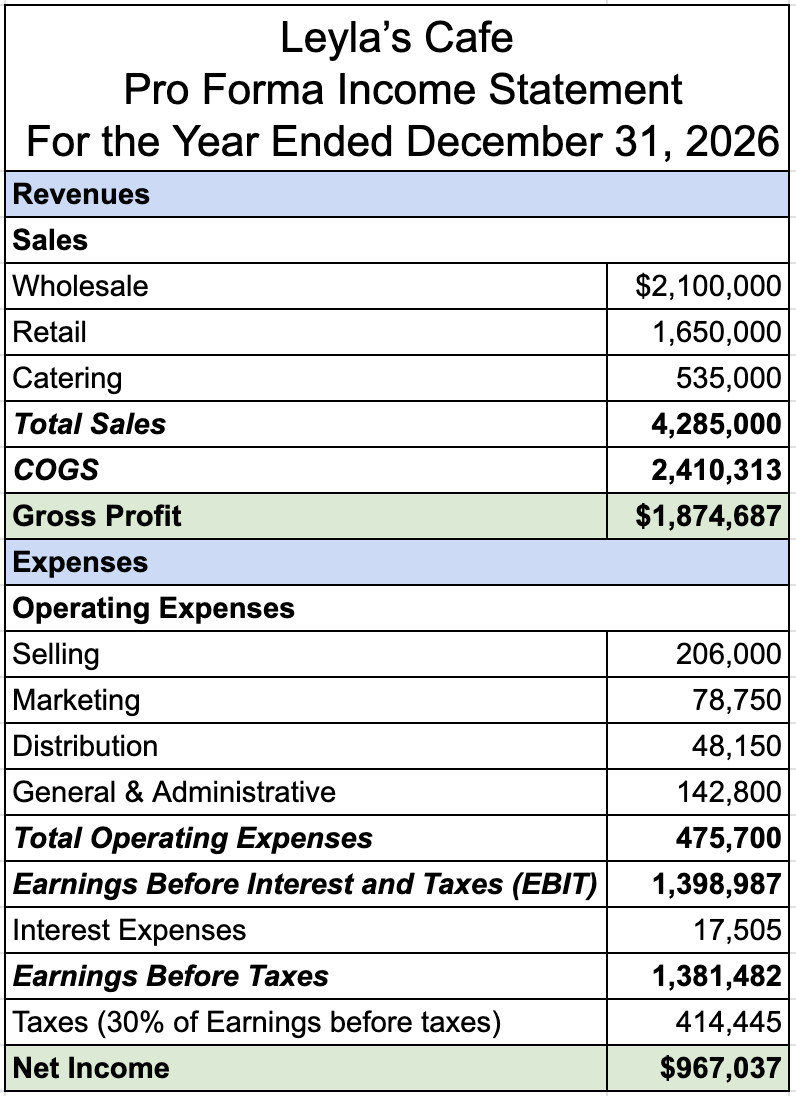
Predicted space EBIT equals $ 1 comma 874 comma 687 minus $ 475 comma 700 equals $ 1 comma 398 comma 987

1e. Interest and Taxes

Finally, Leyla will deduct projected interest, taxes, and any other irregular items. Leyla expects her interest expense to increase by 3%. She then calculates her earnings before taxes. Leyla’s total tax obligation equals 30% of her earnings before taxes. After subtracting her tax obligation from earnings before taxes, she can calculate her projected net income.


Predicted space Interest space Expenses equals Prior space Interest space Expenses cross times 1.03
Predicted space Interest space Expenses equals $ 16 comma 995 cross times 1.03 equals $ 17 comma 505 space

Predicted space Earnings space Before space Taxes equals Predicted space EBIT minus Predicted space Interest space Expense
Predicted space Earnings space Before space Taxes equals $ 1 comma 398 comma 987 minus $ 17 comma 505 equals $ 1 comma 381 comma 482 space

Predicted space Tax space Obligation equals Predicted space Earnings space Before space Taxes cross times 0.30
Predicted space Tax space Obligation equals $ 1 comma 381 comma 482 cross times 0.30 equals $ 414 comma 445 space

Predicted space Net space Income equals Predicted space Earnings space Before space Taxes minus Predicted space Tax space Obligation
Predicted space Net space Income equals $ 1 comma 381 comma 482 minus $ 414 comma 445 equals $ 967 comma 037 space

By completing the pro forma income statement, Leyla can predict that her net income for the next year will be approximately $967,037.
hint
Net income is total revenue less all costs, expenses, and taxes.

big idea
Each item that is part of the pro forma income statement forecast is largely determined by a ratio or comparison to the sales forecast that started the process. Each expense item is projected to be the same percentage of sales as it was in the previous period. When finalizing the forecast income statement, these expense items are adjusted for managerial forecast changes in the external environment and the market.

try it
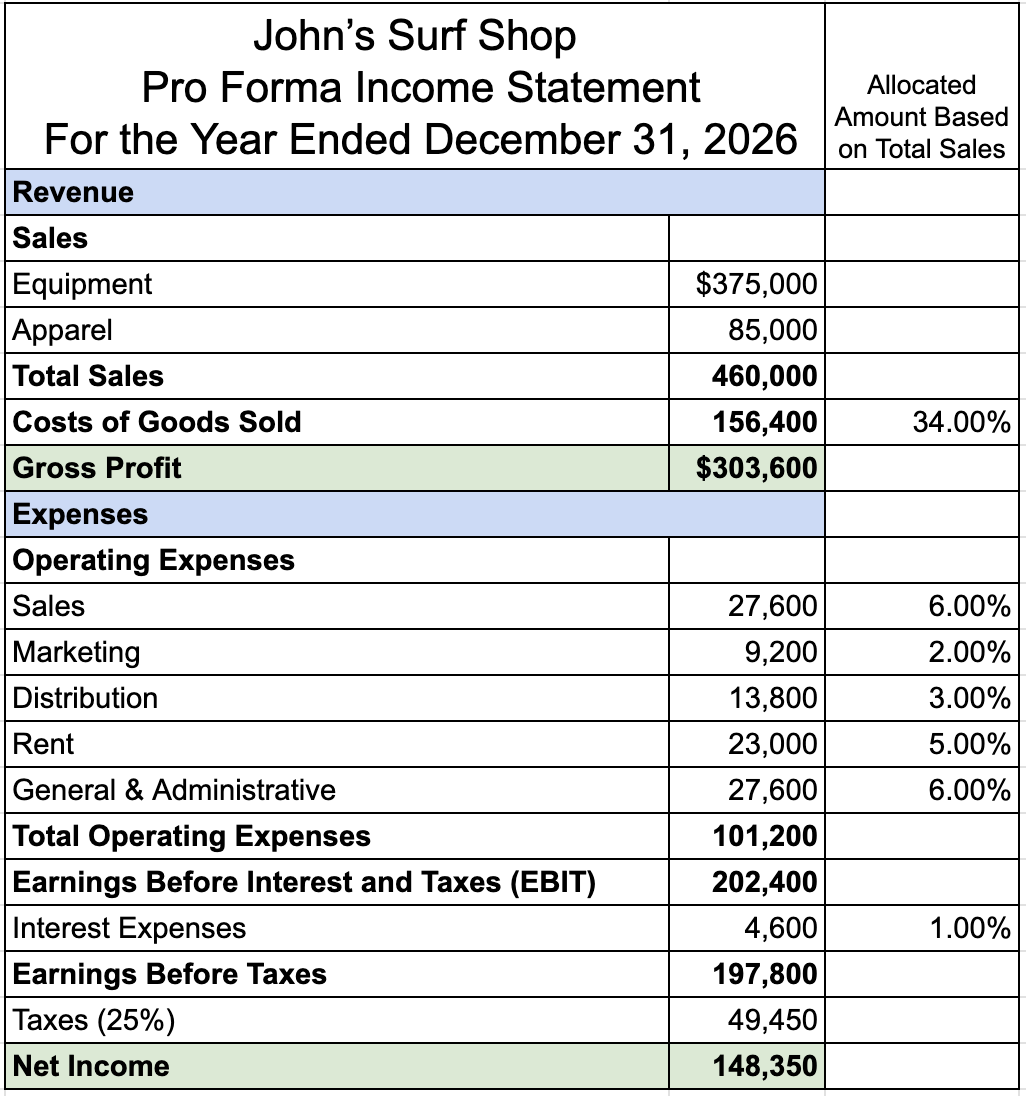
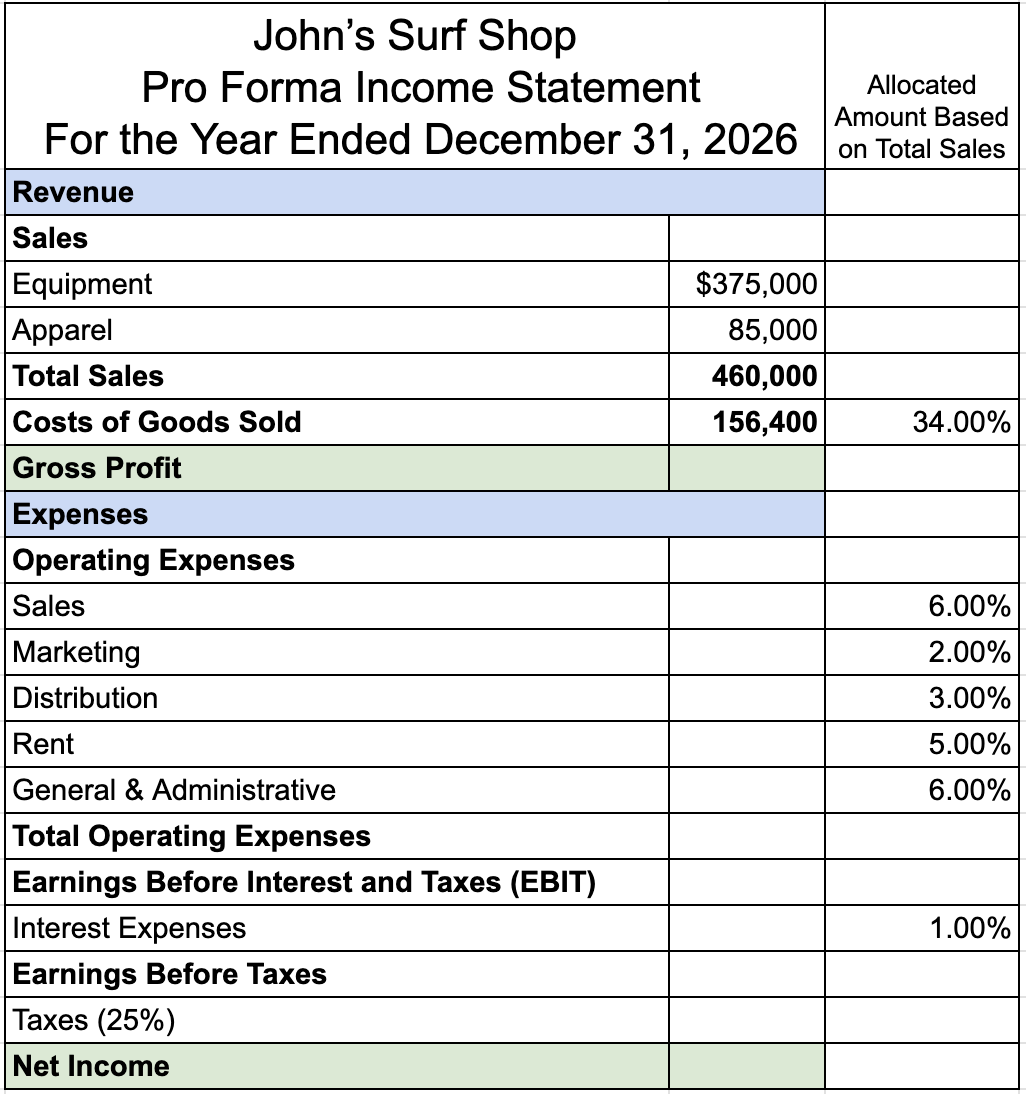
John owns a surf shop, and he wants to project his income for the upcoming fiscal year. He projects that his total revenue for next year will be $460,000. He also assigns percentages to expenses based on last year’s actual results. These assigned percentages are based on John’s total revenue.

hint
The cost of goods sold is 34% of the total revenue of $460,000, or $156,400 ($460,000 × 0.34 = $156,400).

A financial statement titled ‘John’s Surf Shop Pro Forma Income Statement for the Year Ended December 31, 2026’ includes two sections: Revenue and Expenses. A column on the right shows the ‘Allocated amount based on total sales’. Under Revenue, there is Sales, which includes Equipment at $375,000 and Apparel at $85,000, for a Total Sales of $460,000. Cost of Goods Sold is $156,400, representing an allocated amount based on total sales of 34.00%, resulting in a Gross Profit that is not specified. Under Expenses, the allocated amounts based on total sales for operating Expenses include Sales: 6.00%, Marketing: 2.00%, Distribution: 3.00%, Rent: 5.00%, and General & Administrative: 6.00%. Total Operating Expenses and Earnings Before Interest and Taxes (EBIT) are shown but not specified. Interest Expenses are 1.00%. Earnings Before Taxes, Taxes (25%), and Net Income are shown but not specified.
  View this spreadsheet in Google Docs


summary
In this lesson, you learned how to create a pro forma income statement to forecast a company’s future profitability.

The process begins with a revenue forecast, projecting sales growth using historical data and market expectations. From there, you calculated the cost of goods sold (COGS) and derived the gross margin, followed by operating expenses and earnings before interest and taxes (EBIT). You then projected interest, taxes, and net income, arriving at an estimate of overall profitability.

Each step builds from the sales forecast and reflects ratios or percentages based on prior results. This approach helps businesses anticipate future financial performance and make informed decisions about pricing, budgeting, and resource allocation.

Source: THIS TUTORIAL HAS BEEN ADAPTED FROM "BOUNDLESS FINANCE" PROVIDED BY LUMEN LEARNING BOUNDLESS COURSES. ACCESS FOR FREE AT LUMEN LEARNING BOUNDLESS COURSES. LICENSED UNDER CREATIVE COMMONS ATTRIBUTION-SHAREALIKE 4.0 INTERNATIONAL.


Terms to Know
Pro Forma Income Statement

A financial statement of a company’s estimate of how it plans to convert its revenue into net income.