Table of Contents |
MyPlate is a nutritional food guide, developed by the United States Department of Agriculture (USDA). The purpose of MyPlate is to teach Americans to be more aware of what they eat and how to choose healthier foods. People can get individual recommendations through the MyPlate website based on their age, gender, height, weight, and activity level. This nutrition food guide replaced the food pyramid in 2011. MyPlate is broken down into five food groups: fruits, vegetables, grains, proteins, and dairy. Each food group has its own unique functions and are equally important.
MyPlate divides food into five groups, and each food group has a purpose that they fulfill. Without each part, the diet misses a piece of the puzzle that makes up healthy eating. While not every meal may have every food group, you should try to include three or more in each meal. Be sure to check for your individual needs on the MyPlate website for more accurate serving sizes.
| Food Group | Example of Foods | Nutrients Provided |
|---|---|---|
| Grains |
Whole grains: brown rice, oats, whole wheat bread, cereal and pasta, popcorn. Refined grains: typically tortillas, couscous, noodles, naan, pancakes (although sometimes these products can be whole grains too). For more foods and what counts as a cup check out: The Grain Group Food Gallery. |
dietary fiber, several B vitamins (thiamin, riboflavin, niacin, and folate), and minerals (iron, magnesium, and selenium) |
| Vegetables |
Dark green vegetables: broccoli, kale, and spinach. Red and orange vegetables: bell peppers, carrots and tomatoes. Starchy vegetables: corn, peas, and potatoes. Beans and Peas: hummus, lentils and black beans. Other vegetables: asparagus, avocado, zucchini. For more foods and what counts as a cup check out: The Vegetable Group Food Gallery. |
potassium, dietary fiber, folate, vitamin A, and vitamin C |
| Fruits |
Fresh berries, melons, and other fruit as well as 100% fruit juice. Fruits can also be canned, frozen, or dried, and may be whole, cut-up, or pureed. For more foods and what counts as a cup check out: The Fruit Group Food Gallery. |
potassium, dietary fiber, vitamin C, and folate |
| Protein |
Meats, poultry, seafood, beans and peas, eggs, nuts and seeds. For more foods and what counts as a cup check out: The Protein Group Food Gallery. |
protein, B vitamins (niacin, thiamin, riboflavin, and B6), vitamin E, iron, zinc, and magnesium |
| Dairy |
Milk, yogurt, cheese, and calcium-fortified soy milk. Foods such as cream cheese, cream, and butter are not part of the Dairy Group as they have little/no calcium (they count as a fat). For more foods and what counts as a cup check out: The Dairy Group Food Gallery. |
calcium, potassium, vitamin D, and protein |
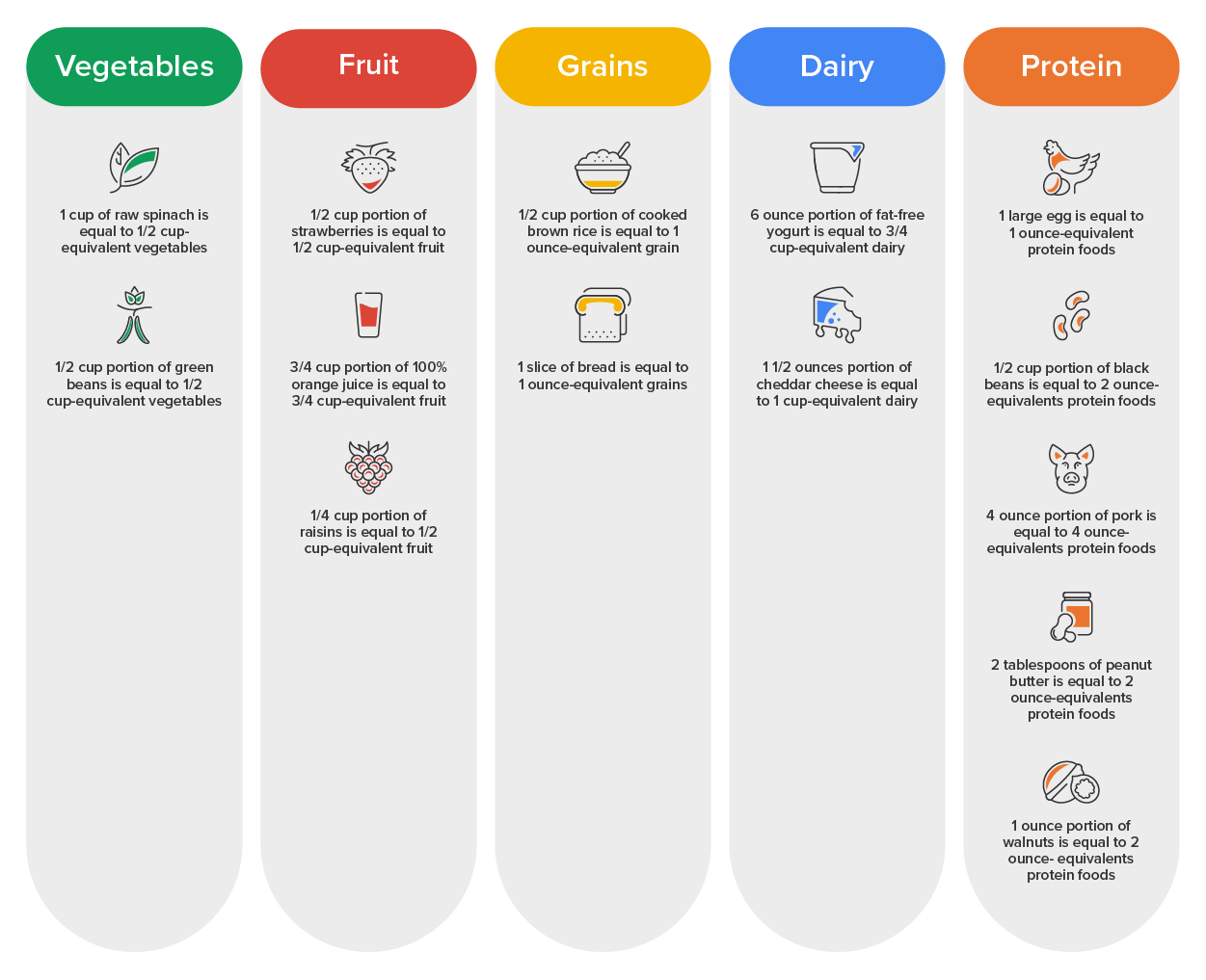
The image below shows the MyPlate food groups, with examples of food options and serving sizes.
The first food group is fruits. Fruits are a key component to MyPlate because of the benefits they offer, such as reducing risk of chronic diseases and containing vitamins and minerals that help the body function properly. Most fruits are low-fat, low-sodium, and low-calorie. This aids in satiation because the volume of fruits can be large, but the caloric value can stay low while providing plenty of fiber. Potassium is a nutrient that most people in the U.S. do not get enough of, but through consumption of fruits, such as bananas, avocados, oranges, grapefruit, and cantaloupe, that can be improved. MyPlate suggests eating one to two cups of fruit per day but can differ based on the individual's needs.
The second food group is vegetables. Vegetables provide many important nutrients, such as potassium, folate, fiber, vitamin A, and vitamin C. The benefits for eating vegetables can be a reduced risk of heart disease, heart attack, and stroke. There are five main groups of vegetables: dark green, red and orange, beans and peas, starchy, and other. Leafy greens are spinach, kale, arugula, bok choy, and broccoli. These vegetables mainly offer antioxidants, magnesium, calcium, and iron. Red and orange vegetables are carrots, sweet potatoes, butternut squash, and pumpkin offering vitamin A, potassium, and fiber. Beans, peas, and lentils are good sources of B vitamins, iron, magnesium, and protein. Starchy vegetables are the most consumed and include foods like potatoes, corn, lima beans, green peas, and string beans. These vegetables make up the bulk of the usual vegetable intake of an average diet.
Grains are the main bulk of the diet and can be divided into two groups: whole and refined. Whole grains contain the whole part of the grain, including the bran, germ, and endosperm. This makes it so that whole grains provide more nutrients, such as fiber, iron, and B vitamins. Refined grains remove the bran and germ leaving only the endosperm increasing shelf life but removing most nutrients. These grains are typically enriched to add back some B vitamins and iron to the grain. Whole grains include whole-wheat flour, bulgur, oatmeal, whole grain cornmeal, and brown rice. Refined grains include white flour, corn grits, white bread, and white rice. At least half of the grains you eat should be whole grains like whole-wheat bread, brown rice, or oatmeal.
Proteins are the fourth food group and can come from a wide variety of foods, such as animal meats, seafoods, beans, peas, and lentils. High-protein foods help the body build and maintain muscles, skin, blood, and other tissues. They also have important vitamins and minerals, like iron. Animal meats are recommended to be either lean or low-fat. To be lean or low-fat, the calories from fat should be 30% or lower. Examples of this are chicken breast, pork loin, and 93% lean ground beef. Proteins are the building blocks of the muscles and tissues and requires the nutrients from the other food groups to function properly.
Dairy is the last food group. This includes foods such as milk, yogurt, cheese, and soymilk. Calcium and vitamin D are the main nutrients that dairy provides but also provides other nutrients, such as proteins, vitamins, and minerals. There are plenty of dairy products, but it is important to consider the extra calories from fat and sugar from products like ice cream, full-fat cheeses, and flavored yogurts. MyPlate recommends two to three cups per day, depending on age and gender. MyPlate shows dairy as a side or extra to your meal, like a glass of milk.
Source: THIS TUTORIAL HAS BEEN ADAPTED FROM LUMEN LEARNING’S “NUTRITION FLEXBOOK”. ACCESS FOR FREE AT https://courses.lumenlearning.com/suny-nutrition/. LICENSE: creative commons attribution 4.0 international.
REFERENCES
What is MyPlate? MyPlate. (n.d.). Retrieved May 9, 2022, from www.myplate.gov/eat-healthy/what-is-myplate



