In this lesson, you will learn more about emails to send after an interview. These follow-up emails have an established format that you should follow. You will explore three basic types you may want to send.
Specifically, this lesson will cover:
- Format of Emails
- Types of Emails
- Thank You
- Checking In
- Staying in Touch
1. Format of Emails
After your interview, it is important to follow up with the person who interviewed you. Strong written communication skills will help you craft an email that hits on the right items and has the right tone. Sending a follow-up email may also help you stand out from other candidates who do not do the same. It helps you to manage the impression that the interviewer has of you by showing real interest in the role and your professionalism.
-
In addition to demonstrating your communication skill, you also demonstrate your self- and social awareness skill by sending a follow-up email. Employers seek candidates who show respect and this small step is a great way to exhibit this.
You want to start your follow-up email by thanking the interviewer for their time. You then go on to use some of those keywords again to highlight what makes you a strong candidate. Lastly, you want to close out with a forward-looking statement about your hopes to hear a positive response soon.
The key parts of any follow-up email are below. As you review them, think about what you would include in each section for your dream job or a job that you are currently considering.
Subject Line
You want this to be clear and concise. Some examples are:
- Great speaking with you today!
- Our earlier call
- My interview on [insert]
- [Your] interview
- Thank you for the opportunity
- Follow up regarding [insert]
First Paragraph
You want to open with a reminder about the specific role title and a thank you. You also want to share your continued interest in the role.
Goals and Experience
In this paragraph, you want to note something specific from your interview. Focus on something that seemed important to the interviewer and draw a connection between that and your own goals and experience.
Unique
In the last paragraph, share what makes you unique and the best candidate for the job. Make sure you indicate to them that they can reach out to you with any questions and share your excitement about hearing from them soon.
Closing
Make sure you include your name and your contact information. You also want to use a formal closing like “Best” or “Thank you.”
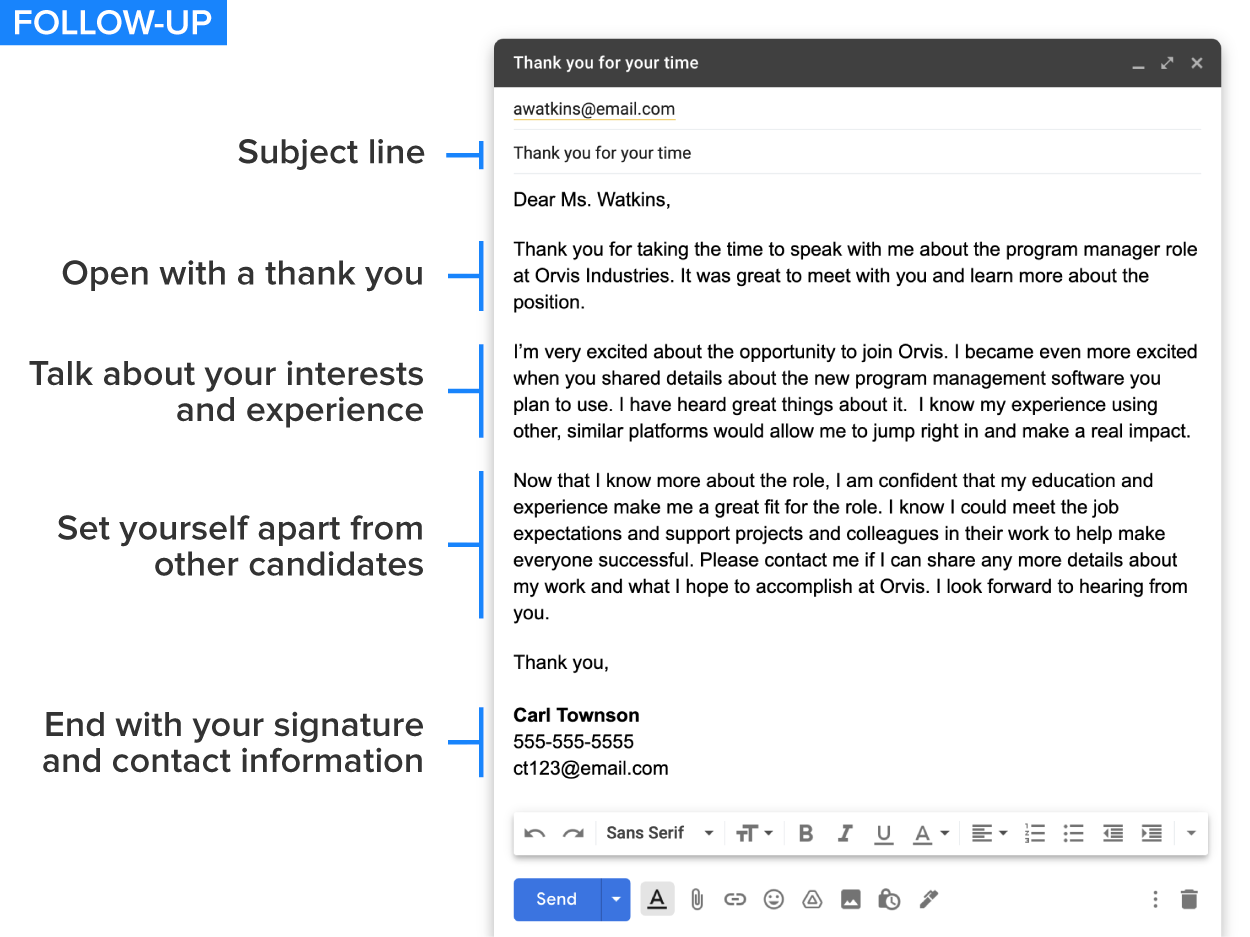
Check out the example of a follow-up email below.
-
In 1959, sociologist Irving Goffman came up with
impression management theory which argues that people try to control the impression they make in order to achieve their goals. He explained the behavior displayed by people in different social situations by using the metaphor of a play with the actor putting on a performance for an audience in order to make a good impression (Goffman, 1959). Using impression management theory, we would expect that if someone is seeking a job, then that person would prepare for and dress up for an interview, control their body language during the interview, and send a follow-up email after the interview in an effort to make a good impression on the interviewer.
-
-
- Impression Management
- A process of behaving in a certain way to control the impression that someone makes on another person.
2. Types of Emails
There are different types of follow up emails, depending on when it is sent and the reason. It is ideal to only need to send one email to thank the interviewer, but there are times you may need or want to follow up after that initial email. It is important to be familiar with three key types of follow-up emails.
- 2a. Thank You
This is most likely the type you are most familiar with and the one that we focused on in the previous section. It would be sent shortly after your interview.
-
EXAMPLE
Subject line: Thank you for your time
Dear Ms. Watkins,
Thank you for taking the time to speak with me about the program manager role at Orvis Industries. It was great to meet with you and learn more about the position.
I’m very excited about the opportunity to join Orvis. I became even more excited when you shared details about the new program management software you plan to use. I have heard great things about it. I know my experience using other, similar platforms would allow me to jump right in and make a real impact.
Now that I know more about the role, I am confident that my education and experience make me a great fit for the role. I know I could meet the job expectations and support projects and colleagues in their work to help make everyone successful. Please contact me if I can share any more details about my work and what I hope to accomplish at Orvis. I look forward to hearing from you.
Thank you,
Carl Townson
555-555-5555
[email protected]
Remember, like other documents we have discussed, you want to keep this as short as possible while still including all of the key elements. An email that is too long may actually hurt your chances of being hired.
- 2b. Checking In
Once you send your thank you email, you may hear back right away. If that does not happen, you will want to send a check-in email. A good rule is to send this if you have not heard back from the company within two weeks of your interview.
-
EXAMPLE
Subject line: Checking in RE: program manager role
Dear Ms. Watkins,
I hope this email finds you doing well! I’m checking in on the program manager role. I appreciated the opportunity to talk with you about this role a couple of weeks ago. Please let me know if you need anything else from me as you continue to consider candidates.
Best,
Carl Townson
555-555-5555
[email protected]
Some people feel they are being “pushy” when they send an email like this, but that is not the case. By keeping it short and to the point, it will be viewed as demonstrating your continued interest in the role. It can also help cut down on the stress you may be feeling by not hearing anything and that is important.
- 2c. Staying in Touch
You may not receive a reply for your “thank you” or “checking in” emails. You may hear back that you were not selected for the role. If this happens, a “staying in touch” email is appropriate.
-
EXAMPLE
Subject line: Staying in touch
Dear Ms. Watkins,
I hope you are having a good week. I wanted to reach out with one more email to thank you again and let you know how much I appreciated being able to learn more about Orvis and the program manager role. I truly enjoy my work as a PM and I always love to talk to others about my industry and my goals. I would like to stay connected, if possible, so I can stay up to date on what is happening at Orvis and in your career.
Please let me know if you are open to a continued conversation and connecting somewhere like LinkedIn.
Sincerely,
Carl Townson
555-555-5555
[email protected]
This email is not intended to change any final hiring decision. It is meant to be another nudge to get some information or to keep a door open for yourself. This will also again demonstrate your communication skills and professionalism.
-
-
- Professionalism
- The behavior and attitude that is expected from a person in a workplace setting.
In this lesson, you learned that sending an email after an interview can make a difference in whether or not you get the job. You reviewed the basic format of these emails. You also explored three basic types of follow up emails. These are a thank you email, a checking in email and a staying in touch email. Your strong written communication skills can help you craft strong versions of these that will leave an impression on any employer.
REFERENCES
Goffman, E. (1959). The presentation of self in everyday life. Doubleday.



