Use Sophia to knock out your gen-ed requirements quickly and affordably. Learn more
×

Financial Markets

Author: Sophia

what's covered
In this lesson, you will learn about the characteristics of different financial markets. Specifically, this lesson will cover the following:

Table of Contents

1. Definition of Financial Markets

A financial market is the aggregate, or collection, of buyers and sellers of financial securities, commodities, and other sellable items, as well as the transactions between them.

Examples of financial markets include the following:

  • Capital markets
  • Derivative markets
  • Money markets
  • Currency markets
Financial markets are important because, without financial markets, borrowers would have difficulty finding lenders themselves. Intermediaries like banks can help with this process. Banks take deposits from those who have money to save, and individuals who aren’t aware that they are lenders are providing capital. However, many do lend money, at least indirectly.

EXAMPLE

When people put money in a savings account or contribute to a pension, intermediaries like banks can then lend money from this pool of deposited money in the form of loans to people who seek to borrow.

More complex transactions than a simple bank deposit require markets where lenders and their agents can meet borrowers and their agents and where existing borrowing or lending commitments can be sold on to other parties.

EXAMPLE

One instance of this is a stock exchange.


2. Classification of Financial Markets

There are many different ways to define and classify financial markets. The image below identifies some markets that we will discuss.
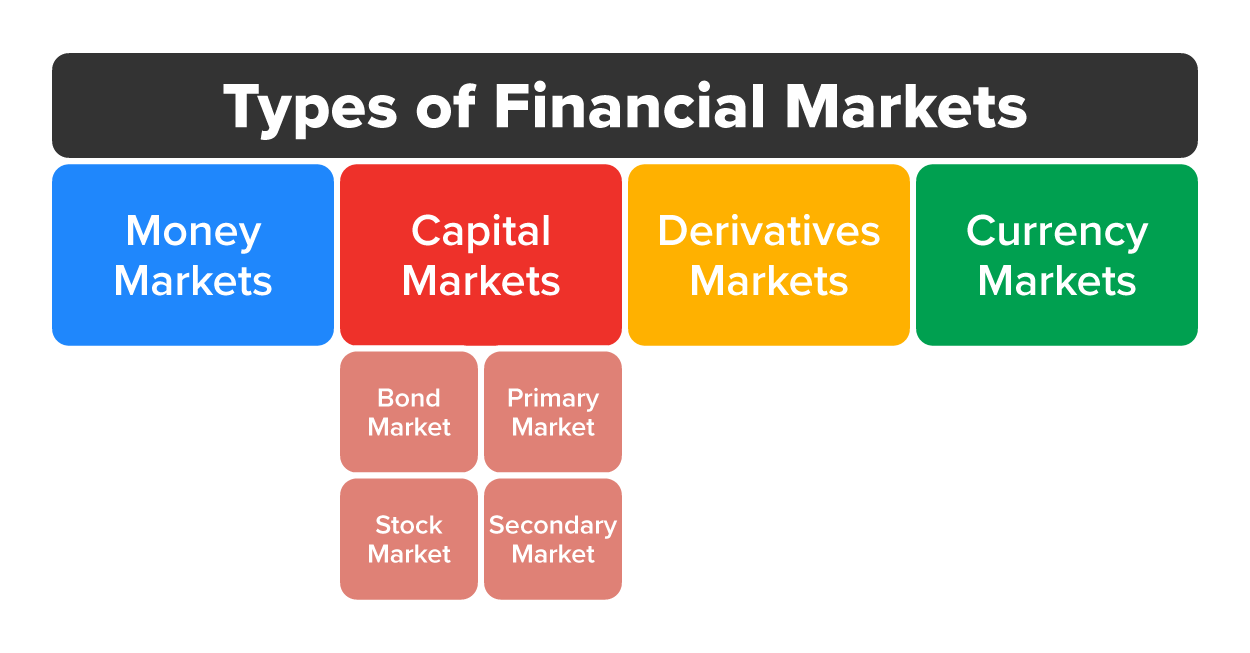
A classification of financial markets into four main types: money markets, capital markets, derivatives markets, and currency markets. Under capital markets, there are subcategories such as the bond market and the stock market, further divided into primary market and secondary market.
Types of Financial Markets

big idea
When dealing with long-term finance with longer maturities, we use the capital markets. For short-term financing, anything up to 1 year, money markets are used.

term to know
Maturity
Date when payment is due.

2a. Capital Markets

Capital markets are platforms (think New York Stock Exchange or NASDAQ) where companies raise funds by issuing securities like stocks and bonds and where investors buy or sell these securities.

Capital markets can be sold in two different formats: primary markets and secondary markets.

  • In the primary market, underwriting firms, like institutional bankers, help companies find the market for their stock (selling equity, or ownership, in the business) or bond issuances (selling debt). The primary market is where new securities are issued and companies receive the proceeds from the sales of their bonds or stocks.
  • The secondary market is where investors like you or me trade, buy, and sell stocks in the market. The company doesn’t get the money that we spend to buy the shares or buy the bonds; they’ve already gotten their money for that. The person who is holding those bonds or holding those shares at that moment gets the money that we spend.

EXAMPLE

Disney wants to raise $10,000,000. They issue 10-year bonds with a par value of $1000. Investors buy the bonds, providing Disney with cash. Later, the investor can sell the bond to another investor in the marketplace. Similarly, stocks are also traded in capital markets, allowing companies to raise funds by issuing shares.

terms to know
Capital Market
Market where companies raise funds by issuing securities like stocks and bonds and where investors trade these securities.
Primary Market
New capital market where securities are issued and offered for the first time.
Secondary Market
Market where private investors trade, buy, and sell stocks and bonds after initial offerings.

2b. Money Markets

Money markets deal with short-term debt instruments, which are usually less than a year. These markets provide liquidity for institutions and governments. At the wholesale level, the money market involves large-volume trades between institutions and traders. Retail participants can invest in the money market by purchasing money market mutual funds, buying Treasury bills, or opening money market accounts at banks.

EXAMPLE

Treasury bills (T-bills) are short-term debt issued by governments and are traded in capital markets. Investors buy T-bills, lending money to the government for a short period, and receive interest when the T-bills mature.

term to know
Money Market
Market where short-term debt instruments are bought, sold, and traded.

2c. Derivatives Markets

Derivatives are financial contracts whose value depends on an underlying asset, like stocks, bonds, or commodities. The financial crisis of 2008 was partially caused by derivatives in the mortgage market, called mortgage-backed securities. Derivatives markets facilitate the trading of these contracts.

EXAMPLE

A futures contract on gold is a derivative. Its value depends on the price of gold. Investors can speculate on gold prices by buying or selling these contracts.

term to know
Derivatives Market
Market where financial contracts whose value depends on an underlying asset, like stocks, bonds, or commodities, are traded.

2d. Currency Markets

Currency markets, also known as foreign exchange markets (forex), involve trading different currencies from around the world. Participants exchange one currency for another. Unlike the stock market, it doesn’t involve a clearinghouse; transactions occur directly between parties, ensuring compliance with obligations.

EXAMPLE

If you travel abroad and exchange U.S. dollars for euros, you’re participating in the currency market. Forex traders also engage in currency trading to profit from exchange rate fluctuations.

term to know
Currency Market
Market that involves trading different currencies from around the world; also known as a foreign exchange market (forex).


3. Financial Market Trends

There are several terms that we often hear in the media when we talk about the markets.

We hear the term bull market, which is a market that is trending upward. A bull market is associated with increasing investor confidence and increased investing in anticipation of future price increases. A bullish trend in the stock market often begins before an economic downturn shows clear signs of a recovery. The bull market shows up first.
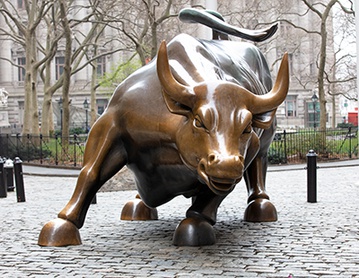
The “Charging Bull” sculpture outside the New York Financial District in New York City

In the other direction is the bear market, which is a general decline in the stock market over a period of time. It’s a transition from high investor optimism to widespread investor fear and pessimism.
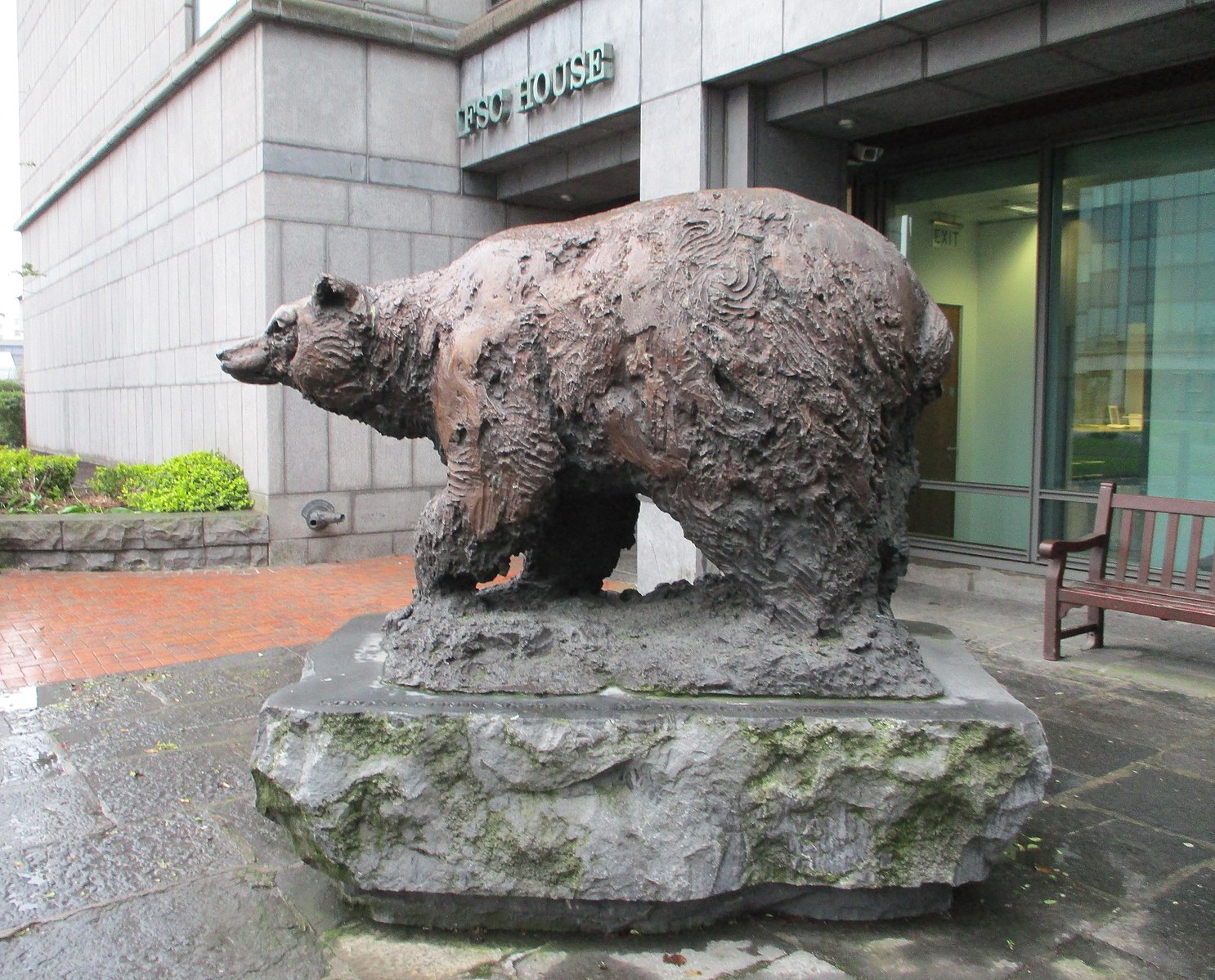
The stock market bear sculpture outside the International Financial Services Centre in Dublin, Ireland

There are also types of trends for the bull and the bear markets. A primary trend is one that has broad support throughout the entire market and lasts for a year or longer. An even longer trend is a secular trend, which can last from 5 years up to 25 years and is actually a series of primary trends.

EXAMPLE

A secular bear market consists of larger bear markets and smaller bull markets. A secular bull market consists of larger bull markets and smaller bear markets. So, over the long term, secular markets follow the pattern associated with that market trend.

hint
It’s often said that the markets are good to everyone, but in the long term.

terms to know
Bull Market
A stock market where a majority of investors are buying (“bulls”), causing overall stock prices to rise.
Bear Market
A stock market where a majority of investors are selling (“bears”), causing overall stock prices to drop.

summary
In this lesson, you learned about the definition of financial markets, which are the aggregate of buyers and sellers of financial securities and commodities and which facilitate the lending and borrowing of money. Financial markets are classified as short-term (money markets) or long-term (capital markets), bond or stock, and primary or secondary. They are also classified by commodity, such as in the case of the derivatives market or the currency market. Finally, financial markets include trends such as the bull markets or bear markets, depending on whether investor confidence and prices are trending upward or downward. These trends are further classified as primary or secular, depending on their duration.

Best of luck in your learning!

Source: THIS TUTORIAL HAS BEEN ADAPTED FROM "BOUNDLESS FINANCE" PROVIDED BY LUMEN LEARNING BOUNDLESS COURSES. ACCESS FOR FREE AT LUMEN LEARNING BOUNDLESS COURSES. LICENSED UNDER CREATIVE COMMONS ATTRIBUTION-SHAREALIKE 4.0 INTERNATIONAL.


Attributions
Terms to Know
Bear Market

A stock market where a majority of investors are selling (“bears”), causing overall stock prices to drop.

Bull Market

A stock market where a majority of investors are buying (“bulls”), causing overall stock prices to rise.

Capital Market

Market where companies raise funds by issuing securities like stocks and bonds and where investors trade these securities.

Currency Market

Market that involves trading different currencies from around the world; also known as a foreign exchange market (forex).

Derivatives Market

Market where financial contracts whose value depends on an underlying asset, like stocks, bonds, or commodities, are traded.

Maturity

Date when payment is due.

Money Market

Market where short-term debt instruments are bought, sold, and traded.

Primary Market

New capital market where securities are issued and offered for the first time.

Secondary Market

Market where private investors trade, buy, and sell stocks and bonds after initial offerings.
