Table of Contents |
In this lesson, you will learn terminology related to the female reproductive system. You will learn about the male reproductive system in the next Challenge. You will have a specific lesson in this Challenge that focuses on those word parts and terms related to pregnancy, labor, and childbirth.
The female reproductive system produces hormones and matures eggs (called ova, singular ovum) during the monthly menstrual cycle (the monthly female reproductive cycle, which you will learn more about later in the course). Every month, an egg (ovum) is released from one of the female’s ovaries with the potential to become fertilized by male sperm. If fertilization occurs (fusion of an egg and sperm), female hormones stimulate the development of the fertilized egg (zygote) into an embryo (up to 8 weeks of development), then a fetus (beginning in the ninth week), and ultimately, a baby ready for delivery in about 40 weeks (OpenStax, n.d.).
The figure below introduces major features of the female reproductive system to help you understand the related word parts. You will learn much more about the anatomy of the female reproductive system later in this Challenge.
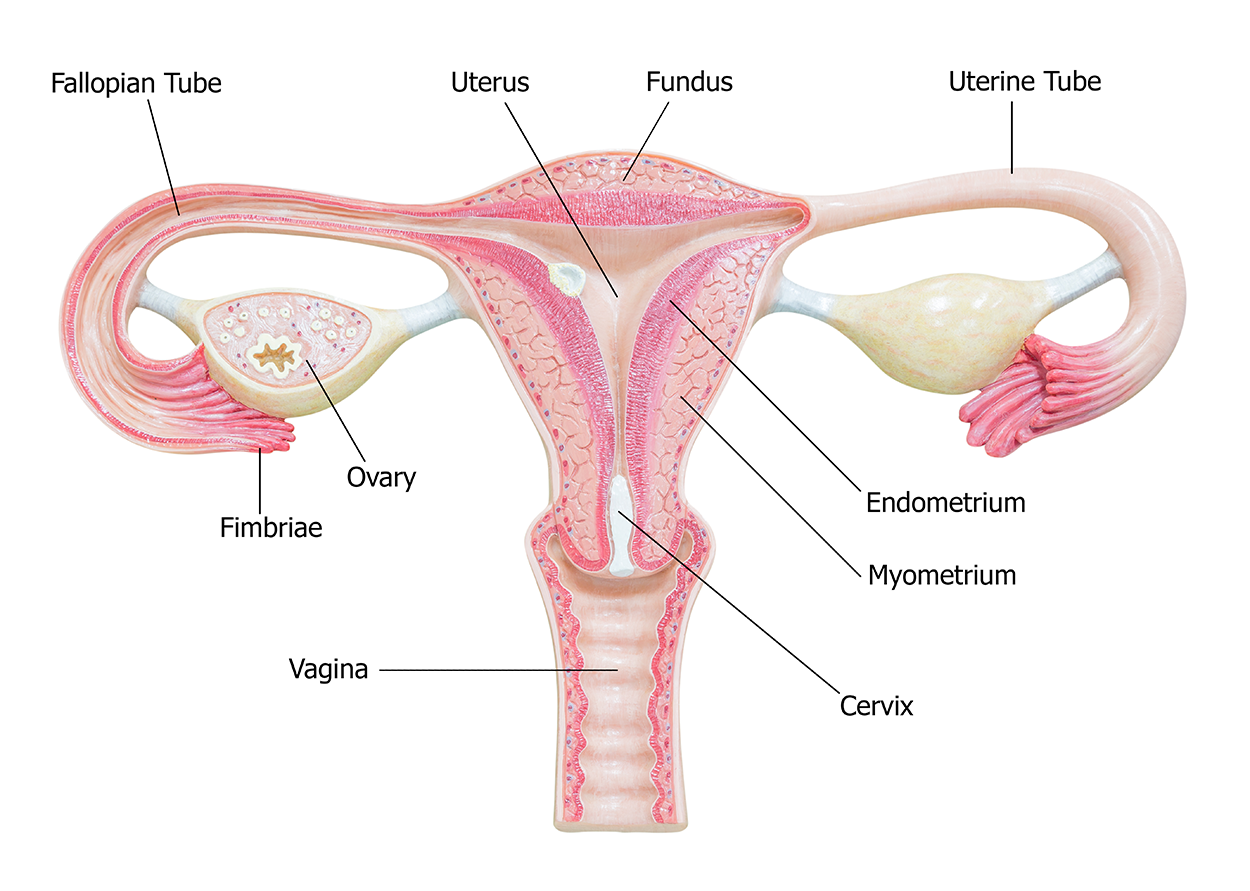
The figure shows the central uterus, which has a wide top that narrows to the cervix, which meets the narrow vagina. The thick, rounded top of the uterus is the fundus. The uterus has an endometrium that lines its interior surface. The muscular myometrium forms much of the middle of the uterus walls. Two uterine tubes, also called fallopian tubes, are present. Each tube extends out to the side, one to the left and one to the right, then curves down and back toward the uterus to meet an ovary. The part of the uterine tube that faces an ovary has fimbriae (singular fimbria), which are fringe-like projections to gather an egg. In this illustration, a small, rounded egg is embedded in the endometrium of the uterus.
The table below shows common prefixes that you will encounter as you learn about the female reproductive system. Remember that many other prefixes are also used, including prefixes that you have already learned.
| Term | Definition | Example | Definition of Example |
|---|---|---|---|
| A-, an- | Absence of, without | Amenorrhea | The absence of menstruation (the typically monthly shedding of the endometrial lining that lines the interior of the uterus) |
| Dys- | Abnormal, difficult | Dysmenorrhea | Painful menstruation, often with cramps |
| Endo- | Within | Endometriosis | A painful condition where tissue similar to the lining of the uterus grows outside the uterus |
| Oligo- | Small amount, few, scanty | Oligomenorrhea | Infrequent or very light menstruation |
Many combining forms that you have already learned are relevant to learning about the female reproductive system. The table below focuses on examples of combining forms that describe female reproductive system structures.
| Term | Definition | Example | Definition of Example |
|---|---|---|---|
| Cervic/o | Cervix (neck; not specifically the cervix in the reproductive system) | Cervical cancer | Cancer arising from the cervix, often associated with human papillomavirus (HPV) infection |
| Colp/o | Vagina | Colposcopy | A procedure using a lighted magnifying instrument to examine the cervix and potentially remove tissue for biopsy |
| Endometri/o | Endometrium | Endometriosis | A painful condition where tissue similar to the lining of the uterus grows outside the uterus |
| Episi/o, vulv/o | Vulva (The external part of the female genitalia, which includes the labia majora, labia minora, clitoris, and the opening of the vagina) | Episiotomy | An incision in the perineum (region separating the genitals and anus; in women, between the vaginal opening and the anus); intended to facilitate childbirth; not routinely recommended (Mayo Clinic staff, 2022; Merriam Webster, n.d.a.) |
| Hyster/o | Uterus | Hysterectomy | Surgical removal of the uterus, which may include the cervix, ovaries, uterine tubes (fallopian tubes), and other surrounding structures |
| Mamm/o, mast/o | Breast | Mammogram | An X-ray image of the breast used to detect and diagnose breast abnormalities |
| Men/o | Menstruation | Menopause | The end of menstrual cycles in a woman’s life, marking the end of reproductive years |
| Metr/i, metr/o | Uterus | Metrorrhagia | Bleeding from the uterus at any time other than normal menstruation |
| Oophor/o | Ovary | Oophorectomy | Surgical removal of one or both ovaries |
| Salping/o | Uterine tube/fallopian tube | Salpingectomy | Surgical removal of one or both uterine tubes (fallopian tubes) |
| Vagin/o | Vagina | Vaginitis | Vaginal inflammation (Mayo Clinic, 2021) |
In addition to prefixes and combining forms, there are many suffixes that are useful in discussing the female reproductive system. Some useful suffixes are presented in the table below, which includes some familiar suffixes and some new suffixes.
| Term | Definition | Example | Definition of Example |
|---|---|---|---|
| -al | Pertaining to | Vaginal | Pertaining to the vagina |
| -cleisis | Surgical closure | Colpocleisis | Procedure in which the walls of the vagina are sewn together to prevent displacement of pelvic organs (prolapse, which refers to other organs as well; Cleveland Clinic, 2022a) |
| -pexy | Surgical fixation, suspension | Hysteropexy | A procedure to fix the uterus in place to preserve, rather than remove, a prolapsed uterus (Oh and Jeon, 2022) |
| -rrhagia | Excessive flow | Menorrhagia | Excessive menstrual bleeding |
| -rrhea | Flow, discharge | Dysmenorrhea | Painful menstruation, often with cramps |
| -salpinx | Uterine tube/fallopian tube | Hydrosalpinx | A condition in which fluid blocks a uterine tube (fallopian tube; Cleveland Clinic, 2022b). |
| -tomy | Incision, cut into | Laparotomy | A surgical procedure with a large incision in the abdomen to access the abdominal organs |
Some additional useful terms related to the female reproductive system are below.
| Term | Definition | Audio |
|---|---|---|
| Oophorectomy | Surgical removal of one or both ovaries |
|
| Salpingectomy | Surgical removal of one or both uterine tubes (fallopian tubes) |
|
| Salpingo-oophorectomy | Surgical removal of a uterine tube and its corresponding ovary |
|
Source: THIS TUTORIAL HAS BEEN ADAPTED FROM “OPEN RN | MEDICAL TERMINOLOGY – 2e” BY ERNSTMEYER & CHRISTMAN AT OPEN RESOURCES FOR NURSING (Open RN). ACCESS FOR FREE AT https://wtcs.pressbooks.pub/medterm/ LICENSING: CREATIVE COMMONS ATTRIBUTION 4.0 INTERNATIONAL.
REFERENCES
28.3 Fetal Development. (n.d.). OpenStax. 28.3 Fetal Development - Anatomy and Physiology 2e | OpenStax
Committee Opinion No 700: Methods for estimating the due date. (2017). Obstetrics and Gynecology, 129(5), e150–e154. doi.org/10.1097/AOG.0000000000002046
Vaginitis. (2021, December 22). Mayo Clinic. Vaginitis - Symptoms & causes - Mayo Clinic
Mayo Clinic staff. (2022, August 2). Mayo Clinic. Episiotomy: When it's needed, when it's not - Mayo Clinic
Merriam-Webster. (n.d.a.). Perineum. In Merriam-Webster.com dictionary. Retrieved July 30, 2025, from www.merriam-webster.com/dictionary/perineum
Merriam-Webster. (n.d.b.). Hysteria. In Merriam-Webster.com dictionary. Retrieved August 2, 2025, from www.merriam-webster.com/dictionary/hysteria
Merriam-Webster. (n.d.). Hysterical. In Merriam-Webster.com dictionary. Retrieved August 2, 2025, from www.merriam-webster.com/dictionary/hysterical
Colpocleisis. (2022a, June 22). Cleveland Clinic. Colpocleisis: What To Expect, Technique & Recovery
Oh, S., & Jeon, M. J. (2022). How and on whom to perform uterine-preserving surgery for uterine prolapse. Obstetrics & Gynecology Science, 65(4), 317–324. doi.org/10.5468/ogs.22003
Hydrosalpynx. (2022b, November 11). Cleveland Clinic. Hydrosalpinx: Causes, Symptoms, Diagnosis & Treatment



