Table of Contents |
After the site location decision has been made, the next focus in production planning is the facility’s layout. The goal is to determine the safest, most comfortable, and most efficient design for the production process. A manufacturer might opt for a U-shaped production line, for example, rather than a long, straight one, to allow products and workers to move more quickly from one area to another.
Service organizations must also consider layout, but they are more concerned with how it affects customer behavior. It may be more convenient for a hospital to place its freight elevators in the center of the building, for example, but doing so may block the flow of patients, visitors, and medical personnel between floors and departments.
In any industry, the objectives of facilities layout include:
Facilities layout is highly connected to ergonomics, the study of optimizing workstations for comfort and safety of workers. This applied science is not just concerned with major accidents but the long-term injuries that result from repetitive movements. Because ergonomics is highly personalized to each individual’s strength, stature, and other attributes, workstations must be adaptable to different individuals.
There are four main types of facility layouts. A manufacturer may use a combination of these rather than use one exclusively.
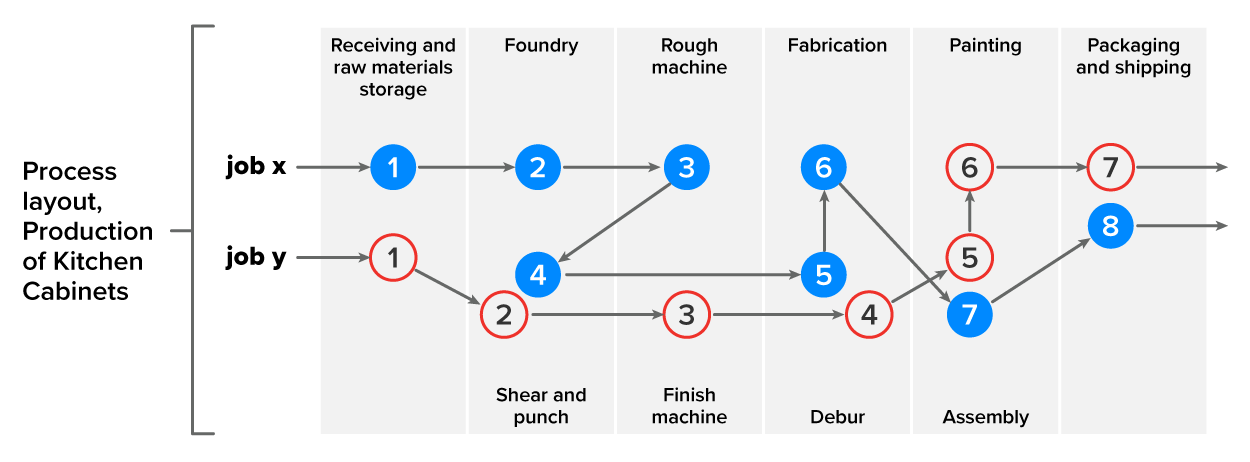
The process layout arranges workflow around the production process. All workers performing similar tasks are grouped together. Products pass from one workstation to another (but not necessarily to every workstation). For example, all grinding would be done in one area, all assembling in another, and all inspection in yet another. The process layout is best for firms that produce small numbers of a wide variety of products, typically using general-purpose machines that can be changed rapidly to new operations for different product designs. For example, a manufacturer of custom machinery would use a process layout.
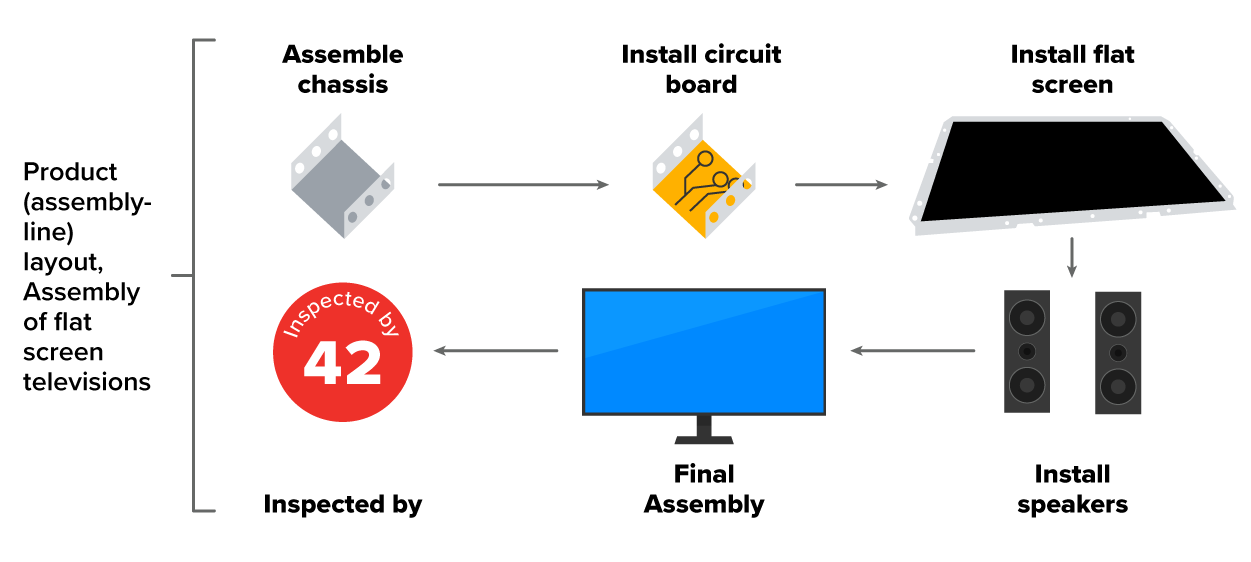
Products that require a continuous or repetitive production process use the product layout (or assembly-line layout). When large quantities of a product must be processed on an ongoing basis, the workstations or departments are arranged in a line with products moving along the line. Automobile and appliance manufacturers, as well as food-processing plants, usually use a product layout. Service companies may also use a product layout for routine processing operations.
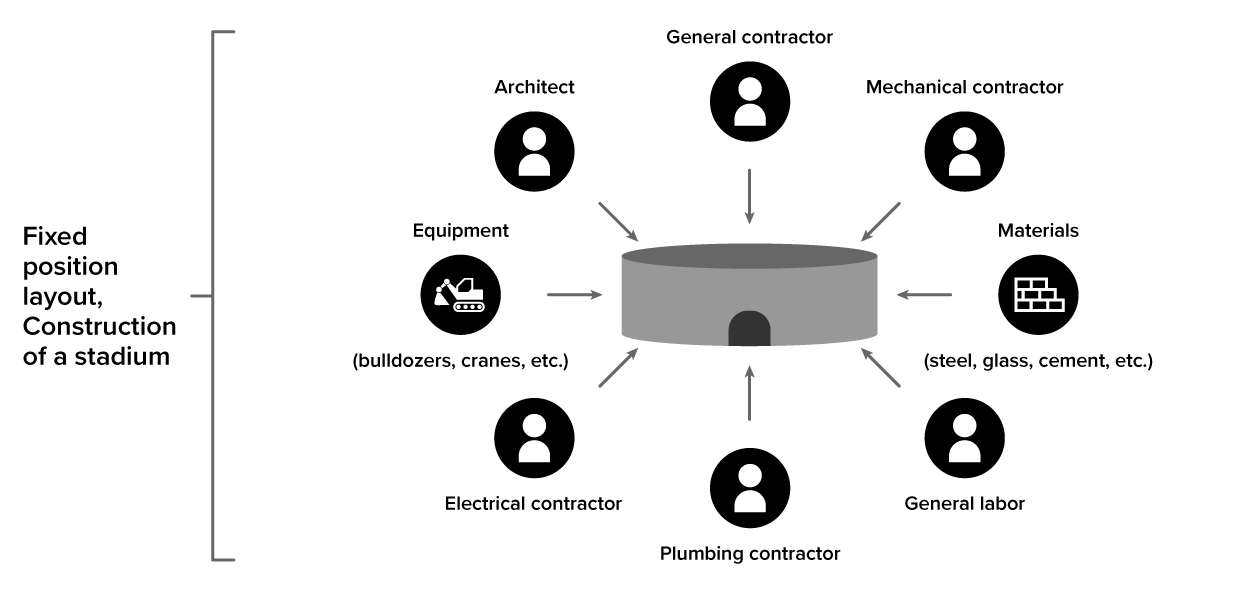
Some products cannot be put on an assembly line or moved about in a plant. A fixed-position layout lets the product stay in one place while workers and machinery move to it as needed. Products that are impossible to move—ships, airplanes, and construction projects—are typically produced using a fixed-position layout. Limited space at the project site often means that parts of the product must be assembled at other sites, transported to the fixed site, and then assembled. The fixed-position layout is also common for on-site services such as housecleaning services, pest control, and landscaping.
Cellular layouts combine some aspects of both product and fixed-position layouts. Work cells are small, self-contained production units that include several machines and workers arranged in a compact, sequential order. Each work cell performs all or most of the tasks necessary to complete a manufacturing order. There are usually five to 10 workers in a cell, and they are trained to be able to do any of the steps in the production process. The goal is to create a team environment wherein team members are involved in production from beginning to end. For example, a circuit board manufacturer might have five cells, such as cutting and drilling, assembly, soldering, testing, and packaging.
Because setting up a facility layout is complex and expensive, there are processes for designing and testing layout options before they are fully implemented. The first step in determining layout is to define the objectives of the layout. For example, some of the goals might include minimizing production time, maximizing space, or improving safety.
Once goals are set, information is gathered on processes, equipment needs, the flow of materials, space requirements, and employee needs, including health and safety.
The organization will then design the layout. These are often done with models, scaled down versions of the plans based on approved drawings; these are usually three-dimensional models.
Companies might also use data analysis and simulations which are digital processes for determining the optimal use of space for workflow. Data analysis can use existing data from the company or use published data from similar companies. Simulations can test a layout for productivity with and without disruption to find the layout that optimizes production and is most able to compensate for disruptions.
Line balancing is a timing data analysis done specifically for assembly lines where the time and space for each task can be determined through statistical analysis. The purpose is to synchronize workflow so that each phase completes a task at the same time and can move the product down the line.
EXAMPLE
Many companies use line balancing because uniform workload distribution helps to prevent bottlenecks and minimize employee idle time. Examples of companies that use line balancing include Toyota, Intel, Nike, and General Electric.Once the designs are tested, the company will assess the efficiency of each of the goals they’ve set forth in the first step. For example, they’d look at space utilization, the cost of handling the materials, safety factors, and many others depending on the goals they’ve set.
Once the layout plan has been chosen, it is important for companies to involve stakeholders in the decision making. For example, involvement of the unions, management, and employees can help ensure acceptance of the layout and also help determine any challenges associated with the design from a variety of perspectives.
Once the layout is implemented, it is important to monitor and ensure the facilities layout goals are met. In order to ensure continuous improvement, making adjustments and changes to the layout is necessary to optimize the facilities.
While we have mostly been addressing facilities layout for manufacturing, even office work environments attempt to optimize their layouts. Types of office layouts include:
Source: This tutorial has been adapted from Saylor Academy and NSCC "Operations Management". Access for free at pressbooks.nscc.ca/operationsmanagement2/. License: Creative Commons Attribution 4.0 International. Accessed by May 2024.
REFERENCES
MSG (n.d.). Facility Layout - Objectives, Design and Factors Affecting the Layout. Management Study Guide. managementstudyguide.com/facility-layout.htm
Gaither, N. & Frazier, G. (2002) Operations Management. South-Western Thomas Learning.



