Table of Contents |
When a function has several critical numbers, and when the second derivative is relatively easy to get, the second derivative test is much more efficient to use than the first derivative test when locating maximum and minimum values. However, there are conditions under which the second derivative doesn’t give enough information, and we need to use information from the first derivative to determine maximum and minimum points of a function.
Consider the graph shown below:
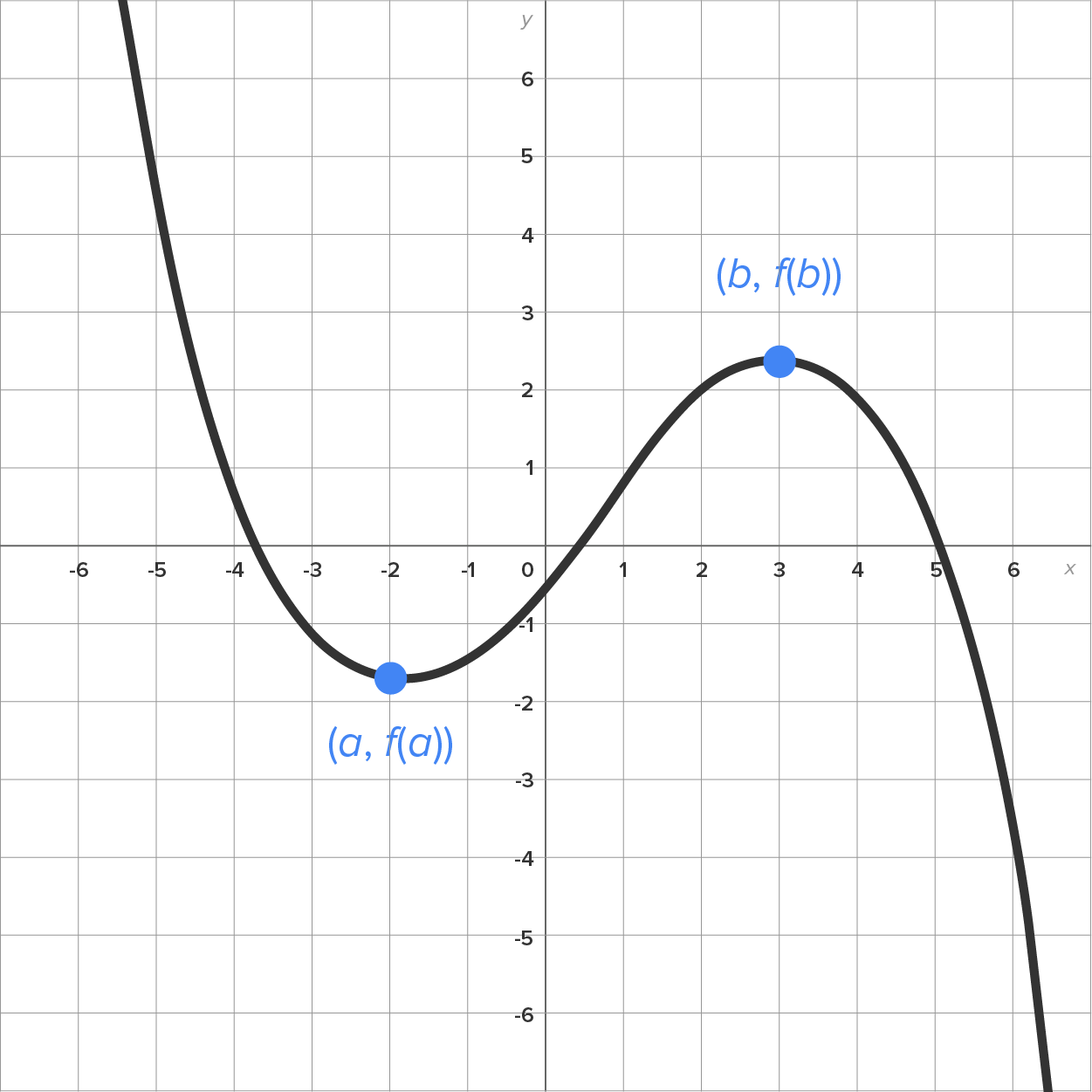
Observe the following at the local extreme points:
The point  is a local minimum.
 we know
  we know that
 is a local maximum.
 we know
  we know that
 when there is a horizontal tangent line and the type of local extrema at that point. Formally stated, this is called the second derivative test.
 are considered for the second derivative test. If
  is undefined, then
  is also undefined, which means we cannot determine if is positive, negative, or zero.
has critical numbers where is undefined, then the first derivative test will need to be used to determine if any local extrema occur at
is also undefined, which means we cannot determine if is positive, negative, or zero.
has critical numbers where is undefined, then the first derivative test will need to be used to determine if any local extrema occur at 
 which means has a horizontal tangent at
  this means is concave down around c, which means there is a local maximum at c.
 this means is concave up around c, which means there is a local minimum at c.
  the test is inconclusive, and the first derivative test needs to be used to determine the behavior at c.
Let’s look at a few examples of how the second derivative test is implemented.
EXAMPLE
Determine the local maximum and minimum values of


|
Start with the original function; the domain is all real numbers. |

|
Take the derivative. |
   
|
Set  and solve. and solve.
|
 and
and  and substitute and
|
|
Take the first derivative. |

|
Take the second derivative. |

|
Substitute the critical number,  Since Since  is positive, is positive,  is a local minimum. is a local minimum.
|

|
Substitute the critical number, Since  is negative, is negative,  is a local maximum. is a local maximum.
|
 and the local maximum value is
  On the graph, the local minimum is located at (0, 15) and the local maximum is located at (2, 23).
Let’s look at another example.
EXAMPLE
Determine the local maximum and minimum values of

|
Start with the original function; rewrite to use the power rule. The domain is  . .
|

|
Take the derivative. |
     
|
Set and solve.
|
 and
and
 then substitute and
|
|
Take the first derivative. |

|
Take the second derivative. |

|
Substitute the critical number,  Since Since  is negative, is negative,  is a local maximum. is a local maximum.
|

|
Substitute the critical number, Since is positive, is a local minimum.
|
 and the local minimum value is
  On the graph, the local maximum is located at (-2, -20) and the local minimum is located at (2, 20).
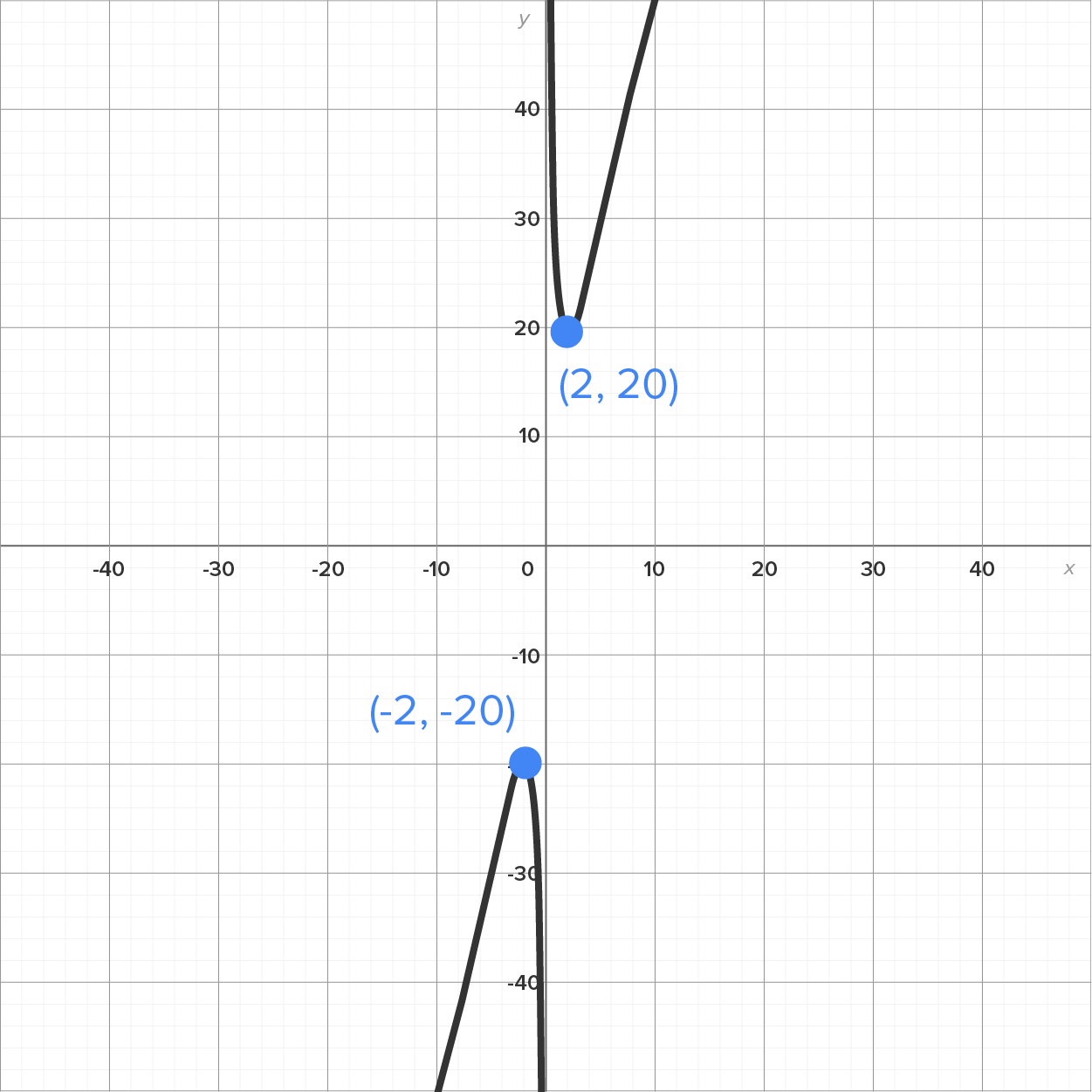
Let’s now look at an example where the second derivative test cannot be used.
EXAMPLE
Determine the local maximum and minimum values of

|
Start with the original function; the domain is all real numbers. |

|
Take the derivative. |
   
|
Set and solve.
|
 then substitute
|
|
Take the first derivative. |

|
Take the second derivative. |

|
Substitute the critical number, .
|
attains a local maximum or minimum at
at  we now turn back to the first derivative,
 and
and 
 (increasing)
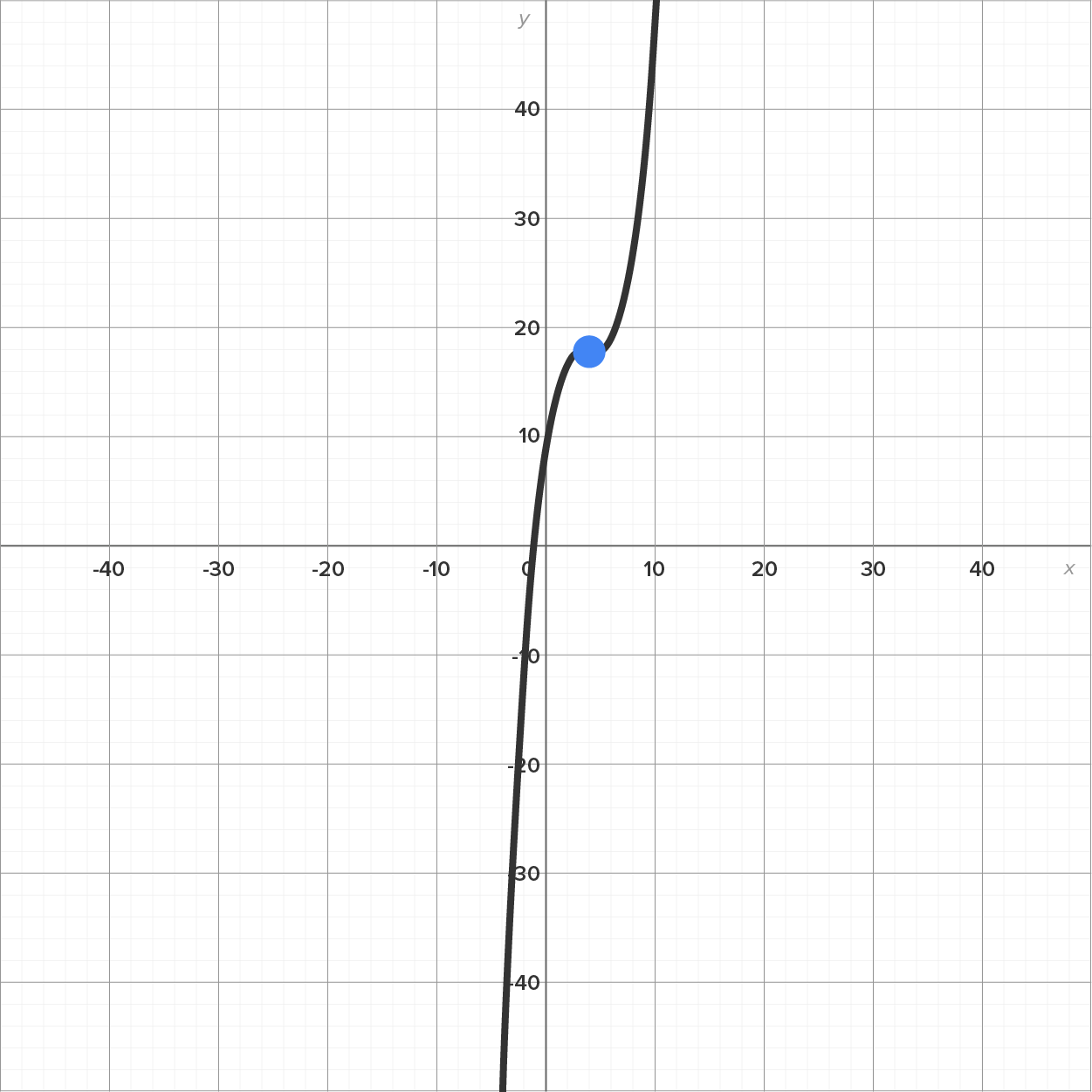
 (increasing) is increasing on both sides of this means that there is no minimum or maximum when
is shown in the figure:
(increasing) is increasing on both sides of this means that there is no minimum or maximum when
is shown in the figure:
 has a local maximum or minimum at a critical value c for which , known as the second derivative test. Next, you explored several examples locating the maximum and minimum values with the second derivative test; however, when those conditions aren’t met, the first derivative test is used to determine the locations of local maximum and minimum values.
Source: THIS TUTORIAL HAS BEEN ADAPTED FROM CHAPTER 3 OF "CONTEMPORARY CALCULUS" BY DALE HOFFMAN. ACCESS FOR FREE AT WWW.CONTEMPORARYCALCULUS.COM. LICENSE: CREATIVE COMMONS ATTRIBUTION 3.0 UNITED STATES.
Suppose  , which means
  has a horizontal tangent at
  .
.
• If  , this means
  is concave down around c, which means there is a local maximum at c.
• If  , this means
  is concave up around c, which means there is a local minimum at c.
• If  , the test is inconclusive, and the first derivative test needs to be used to determine the behavior at c.




