Table of Contents |
Existentialism is a philosophical approach that highlights the importance of personal freedom, individual choice, and the search for meaning in life. In education, it encourages students to become independent thinkers who take ownership of their learning.
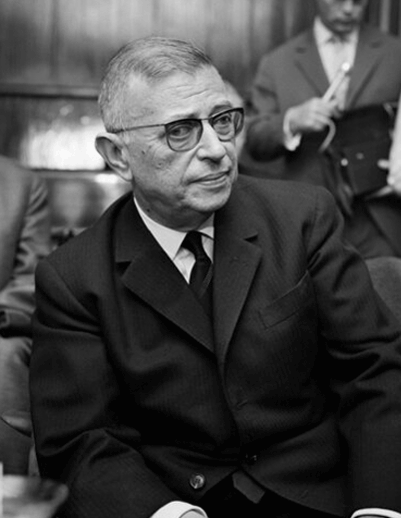
Essential thinkers in existentialism include Jean-Paul Sartre, Simone de Beauvoir, and Martin Heidegger. Jean-Paul Sartre was a French philosopher who believed that people are free to make their own choices and must take full responsibility for those choices. He argued that individuals create their own meaning through their actions. Simone de Beauvoir, also a French philosopher and a leading feminist thinker, emphasized the importance of personal freedom and the role of education in helping individuals define themselves and challenge societal expectations. Martin Heidegger, a German philosopher, focused on the concept of “being” and how people understand their existence in the world. He believed that education should help students become more aware of their place in life and the choices they face.
Together, these philosophers shaped the core beliefs of existentialism, which include freedom, individuality, personal responsibility, and the pursuit of meaning. In education, these ideas support helping students become more self-aware and guiding them to explore what matters most to them.
In an existentialist classroom, the curriculum is typically flexible, open-ended, and centered around the students’ interests and experiences. Rather than following a fixed set of lessons or standardized tests, instruction is designed to help students explore real-life issues and reflect on their personal values. Teachers may use open discussions, creative projects, journaling, and self-assessments to encourage deeper thinking and personal expression. The learning environment supports student choice and promotes meaningful engagement with topics that matter to them. The focus is on personal growth, self-awareness, and understanding rather than simply mastering content or memorizing facts.
Existentialist ideas appear in classrooms that prioritize student voice, choice, and self-expression.
EXAMPLE
In an elementary setting, students might set personal learning goals and reflect on their progress through journals or class discussions. Middle school students may choose research project topics based on individual interests, such as gaming, environmental issues, or cultural identity, fostering ownership and deeper engagement. In high school, students might select novels that resonate with their values or experiences, and these selections can lead to discussions on themes such as identity, freedom, or resilience.These practices support independent thinking and help students connect learning to their personal growth and life purpose, beyond academic achievement.
Behaviorism is a philosophy of education that focuses on how people learn by reacting to their environment. It is based on the idea that learning occurs through practice, repetition, and the reinforcement of rewards or punishments. Instead of focusing on thoughts or feelings, behaviorism examines observable actions that can be measured. In schools, this means teaching students by providing clear instructions, offering constructive feedback, and promoting good behavior through positive reinforcement.
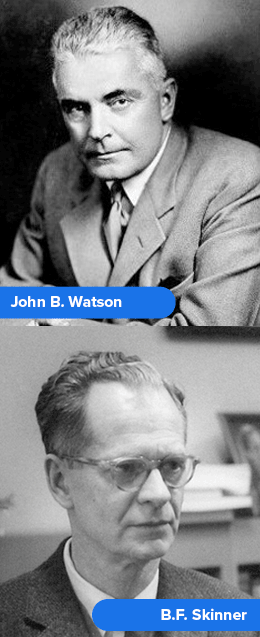
The leading thinkers behind behaviorism are John B. Watson, B.F. Skinner, and Ivan Pavlov. John B. Watson was an American psychologist who believed that all human behavior is learned through interactions with the environment. He argued that psychology should focus solely on observable actions, rather than thoughts or feelings, because behavior can be measured and studied scientifically. B.F. Skinner, another influential American psychologist, expanded on Watson’s ideas by developing the theory of operant conditioning, which explains how rewards and punishments shape behavior. Skinner believed that positive reinforcement could increase desired behaviors, while harmful consequences could reduce unwanted ones. Ivan Pavlov, a Russian physiologist, is best known for his work on classical conditioning, in which he demonstrated that a neutral stimulus (such as a bell) could be associated with an involuntary response (such as salivation) through repeated pairing with a natural stimulus (such as food). His experiments with dogs helped show that reflexive behaviors, such as salivation, can be trained to occur in response to something new through repetition.
The core beliefs of behaviorism include the idea that learning results from conditioning, that the environment plays a key role in shaping behavior, and that teachers can guide student learning by creating structured environments with clear expectations and consistent feedback.
In a behaviorist classroom, the curriculum is highly structured and focused on mastering specific skills or facts through repetition and reinforcement. Lessons are carefully broken down into small, manageable steps, allowing students to build understanding gradually. Teachers often use techniques such as drills, flashcards, and guided practice to reinforce learning. Immediate feedback is a crucial component of instruction, enabling students to correct mistakes and learn the correct responses quickly. Positive reinforcement, such as praise, stickers, points, or privileges, is used to encourage desired behaviors and academic success.
EXAMPLE
A teacher might use a reward chart to track homework completion or offer extra recess time to students who consistently participate. This approach helps maintain order and supports skill development, particularly in subjects such as math, reading, and spelling, where accuracy and repetition are crucial.Behaviorist principles are still widely used, especially in settings that benefit from structure and reinforcement.
EXAMPLE
In elementary classrooms, teachers often use behavior charts or point systems to reward task completion, following directions, and positive behavior, helping students build good habits through consistent feedback. In middle school, behaviorist strategies might include using platforms like IXL or Khan Academy, which provide instant feedback, allowing students to earn badges, and help them track progress as they master skills. High school teachers may apply behaviorism in skill-based instruction, such as language learning or math drills, using repetition and rewards to reinforce correct responses and build fluency.While some educators prefer more student-centered approaches, behaviorism remains a valuable tool for teaching foundational skills, managing behavior, and supporting learners who thrive with routine and clear expectations.
| Aspect | Existentialism | Behaviorism |
|---|---|---|
| Main Focus | Personal freedom, choice, and self-discovery | Observable behavior and responses to environment |
| Purpose of Education | Help students find meaning and become their true selves | Teach specific skills and behaviors through reinforcement |
| View of Knowledge | Subjective and personal; based on individual experience | Objective and measurable; based on facts and actions |
| Subjects Emphasized | Philosophy, literature, arts, and personal reflection | Math, reading, science, and skill-based subjects |
| Role of the Teacher | Guide and facilitator of personal growth | Instructor who shapes behavior through structure |
| Role of the Learner | Active decision-maker and self-explorer | Responder to stimuli and learner of correct behaviors |
| Student Expectations | Think deeply, make choices, and reflect on values | Follow instructions, practice tasks, and improve performance |
| Classroom Style | Flexible, open-ended, and student-centered | Structured, routine-based, and teacher-directed |
| View on Change | Driven by personal growth and self-awareness | Driven by external reinforcement and behavior modification |
Existentialism in education is often criticized for its lack of structure and clear guidelines. Because it emphasizes personal choice, self-direction, and individual meaning-making, some educators argue that it may not provide sufficient support for students who require more guidance or struggle with independent learning. Additionally, the focus on subjective experience can make it difficult to assess student progress using traditional methods, which may lead to challenges in maintaining academic standards and accountability.
Behaviorism, while effective in promoting specific skills and behaviors, is frequently critiqued for its narrow focus on observable actions. Critics argue that it overlooks the importance of internal thought processes, creativity, and emotional development. By relying heavily on rewards and punishments, behaviorist approaches may discourage intrinsic motivation and limit students' opportunities to engage in critical thinking or explore their personal interests. As a result, some educators believe that behaviorism may not fully support the development of well-rounded, independent learners.
Source: THIS TUTORIAL WAS AUTHORED BY SOPHIA LEARNING. PLEASE SEE OUR TERMS OF USE.
REFERENCES
Morris, V. C. (1990). Existentialism in education: What it means. Waveland Press. archive.org/details/existentialismin0000morr
National University. (2023, August 17). Behaviorism in education: What is behavioral learning theory? Retrieved from www.nu.edu/blog/behaviorism-in-education/
McLeod, S. (2025, May 12). Behaviorism in psychology. Simply Psychology. Retrieved from www.simplypsychology.org/behaviorism.html
McLeod, S. (2025, March 17). Operant conditioning in psychology: B.F. Skinner theory. Simply Psychology. Retrieved from www.simplypsychology.org/operant-conditioning.html
Philosophies of Life. (n.d.). Jean-Paul Sartre’s philosophy: Understanding freedom, responsibility, and authenticity. philosophiesoflife.org/jean-paul-sartres-philosophy/
Philosophies of Life. (n.d.). Simone de Beauvoir’s philosophy: Life, thought, and the ethics of ambiguity explained. philosophiesoflife.org/simone-de-beauvoirs-philosophy/
Philosophies of Life. (n.d.). Martin Heidegger’s philosophy: Easy-to-follow guide to being, truth, and meaning. philosophiesoflife.org/martin-heideggers-philosophy/



