Table of Contents |
If you want to find out if the premises are correct, then you need to see if the facts really match up to how things are. But if you want to find out if the inference is correct, then you need to ask, “Assuming all premises were true, would they support the conclusion?”
There are two different sorts of inferences: deductive and inductive. How you evaluate an argument depends on what sort of inference is at work. In the following illustration, you can see the different kinds of questions you must ask.
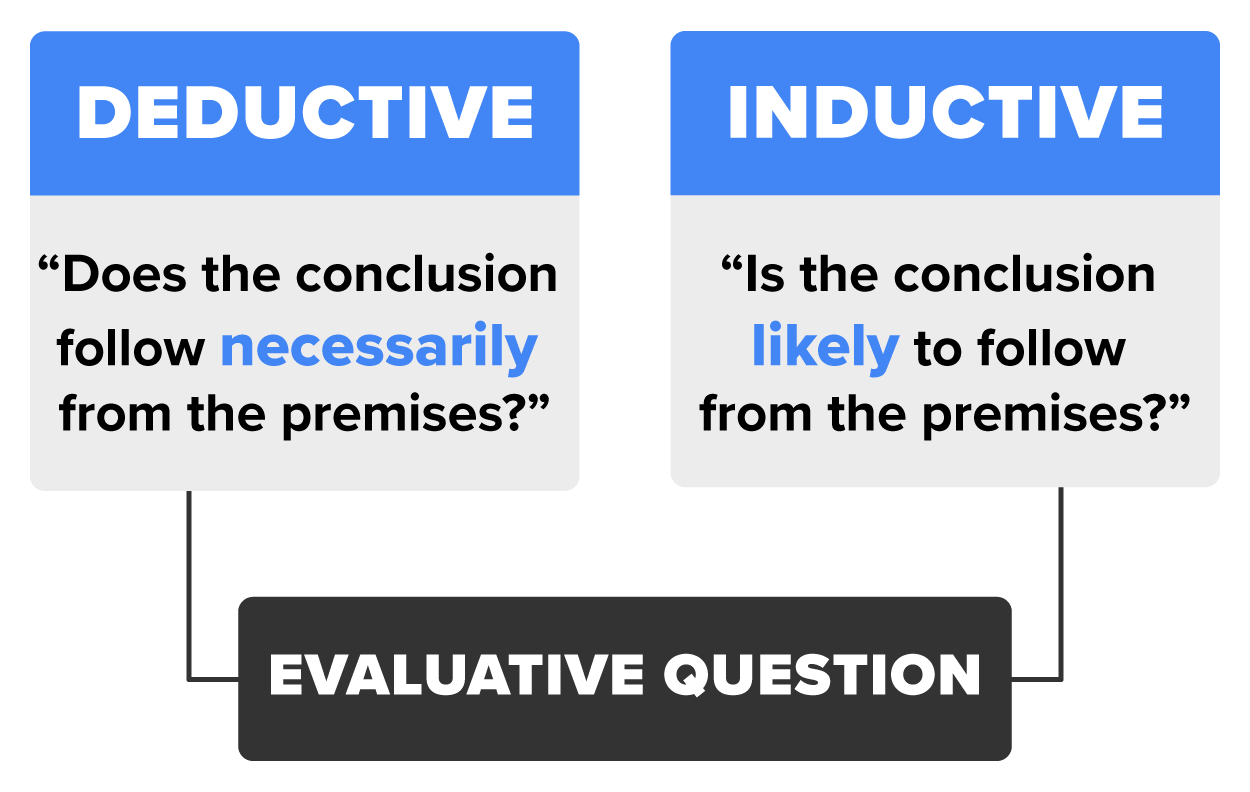
With this distinction in view, we can now look at how you should evaluate each type of inference in more detail.
A deductive argument is either valid or invalid. It must be one of these, and it cannot be somewhere in between. For instance, you can’t say a deductive argument is “somewhat valid” or “kind of invalid.”
This is because validity has to do with the necessity with which the conclusion follows from the premises. An argument is valid if there is necessity and invalid if there isn’t necessity. It should be noted, however, that a valid argument can still produce a false conclusion.
EXAMPLE
The following argument is valid but has a false conclusion: Cats can read minds. Whiskers is a cat. Therefore, Whiskers can read minds.The first premise (“cats can read minds”) is factually incorrect, but the structure of this argument is nevertheless valid. Recall that a valid argument is one where, assuming the premises are true, it is inconceivable that the conclusion is false. Since one of the premises isn’t true, a false conclusion cannot prove that it is invalid.
Let’s start with an argument that looks to be providing deductive support to a conclusion: All roses are plants. All flowers are plants. Therefore, all roses are flowers.
The premises and the conclusion are true, but the form of the argument is actually invalid. To see that this is the case, let’s go through the steps of the counterexample method.
First, you need to make the structure (the form) of the argument clear by giving symbols to the things you are talking about. In the following illustration, the symbols used are the first three letters of the alphabet.
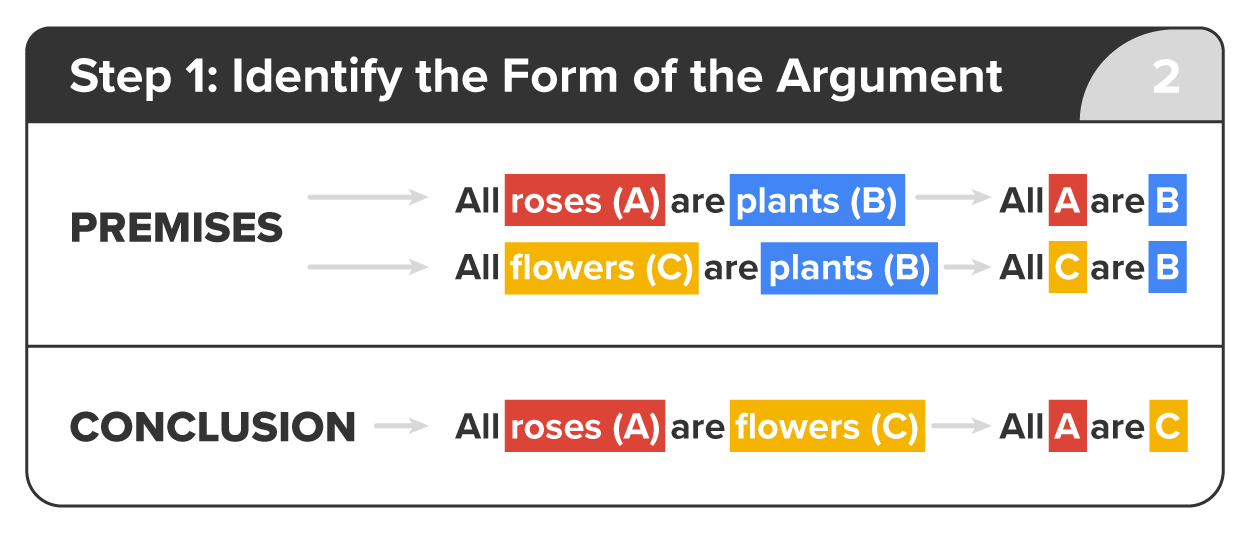
Next, you need to try to find an example of an argument of the same form but which gives a false conclusion from true premises. If you are able to find an example such as this, then you have found a counterexample to the first argument. In other words, you would have proven the argument invalid.
Let’s see how you could do this for the structure we just extracted.
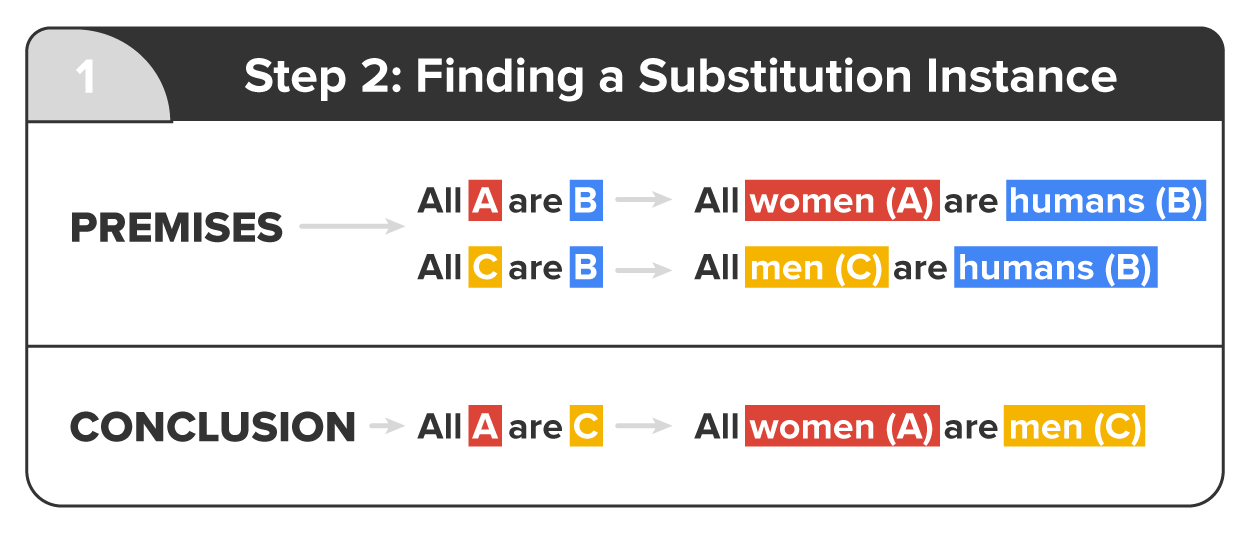
Here, the symbols have been filled in again with some content—this process is usually referred to as providing a substitution instance. You can see that the form of the argument is the same, but the conclusion is false. Therefore, you know that the argument is invalid.
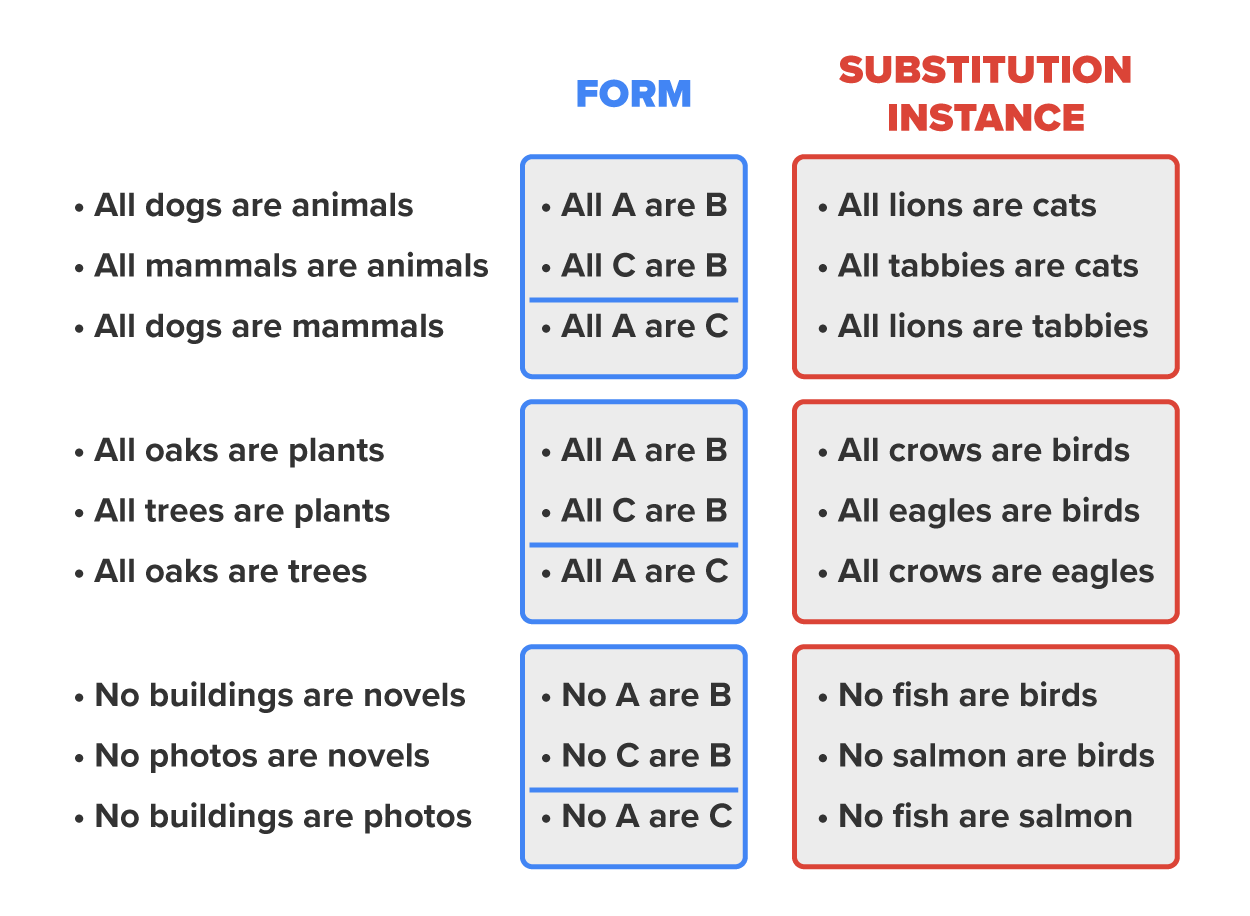
Here are some more instances of using the counterexample method to show that an argument is invalid.
An inductive argument is either strong or weak. It must be one of these, but there is room for levels of strength and weakness (e.g., “quite strong” or “very weak”). This is because evaluating the inference of an inductive argument is only a matter of likelihood or probability, rather than a matter of necessity as it is with deductive arguments.
You need to keep in mind that a strong inductive argument could still produce false conclusions if the premise is false.
EXAMPLE
Every cat you’ve walked past on this street barked at you. The next cat you walk past will probably bark.This is a strong inductive argument because if the premise were true, then the conclusion would also likely be true. However, in this case, the premise and the conclusion are untrue. This shows that strength (like validity) is not enough to make a conclusion true.
It should be noted that the counterexample method cannot be used to evaluate inductive arguments. This is because the counterexample method only proves invalidity, and inductive arguments cannot be invalid— only weak.
Source: This tutorial has been adapted from OpenStax "Introduction to Philosophy." Access for free at OpenStax. License: Creative commons attribution 4.0 international.



