Use Sophia to knock out your gen-ed requirements quickly and affordably. Learn more
×

Evaluating Solutions

Author: Sophia

what's covered
In this lesson, you will explore the next step in the problem-solving process: evaluation. You will review how you can eliminate non-viable solutions, keep those that might work, and make a final decision on the best one.

Specifically, this lesson will cover:
  1. Eliminating Options
  2. Choosing the Best

1. Eliminating Options

big idea
The evaluation stage is a time to think about your goals, narrow your list of ideas, and look more closely at options that have real potential.

Recall the four steps of the problem solving process. Notice where evaluation fits in:
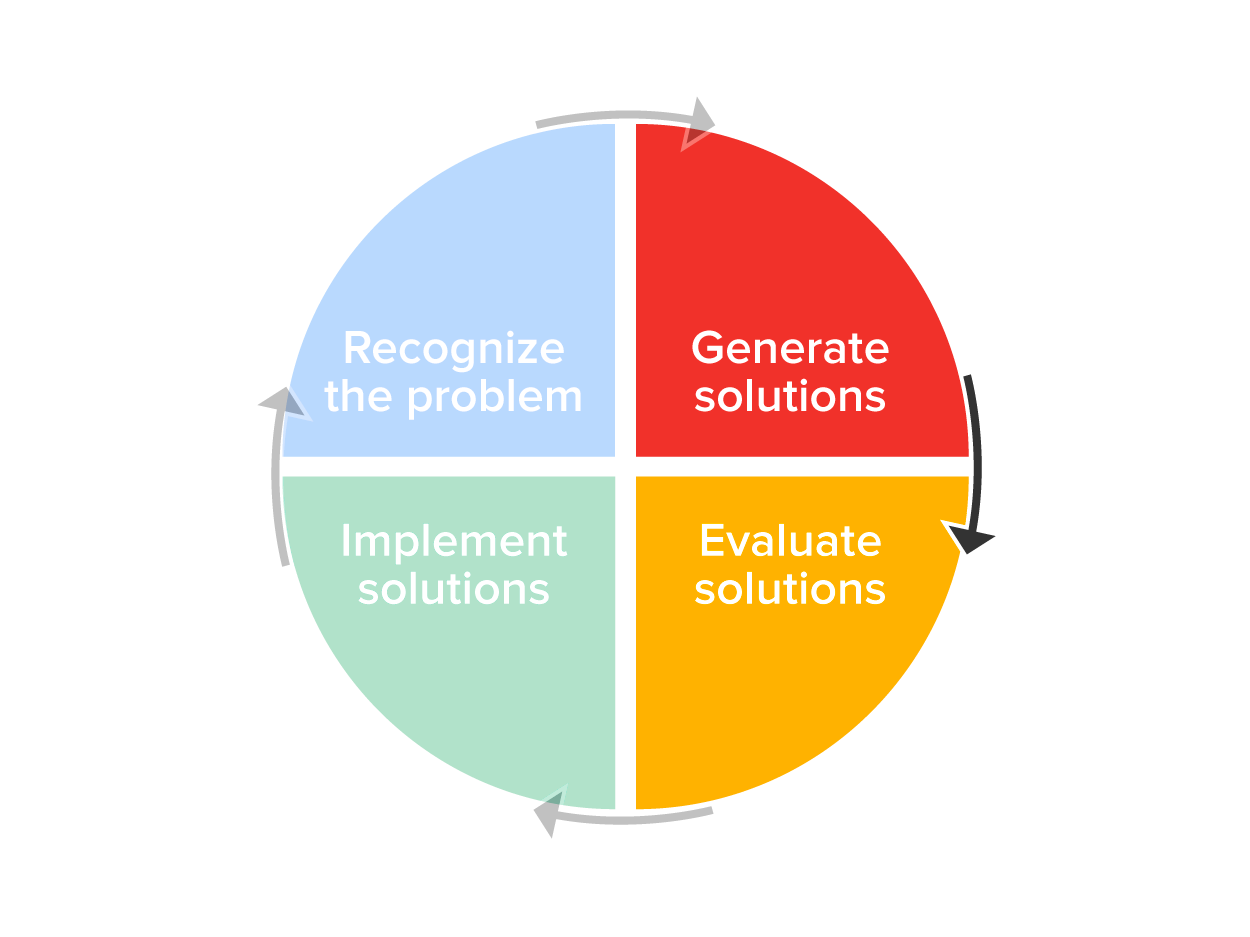
  1. Recognize the problem
  2. Generate solutions
  3. Evaluate solutions
  4. Implement solutions
the steps of the problem solving process: (one) recognize the problem, (two) generate solutions, (three) evaluate solutions, (four) implement solutions

Now that you know how to recognize a problem and generate solutions, you will move on to step three: evaluation. It's time to look more closely at the list of solutions you created during step two. Remember, as you came up with potential solutions, it was important that you not judge too harshly whether or not they would actually work. The time for that comes now in step three!

To evaluate, begin by looking at your list of ideas and determine if any can be removed immediately. For example, you might eliminate solutions that are too expensive or not feasible based on a fixed set of criteria. Consider the following example.

IN CONTEXT

Jevian had created a list of potential locations to throw a 40th birthday party for his best friend. He had come up with 12 cities across the United States that seemed like they would be fun:

Las Vegas New York Orlando Chicago Trenton Newark
Los Angeles Camden Cleveland Hartford Atlantic City Buffalo

Jevian and the birthday boy live in New Jersey. Some of the party guests live there as well, but others live in different states. Jevian had recently paid some bills and he did not have much money in his budget for travel. Knowing this, he determined he needed to remove any cities he had listed that were not in the New Jersey, New York, or Connecticut area. When he was done, he had trimmed his list to these seven options:

New York Hartford Atlantic City Buffalo
Camden Trenton Newark

When Jevian generated his first list of cities, he brainstormed and wrote down any viable city that came to mind. He didn't think in a way that would constrict his selection. During evaluation, however, Jevian began to consider potential roadblocks and issues. By eliminating solutions that simply could not be put into practice, he ended up with a reasonable list of cities that he could explore further to find the best solution.

did you know
Critical thinking is a skill that many employers seek in job candidates, regardless of the job type. In fact, it is one of the main skills that can make you a very attractive candidate for hiring and promotion. Critical thinking helps you to problem solve by considering all possible solutions and making rational judgments about which is the best to address a problem.

When you think critically, you ask questions about the issue, define the problem, and consider reliable data and evidence related to the issue. You analyze the information that you have from different perspectives and stick to logical reasoning rather than letting emotions (or bias) influence your decision-making (Bassham, Irwin, Nardone, & Wallace, 2012). In other words, a person who has critical thinking skills is able to make informed, logical decisions that are useful whether they are working as an administrative assistant or a business executive.

try it
Critical thinking skills can help you with problem-solving, especially at work. Take a look at the following link for ways you might improve your critical-thinking skills: How to Improve Critical Thinking.

terms to know

Constrict
Cause to become narrower or shorter.
Critical Thinking
A type of thought process that involves using facts and evidence to analyze something and form a judgment based on logical reasoning. Critical thinking allows one to come up with the best possible solution(s) for a problem by considering a variety of viewpoints and analyzing factual information in a rational way.
Data
Factual information that is collected on something of interest.
Bias
Prejudice that is either in favor of or against something.

2. Choosing the Best

Once a list of potential, viable solutions has been generated, the evaluation process can continue in more depth. You want to do the following to help you consider each option:

step by step

  1. Create a list of criteria for judging all solutions. Some examples of criteria are cost-effectiveness, social acceptability, ease of implementation, longevity, and speed of implementation.
  2. Give weight to each criterion. Sometimes it will make sense for all the criteria to have the same weight. Sometimes, however, a criterion may be more important and be weighted more heavily. For example, cost may be more important if you have a strict budget.
  3. Rank all criteria. Give each solution a score from one to five based on the criterion, where five is the highest. Other ranges can be used depending on the number of potential solutions.
You can create a table to help you track your options and how well they fulfill the criteria. Take a look at what Jevian’s chart might look like:

Solution Cost Attractions Easiest to Plan Total
New York 5 7 6 18
Camden 4 5 3 12
Hartford 1 1 2 4
Trenton 6 3 1 10
Atlantic City 7 6 5 18
Newark 3 4 4 11
Buffalo 2 2 7 11

With seven potential solutions, Jevian ranked each criterion on a scale of one to seven, with seven meaning it was the best solution for that criteria. He also ranked Cost as the most important criteria with Attractions and Easiest to Plan holding equal weight.

When looking at the totals, Atlantic City and New York are tied with 18 points each. In a case like this, Jevian would look at the cost to see which one scored higher. Remember that Cost was ranked as the most important criterion. Since Atlantic City scored higher (7), it would mean Jevian should throw the party in Atlantic City.

think about it
Can you recall a recent problem you had to solve? Did you use any sort of ranking method to determine the best solution? If not, do you think a process like this could have helped you?

term to know

Viable
Capable of working.
summary
In this lesson, you learned about step three in the problem-solving process: evaluating solutions. You considered the need to eliminate some options before you look more closely at what choosing what might work best. You reviewed an example of how you can use criteria and rankings to help you as you make your decision. You then reflected on some of your own past experiences and how a method like this could be helpful.

REFERENCES

Bassham, G., Irwin, W., Nardone, H., & Wallace, J. (2012). Critical thinking: A student’s introduction, 5th ed. McGraw-Hill Education.


Terms to Know
Bias

Prejudice that is either in favor of or against something.

Constrict

Cause to become narrower or shorter.

Critical Thinking

A type of thought process that involves using facts and evidence to analyze something and form a judgement based on logical reasoning. Critical thinking allows one to come up with the best possible solution(s) for a problem by considering a variety of viewpoints and analyzing factual information in a rational way.

Data

Factual information that is collected on something of interest.

Viable

Capable of working.
