In this lesson, you will examine core ideas in business ethics and how they shape everyday decisions in finance and management. You’ll learn key terms, practice-oriented skills, and the connection between personal values, organizational culture, and law. Specifically, this lesson will cover:
Ethics is the set of moral principles that guide a person’s behavior. These morals are shaped by social norms, cultural practices, and religious influences. Ethics reflects beliefs about what is right, what is wrong, what is just, what is unjust, what is good, and what is bad in terms of human behavior. It serves as a compass to direct how people should behave toward each other, understand and fulfill their obligations to society, and live their lives.
While ethical beliefs are held by individuals, they can also be reflected in the values, practices, and policies that shape the choices made by decision-makers on behalf of their organizations. The phrases “business ethics” and “corporate ethics” are often used to describe the application of ethical values to business activities. Ethics applies to all aspects of conduct and is relevant to the actions of individuals, groups, and organizations.
In addition to individual ethics and corporate ethics, there is professional ethics. Professionals such as managers, lawyers, and accountants are individuals who exercise specialized knowledge and skills when providing services to customers or to the public. By virtue of their profession, they have obligations to those they serve.
EXAMPLE
In 2020, internal auditors at Luckin Coffee, a rapidly growing Chinese coffee chain listed on the NASDAQ, uncovered that the company had fabricated over $300 million in sales. The fraudulent activity was orchestrated by senior executives to inflate revenue and mislead investors about the company’s financial performance.
Despite pressure from within the company, the auditors reported their findings to the board of directors. This internal whistleblowing led to an independent investigation, which confirmed the fraud. As a result, several top executives were fired, the company’s stock plummeted, and it was eventually delisted from the NASDAQ.
This case highlights the critical role of professional ethics in finance. The auditors, bound by ethical standards and professional duty, chose to act with integrity—even when it meant exposing wrongdoing at the highest levels of the company. Their actions protected investors and upheld the credibility of financial reporting.
big idea
The concept of corporate social responsibility emphasizes ethical behavior in that it requires organizations to understand, identify, and eliminate unethical economic, environmental, and social behaviors.
terms to know
Ethics
The study of principles relating to right and wrong conduct.
Norms
Rules or laws that govern a group’s or a society’s behaviors.
Values
A collection of guiding principles; what one deems correct, important, and desirable in life, especially regarding personal conduct.
2. Ethics Training
Moral reasoning is the process in which an individual tries to determine the difference between right and wrong in a personal situation by using logic. To make such an assessment, one must first know what an action is intended to accomplish and what its possible consequences will be for others.
People use moral reasoning in an attempt to do the right thing. They are frequently faced with moral choices, such as whether to lie to avoid hurting someone’s feelings or to take an action that will benefit some while harming others. Such judgments are made by considering the objective and the likely consequences of an action. Moral reasoning is the consideration of the factors relevant to making these types of assessments.
According to consultant Lynn W. Swaner, moral behavior has four components:
Moral sensitivity, which is “the ability to see an ethical dilemma, including how our actions will affect others”
Moral judgment, which is “the ability to reason correctly about what ‘ought’ to be done in a specific situation”
Moral motivation, which is “a personal commitment to moral action, accepting responsibility for the outcome”
Moral character, which is a “courageous persistence in spite of fatigue or temptations to take the easy way out”
The ability to think through moral issues and dilemmas, then, requires an awareness of a set of moral and ethical values; the capacity to think objectively and rationally about what may be an emotional issue; the willingness to take a stand for what is right, even in the face of opposition; and the fortitude and resilience to maintain one’s ethical and moral standards.
Realizing good conduct, being an effective moral agent, and bringing values into one’s work all require skills in addition to a moral inclination. Studies have uncovered four skill sets that play a decisive role in the exercise of moral expertise:
Moral imagination: This is the ability to see a situation through the eyes of others. Moral imagination achieves a balance between becoming lost in the perspectives of others and failing to leave one’s own perspective.
Moral creativity: This is the ability to frame a situation in different ways and is closely related to moral imagination.
Reasonableness: This is the ability to balance openness to the views of others with a commitment to moral values and other important goals; that is, a reasonable person is open but not to the extent where they are willing to believe just anything and/or fail to keep fundamental commitments.
Perseverance: This is the ability to decide on a moral plan of action and then adapt to any barriers that arise in order to continue working toward that goal.
IN CONTEXT
William LeMesseur designed the Citigroup Center in New York. When a student identified a critical design flaw in the building during a routine class exercise, LeMesseur responded not by shooting the messenger but by developing an intricate and effective plan for correcting the problem before it resulted in drastic real-world consequences.
The Citigroup Center
3. Culture and Ethics
Culture is the shared way of life within a group, shaped by common values, beliefs, goals, and practices. It evolves across time, regions, and organizations, and reflects the moral standards that guide behavior and interaction.
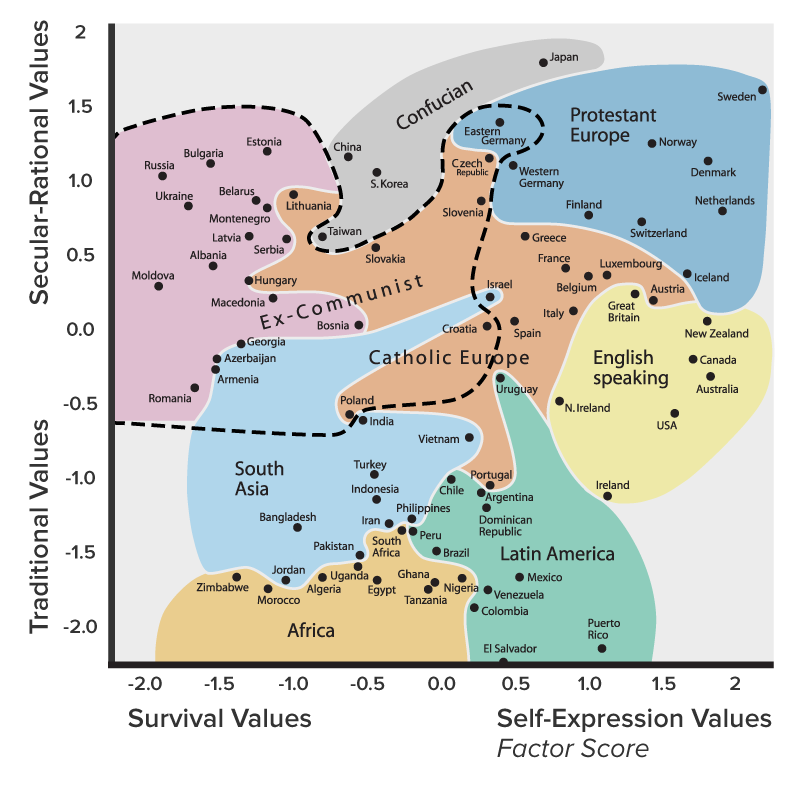
The diagram below maps countries based on two cultural dimensions: traditional vs. secular-rational values, and survival vs. self-expression values. Countries are grouped into cultural zones such as Catholic Europe, English-speaking, and Ex-Communist regions.
A cultural map of the world
In global finance, culture and ethics shape how financial professionals make decisions, interact with clients, and comply with regulations. While financial principles such as valuation, risk management, and capital allocation are universal, their application is deeply influenced by local customs, values, and ethical norms.
Cultural differences can affect:
Risk Attitudes: In the U.S., risk-taking is often encouraged as a path to innovation and growth. In contrast, countries like Japan or Germany may emphasize caution and long-term stability.
Decision Making: In hierarchical cultures (e.g., South Korea), decisions may be centralized and deferential to seniority. In more egalitarian cultures (e.g., Sweden), consensus and collaboration are valued.
Transparency and Disclosure: Western financial systems often emphasize full disclosure and shareholder rights. In some emerging markets, informal networks and opaque practices may still dominate.
Ethical expectations also vary:
Bribery and Corruption: Practices considered normal in one country, such as facilitation payments, may be illegal elsewhere. Global firms must navigate these differences while complying with international laws like the U.S. Foreign Corrupt Practices Act (FCPA).
Corporate Social Responsibility (CSR): European firms often lead in integrating environmental, social, and governance (ESG) into financial reporting, while others may prioritize short-term profitability.
IN CONTEXT Coca-Cola’s Ethical Challenges in India
In the early 2000s, Coca-Cola faced backlash over allegations of excessive groundwater extraction and pollution near its bottling plants in rural India. Local communities accused the company of depleting water resources and harming agriculture.
While Coca-Cola complied with Indian legal standards, the company underestimated the cultural and ethical expectations of local communities, where water is considered a shared public resource. The backlash led to plant closures, protests, and reputational damage.
Often culture intersects with ethics. Since interpretations of what is moral are influenced by cultural norms, the possibility exists that what is ethical to one group will not be considered so by someone living in a different culture. According to cultural relativists, this means that there is no singular truth on which to base ethical or moral behavior for all time and geographic space, as our own culture influences our interpretations of truths. This approach is in contrast to universalism, which holds the position that moral values are the same for everyone. Cultural relativists consider this to be an ethnocentric view, as the universal set of values proposed by universalists is based on their set of values. Cultural relativism is also considered more tolerant than universalism, because if there is no basis for making moral judgments between cultures, then cultures must be tolerant of each other.
term to know
Ethnocentric
Of the idea or belief that one’s culture is more important than or superior to other cultures.
4. The Manager’s Role in Ethical Conduct
In financial management, personal values influence how professionals handle money, make investment decisions, and manage resources on behalf of others. These values serve as a moral compass when facing complex financial choices.
Financial managers are often responsible for decisions that affect shareholders, employees, and the broader public. Whether it's budgeting, capital investment, or financial reporting, ethical judgment is essential. For example, a manager’s personal commitment to honesty and transparency can guide them to report financial results accurately, even when under pressure to meet short-term targets.
When personal values align with an organization’s ethical standards, decision making becomes more consistent and principled. Companies often seek employees whose values support their culture of integrity, accountability, and long-term value creation.
However, conflicts can arise. A financial manager might be asked to approve aggressive accounting practices or cut corners to meet earnings goals. In such cases, a clear understanding of one’s values helps one resist unethical pressure and make decisions that uphold both personal integrity and professional responsibility.
Ultimately, ethical financial management depends not just on rules and regulations, but on individuals who are guided by strong personal values.
think about it
Think of a situation where a financial manager might face pressure to act unethically. How might personal values influence their decision? What steps can organizations take to support ethical decision making in these situations?
5. Blurring Ethical Lines
While both laws and ethics aim to guide behavior, they are fundamentally different in nature.
Laws are formal rules established by governments and must be followed. Failure to comply can result in penalties or legal action.
Ethics are moral principles that guide what individuals and organizations consider right or wrong.
In finance, legal compliance ensures that firms meet regulatory standards, such as accurate financial reporting or insider trading restrictions. However, ethical behavior goes beyond legal requirements, encouraging transparency, fairness, and accountability even when the law is silent.
5a. The Role of Individual Judgment
Ethical decision making in finance often falls to individuals, especially in situations where the law is ambiguous or silent. Financial professionals may face ethical gray areas like aggressive tax strategies or earnings management that are technically legal but ethically questionable. In these cases, individuals must rely on their personal judgment, guided by professional codes of ethics and organizational values. Ethical decisions require considering the potential consequences of actions, including who might be harmed and how likely that harm is. This process is complex and often influenced by personal beliefs, workplace culture, and perceived expectations.
5b. Ethical Integrity in Practice
In finance, ethical integrity means doing the right thing even when no one is watching. Many ethical breaches occur not because individuals do not know what is right, but because they believe they will not be caught or that the ends justify the means. For example, manipulating financial statements to meet short-term goals may seem justified if it protects jobs or boosts stock prices. However, such actions can erode trust and lead to long-term damage. Ethical finance professionals uphold their values consistently, recognizing that trust and credibility are essential to the health of financial markets.
IN CONTEXT
Between 2011 and 2016, Wells Fargo, one of the largest banks in the United States, became the center of a major ethical scandal. Employees, under intense pressure to meet aggressive sales targets, opened over 2 million unauthorized bank accounts and credit cards in customers’ names, without their knowledge or consent. These actions were driven by a corporate culture that rewarded high sales numbers, often at the expense of ethical behavior.
Although the actions violated customer trust and internal policies, they were not initially illegal under existing laws. This highlights the distinction between legal compliance and ethical responsibility. Many employees likely knew the behavior was wrong but felt justified or pressured to meet unrealistic goals. The scandal eventually led to $3.7 billion in fines and settlements, the resignation of top executives, and long-term damage to the bank’s reputation.
summary
In this lesson, you defined ethics, including how moral principles (shaped by norms, culture, and professional obligations) guide behavior for individuals and organizations. You also examined ethics training, where moral reasoning and skills like moral imagination, reasonableness, and perseverance help people recognize dilemmas and act with integrity.
In addition, you explored culture and ethics, seeing how national and organizational cultures influence risk attitudes, decision making, transparency, and expectations for responsibility across global contexts. You then analyzed the manager’s role in ethical conduct, including how personal values, transparent reporting, and accountability support fair, long-term decisions even under pressure.
Next, you investigated blurring ethical lines, clarifying the difference between what is legal and what is ethical in areas like reporting and compliance. You also considered the role of individual judgment, where professionals navigate gray areas using codes of ethics and an awareness of potential harm. Finally, you evaluated ethical integrity in practice, which means doing the right thing consistently, even when unobserved, to protect trust, people, and markets.