Table of Contents |
Ethics are the moral standards by which members of a society agree to conduct themselves as they make decisions about right and wrong. For example, many societies value integrity, respect, and responsibility. Every ethical action helps pass forward the actions, and habits of action, to the next generation. Doctors, lawyers, journalists and police officers, for example, have professional codes of ethics to guide their professional conduct. If you consistently treat others with respect, fairness, and integrity, you’ll be able to manage most ethical dilemmas.
Ethical theory involves attempts to provide a clear, concise, and unified account of one’s ethical obligations: where they come from, what they are, and how they guide one’s actions, behaviors, and decisions. It involves the evaluation of actions as right or wrong by the degree to which they adhere, follow, or conform to a specific code of conduct, set of principles, or decision-making model. For example, if a therapist’s code requires confidentiality, then an action which conforms to this principle would be considered right or ethical, but an action that revealed a patient’s private information would be considered wrong or unethical. Ethical theories are generally normative; that is, they say how people or other entities (like businesses) ought to behave instead of making factual statements about how they do behave. The word gets its meaning from the idea of establishing a norm for behavior by listing the principles that would guide decisions in a perfect world.
The word “ethics” means different things to different people. Whether it is an ethical lapse in business or politics, or a disagreement about medical treatments and end-of-life choices, people come into contact with ethical dilemmas regularly. The workplace is no exception.
What kinds of support material and sources are ethical to use in the workplace? How much should a person adapt to an audience, customer, client, or patient without sacrificing their own views? What makes an action ethical? Elspeth Tilley, a communication ethics expert from Massey University, proposes a structured approach to thinking about ethics: a pyramid that illustrates the ethics of intentions, means, and ends. You might recall that deontology is more interested in good intentions, and utilitarian ethics is more concerned with ends. This model allows you to consider ethical decisions in a more holistic way in which both intentions and consequences—and how you achieve them—are all important.
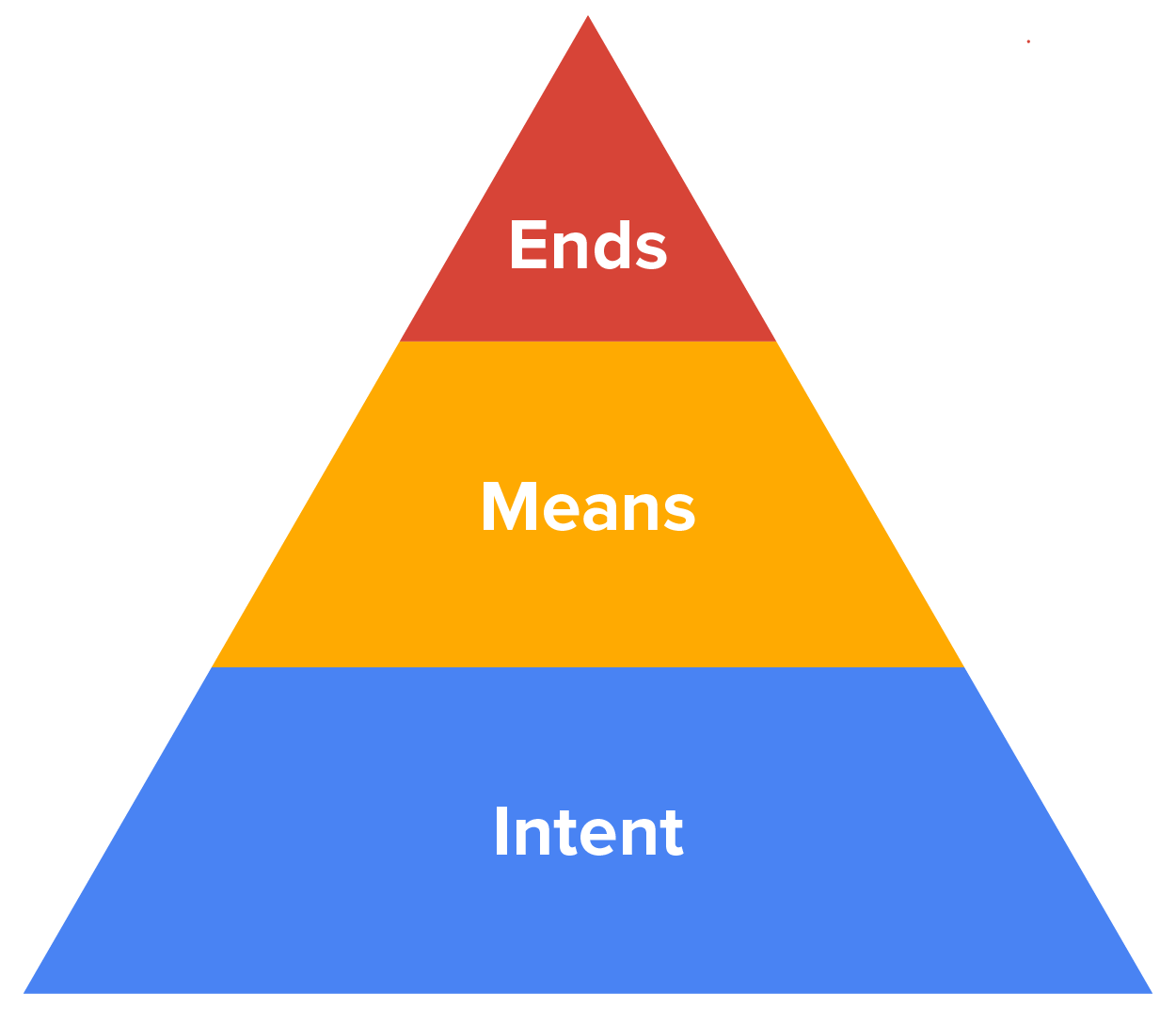
According to Tilley, the first major consideration to be aware of when examining the ethicality of something is the issue of intent, or why one does what one does. To be an ethical speaker or listener, it is important to begin with ethical intentions. Let’s start with the principle of honesty. If you agree that honesty is ethical, it follows that as an ethical employee you will prepare your remarks with the intention of telling the truth to stakeholders (whether they are customers or colleagues). Similarly, if you agree that it is ethical to listen with an open mind, it follows that you will be intentional about letting a person make their case before forming judgments.
One option for assessing intent is to talk with others about how ethical they think a behavior is; if you get a variety of answers, it might be a sign that the behavior is not ethical and should be avoided. A second option is to check out existing codes of ethics. Many professional organizations, including the Independent Computer Consultants Association, American Counseling Association, and American Society of Home Inspectors, have codes of conduct or ethical guidelines for their members. Individual corporations such as Monsanto, Coca-Cola, Intel, and ConocoPhillips also have ethical guidelines for how their employees should interact with suppliers or clients. Even when specific ethical codes are not present, you can apply general ethical principles, such as whether a behavior is beneficial for the majority or whether you would approve of the same behavior if you were listening to a speech instead of giving it.
In addition, it is important to be aware that people can engage in unethical behavior unintentionally. For example, most people agree that it is unethical to take someone else’s words and pass them off as one's own—a behavior known as plagiarism. What happens if an employee makes a statement that she believes she thought of on her own, but the statement is actually quoted from a radio commentator whom she heard without clearly remembering doing so? The plagiarism was unintentional, but does that make it ethical? In general, no; people are responsible for their actions and must take care in how they do things.
Tilley describes the means you use to communicate with others as the second level of the ethics pyramid. Means involves how one does what one does, the tools or behaviors one employs to achieve a desired outcome (McCroskey et al, 2003). There are usually a range of possible behavioral choices for any situation, and some choices are good, some are bad, and some fall in between.
The final part of the ethics pyramid is the ends. Ends are the outcomes that one desires to achieve from one’s actions (McCroskey, 2003). Examples of ends might include persuading your audience to make a financial contribution for your participation in Relay for Life, convincing a group of homeowners that your real estate agency would best meet their needs, or getting customers to buy life insurance. Whereas the means are the behavioral choices you make, the ends are the results of those choices. Ends involve the results, outcomes, or consequences of what you do.
Like intentions and means, ends can be good or bad, or they can fall into a gray area where it is unclear just how ethical or unethical they are. For example, suppose a city council wants to balance the city’s annual budget. Balancing the budget may be a good end, assuming that the city has adequate tax revenues and areas of discretionary spending for nonessential services for the year in question. However, voters might argue that balancing the budget is a bad end if the city lacks these things for the year in question, because in that case, balancing the budget would require raising taxes, curtailing essential city services, or both.
When examining ends, you need to think about both the source and the receiver of your actions. Some end results could be good for the source but bad for the receiver, or vice versa. Suppose, for example, that you are helping your niece raise money for her dance club by selling raffle tickets; the prize is a free dance lesson. You sell Ben ten dollars' worth of tickets. Ben indicates that he has no interest in taking the lesson even if he wins. Anita’s club has gained ten dollars—a good end—but Ben has lost ten dollars, which is a bad end. The ethical standards you expect of yourself and others will help in deciding whether a particular end (or goal) is itself ethical.
In practice, ethics is a matter of balancing all three parts of the ethical pyramid: intent, means, and ends. When thinking about the ethics of a given behavior, Tilley recommends asking yourself three basic questions:
IN CONTEXT
Regan oversees a small staff. One staff person is an old friend; she helped him get the job. She knows he’s been having a hard time due to having a new baby. He is often late for work, but she notices his time sheet is perfect. He’s signed in right at 8:00 AM every morning but is usually in between 8:15 and 8:30. “I clock in before I leave the house,” he explains. “That’s cool, right?” When she attempts to get him to be more honest in reporting his time worked, he either laughs off her suggestions or insists that it’s no big deal.
Regan thinks he does good work when he is in the office but is concerned about the behavior. She’s been put in a tough spot where she has to either let the fudging on his timesheets pass or put him in jeopardy of losing his job. Since she recommended him, it also puts her at risk of having her superiors question her judgment. She knows the behavior is unethical but broaches the topic with HR without naming names to confirm that the company does not expect people to clock in until they are at their desk and ready to work. Moreover, the code of ethics confirms that workers will be honest in their reporting of time worked.
She thinks through the pyramid.
Intentions: Regan wants to do her own job ethically and has no ill feelings for her friend, but she worries that by reporting him, she is being selfish. On the other hand, if she lets the behavior continue, it would be perceived as playing favorites.
Means: Regan has tried and failed to address the matter informally; the only means she has now is to make a formal statement to HR that his hours have been padded. Since she has approved the time sheets in the past, this also means admitting that she allowed it to happen for a few weeks.
Ends: When looking at the consequences, Regan considers the money lost to the company, the fairness to other employees who do not pad their hours, the impact of a complaint against her friend during his probationary period, and the potential impact on his family. She must also consider her own future, her professional reputation, and good standing with the company.
What decision do you think Regan should make and why?
Source: THIS TUTORIAL WAS AUTHORED BY SOPHIA LEARNING. PLEASE SEE OUR TERMS OF USE.
REFERENCES
Tilley, E. (2005). The ethics pyramid: Making ethics unavoidable in the public relations process. Journal of Mass Media Ethics, 20, 305–320.
McCroskey, J.C., Wrench, J.S., & Richmond, V. P. (2003). Principles of public speaking. Indianapolis, IN: The College Network.



