In this lesson, you will learn how your mindset can impact your ability to work toward your goals and achieve your desired results. You will better understand how employers seek candidates and employees who have the right kind of mindset. You will then explore how moving forward with positivity can help you as you use a proven technique to create goals for yourself at work, school, and home.
Specifically, this lesson will cover:
- Mindset
- Be Positive
- Work Connection
- SMART Goals
1. Mindset
Part of the results-driven skill is understanding your approach to reaching a goal. It‘s helpful to have a growth mindset, which means that you‘re confident you can develop specific abilities as you need them (like creating an organizational system for loose nails and screws as you noted in the last lesson).
-
-
- Growth Mindset
- The belief that your abilities and performance can improve over time with training and perseverance.
- 1a. Be Positive
A positive outlook will help you commit to practicing something new and will help you get past the hurdles you‘ll face along the way. It will also help you pick yourself up and try again when things don‘t go your way. And practicing your productivity skill can help you stay results-driven by allowing you to create a plan and prioritize the tasks you need to reach your goal.
To start honing your results-driven skill, try these simple tips while keeping your end goal in mind:
- Before making a decision, consider all the available options and make a thoughtful choice.
- Balance urgency and quality, understanding that each project needs to be completed quickly… but also with integrity.
- Work efficiently and maximize your time.
- Stay focused and don‘t get sidetracked by other, less important tasks.
- Be resilient in the face of challenges.
- Measure your work. Use data when possible to track and report results.
- Take pride in your accomplishments.
- 1b. Work Connection
The results-driven skill is essential in any career. Today‘s employees are required to complete their tasks while being flexible and responsive to changes that happen along the way. Being results-driven helps professional teams stay successful since they are always focused on achieving their goals.

This skill also comes into play during a career search. Whether you‘re starting your career journey or looking to make a change, practicing your results-driven skill will help you stay focused on what you want without giving up. Connecting and networking with others can sometimes feel anxiety-inducing, but it‘s also a transformational step toward getting where you want to go!
-
Think about a time when you were driven to achieve something. What challenges did you face? How did you overcome them? Whatever the details were, you can use that hustle, that "git ‘er done" spirit, as a student and in your career to take initiative and stay results-driven now and in the future.
2. SMART Goals
Having the right mindset plays a large role in achieving your goals, but before you can get started, you will need to create and understand those goals. There are many strategies that you can use to help you create goals that will get you where you want to be, but one of the most commonly used is the SMART goal technique:
Specific. What are you going to do?
Measurable. How will you measure it?
Achievable. Are you able to do it?
Relevant. Why should you do it?
Time-bound. When will you do it?
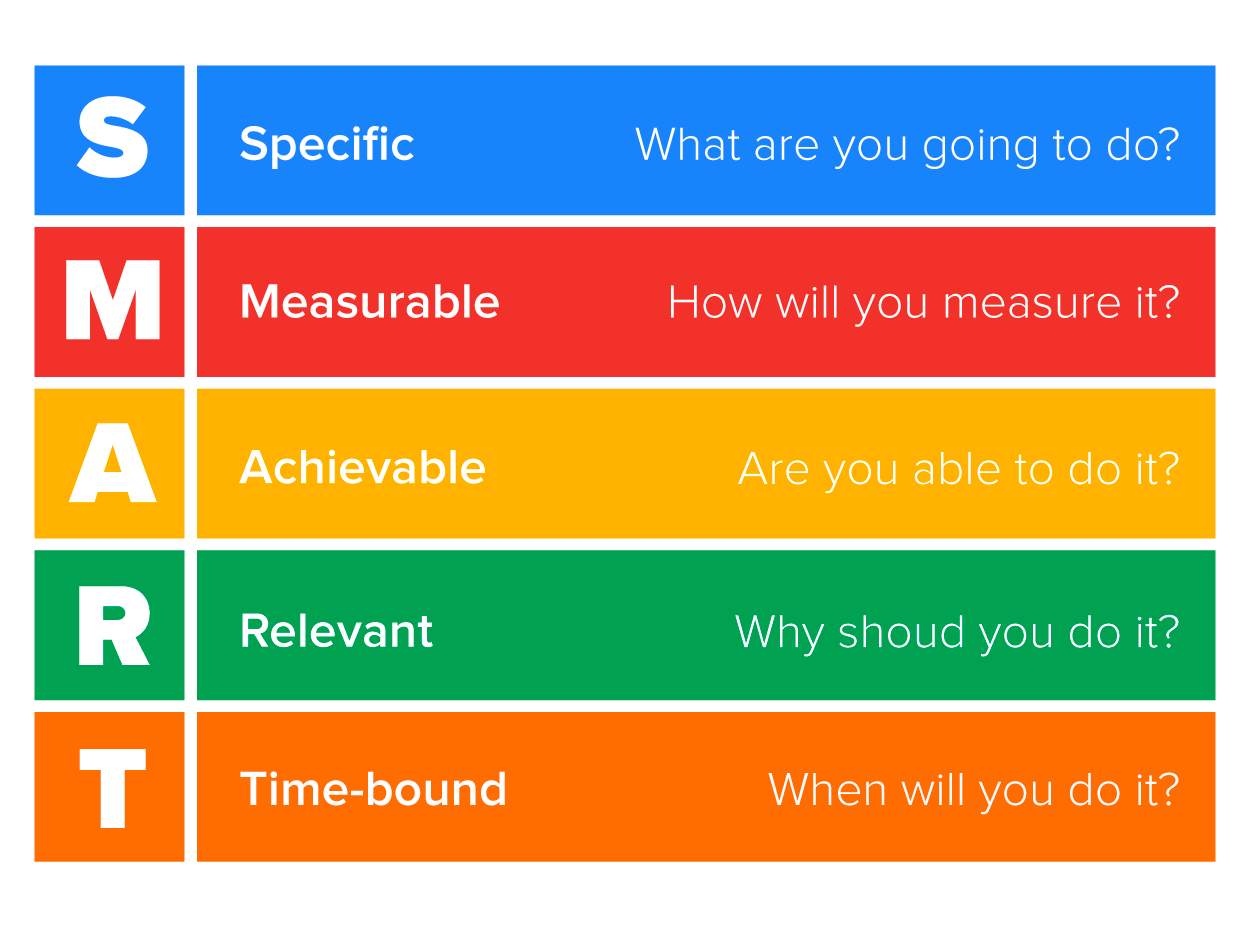
The SMART acronym is a great way to make sure you focus on key elements of good goal-setting. Using this method can help ensure that your goals are clear, realistic, and that you have a set time to achieve them. By working through each letter of the acronym, you can be sure that your final goal statement is as strong as it can be.
-
S - Think about what you want to accomplish and who will need to be involved. Why is this goal important to you? What is your general time frame to do this work?
M - How can you measure your progress and how will you know if your goal has been achieved?
A - Do you have the skills needed to do the work? If not, are you able to gain them before or along the way? Will the amount of time and work spent on the goal be worth it?
R - Why is this goal important at this point in time? Will achieving it make an impact on my life?
T - What are the deadlines that I should set along the way? What should my final deadline be? Is this work I can fit into my life given my other commitments?
Taking initiative and putting in the work upfront, before you begin your journey toward achieving your results can make it more likely that you will reach your goals. You can find many resources online to help you learn more about crafting SMART goals. There are even templates you can download and use.
The growth mindset that will help you to achieve the goals you develop using the SMART goal technique may lead to you learning new skills throughout your life. The people who adopt a growth mindset tend to embrace challenges and enjoy opportunities to learn new things and improve themselves. For those people, that includes lifelong learning, which allows them to acquire new capabilities that can be used to enhance their agility and initiative skills.
-
Think about the career that you would like to have in four years. Then, take time to look at a couple of job postings for the position that you anticipate having and consider what skills you could learn that would bring further value to the position. For instance, someone who plans to be a social worker living in an area with a large deaf community might consider taking additional courses in American Sign Language in order to become fluent. What courses or learning experiences do you think you will seek out in the future as part of
your lifelong learning?
The next time you find yourself faced with a problem or in need of a solution, consider using the SMART goal technique. It is something you can use at home, school, and work. It works for a variety of issues and can help you find more success in your life.
-
-
- Lifelong Learning
- The practice of learning new skills and building knowledge throughout one’s life.
In this lesson, you learned that a positive mindset plays a big role in whether or not you are successful in achieving your goals. You considered how important it is to have this kind of attitude at work as you look to deal with challenges and grow as an individual. You explored how using your initiative skill to take the time to plan your goals carefully using a technique like SMART goals can help you be more likely to achieve your desired results.



