Table of Contents |
Developed by workplace behavioral psychologist J. Stacy Adams in the 1960s, equity theory is the concept that motivation is affected by the outcomes we receive for our inputs compared to the outcomes and inputs of people in similar roles. This theory is based on the earlier theory of social exchange, the concept that one perceives social relationships in terms of investment and return.
EXAMPLE
Ken and Janice are friends at work. Ken frequently helps Janice out, such as covering her phone when she’s away from her desk or running copies for her when she is going to the copy room anyway. Over time, Ken realizes Janice never returns the favor, and the friendship sours.In terms of work, we don’t just ask ourselves, “Are my contributions (time and labor) worth the rewards (compensation and recognition)?” but also ask, “How do my contributions and rewards compare to my coworkers’ contributions and rewards?” Equity theory suggests that the second question is more important than the first, that we are dissatisfied if we feel our efforts are greater than other coworkers with the same salary, or similarly, if our coworkers are paid more for doing the same job. In short, we don’t just want the outcomes to be worth the effort, we want to be treated fairly.
In determining whether we are being treated fairly, we consider four factors:
Personal inputs are what we contribute to the organization that we perceive as valuable and relevant. This is based on our own perceptions; whether or not anyone else agrees doesn’t matter. These inputs include time, effort, performance, education level, skill levels, and bypassed opportunities. Since any factor we consider valuable and relevant is included in our evaluation of equity, inputs may include elements that the organization (or even the law) might argue are not important, such as our personality or our demographic characteristics.
Personal outcomes are anything we perceive we are getting back from the organization in exchange for our inputs. Again, the value attached to an outcome is based on our perceptions. Common outcomes from organizations include pay, working conditions, job status, feelings of achievement, and friendship opportunities. Both positive and negative outcomes influence our evaluation of equity. Stress, headaches, and fatigue are also potential outcomes. Since any outcome we consider relevant to the exchange influences our equity perception, we include personal factors like peer disapproval and family reactions to our job.
Equity theory predicts that we will first compare our outcomes to our inputs as a ratio. If we perceive that the outcomes we receive are commensurate with our inputs, we are satisfied. If we believe that the outcomes are not commensurate with our inputs, we are dissatisfied. This dissatisfaction can lead to ineffective behaviors for the organization if they continue, effectively lowering the inputs to match the outcomes.
But the bigger premise of equity theory is that we compare our inputs and outputs to referent others. These other people are called referent others because we refer to them when we judge equity. Usually, referent others are people we work with who do similar work and have the same amount of experience. The other two factors we thus consider are:
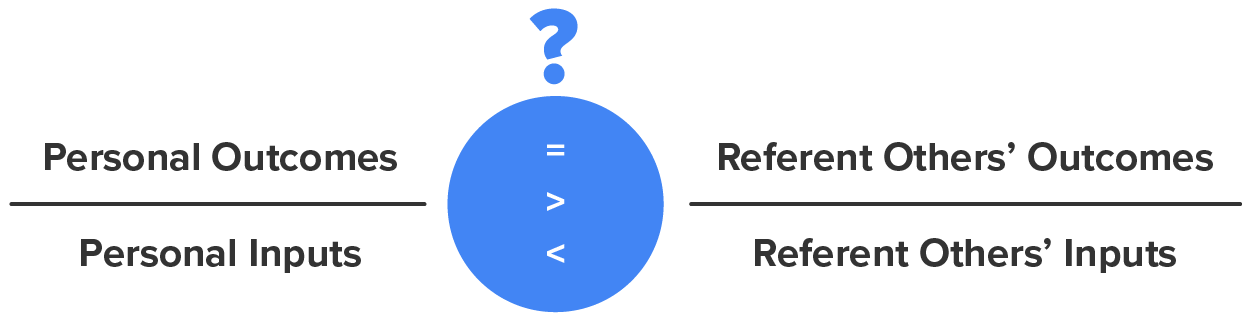
When we perceive that overreward inequity exists (that is, we unfairly make more than others), it is rare that we are dissatisfied, guilty, or sufficiently motivated to make changes to produce a state of perceived equity. Indeed, feelings of overreward, when they occur, are quite transient. Very few of us go to our employers and complain that we’re overpaid! Most people are less sensitive to overreward inequities than they are to underreward inequities. If a person is dissatisfied, they may take the same actions described below.
When we perceive that underreward inequity exists (that is, others unfairly make more than we do), we will likely be dissatisfied, angered, and motivated to change the situation (or change jobs) in order to produce a state of perceived equity. As we discuss shortly, people can take many actions to deal with underreward inequity.
| Mary | John |
|---|---|
| 10 lug nuts per car x 4 cars per hour x 40 hours @ $15.40 per hour | 10 lug nuts per car x 4 cars per hour x 40 hours @ $16.00 per hour |
| $616/week | $640/week |
Adams identified a number of things people do to reduce the tension produced by a perceived state of inequity. You might see that while the effectiveness of these varies for the employee, several are also less than ideal for the employer. It is also important to note that often, these responses by employees, whether positive or negative, can be somewhat subconscious.
| Strategy | Description | Example |
|---|---|---|
| Alter Personal Inputs | The person who perceives underreward inequity can decrease the quantity or quality of their performance. | Mary can slow down her work by about 4% (i.e., attaching 39 lug nuts per hour instead of 40). She may also take longer breaks or otherwise change her performance so that she has the same ratio of input to outputs. In this scenario, she may lose her job since it would slow down the entire assembly line, but in other settings, a person may get away with simply doing slightly less work. |
| Alter Personal Outcomes | The person who perceives underreward inequity could ask for a change to achieve a state of equity—usually a pay raise. | Mary could ask for a raise to achieve pay equity, and if she gets it, the problem is solved. In extreme cases, workers may steal from the company (such as taking office supplies) to feel their outcomes are equitable. |
| Alter Inputs of the Referent Other | The person who perceives underreward inequity may try encouraging the referent other to increase their inputs. They may demand, for example, that the referent other “start pulling their own weight,” or perhaps help the referent other to become a better performer. It doesn’t matter if the referent other is already pulling their weight—remember, this is all about perception. | Mary could ask John to do some of her own work, such as attaching all the lug nuts while she takes a short unplanned break. In other settings, it is feasible to even ask a manager to redistribute the workload until the situation is perceived as fair. |
| Alter Outcomes of the Referent Other | The person who perceives underreward inequity can mitigate a state of inequity by directly or indirectly reducing the other’s outcomes. | Mary would probably not be able to lower John’s compensation as an individual, but at an organizational level (particularly if they are in a union), she could lobby for pay equity; this is as likely to involve less pay for John as more pay for herself. |
| Alter Perceptions of the Inequity | The person who perceives underreward (or overreward) inequity can simply change their own perceptions of the situation, whether it is their own inputs and outputs or the other’s inputs and outputs. | Mary might recall that since the job pays full health insurance for her dependents, and John has no dependents, that the overall compensation package is equal to or greater than his. She might remind herself that John has been there longer, or somehow contributes more to the job. These new perceptions might be a clearer or fuller picture but might also be distorted in an effort to resolve the dilemma. |
| Choose a Different Referent Other | The person who perceives underreward or overreward inequity can change the referent other. This is the simplest and most powerful way to deal with perceived inequity. It requires neither actual nor perceptual changes in anybody’s inputs or outcomes. It causes us to look around and assess our situation more carefully. | Mary might compare herself to a person who makes the same or less than she does and decide that John is not the best comparison. Perhaps he has a two-year degree or job experience that she does not, so she can rationalize comparing herself to someone else. |
| Leave the Situation | A final technique for dealing with a perceived state of inequity is leaving the job. This is usually not done unless the perceived inequity is quite high or other attempts at achieving equity are not successful. | Mary is more likely to start looking for work elsewhere if she can match or exceed her current compensation; even if another job is a lateral move (with similar pay and responsibilities), she might find it preferable to one where she feels she is not being treated fairly. |
Equity theory is widely used, and its implications are clear. In the vast majority of cases, employees experience (or perceive) underreward inequity rather than overreward, which is really a matter of perceived fairness. As said above, most of the behaviors that result from underreward inequity are not desirable for employers. Thus, employers try to prevent unnecessary perceptions of inequity. They do this in a number of ways.
Source: THIS TUTORIAL HAS BEEN ADAPTED FROM OPENSTAX "ORGANIZATIONAL BEHAVIOR". ACCESS FOR FREE AT OPENSTAX.ORG/BOOKS/ORGANIZATIONAL-BEHAVIOR/PAGES/1-INTRODUCTION. LICENSE: CREATIVE COMMONS ATTRIBUTION 4.0 INTERNATIONAL.



