Use Sophia to knock out your gen-ed requirements quickly and affordably. Learn more
×

Equilibrium

Author: Sophia

what's covered
This lesson will cover the topic of equilibrium with a focus on the intersection of the short-run aggregate supply curve and aggregate demand, which represents the economy’s current equilibrium price level and real GDP level. Specifically, this lesson will cover the following:

Table of Contents

1. Aggregate Supply/Aggregate Demand

Let’s briefly review aggregate supply/aggregate demand.

1a. Aggregate Demand/Aggregate Supply Model

The x-axis, in microeconomics, generally represents quantity, as in the quantity of one specific item. In this case, however, it represents overall quantity or all output in an economy, which is GDP.

The y-axis represents the overall price level, not just the price of a specific item.
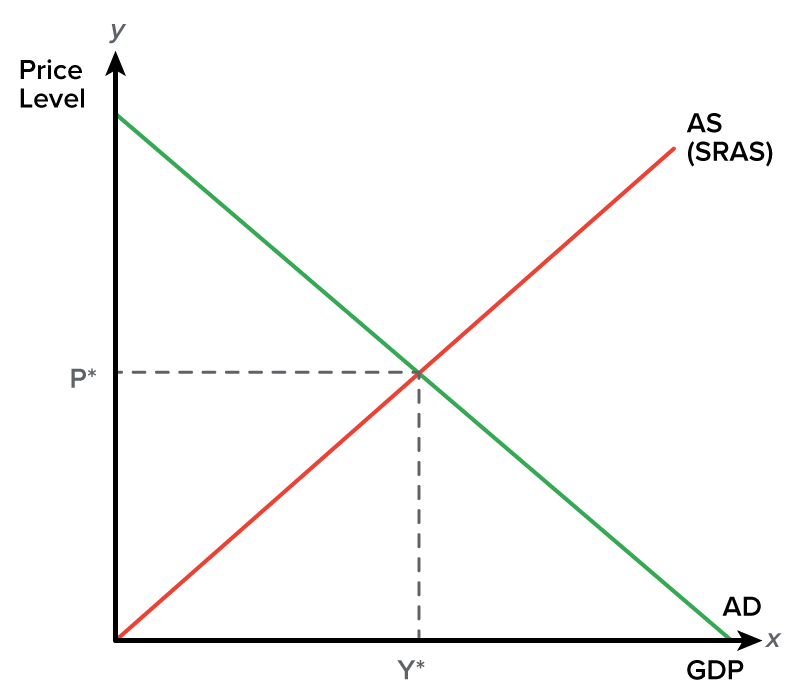
A graph depicting the aggregate supply/aggregate demand model. The horizontal x-axis represents the GDP, and the vertical y-axis represents the Price Level. The curve for aggregate supply or A S or short-run aggregate supply or S R A S starts at the origin (x equals 0, y equals 0) and slopes upward. The aggregate demand or A D curve begins at the endpoint of the y-axis and ends at the endpoint of the x-axis. The point at which the A S and the A D intersect is the equilibrium, which corresponds to the points Y* at the middle of the x-axis and P* at the middle of the y-axis. A horizontal dashed line from the point P* and a vertical dashed line from the point Y* extend to the equilibrium point.

hint
This is the most common graph used in macroeconomics to show overall, or macroeconomic, activity.

Now, real GDP, which is the x-axis, is defined as the real gross domestic product (RGDP). This is the sum of the final value of goods and services produced over a specific time interval within a country’s borders. It is calculated across time periods using a constant price level, which is where the “real” aspect enters the equation.

The “real” in RGDP indicates that we are adjusting for inflation and evaluating whether we have been more or less productive, as evidenced by our GDP.

The price level on the y-axis is an aggregate index value that provides an indication of the increase in prices from one period to another. It is used to evaluate inflation across periods.

terms to know
Real Gross Domestic Product (RGDP)
Gross domestic product (the sum of the final value of goods and services produced over a specific time interval and within a country’s national borders) calculated across time periods using a constant price level.
Price Level
An aggregate index value that provides an indication of the increase in prices from one period to another; used to evaluate inflation across periods.

1b. Aggregate Demand

Aggregate demand is the total amount of goods and services demanded in the economy at a specific point in time and at a prevailing price level.

Here is our aggregate demand curve. Notice that it is a downward-sloping curve, which shows an inverse relationship between the two axes, price level, and real GDP.
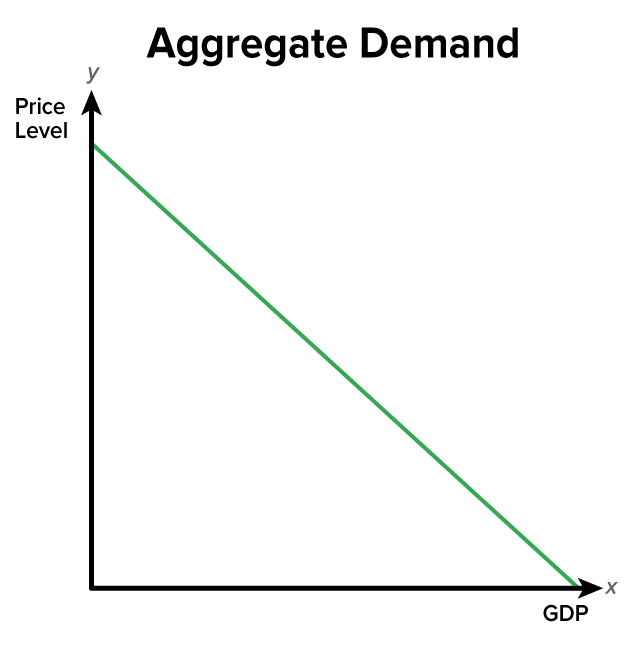
A graph of an aggregate demand curve represented by a line resembling the hypotenuse of a right-angled triangle. The x-axis is labeled ‘GDP’, whereas the y-axis is labeled ‘Price Level’. The A D curve slopes downward, beginning at the top of the y-axis and ending at the end of the x-axis.
This implies that people (consumers, firms, governments, and net foreign purchases of U.S. goods) will want to purchase more as the overall price level falls.

This indicates that people want to purchase more as the overall price level falls. So, as prices go down, people want to buy more.

However, it is important to note that when we say “people” want to purchase more, we are actually referring to different groups of people, which comprise the aggregate demand formula.

formula to know
Aggregate Demand
table attributes columnalign left end attributes row cell A D equals C plus I plus G plus left parenthesis X minus M right parenthesis end cell row cell w h e r e end cell row cell C equals C o n s u m p t i o n space o r space C o n s u m e r s space end cell row cell I equals I n v e s t m e n t comma space R e f e r r i n g space t o space B u s i n e s s e s space o r space F i r m s space end cell row cell G equals space G o v e r n m e n t s space end cell row cell X minus M equals E x p o r t s space M i n u s space I m p o r t s equals N e t space F o r e i g n space P u r c h a s e s space o f space D o m e s t i c space G o o d s end cell end table

Now, in a different lesson, we cover the reasons people want to purchase more as the overall price level falls, but basically, it is because of three different effects—the wealth effect, interest rate effect, and exchange rate effect.

term to know
Aggregate Demand
The total amount of goods and services demanded in an economy at a specific point in time and at a prevailing price level.

1c. Aggregate Supply

Short-run aggregate supply (SRAS), the other curve in this model, is assumed to maintain a positive correlation between price and quantity. More can be produced through increased resource utilization, technological improvements, or other factors.

For these reasons, the SRAS curve is, in fact, an upward-sloping curve. It represents the total amount produced at various price levels.
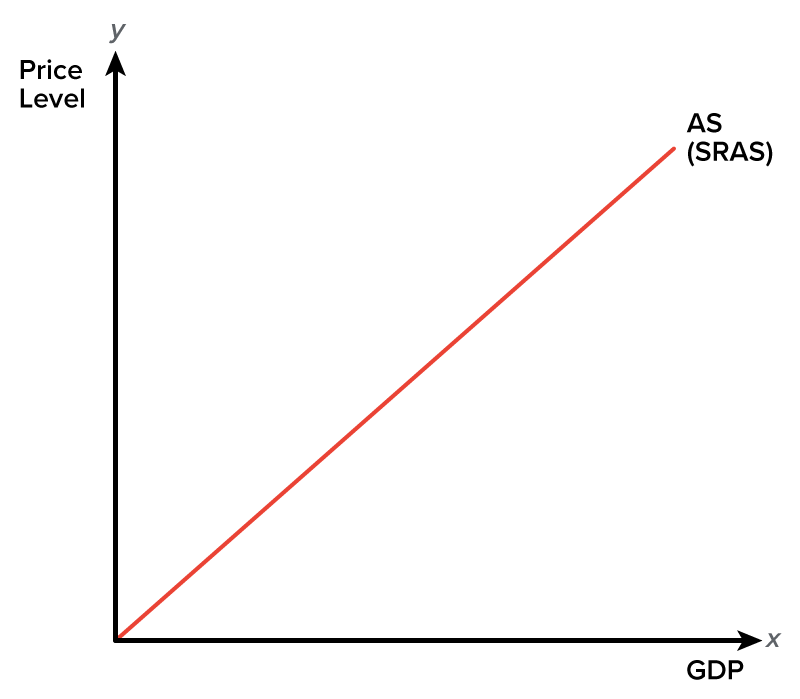
A graph depicting the concept of aggregate supply or A S. The horizontal x-axis represents the GDP, and the vertical y-axis represents the Price Level. The curve for A S or short-run aggregate supply or S R A S starts at the origin (x equals 0, y equals 0) and slopes upward. The curve is represented by a line.

In the short run, if prices go up, businesses can take advantage of this and produce more. They will not have to necessarily pay their workers more immediately because, as prices go up, wages will not immediately adjust. In addition, businesses can use the inventories that they already have.

Therefore, this is why it is possible for aggregate supply to slope upward in the short run.

term to know
Short-Run Aggregate Supply (SRAS)
Assumed to maintain a positive correlation between price and quantity; more can be produced through increased resource utilization, technological improvements, or other factors. SRAS is an upward-sloping curve.


2. Equilibrium

This lesson, though, is about equilibrium, so let’s shift our focus.

2a. Short-Run Equilibrium

In the short run, the point where aggregate demand and SRAS intersect will give us equilibrium.
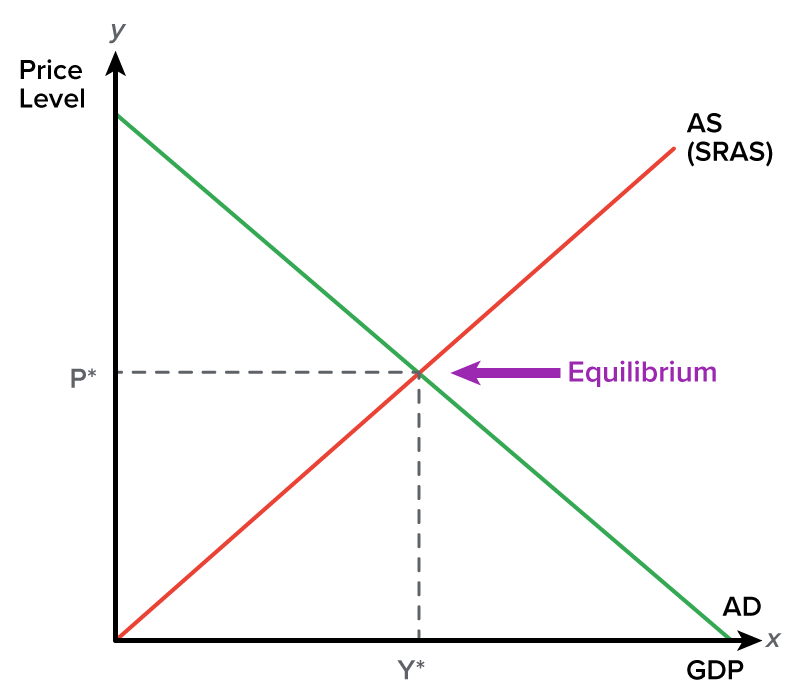
A graph depicting the aggregate supply/aggregate demand model. The horizontal x-axis represents the GDP, and the vertical y-axis represents the Price Level. The curve for aggregate supply or A S or short-run aggregate supply or S R A S starts at the origin (x equals 0, y equals 0) and slopes upward. The aggregate demand or A D curve begins at the endpoint of the y-axis and ends at the endpoint of the x-axis. The point at which the A S and the A D intersect is the equilibrium, which corresponds to the points Y* at the middle of the x-axis and P* at the middle of the y-axis. A horizontal dashed line from the point P* and a vertical dashed line from the point Y* extend to the equilibrium point.

Y*—note that it is now on the x-axis—represents the equilibrium level of production or output, also known as real GDP. This is how much is currently being produced in the economy.

P* on the y-axis represents our current price level or the prevailing price level.

2b. Long-Run Equilibrium

However, the other part of aggregate supply is the long-run aggregate supply (LRAS) curve. There is no positive relationship between the overall price level and quantity, or real GDP, in the long run.

LRAS is assumed to be constant in the long run because there are only so many resources that an economy has at a given point in time. Therefore, there is no potential to increase capacity unless more resources are found. For this reason, the LRAS curve is a vertical line.
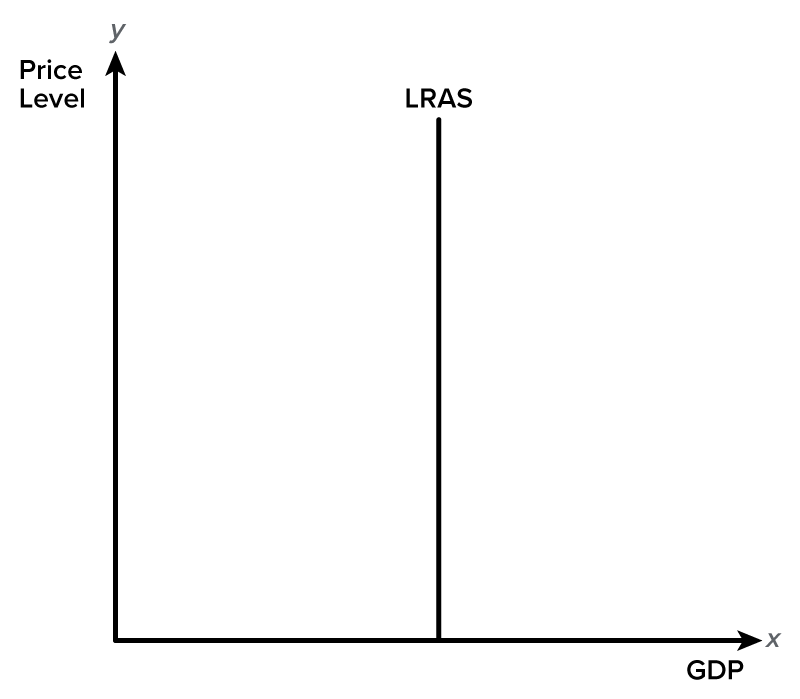
A graph depicting the concept of long-run aggregate supply or L R A S. The horizontal x-axis represents the GDP, and the vertical y-axis represents the Price Level. The L R A S curve, represented by a line, begins at a point in the middle of the x-axis and extends vertically upward, parallel to the y-axis.

did you know
The LRAS curve is also known as the Solow growth curve.

The LRAS curve represents our economy’s full potential; this is the quantity of GDP that we can produce if we are utilizing all of our current resources.

In the short run, we can ramp up our production, but this can really only get us so far. In the long run, we have a limited amount of resources, such as materials and workers.

Therefore, that vertical line represents the current potential for how much we can produce.

hint
Think of this curve as our economy producing as much as possible, given what we have. In other words, given all of our current resources, this represents our full production potential.

So, by combining all three of these things—aggregate demand, SRAS, and LRAS—we can see how our economy is doing at any given point in time.
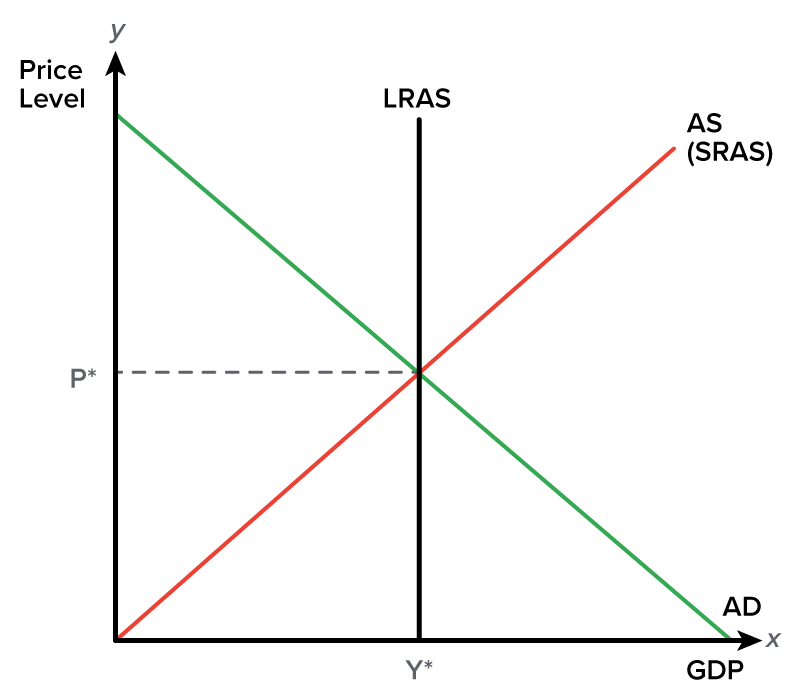
A graph with the A D or aggregate demand, S R A S or short-run aggregate supply, and L R A S or long-run aggregate supply curves representing the state of the economy at a given point in time. All the curves are shown by solid lines. The horizontal x-axis represents the GDP, and the vertical y-axis represents the Price Level. The A S or S R A S curve starts at the origin (x equals 0, y equals 0)and slopes upward. The A D curve begins at the endpoint of the y-axis and ends at the endpoint of the x-axis. The point at which the A S and the A D intersect is the equilibrium, which corresponds to the points Y* at the middle of the x-axis and P* at the middle of the y-axis. A horizontal dashed line extends from the point P* on the y-axis to the equilibrium point. An L R A S curve begins from the point Y* and extends upward, parallel to the y-axis.

This graph shows that our economy is producing the level of GDP represented by our LRAS. If you look at Y*, you can see that we are producing where our LRAS curve intersects.

This means that our economy is fully employed; we are utilizing all of our land, labor, and capital and producing the maximum amount possible, given all of our current resources.

Generally speaking, though, this is not the case. Our economy is generally not producing the exact quantity of real GDP in the short run as represented by this LRAS curve.

term to know
Long-Run Aggregate Supply (LRAS)
Assumed to be constant in the long run as, in the long run, resources are assumed to be used optimally, leaving no potential for increasing capacity. LRAS is a vertical curve.


3. Equilibrium During Recession

So, what would it look like if we were actually producing at a real GDP less than the LRAS? Well, here is one example of what it could look like.
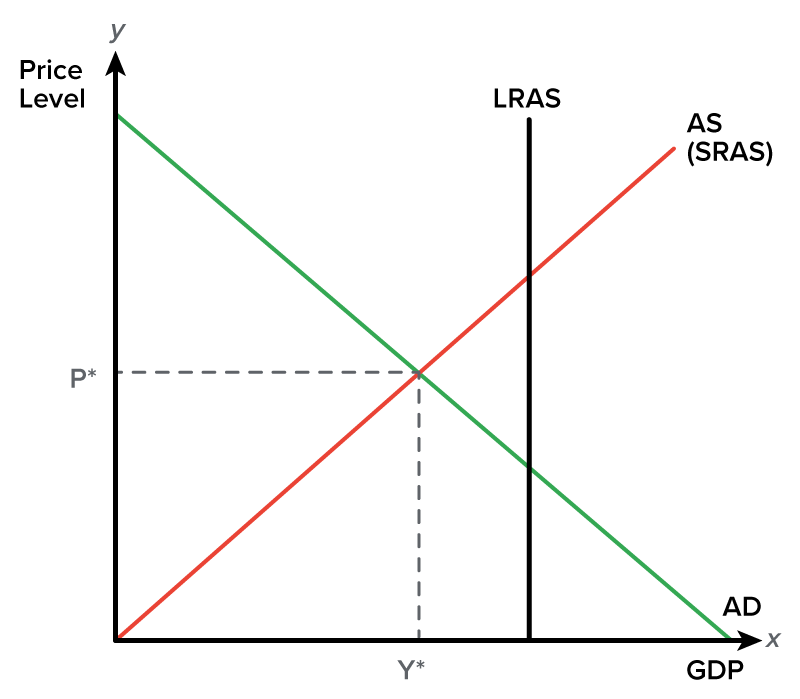
A graph of an economy where the GDP is less than L R A S consists of A D or aggregate demand, S R A S or short-run aggregate supply, and L R A S or long-run aggregate supply curves. All the curves are shown by solid lines. The horizontal x-axis represents the GDP, and the vertical y-axis represents the Price Level. The A S or S R A S curve starts at the origin (x equals 0, y equals 0) and slopes upward. The A D curve begins at the endpoint of the y-axis and ends at the endpoint of the x-axis. The point at which the A S and the A D intersect is the equilibrium, which corresponds to the points Y* at the middle of the x-axis and P* at the middle of the y-axis. A horizontal dashed line from the point P* and a vertical dashed line from the point Y* extend to the equilibrium point. The L R A S curve is positioned further to the right along the GDP axis, beyond the equilibrium point, indicating that the nation’s GDP is below its full potential.

At Y*, you can see that we are producing, but our real GDP is less than our full potential.

This situation would generally occur during a recession. This means that the economy is not using all of its resources. It is not fully employed, so it is producing less than its full potential.

In turn, this means that resources are unemployed. Unemployment is measured as a percentage rate of the number of individuals who would like to work and are an active part of the labor force compared to the number of individuals who comprise the active labor force.

hint
In a different tutorial, we discuss the different components of unemployment: frictional, structural, and cyclical. The important thing to remember, however, is that frictional and structural unemployment will always exist; they are standard parts of unemployment that will always be around. Cyclical unemployment, on the other hand, exists specifically during a recession.

If we are in a recession, we could be nearing a trough, which is the business cycle period that coincides with the lowest GDP for a given point in time.

Remember, here is what a business cycle looks like according to the National Bureau of Economic Research (NBER):

IN CONTEXT
“A recession is a significant decline in economic activity spread across the economy, lasting more than a few months, normally visible in real GDP, real income, employment, industrial production, and wholesale-retail sales.”
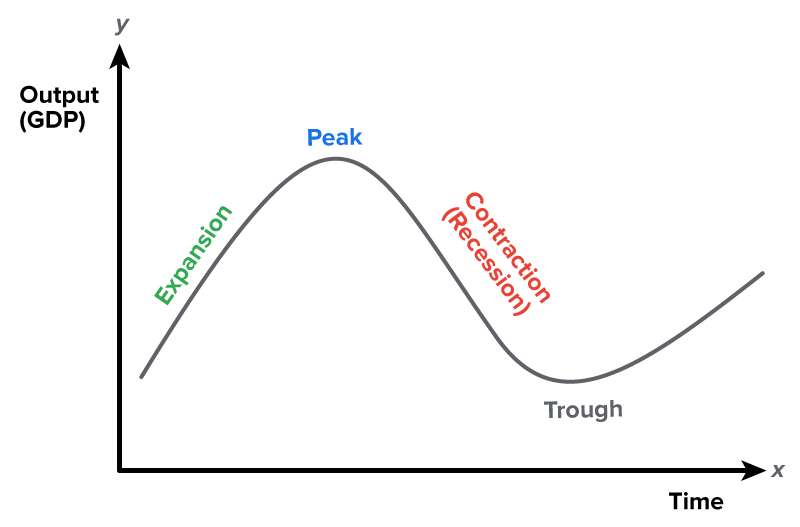
A graph depicting a business cycle. The x-axis is labeled ‘Time’, and the y-axis is labeled ‘Output, GDP’. The graph has a curve with a sine wave pattern, depicting the four phases of the business cycle over time. Initially, the curve moves upward, representing the growth phase, during which GDP increases with time; this phase is labeled ‘Expansion’. The highest point of this phase is labeled ‘Peak’. After the peak, the curve moves downward, depicting the contraction phase when the GDP decreases; this phase is labeled ‘Contraction, Recession’. The lowest point of contraction is labeled ‘Trough’. From the Trough, the curve rises again, indicating the cyclical nature of the economy.

A recession would occur in a period where our GDP is less than our full potential. If we are at a trough, we are at the bottom of the recession.

Since the economy is operating at less than full employment, some cyclical unemployment would exist. If this lasts a long time, expansionary fiscal and monetary policies can be put in place to try to raise the economy out of this recession.

terms to know
Unemployment
Measured as a percentage rate of the number of individuals who would like to work and are an active part of the labor force to the number of individuals who comprise the active labor force. Unemployment may be categorized into frictional, structural, and cyclical components.
Trough
The business cycle period that coincides with the lowest GDP for a given point in time.


4. Equilibrium During Expansion

Now, the opposite situation could also occur in the short run. This graph shows the economy currently producing a real GDP greater than the LRAS.
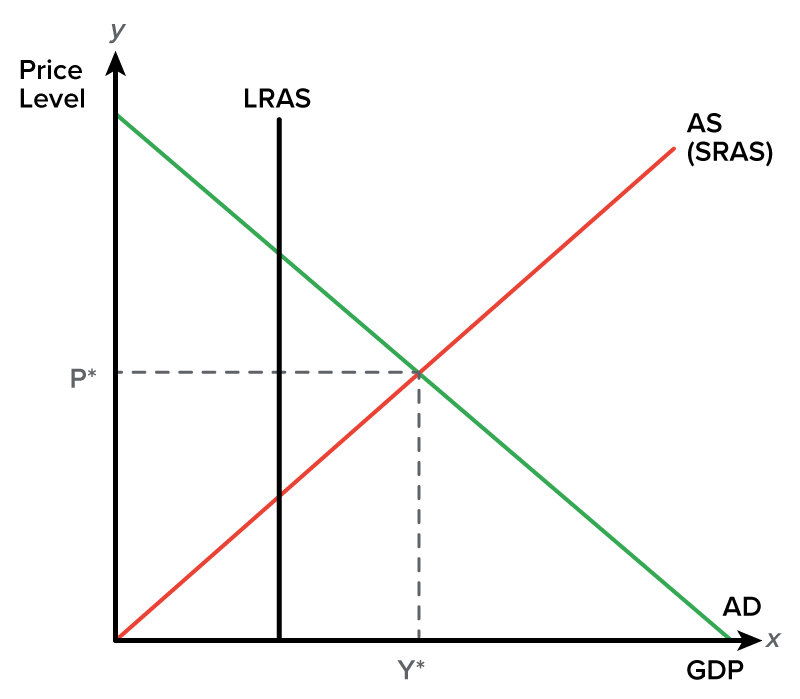
A graph of an economy where the GDP is greater than the L R A S consists of A D or aggregate demand, S R A S or short-run aggregate supply, and L R A S or long-run aggregate supply curves. All the curves are shown by solid lines. The horizontal x-axis represents the GDP, and the vertical y-axis represents the Price Level. The A S or S R A S curve starts at the origin (x equals 0, y equals 0) and slopes upward. The A D curve begins at the endpoint of the y-axis and ends at the endpoint of the x-axis. The point at which the A S and the A D intersect is the equilibrium, which corresponds to the points Y* at the middle of the x-axis and P* at the middle of the y-axis. A horizontal dashed line from the point P* and a vertical dashed line from the point Y* extend to the equilibrium point. The L R A S curve is positioned to the left of the equilibrium point.

So, how can we be producing beyond our full potential? Well, this can happen during a period of expansion.

During a period of expansion, GDP grows at a rate faster than the overall time trend, as stated by the NBER:

IN CONTEXT
“Converse to a recession, if GDP is growing at a rate faster than the overall time trend, we are said to be in an expansion.”

An expansionary peak in the economy is possible only when producers are using resources faster than they are being replaced.

This would require a very low unemployment rate—less than 5%—which would be above full employment or lead to a situation of negative cyclical unemployment.

This is not sustainable in the long run, only in the short run. Hence, the economy will go back to the long-run equilibrium because we cannot sustain this type of production in the long run.

Therefore, a peak is defined as the business cycle period that coincides with the maximum attainable GDP for a given point in time.

term to know
Peak
The business cycle period that coincides with the maximum obtainable GDP for a given point in time.

summary
Today, we looked at equilibrium on the aggregate supply/aggregate demand model. We learned that the intersection of the SRAS curve and aggregate demand curve represents our economy’s current equilibrium price level and level of real GDP. We also learned that the LRAS shows us the level of real GDP that is possible when our economy is fully employed. When we combine all of these curves, we can see the following: our economy in short-run equilibrium, our economy in long-run equilibrium, equilibrium during recession, and equilibrium during expansion.

Source: THIS TUTORIAL WAS AUTHORED BY KATE ESKRA FOR SOPHIA LEARNING. PLEASE SEE OUR TERMS OF USE.


Terms to Know
Aggregate Demand

The total amount of goods and services demanded in an economy at a specific point in time and at a prevailing price level.

Long-Run Aggregate Supply (LRAS)

Assumed to be constant in the long run as, in the long run, resources are assumed to be used optimally, leaving no potential for increasing capacity. LRAS is a vertical curve.

Peak

The business cycle period that coincides with the maximum obtainable GDP for a given point in time.

Price Level

An aggregate index value that provides an indication of the increase in prices from one period to another; used to evaluate inflation across periods.

Real Gross Domestic Product (RGDP)

Gross domestic product (the sum of the final value of goods and services produced over a specific time interval and within a country’s national borders) calculated across time periods using a constant price level.

Short-Run Aggregate Supply (SRAS)

Assumed to maintain a positive correlation between price and quantity; more can be produced through increased resource utilization, technological improvements, or other factors. SRAS is an upward-sloping curve.

Trough

The business cycle period that coincides with the lowest GDP for a given point in time.

Unemployment

Measured as a percentage rate of the number of individuals who would like to work and are an active part of the labor force to the number of individuals who comprise the active labor force. Unemployment may be categorized into frictional, structural, and cyclical components.

Formulas to Know
Aggregate Demand

table attributes columnalign left end attributes row cell A D equals C plus I plus G plus left parenthesis X minus M right parenthesis end cell row cell w h e r e end cell row cell C equals C o n s u m p t i o n space o r space C o n s u m e r s space end cell row cell I equals I n v e s t m e n t comma space R e f e r r i n g space t o space B u s i n e s s e s space o r space F i r m s space end cell row cell G equals space G o v e r n m e n t s space end cell row cell X minus M equals E x p o r t s space M i n u s space I m p o r t s equals N e t space F o r e i g n space P u r c h a s e s space o f space D o m e s t i c space G o o d s end cell end table

