Table of Contents |
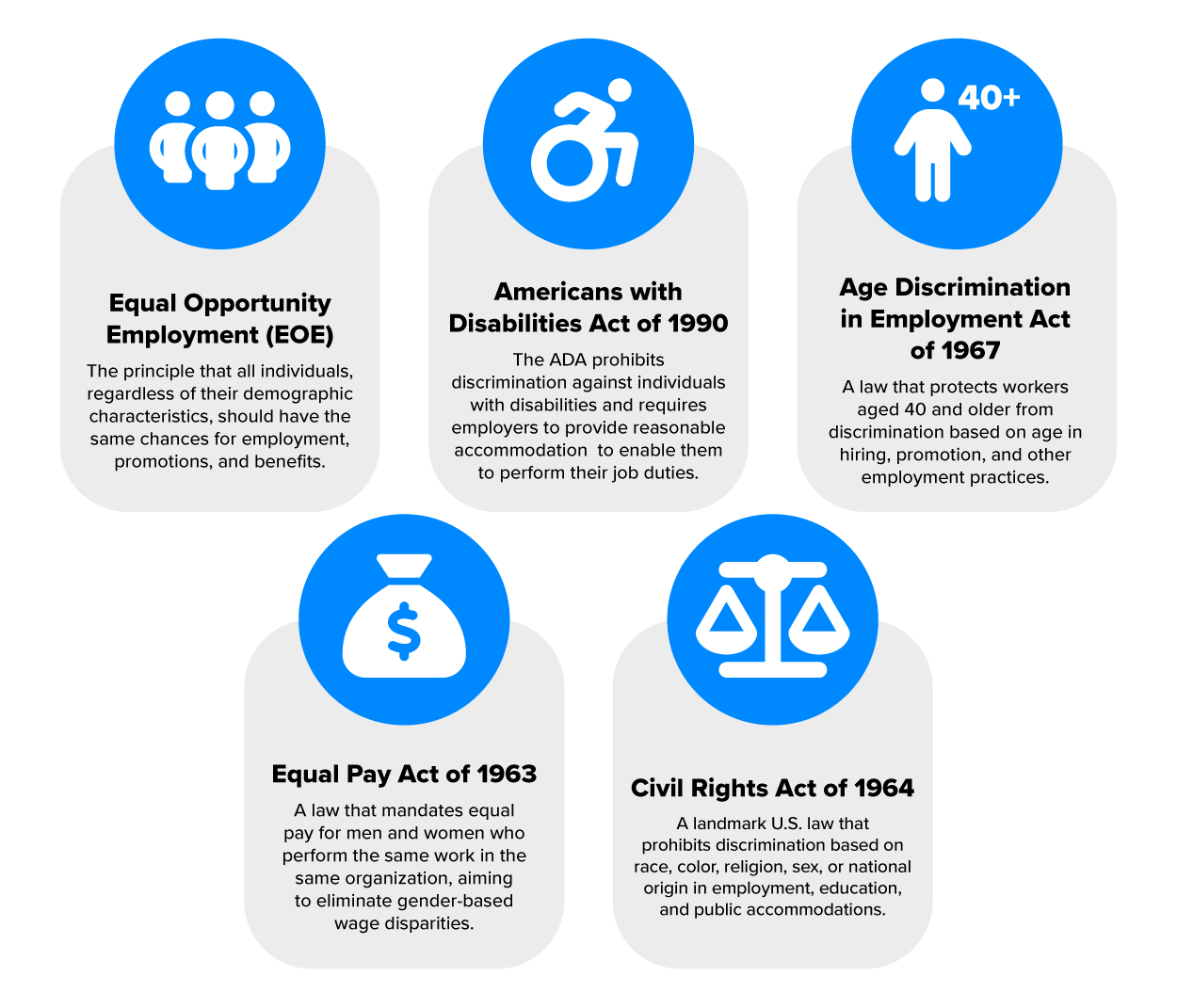
Equal employment opportunity (EEO) refers to the principle that all individuals, regardless of their demographic characteristics, should have the same chances for employment, promotions, and benefits. Under EEO, employers are prohibited from discriminating against individuals based on protected categories such as race, color, national origin, sex, disability, age, religion, genetic information, or sexual orientation. These protections are enforced through various laws and acts, most notably the Civil Rights Act of 1964, the Americans with Disabilities Act of 1990, the Age Discrimination in Employment Act of 1967, and the Equal Pay Act of 1963.
The Civil Rights Act of 1964 is a landmark U.S. law that prohibits discrimination based on race, color, religion, sex, or national origin in employment, education, and public accommodations. As a manager, you will need to understand how this law applies to all aspects of employment, including hiring, firing, promotions, and compensation. In healthcare, this means that all employees must be given equal opportunities for advancement and must be paid fairly for their work.
The Americans with Disabilities Act of 1990 (ADA) is another important EEO law that impacts healthcare. The ADA prohibits discrimination against individuals with disabilities and requires employers to provide reasonable accommodations to enable them to perform their job duties.
EXAMPLE
A hospital might need to provide special equipment or modify work schedules to accommodate an employee with a disability. By complying with the ADA, healthcare organizations can ensure that they are inclusive and supportive of all employees.The Age Discrimination in Employment Act of 1967 (ADEA) protects employees who are 40 years of age or older from discrimination based on age. In healthcare, this means that older employees must be given the same opportunities as younger employees and cannot be forced into retirement or passed over for promotions simply because of their age. By valuing the experience and skills of older workers, healthcare organizations can benefit from a diverse and knowledgeable workforce.
The Equal Pay Act of 1963 is a U.S. federal law that mandates equal pay for men and women who perform the same job in the same organization. It prohibits wage discrimination based on gender, ensuring that employees are paid equally for equal work, regardless of sex. The law applies to all forms of compensation, including salary, bonuses, and benefits, and aims to eliminate the gender wage gap by requiring employers to provide the same pay for comparable work. Exceptions to the law exist if wage differences are based on factors such as seniority, experience, or performance, but gender cannot be a factor in determining pay.
These laws ensure that employment decisions—such as hiring, promotions, compensation, and benefits—are made based on merit rather than bias or prejudice.
Equal employment opportunity has a profound effect on managers since they are responsible for implementing and upholding EEO policies within their teams and departments. Managers must ensure that their hiring practices are free from bias and that all candidates are evaluated based on their qualifications and ability to perform the job. EEO impacts various aspects of managerial responsibility, including recruitment, team dynamics, performance evaluations, and workplace culture.
One of the most direct impacts of EEO on managers is during the recruitment and hiring process. Managers must be diligent in ensuring that job descriptions, interview processes, and selection criteria do not inadvertently discriminate against certain groups. This may involve revising job descriptions to focus strictly on the essential skills and qualifications needed for the role and ensuring that interview questions are standardized and relevant to the position. Managers must be trained to recognize and avoid unconscious bias that could affect hiring decisions. Unconscious bias refers to the unintentional or indirect attitudes or stereotypes that affect our judgments, decisions, and behaviors without us being aware of them. These biases can be based on factors like race, gender, age, or appearance and can influence how we interact with others, often in ways that are unfair or discriminatory. Additionally, it is crucial for managers to ensure that recruitment channels are diverse and inclusive, attracting candidates from various backgrounds and experiences.
Equal employment opportunity also influences how managers conduct performance evaluations and make promotion decisions. Performance reviews must be based on objective, measurable criteria and not influenced by personal biases or stereotypes. Managers are responsible for offering fair evaluations, providing opportunities for growth and development, and recognizing high performers regardless of their race, gender, or background. Managers must also ensure that promotional opportunities are open to all qualified employees and there is no discrimination against who is considered for advancement.
Managers are also responsible for ensuring that their teams adhere to equal employment opportunity laws and internal company policies. This includes ensuring that workplace policies regarding discrimination, harassment, and retaliation are effectively communicated and enforced. Managers must address any concerns regarding EEO violations promptly and take appropriate actions to resolve issues in accordance with company procedures and legal requirements.
IN CONTEXT
You are a healthcare manager at a large hospital tasked with hiring a registered nurse (RN) for the emergency department. The position is critical due to an increase in patient load, and you have received a strong pool of applicants.
During the interview process, you follow EEO principles by ensuring all candidates are assessed based on their qualifications, experience, and ability to perform the role, rather than on personal characteristics such as gender, age, or race. One candidate, a woman in her early 50s, has extensive experience in emergency nursing but is slightly older than other applicants. Another candidate, a younger male applicant, has slightly more recent experience but lacks the depth of expertise in the emergency room setting.
Although the younger male applicant is more familiar with the latest technology in the department, you decide to focus on the more experienced woman, recognizing that her extensive experience would provide the best care for patients, and her ability to mentor junior staff could benefit the team. You make this decision based on the candidate’s qualifications and the role’s requirements, not because of her age or gender, ensuring compliance with EEO principles.
Additionally, you ensure that the hiring process remains free of bias by reviewing interview notes and feedback from the team, confirming that decisions were made based on the candidates' merit, without any discrimination or favoritism.
In this scenario, your adherence to EEO policies results in a fair, unbiased hiring decision that prioritizes qualifications and experience, promoting a diverse and inclusive workforce while meeting the department’s staffing needs.
Despite the legal requirements and clear benefits of equal employment opportunity, healthcare organizations, like many others, may face challenges in fully implementing and maintaining EEO policies. One challenge is addressing unconscious bias in hiring and promotion practices. Even with the best of intentions, managers and HR professionals may unknowingly favor candidates who share similar backgrounds, experiences, or characteristics. This highlights the importance of ongoing training and awareness efforts to ensure that hiring and management decisions are truly based on qualifications and not personal biases.
Additionally, healthcare organizations may face challenges in ensuring that all employees, particularly those from marginalized groups, have equal access to professional development opportunities. Often, there may be disparities in the leadership pipeline, with certain demographic groups underrepresented in senior leadership roles. Healthcare organizations must make deliberate efforts to create mentorship programs, leadership training, and other opportunities for employees from all backgrounds to advance in their careers.
Source: THIS TUTORIAL WAS AUTHORED BY SOPHIA LEARNING. PLEASE SEE OUR TERMS OF USE.



