Table of Contents |
Managers can do everything possible to recognize, reduce, and prevent conflict, but inevitably, there will be conflict that cannot be easily remedied or ignored. As we’ve seen, ignoring conflict is likely to lead to the conflict growing until it is unavoidable. Managers are thus often required to manage conflict through negotiation. Negotiation is the process for reaching an agreement through dialogue and finding a solution where all parties are satisfied. The negotiation process requires considerable skill in communication and decision making, and the ability to leverage power. Over the next two tutorials, we will consider stages of negotiation, types of negotiation behavior, and the negotiation process itself.
We begin with the reasons why people engage in negotiation and bargaining in the first place. While negotiation strategies are applied to everyday situations, the word implies a more formal process, perhaps even involving a mediator. Moreover, remember that conflict exists if different parties have different goals. This doesn’t mean that conflict is necessarily “ugly” in the sense that both parties are angry at the other. Negotiations may be completely peaceful and respectful and are simply part of doing business. The following situations are six reasons why negotiation may be necessary, and why negotiation skills are important (Gibson, 2023).
| Reason for Negotiation | Description |
|---|---|
| Managing interpersonal conflict | The most common need for negotiation skills in the day-to-day life of a manager is handling conflicts within the organization, either between employees, between one employee and a group, or between a group and the organization. There are strategies for preventing or reducing these conflicts, as we discussed in the last tutorial, but as a manager, you will be frequently trying to settle this kind of conflict. |
| Representing your organization | One of the “peaceful” forms of conflict that requires negotiation skills is working outside the organization, such as talking to vendors or selling your own organization to potential clients. These will inevitably involve working out a price and a set of expectations that will be delivered, but part of a manager’s duty is to also create goodwill between organizations. |
| Finding opportunities | Creating goodwill is a way of adding value to your relationships and finding opportunities for your organization. For example, perhaps in the middle of negotiating a price for your services, you discover other ways your own organization and a potential client can work together. |
| Handling a crisis | Negotiation skills are crucial for unexpected problems that arise at work, such as being short-staffed and needing staff to work extra hours or needing to allocate limited resources. |
| Crossing cultural boundaries | As described at length, globalization is an unavoidable feature of the 21st-century workplace, meaning that managers must be fluent in cross-cultural negotiation skills. These are also invaluable in the diverse modern workforce. |
| Representing yourself | Last but not least, you will be negotiating for yourself throughout your career, whether it is asking for a raise or finding a work-from-home plan when you need to do so. It may also mean simply asking for more responsibilities and the opportunity to grow. Advocating for yourself is a good way to practice the skills we discuss below. |
The negotiation process consists of identifying one’s desired goals—that is, what you are trying to get out of the exchange—and then developing suitable strategies aimed at reaching those goals. A key feature of one’s strategy is knowing one’s relative position in the bargaining process. That is, depending upon your relative position or strength, you may want to negotiate seriously (if you don’t have as strong a position), or you may simply make your offer and let the other side decide to “take it or leave it” (if you have a very strong position). However, the strength of your position is not the only factor that determines whether you need to negotiate or how much you want to invest in the negotiation process. Some of the key factors are listed below.
| Factor | Need to Negotiate |
|---|---|
| Value of exchange | You have more need to negotiate if you value the exchange more than the other party. For example, if you’re buying a house in a hot market (where lots of people are trying to buy houses), you need the exchange more than the seller because it is easier to find a buyer than it is to find a home. Your position is weaker (and the need to negotiate is greater). |
| Commitment to a decision | You have more need to negotiate if you are committed to a particular outcome. Your position is stronger (and the need to negotiate is lower) if there are several different outcomes that would satisfy you. |
| Trust level | You have more desire to negotiate if there is a lot of trust in the other party. If you do not have confidence that the other party will keep up their end of the deal, you are less likely to invest the time and energy in forming a deal. |
| Time | You have more need to negotiate if time is pressing, such as in labor negotiations when both sides are losing money during a strike. |
| Power distribution | You usually have more need to negotiate if the other side has more power. |
| Value of the relationship | You have more need to negotiate if you value the relationship beyond the exchange. |
One term that encapsulated this analysis is offered by Rogers and Ury in the classic book of management strategy, Getting to Yes. They describe the party with an advantage in negotiations as the one with the best BATNA, or “Best Alternative To a Negotiated Agreement.” What will either party do if they do not work out a deal? Some may simply move on, while others have to radically change their plans. In general, the party with the more attractive BATNA gets the better of the deal.
Within the context of these four stages, both parties must select an appropriate strategy that they believe will help them attain their objectives. While there is more to negotiation than “getting what you want,” deciding outcomes of the process, or bargaining, is the key part of negotiation and the way the success of negotiations will be evaluated. In short, what will each party give up, and what will each get? What are the terms and conditions of the negotiation, such as factors that both sides agree will render the rest of it null and void? Two approaches to this part of the negotiation process are described below.
Distributive bargaining is when the goals of one party are in fundamental and direct conflict with those of the other party. Resources are fixed and limited, and each party wants to maximize their share of these resources. Finally, in most cases, this situation represents a short-term relationship between the two parties. In fact, such parties may not see each other ever again. In such cases, distributive bargaining is usually unavoidable, although not ideal.
EXAMPLE
Say you want to buy a new car and visit a dealer's lot. You find a car you’d like to buy but are unable to pay more than $25,000 for the car. The car is priced at $30,000. You are able to bargain them down to $25,000, but this means the salesperson does not receive as much commission as if they’d sold it for the list price. In this case, you win, in that you get the car for the price you want, and the salesperson loses because they didn’t make the full amount of commission. Having said that, however, one could argue that the salesperson still earned commission, so even though it wasn’t as much, it was still a “win.” As you can see, there aren't many situations so black and white where one person wins, and one person loses.Under such circumstances, each side will probably adopt a course of action as follows. First, each side to a dispute will attempt to discover just how far the other side is willing to go to reach an agreement. This can be done by offering outrageously low (or high) proposals simply to feel out the opponent. For example, in selling a house, the seller will typically ask a higher price than they expect to get. The buyer, in turn, typically offers far less than they are willing to pay. These two prices are put forth to discover the opponent’s resistance price. The resistance price is the point beyond which the opponent will not go to reach a settlement. The bargaining zone is the space between the two resistance prices, but in some cases, it may get nudged one way or the other during negotiations. For example, if a shrewd buyer notes some issues with the house, the seller may have to lower their resistance price. If the buyer has multiple offers in a hot market, the buyer may have to raise their resistance price.
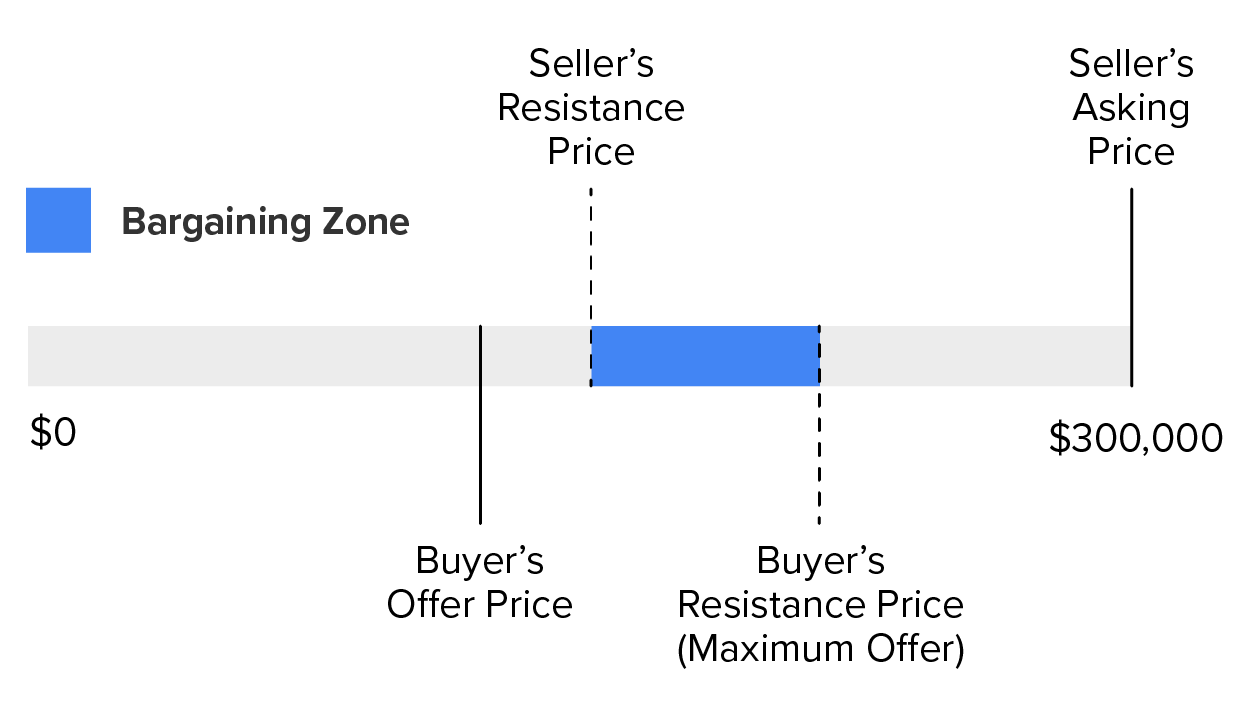
Though these kinds of bargains may have one side feeling like they “won” because they did better than they expected, that doesn’t mean both seller and buyer can’t close the deal feeling that the price was fair. This just means that both approach the bargaining table trying to get as much as possible out of the deal. Neither expects the relationship to continue, so there is unlikely to be the kind of bargaining we describe next.
Integrative bargaining is when both parties try to reach a settlement that they are satisfied with and which the other party is satisfied with. That is, they find a “win-win” solution. Such an approach to negotiation is predicated on the belief that if people mutually try to solve the problem, they can identify some creative solutions that help everyone.
A good example is in bilateral trade negotiations between two nations. In such negotiations, participants usually agree that a trade war would hurt both sides; therefore, both sides attempt to achieve a balance of outcomes that are preferable to a trade war for both sides. While both sides still approach the negotiation with the hope of achieving the best deal possible, they want there to be a continuing relationship and will not sacrifice that for an immediate win. They may look for outcomes that are mutually beneficial rather than try to get the best deal.
Another key difference between integrative and distributive bargaining is that there are more resources to be considered. In the scenario of buying and selling a house, the only variable is price. But consider the scenario of a candidate for a job negotiating the conditions under which they accept it. Salary is usually the most important negotiating factor, but the employer may offer other benefits such as a flexible schedule, an attractive working environment, and opportunities for growth.
Finally, the interests of the two parties in integrative bargaining are not competitive. Instead, they may be convergent (driven by a common goal, such as preventing a trade war between two countries) or congruent (mutually supportive, as when two countries reach a defense pact).
Because they have different ends, integrative bargaining tactics are quite different from those in distributive bargaining. Here, both sides must be able and willing to understand the viewpoints of the other party. Otherwise, they will not know where possible consensus lies. Moreover, the free flow of information is required, and a higher degree of trust. In discussions, emphasis is placed on identifying commonalities between the two parties; the differences are played down. And finally, the search for a solution focuses on selecting those courses of action that meet the goals and objectives of both sides. This approach requires considerably more time and energy than distributive bargaining, yet under certain circumstances, it has the potential to lead to far more creative and long-lasting solutions.
These differences are summarized below.
| Bargaining Characteristic | Distributive Bargaining | Integrative Bargaining |
|---|---|---|
| Payoff structure | Fixed amount of resources to be divided | Variable amount of resources to be divided |
| Primary motivation | Winning | Mutual benefit |
| Primary interests | Competitive | Convergent or congruent |
| Focus of relationships | Short term | Long term |
In the final tutorial, we will take a deeper dive into the negotiation process, including cross-cultural negotiation.
Source: THIS TUTORIAL HAS BEEN ADAPTED FROM OPENSTAX "ORGANIZATIONAL BEHAVIOR". ACCESS FOR FREE AT OPENSTAX.ORG/BOOKS/ORGANIZATIONAL-BEHAVIOR/PAGES/1-INTRODUCTION. LICENSE: CREATIVE COMMONS ATTRIBUTION 4.0 INTERNATIONAL.
REFERENCES
Gibson, K. (2023, June 6). 6 Reasons Managers Need Negotiation Skills. Harvard Business School Online. online.hbs.edu/blog/post/negotiation-skills-for-managers



