Use Sophia to knock out your gen-ed requirements quickly and affordably. Learn more
×

"Either/Or" Probability for Non-Overlapping Events

Author: Sophia

what's covered
This tutorial will explain the rule for finding the probability of at least one of two or more non-overlapping events happening. Our discussion breaks down as follows:

Table of Contents

1. "Or" Probability for Non-Overlapping Events

When finding "either/or" probability for non-overlapping events, we need to consider the two parts of this term. "Either/or" refers to a scenario in which either one or both of two events happen. However, non-overlapping means they can't both happen at the same time; therefore, exactly one of them happens: either event A OR event B, but not both A and B.

EXAMPLE

Suppose you have a standard deck of 52 cards. You have two mutually exclusive, or non-overlapping, events, like selecting a 6 and selecting a face card. These events can't both happen at the same time. If you are selecting a 6, then you are not selecting a face card, and vice versa.
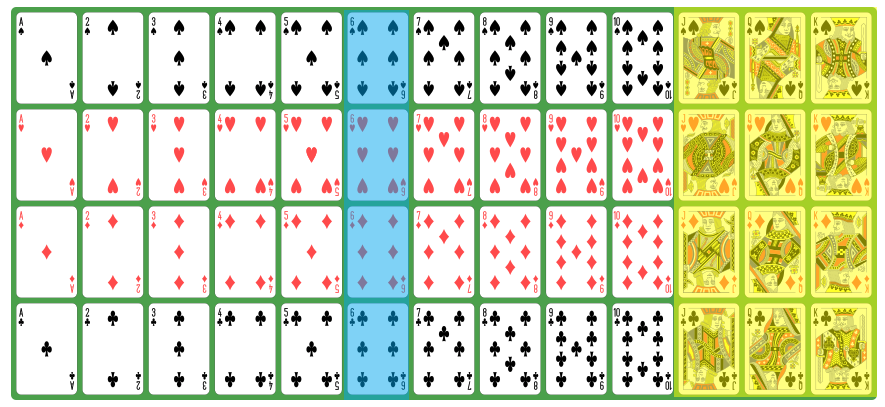

A complete deck of playing cards laid out in a grid. There are four rows and 13 columns. Each row has all cards that have the same shape on them: black spades, red hearts, red diamonds, and black clubs. Each row has the 13 ranks: ace, two, three, four, five, six, seven, eight, nine, 10, jack, queen, and king. The face cards and cards with the number 6 are highlighted with the colors yellow and blue, respectively.

What's the probability of selecting a 6 or a face card?

Well, there are four 6's and 12 face cards, so 16 out of 52.

P left parenthesis 6 space o r space F a c e right parenthesis equals 4 over 52 plus 12 over 52 equals 16 over 52

It would appear, then, that for non-overlapping events, you can calculate the "or" probability as the individual probabilities added together.

formula to know
Either/Or Probability for Non-Overlapping Events
P left parenthesis A space o r space B right parenthesis equals P left parenthesis A right parenthesis plus P left parenthesis B right parenthesis

It is important to note, however, that this formula doesn't work if you have overlapping events.

EXAMPLE

Referring back to our deck of cards, what is the probability of a 6 or diamond?
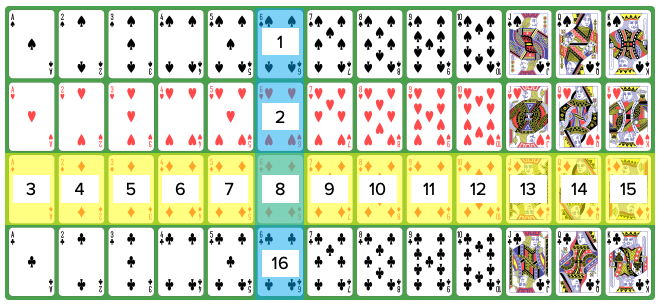

A complete deck of playing cards laid out in a grid. There are four rows and 13 columns. Each row has all cards that have the same shape on them: black spades, red hearts, red diamonds, and black clubs. Each row has the 13 ranks: ace, two, three, four, five, six, seven, eight, nine, 10, jack, queen, and king. Cards with the number 6 and cards with the diamond shape are highlighted with the colors blue and yellow, respectively.
If you counted out all the cards that were either 6's or diamonds, you would end up with 16 out of 52 cards. However, that's not the same as adding the probability of a 6 (four out of 52) with the probability of a diamond (13 out of 52), which would give you 17 out of 52.

table attributes columnalign left end attributes row cell 16 over 52 not equal to 4 over 52 plus 13 over 52 end cell row cell P left parenthesis 6 space o r space d i a m o n d right parenthesis not equal to P left parenthesis 6 right parenthesis plus P left parenthesis d i a m o n d right parenthesis end cell end table

This formula only works for non-overlapping events.

term to know
Either/Or Probability for Non-Overlapping Events
The probability that either of two non-overlapping events occurs is the sum of their individual probabilities. Also known as the "special addition rule."

summary
If two events A and B are mutually exclusive, meaning they can't happen at the same time, then the probability that either A or B happens—the "or" probability for non-overlapping events—is equal to the probability of A plus the probability of B. The "special addition rule for non-overlapping events" states that the probability that either of two non-overlapping events occurs is the sum of their individual probabilities. This is a special addition rule because there will be a different addition rule for cases in which the events are overlapping.

Good luck!

Source: THIS TUTORIAL WAS AUTHORED BY SOPHIA LEARNING. PLEASE SEE OUR TERMS OF USE.

Terms to Know
Either/Or Probability for Non-Overlapping Events

The probability that either of two non-overlapping events occurs is the sum of their individual probabilities. Also known as the "special addition rule."

Formulas to Know
Either/Or Probability for Non-Overlapping Events

P left parenthesis A space o r space B right parenthesis space equals space P left parenthesis A right parenthesis space plus thin space P left parenthesis B right parenthesis



