Educational law and policy shape how schools operate and how teaching and learning occur. They set the rules and expectations for schools, teachers, students, and families. Understanding these laws and policies helps educators make informed decisions, protect students’ rights, and create safe and fair learning environments.
Educational laws and policies directly affect daily classroom practice. They influence student discipline, privacy protections, support for students with disabilities, and school safety. They also guide school operations, including funding, teacher evaluation, and curriculum standards.
Law and policy are also essential to educational equity. Many laws are designed to ensure that all students—regardless of race, disability, gender, language, or income—have access to a quality education. Policies help schools address learning barriers and close achievement gaps.
It is important to understand the difference between law and policy.
Educational law comes from multiple sources that work together to shape how schools operate and how education is governed. These sources determine who has authority over education, what rights students and educators have, and how laws are enforced. Understanding the origins of educational law helps educators recognize why certain rules exist and how they are applied in schools. The chart below shows the main sources of educational law and describes how each one affects schools.
Major Sources of Educational Law
| Source of Educational Law | Description |
|---|---|
| U.S. Constitution | Provides the legal foundation for education governance. The 10th Amendment gives states primary control of education, while the 14th Amendment protects students’ civil rights through equal protection and due process. |
| Federal Statutes | National laws passed by Congress that focus on civil rights, access, and accountability. Compliance is often required to receive federal funding. |
| State Constitutions and Statutes | State laws that require public education and set rules for curriculum, graduation, teacher certification, and school funding. |
| Court Decisions (Case Law) | Court rulings that interpret education laws, clarify rights and responsibilities, and influence school policies and practices. |
| Administrative Regulations | Rules created by education agencies to enforce laws and explain how schools must implement legal requirements. |
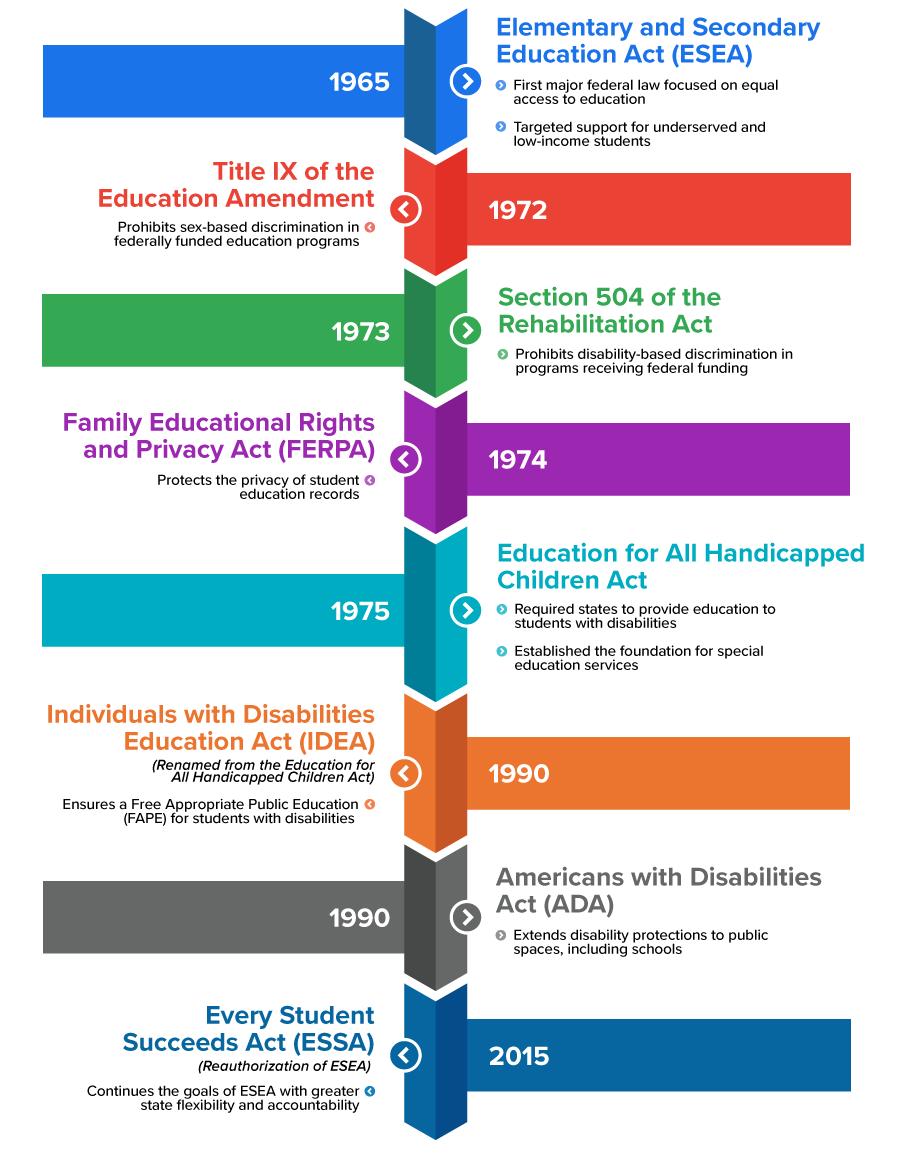
The timeline below highlights major federal education laws that have shaped the United States education system over time. These laws were passed in response to changing social needs, civil rights movements, and growing awareness of the importance of equal access to education. When viewed together, they show how the federal government’s role in education has expanded to protect students’ rights and promote fairness in schools.
Students in public schools have legal rights that are designed to protect them and ensure fair treatment. These rights come from the U.S. Constitution, federal laws, and court decisions. While schools have the authority to maintain order and safety, students do not give up their rights when they enter a school building. Understanding students’ rights helps educators create learning environments that are both respectful and legally sound. The following chart outlines key rights that students are entitled to within the educational environment.
| Right | Description |
|---|---|
| Right to Equal Educational Opportunity |
- All students have the right to equal access to public education. - Schools may not discriminate based on race, color, national origin, sex, or disability. - Laws require schools to provide fair opportunities and needed supports. |
| Due Process (Discipline, Suspension, and Expulsion) |
- Students must receive fair procedures during disciplinary actions. - Students are entitled to notice of the issue and a chance to share their side. - Due process protects students from unfair punishment. |
| Freedom of Speech and Expression |
- Students have the right to express opinions and ideas. - Schools may limit speech that disrupts learning or threatens safety. - Student rights must be balanced with school order and respect. |
| Search and Seizure in Schools |
- Students are protected from unreasonable searches. - School officials may search students if there is reasonable suspicion. - School rules allow more flexibility than law enforcement standards. |
| Privacy and Student Records |
- Students have the right to privacy regarding educational records. - Schools must protect grades, discipline records, and special education information. |
Parents and guardians play an essential role in their children’s education and are granted specific legal rights to support student success and protect family interests. These rights come from federal and state laws and ensure that parents are informed, involved, and treated as partners in the educational process. Understanding parents’ rights helps educators build positive relationships with families and comply with legal and ethical expectations. The following chart outlines key rights that parents and guardians have in supporting and participating in their child’s educational experience.
| Right | Description |
|---|---|
| Right to Be Informed |
- Receive timely information about academic progress, attendance, and behavior - Be informed about school policies and important updates |
| Right to Access Educational Records |
- Review education records such as grades, assessments, and discipline records - Request corrections to inaccurate or misleading information |
| Right to Participate in Educational Decision Making |
- Be involved in decisions affecting their child’s education - Participate on teams that plan services and supports |
| Rights Related to Special Education |
- Participate in developing Individualized Education Programs (IEPs) - Receive notice of meetings and proposed changes - Give consent for evaluations and services - Challenge school decisions through formal procedures |
| Right to Due Process and Complaint Procedures |
- Challenge decisions believed to be unfair or unlawful - Access complaint, mediation, or hearing processes |
| Right to a Safe and Respectful School Environment |
- Expect a safe, nondiscriminatory learning environment - Raise concerns about harassment, discrimination, or safety |
Teachers play a critical role in the education system and are protected by certain legal rights while also being held to important professional responsibilities. For pre‑service teachers, understanding both protections (harm, discrimination, or violations of their freedoms) and obligations (responsibilities or duties that individuals or organizations are required to fulfill, often because of laws, policies, or ethical expectations) is essential to becoming ethical, effective, and legally responsible educators. Knowing these rights and responsibilities helps teachers advocate for themselves while ensuring they act in students’ best interests. The following chart identifies whether each item is a teacher right or a teacher responsibility within the educational environment.
| Category | Type | Description |
|---|---|---|
| Academic Freedom (within limits) | Right |
- Use professional judgment in teaching methods and materials - Must follow state standards, district curriculum, and school policies - Instruction must be age‑appropriate and educationally relevant |
| Due Process and Fair Employment Practices | Right |
- Right to fair treatment in evaluations, discipline, and termination - Must be informed of concerns and allowed to respond - Protects against unfair or discriminatory employment actions |
| Freedom of Speech (on and off campus) | Right |
- Speech related to job duties may be regulated by the school - Private speech may be protected if it does not disrupt the school environment - Public communication, including social media, can impact professional roles |
| Duty of Care (student safety) | Responsibility |
- Protect students from harm while under supervision - Maintain a safe classroom environment - Respond appropriately to injuries and emergencies |
| Mandatory Reporting | Responsibility |
- Legally required to report suspected child abuse or neglect - Not responsible for investigating—only reporting concerns promptly |
| Professional Ethics | Responsibility |
- Treat students respectfully and fairly - Maintain appropriate boundaries - Act with honesty and integrity |
| Following District and State Policy | Responsibility |
- Follow rules related to curriculum, assessment, discipline, and technology - Communicate appropriately with families - Help ensure schools operate legally and consistently |
Special education law is a critical area of knowledge for future teachers and often one of the most confusing. These laws are designed to ensure that students with disabilities receive appropriate support while being included in general education settings as much as possible. Understanding both the legal requirements and the ethical responsibilities of special education helps educators serve students effectively and foster inclusive learning environments. Several core principles guide special education services in public schools. These principles define students’ rights and schools’ responsibilities and shape daily classroom practices. The following chart outlines foundational principles and legal requirements that guide special education services and supports for students with disabilities.
| Category | Description |
|---|---|
| Free Appropriate Public Education (FAPE) |
- Students with disabilities are entitled to a free education that meets their individual needs. - Services must support meaningful academic and developmental progress. |
| Least Restrictive Environment (LRE) |
- Students with disabilities should learn with nondisabled peers whenever appropriate. - Removal from general education occurs only when needs cannot be met with supports. |
| Individualized Education Programs (IEPs) |
- IEPs are legally required plans outlining goals, services, and accommodations. - Created by a team including educators, specialists, and families. |
| Procedural Safeguards for Families |
- Protect the rights of students and their families. - Ensure families are informed and involved in decision making. - Provide a process to challenge school decisions. |
| Legal Compliance vs. Ethical Teaching |
- Meeting legal requirements is mandatory. - Ethical teaching goes beyond compliance. |
| Collaboration With Families and Specialists |
- Effective special education relies on teamwork. - Collaboration includes families, special educators, counselors, and service providers. |
Educational law and policy shape how schools are organized, managed, and run on a daily basis. While teachers often experience these influences in the classroom, laws and policies also guide many behind‑the‑scenes decisions that affect the entire school community. Understanding this influence helps future educators see how legal requirements connect to school practices and structures. The following key areas illustrate how laws and policies shape school operations, influence instructional practices, and support the overall functioning of the educational system.
Governance, Funding, and Accountability
Source: THIS TUTORIAL WAS AUTHORED BY SOPHIA LEARNING. PLEASE SEE OUR TERMS OF USE.
REFERENCES
American Federation of Teachers. (n.d.). Teachers’ rights: Due process. www.aft.org
Amicus Curiae Foundation. (2025). What are the main federal laws governing education in the U.S.? www.amicuscf.org/blog/what-are-the-main-federal-laws-governing-education-in-the-us
Centers for Disease Control and Prevention. (2024). Family Educational Rights and Privacy Act (FERPA). www.cdc.gov/phlp/php/resources/family-educational-rights-and-privacy-act-ferpa.html
Child Welfare Information Gateway. (2023). Mandatory reporters of child abuse and neglect. www.childwelfare.gov
FindLaw. (2024). The roles of federal and state governments in education. www.findlaw.com/education/curriculum-standards-school-funding/the-roles-of-federal-and-state-governments-in-education.html
Individuals with Disabilities Education Act. (2024). A guide to the Individualized Education Program (IEP). U.S. Department of Education. sites.ed.gov/idea/parents-and-families/iep-process
Institute of Education Sciences. (2023). About IES. U.S. Department of Education. ies.ed.gov/about
LegalClarity. (2025). IDEA and FERPA: Student record privacy and access rights. legalclarity.org/idea-and-ferpa-student-record-privacy-and-access-rights/
National Center for Education Statistics. (2024). The Nation’s Report Card (NAEP). www.nationsreportcard.gov
U.S. Department of Education. (2022). IDEA and FERPA crosswalk. studentprivacy.ed.gov/sites/default/files/resource_document/file/IDEA-FERPA%20Crosswalk_08242022.pdf
U.S. Department of Education, Office for Civil Rights. (2024). Protecting students’ civil rights. www2.ed.gov/about/offices/list/ocr
Wrightslaw. (2026). Privacy, education records, & FERPA. www.wrightslaw.com/info/ferpa.index.htm



