Table of Contents |
In a function, the domain is the set of all possible input values. In other words, it represents all values that the independent variable (usually x) is allowed to take on in order to return a value for the function. The range is the set of all possible output values (usually y); or values that the function will have, depending on all of the possible input values.
When a function has no restrictions on its domain, it is continuous from negative infinity to positive infinity along the x-axis. If the range also has no restrictions, then on one end, the graph tends towards negative infinity, and on the other end, it tends towards positive infinity. Below is the graph of a polynomial that has no domain or range restrictions:
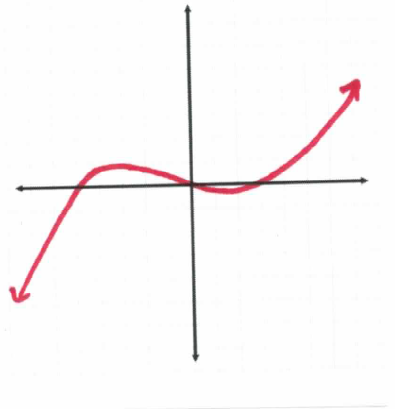
When talking about domain restrictions, the two common cases:
The find the domain range, we need to identify restrictions to both the domain and range.
EXAMPLE
Find the domain and range of .
.
 , greater than or equal to zero, and solve the inequality for x:

|
Subtract 2 from both sides |

|
Divide by 4 |

|
Simplify |

|
Our solution |
 . We can see this below when we graph the function. If the inequality had no solution (that is, no values of x for which the expression is less than zero), then the domain has no restrictions.
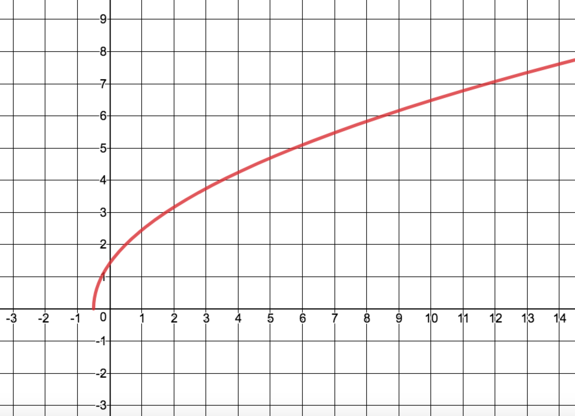
 , the domain is and the range is
 . It is not possible for a square root to result in a negative value, so the functions in the form
  or
or  will always be greater than or equal to zero.
With rational functions, the domain restrictions are x-values that make the denominator equal to zero. So we need to set the denominator equal to zero and solve for x. This will give us x-values to exclude from the domain:
EXAMPLE
Find the domain and range of .
.
 equal to zero and solve for x.

|
Factor the quadratic expression |

|
Set each factor to zero |

|
Evaluate each factor |

|
Our solutions |
 and
and  .
can be written as
.
can be written as  . Setting each factor in the denominator to zero will give the values of the restrictions. And as we said above, if the equation has no solution (that is, no values of x that make the denominator equal to zero), then the domain has no restrictions.
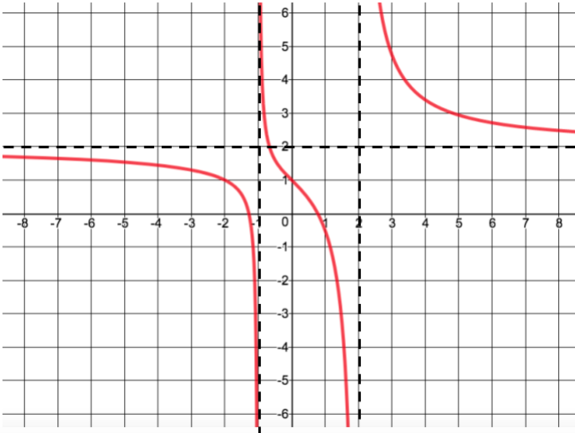 and .
and .
 . We may be tempted to say that 2 is excluded from the range, because as the function gets more and more negative, and more and more positive, the value of the function approaches, but never reaches 2. However, in between our vertical asymptotes, we see that function actually does at one point have a value of 2. So we can then say that the range of this function is all real numbers,
  , the domain is all values of x EXCEPT for -1 and 2, and the range is all real numbers.
Source: THIS TUTORIAL HAS BEEN ADAPTED FROM "BEGINNING AND INTERMEDIATE ALGEBRA" BY TYLER WALLACE. ACCESS FOR FREE AT www.wallace.ccfaculty.org/book/book.html. License: Creative Commons Attribution 3.0 Unported License



