In this lesson, you will learn how to understand the basic characteristics of organisms and how they're classified, and how humans are classified and may have evolved. Specifically, this lesson will cover:
Scientists like to classify organisms into different groups based on the characteristics they have in common. In the field of taxonomy, which is the field of science in which organisms are classified and named, every living thing is classified by scientists into:
Domain
Kingdom
Phylum
Class
Order
Family
Genus
Species
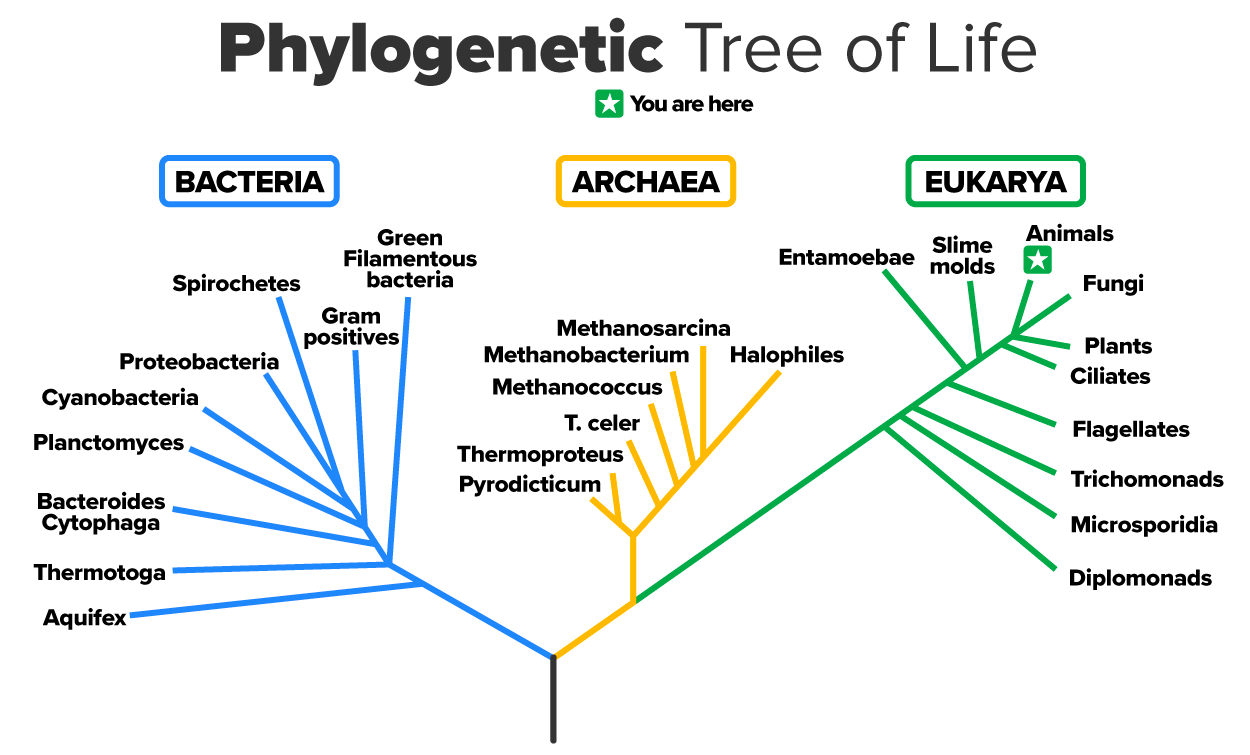
All life on Earth evolved from a common ancestor. The study of organisms with the purpose of deriving their relationships is called systematics. The field of systematics is broken into taxonomy (classifying and naming organisms) and phylogenetics (determining their relationships). A phylogeny is the inferred evolutionary history and the relationships among a species or group of species. Biologists can map how organisms are related by constructing a phylogenetic tree (“tree of life”). A phylogenetic tree can be constructed to illustrate when different organisms evolved and to show the relationships among different organisms, as shown below. Notice that from a single point, the three domains of Archaea, Bacteria, and Eukarya diverge and then branch repeatedly. The small branch that plants and animals (including humans) occupy in this diagram shows how recently these groups had their origin compared with other groups.
Phylogenetic Tree of Life
If you think of every living thing in the entire world fitting into one of these three domains, these taxonomic ranks (groups) are actually very, very large. However, as you move down these ranks, all the way to species, it becomes very specific. Therefore, you’re getting more specific as you move down the classification.
To better understand, take a look at the classification of a panda bear.
Domain: Eukarya
Kingdom: Animalia
Phylum: Chordata
Class: Mammalia
Order: Carnivora
Family: Ursidae
Genus: Ailuropoda
Species: Melanoleuca
Classification of a Panda Bear
Domain: Eukarya
The panda bear belongs to the domain Eukarya, which tells us that it has eukaryotic cells (cells with a well-defined nucleus).
Kingdom: Animalia
The panda bear fits into the kingdom Animalia, which tells us that the panda bear is an animal.
Phylum: Chordata
Within the kingdom Animalia, there are approximately 35 recognized phyla. The phylum (plural, phyla) for panda bear is Chordata; this means that it's a vertebrate, or it has a backbone. Humans have a backbone and thus fit into the same kingdom and phylum as a panda bear.
A clam does not have a backbone, so it would be considered an invertebrate and belong to a different phylum but would still be in the same kingdom as a panda bear because it's still an animal.
Class: Mammalia
The class Mammalia means that the panda is a mammal. All mammals share certain unique characteristics, such as mammary glands and fur or hair. Humans are also considered mammals, so humans are in the same kingdom, phylum, and class as a panda bear.
Order: Carnivora
The order for a panda bear is Carnivora because it is a carnivore, meaning it eats meat.
Family: Ursidae
The Ursidae family is the family of bears. Humans do not share this characteristic in common with the panda bear.
Genus & Species: Ailuropoda melanoleuca
This is when you hear the scientific name of an animal. The scientific name is its genus and species names together. The species is specific only to the panda bear; no other animal in the world is the same species as a panda bear.
Note that after a genus has been written out in scientific literature, the genus name is then typically abbreviated when writing the scientific name (e.g., A. melanoleuca).
terms to know
Taxonomy
The science of classifying organisms.
Systematics
The science of determining the evolutionary relationships of organisms.
Phylogeny
The evolutionary history and relationship of an organism or group of organisms.
Vertebrate
An organism that has a backbone.
Invertebrate
An organism that does not have a backbone.
2. Classification and Evolution of Humans
Millions of years ago, our distant ancestors descended from the trees, took to walking upright on the land, and gradually evolved into the species we are today. Their evolution was influenced by many variables, including changes in climate, diet, and survival strategies. Over time, humans developed new skills and tools to meet the challenges of endurance and sought better prospects for themselves through cooperation and migration.
Understanding these changes and the long-ago origins of our species has required careful research by archaeologists, anthropologists, genetic scientists, historians, sociologists, and many others. Through painstaking reconstructions and study, these specialists have used a relatively small number of archaeological finds and material remnants of our distant ancestors to paint a striking picture of our prehistoric past, going back millions of years. The nature of this work, however, requires using some extrapolation, educated speculation, and outright guesswork to piece together the bits of unearthed evidence into an intelligible story. This means that even as we have had to discard old theories when new information has emerged, there remain plenty of things we’ll simply never know for sure.
In human history, chance biological adaptations to a changing environment likely drove the evolutionary process. We can trace human evolution back to a very distant ancestor called Australopithecus, who lived in eastern and southern Africa between 2.5 and 4 million years ago.
IN CONTEXT
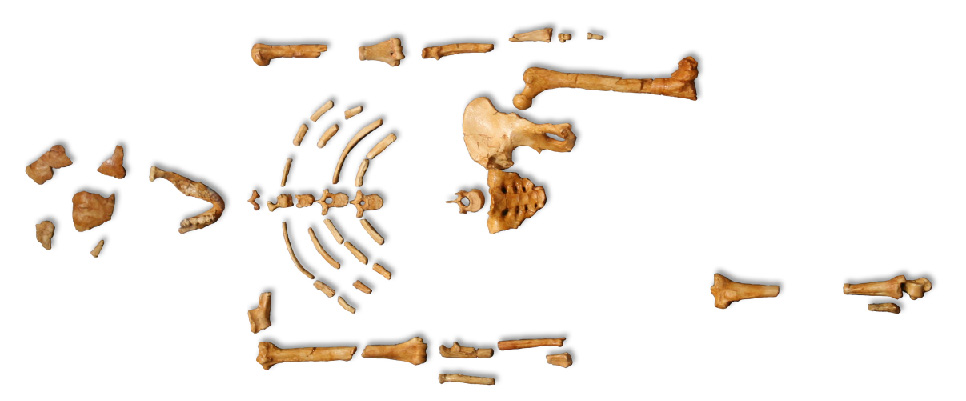
In 1974, while on a mapping expedition in Ethiopia, an American paleoanthropologist named Donald Johanson and a colleague stumbled upon a skeletal forearm and skull in a gully that had belonged to some type of early human. After careful work, Johanson’s team was able to recover about 40% of the skeleton, which they named Lucy after the popular Beatles song, “Lucy in the Sky with Diamonds.” We now know that, though small, Lucy was an adult when she died about 3.2 million years ago.
Lucy was of the genus Australopithecus. Like us, members of Lucy’s species afarensis (named for the Afar region of East Africa where she was found) could walk upright and likely used tools. Beyond that, however, they were very different from us. They had plenty of hair, like chimpanzees, fingers and arms well suited for climbing trees, and brains about one-third the size of ours. Despite these differences, scholars have concluded that the genus Homo (“human”) evolved from Australopithecus somewhere around 2–3 million years ago.
Lucy—Despite the incomplete state of the remains of Lucy, a member of the ancient genus Australopithecus, the similarities between her and modern humans of the genus Homo are striking. This image is a photoshopped reproduction of her skeleton. (credit: Modification of work “Reconstruction of the fossil skeleton of ‘Lucy’ the Australopithecus afarensis” by Wikimedia Commons, CC BY 2.5)
In addition to Australopithecus, archeological discoveries of Homo species have provided insight into the evolution and migration of Homo sapiens (modern humans). Some notable human ancestors of the genus Homo and their characteristics are listed in the table below.
Species
Estimated Time of Existence
Location(s)
Characteristics
H. habilis
2–3 million years ago
Sub-Saharan Africa
An early species that used stone tools (“habilis” means “handy”)
Human-like characteristics included a large brain and small teeth
Ape-like characteristics included long arms, hairy bodies, and 3–4 ft tall adults
H. erectus
110,000–2 million years ago
Emerged in East Africa
Migrated to other parts of Africa and beyond, reaching North Africa, the Near East, Europe, and East and South Asia over hundreds of thousands of years
Likely evolved from H. habilis
Lived entirely on the ground
Upright body position
Upright position left hands free to use tools, resulting in more sophisticated tool development
Dietary shift toward easier-to-digest foods because of digestive organ shift into a smaller space associated with body position change
H. heidelbergensis
300,000–600,000 years ago
Emerged in Africa
Later migrated to other areas, including Europe and possibly Asia
Typically considered the most recent common ancestor between humans and Neanderthals
Denisovans
50,000–300,000 years ago
Asia
Likely evolved from H. heidelbergensis
Classification is debated; possibly a new Homo species or a subspecies of H. sapiens
H. neanderthalensis
30,000–130,000 years ago
Europe and Asia
Likely evolved from H. heidelbergensis
Rapidly died out following modern humans arriving in Europe
H. sapiens
~300,000 years ago–present
Emerged in Africa
Later migrated to other regions
Modern humans
Likely evolved from H. heidelbergensis
The extent to which these different Homo species interacted with each other remains unclear. DNA evidence from a bone found in Siberia showed that a girl (who died at age 13) was born to a Denisovan father and a Neanderthal mother. Other studies have demonstrated that modern European, Middle Eastern, and Eastern Asian populations have some Neanderthal DNA. This suggests that mating between H. sapiens and Neanderthals was quite common.
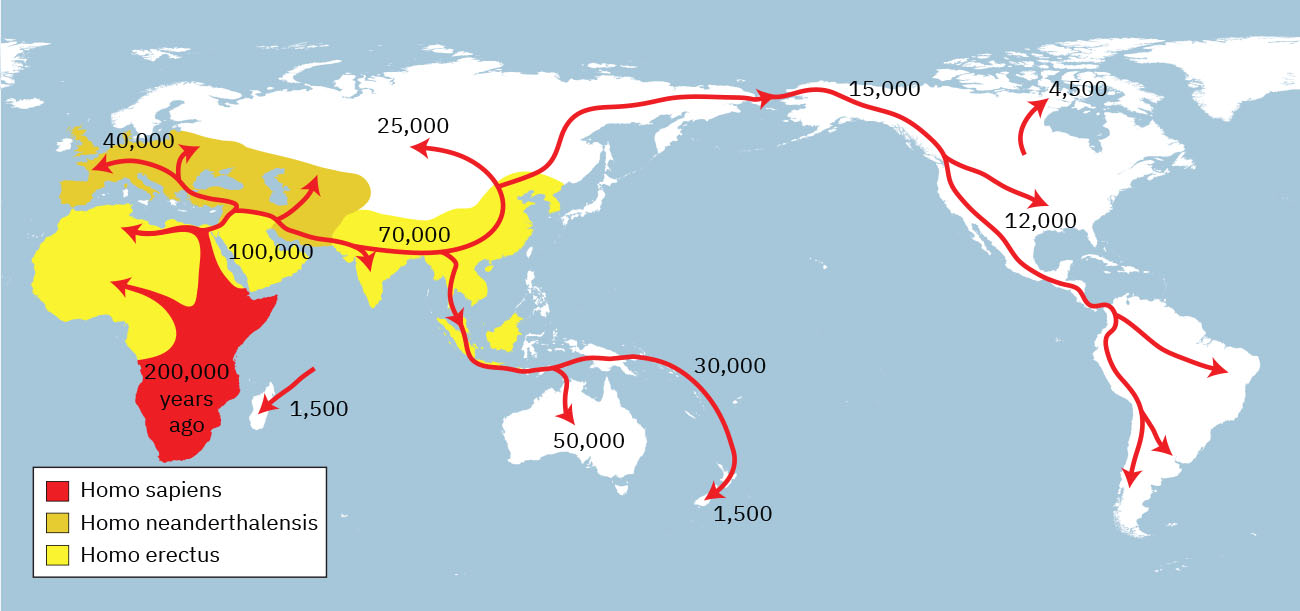
At some point between 40,000 and 15,000 years ago, the diversity of human species declined and only H. sapiens remained. Two models attempt to explain why. The first and most commonly accepted is the “out of Africa” model. This model suggests that modern humans emerged first in Africa approximately 200,000 years ago and then, approximately 100,000 years ago, groups of H. sapiens left the African continent and began a global migration that lasted for tens of thousands of years. This expansion out of Africa may have resulted in H. sapiens replacing all other Homo species.
Migration of the Earliest Humans—Homo sapiens first expanded around south and eastern Africa before embarking on migrations that eventually took them around the world. Source: Modification of work “Spreading of Homo sapiens” by “NordNordWest” Wikimedia Commons, Public Domain.
The second model is often called the “multiregional evolution model” and proposes that H. sapiens evolved from archaic humans in several places around the same time. This model emerged as an explanation for the great diversity of modern human traits in different populations around the world. However, it relies primarily on the study of fossils and archaeological records rather than on genetic data.
These theories about human evolution are not necessarily mutually exclusive, and the real answer to the puzzle may be a combination of the two. For example, it’s entirely possible that modern humans or a common ancestor did emerge first in Africa. Then, as this species expanded around the world, it mixed its genetic information with that of other human species. The DNA evidence collected in recent years certainly suggests a more complicated picture, and the debate has not yet been settled. The tools of both archaeology and molecular genetics continue to reveal new insights into the puzzle of human evolution and the rise of H. sapiens, and the conclusions we can draw about our distant past will continue to change as we learn more.
IN CONTEXT What Happened to Neanderthals in Europe?
For tens of thousands of years before H. sapiens arrived in Europe, the continent was home to Neanderthals. Then, about 40,000 years ago, right around the time modern humans entered Europe, the species neanderthalensis began to rapidly die out. For more than a century and a half, scholars have been trying to understand why.
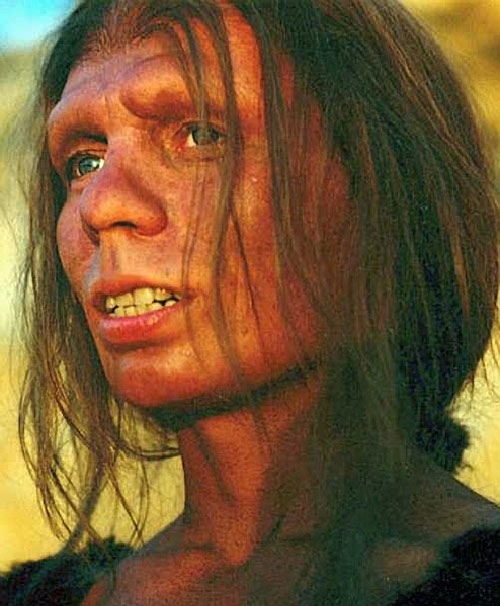
An Imagined Neanderthal Woman—This modern reconstruction of what a Neanderthal woman may have looked like demonstrates a striking resemblance to modern humans. (credit: “Reconstruction of Neanderthal woman (makeup by Morten Jacobsen)” by Public Library of Science/Wikimedia Commons, CC BY 2.5)
One theory is that modern humans replaced the Neanderthals in Europe through violent competition, including a type of warfare between the two groups. Another model argues that the competition was less about violence and more about resources. This theory posits that modern humans were simply better tool makers, had better survival strategies, and possibly experienced lower mortality rates and higher birth rates. Neanderthals simply couldn’t keep up, and their small population dwindled and then disappeared entirely.
Modern DNA analysis has opened the door for a new theory, that mating occurred between the two species and that the population of Neanderthals was simply absorbed by modern humans. The presence of small amounts of Neanderthal DNA in modern human populations lends some credibility to this idea, but it seems unlikely to explain the total disappearance of Neanderthals.
Finally, analysis of climate change in Europe has revealed some variations that could have weakened Neanderthal populations and led to their disappearance in some areas. As of now, no one theory can account for everything. It seems possible that several factors were at play rather than a single primary cause, so the debate goes on.
think about it
How might more than one of these reasons, or all of them, have contributed to the decline of Neanderthals in Europe?
Can you think of any other explanations for the extinction of Neanderthals?
summary
In this lesson, you learned about how scientists classify organisms using taxonomy and phylogenetics. Then, you learned about the classification and evolution of humans, and how humans may have migrated and promoted the decline of other Homo species.
Rodriguez-Flores, J. L., Fakhro, K., Agosto-Perez, F., Ramstetter, M. D., Arbiza, L., Vincent, T. L., ... & Mezey, J. G. (2016). Indigenous Arabs are descendants of the earliest split from ancient Eurasian populations. Genome research, 26(2), 151-162.
Wall, J. D., Yang, M. A., Jay, F., Kim, S. K., Durand, E. Y., Stevison, L. S., ... & Slatkin, M. (2013). Higher levels of Neanderthal ancestry in East Asians than in Europeans. Genetics, 194(1), 199-209.
Sankararaman, S., Mallick, S., Dannemann, M., Prüfer, K., Kelso, J., Pääbo, S., ... & Reich, D. (2014). The genomic landscape of Neanderthal ancestry in present-day humans. Nature, 507(7492), 354-357.
Attributions
Panda | Author: Wikipedia | License: Creative Commons
Terms to Know
Invertebrate
An organism that does not have a backbone.
Phylogeny
The evolutionary history and relationship of an organism or group of organisms.
Systematics
The science of determining the evolutionary relationships of organisms.