Table of Contents |
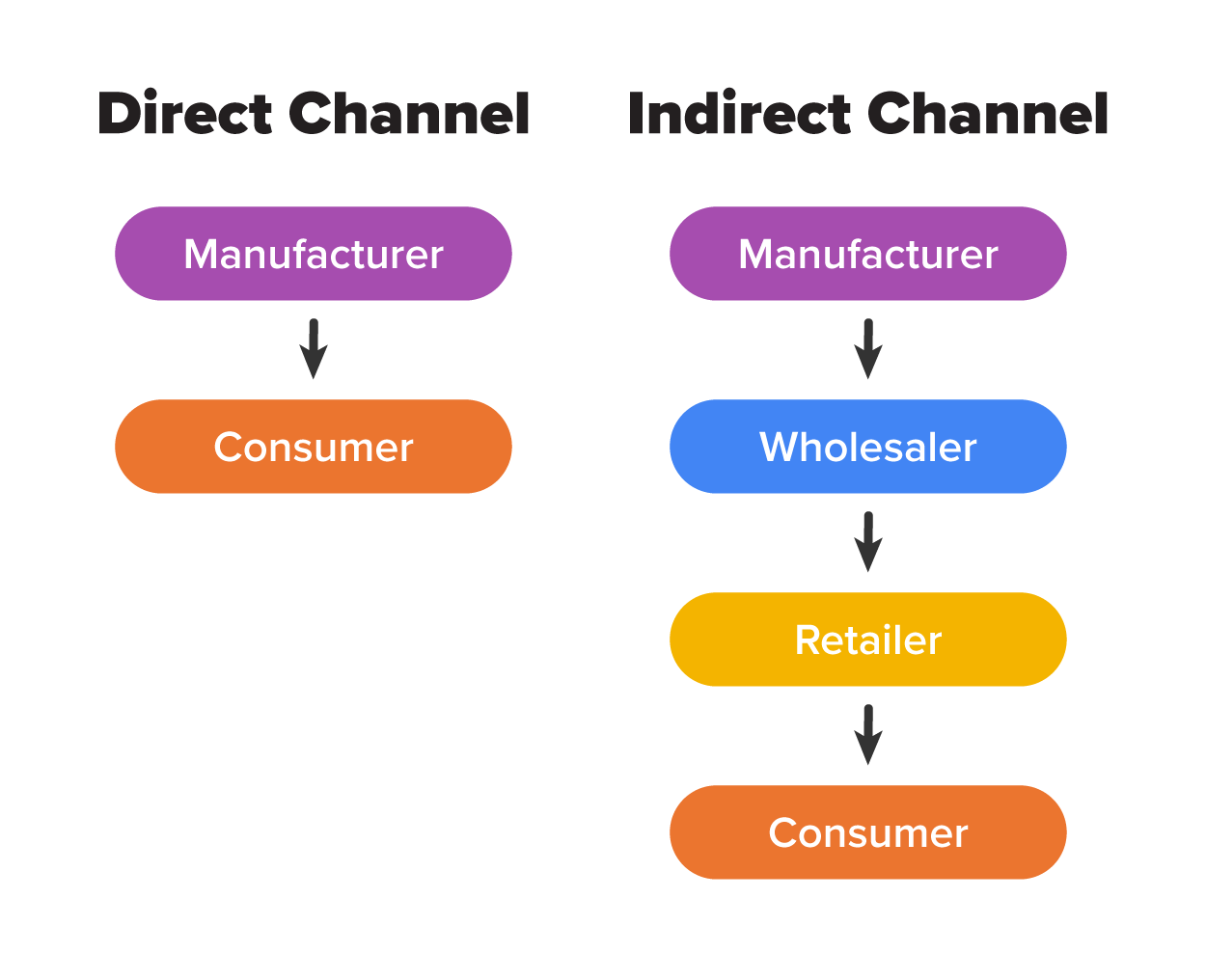
When determining the most effective and efficient way to reach consumers with products, companies have two options. Companies can either sell and distribute their products directly to consumers, known as a direct channel, or they can partner with intermediaries who can assist with the distribution, known as an indirect channel.
Direct Channel - From Producer to Consumer: In some cases, manufacturers decide that a direct marketing channel makes sense. A direct marketing channel does not use intermediaries but rather involves the manufacturer distributing its market offering directly to consumers.
EXAMPLE
When consumers purchase pizza from their locally owned and operated pizza shop, the distribution of that pizza passes from the restaurant directly to the consumer. There are no intermediaries between the pizza shop and the customer.Indirect Channels - From Producer to Intermediary to Consumer: An indirect marketing channel involves the utilization of one or more intermediaries to distribute a market offering to consumers.
EXAMPLE
If a local pizza shop offered pizza that was delicious enough to package, freeze, and sell through local grocery stores in the frozen food aisle, that pizza shop would be adding an indirect channel of distribution.In some cases, manufacturers or producers sell to retailers without the use of wholesalers or distributors, called the producer to retailer to consumer channel. A local Ace Hardware, for example, sells fishing lures made by the local scout troop. The troop purchases the supplies necessary to make the lures and then sells them to Ace Hardware, which sells them to customers.
With producer to wholesaler to retailer to consumer—a more complex marketing channel—multiple types of intermediaries are needed. Procter & Gamble, the maker of Crest, Gillette, and Pampers, relies on an intricate network of intermediaries composed of wholesalers and retailers that work interdependently to ensure the right mix and quantity of products reach consumers. Consider all the places a consumer can purchase Procter & Gamble products all over the world.
The business-to-business (B2B) market is comprised of companies that buy from and sell to other companies. In the B2B space, businesses are not distributing to final consumers but rather to other businesses. Companies in the B2B market buy, sell, and use materials, resources, and technology from one another to create products, where a business is the final consumer or destination. Within this market, there are agents, brokers, distributors, and wholesalers who specialize in moving industrial products along the marketing channel to the final business consumer.
Asset Name: PMAR105
IN CONTEXT
Direct Channel - From Producer to Business and/or Industrial User: Much like the business-to-consumer (B2C) space, when a company sells products or services directly to a final consumer or end user, the B2B marketing channel can be direct without the use of intermediaries. The direct channel is typically used when the nature of the product is complex, expensive, or requires intensive resources to move the product from the manufacturer to the business customer. Airplane manufacturers like Boeing and Airbus produce and sell aircraft directly to airlines like Delta Air Lines and American Airlines, who then offer flights to consumers. Given the expense and complexity of distributing airplanes, the direct channel makes the most sense.
Indirect Channels - From Producer to Intermediaries to Business and/or Industrial User: Industries often rely on the expertise of intermediaries to reach business users with their products and services. The advantages of the indirect channel in the business-to-business (B2B) space are like those in the business-to-consumer (B2C) space. For some industries, intermediaries perform essential functions along the business marketing channel that they themselves are not experts in. Let’s explore the different indirect marketing channels.
From producer to industrial distributor to business and/or industrial user channels, car manufacturers like Toyota and Honda rely on tens of thousands of different parts, which are manufactured by parts producers. Producers are companies that supply the raw materials that manufacturers need to create consumer products. Parts producers such as the car seating and E-Systems engineering company Lear rely on distributors to move their products and technology to automobile manufacturers. Using a distributor allows Lear to focus on its center of excellence—researching, designing, and building innovative seating technology solutions for vehicles.
Agents in the B2B space represent companies that produce industrial products and services and serve as an intermediary between the producer and the business user. The value of the agent is similar in the B2B space as it is in the B2C space. Agents add value by addressing product-related or service-related questions and concerns. They typically earn a commission or a fee off the sale of the industrial product.
For more complex industrial marketing channels with global business users, producers will work with agents who partner directly with distributors to move products.
EXAMPLE
The automobile industry relies on agents and distributors to reach business users. According to Global Fleet, the largest fleet vehicle management company in the world, of the 313 million vehicles driven in the United States and Canada, about 9 million are corporate cars. Element Fleet Management, based out of Toronto, Ontario, manages corporate vehicle fleets across the United States, Canada, and Mexico. Companies whose operations reach global markets typically rely on a much more complex channel that involve multiple layers of intermediaries to distribute products and services to business customers.After a manufacturer has evaluated its distribution channel options, it now needs to select the right channel members and manage and motivate them to operate effectively and efficiently. In addition, the manufacturer must also address any conflicts that may arise in the marketing channel. A channel member, also known as an intermediary, is a company that works in a network with other companies to help move products from manufacturers to final consumers. Channel members perform a variety of important tasks that collectively create value for the consumer.
Source: THIS TUTORIAL HAS BEEN ADAPTED FROM OPEN STAX’S PRINCIPLES OF MARKETING COURSE. ACCESS FOR FREE AT https://openstax.org/details/books/principles-marketing. LICENSE: CREATIVE COMMONS ATTRIBUTION 4.0 INTERNATIONAL.



