Table of Contents |
Having reviewed a market situation with legal minimum prices, we now turn our attention to the opposite case where a legal maximum price is introduced. The setting of a legal maximum price, known as a price ceiling, is rare because of the unintended consequences. Suppliers simply drop out of the legal market circumventing the government’s directive and sell in an unofficial or “hidden” market termed a black market. Prices in illegal markets far surpass those paid in the legal market.
A common application of a price ceiling, a legal maximum price set below market equilibrium, is in the housing markets of large metropolitan communities such as New York City and Los Angeles. Local governments in sympathy with citizens set rental prices on some apartments, and sometimes the selling price of apartments, to ensure affordability.
Let’s examine the impact of using a rent control policy in which the local government sets the legal maximum price. Suppose that the market clears at the equilibrium price of $2,000 per month with quantity equilibrium at 3 million two bedroom apartments. The following diagram highlights this situation as well as identifies both consumer and producer surplus areas.
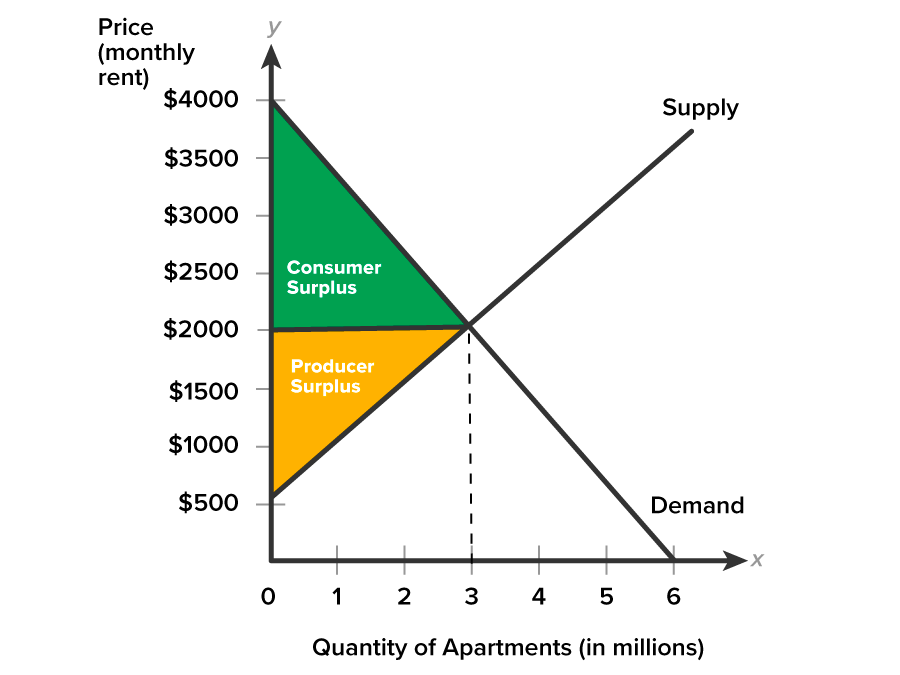
In the diagram, consumer and producer surpluses are identified as triangular areas either above or below the equilibrium price extending to the respective curve. There is no equilibrium point other than market equilibrium that would make either consumer surplus or producer surplus any larger: they are maximized. The market is operating efficiently—to its potential–as can be expected when buyers and sellers trade freely.
However, $2,000 a month is quite expensive for a two bedroom apartment and many families cannot afford that high of rent per month. Suppose the local government in sympathy with citizens’ concerns steps in and imposes a system of rent control, which is a maximum price that landlords can charge per unit, keeping rents affordable for more families in the city. This legal maximum price is a price ceiling.
Suppose the government now sets the price ceiling at $1,500 per month. Landlords can charge no more than $1,500 per month for their two-bedroom apartments. How does this policy intervention impact the rental market?
At the lower legal maximum price, there is a gap between the supply and demand curves. Many more families can now afford the apartments, but fewer landlords are willing to supply apartments. Families are responding in accordance with the law of demand; price decreases result in higher quantities demanded.
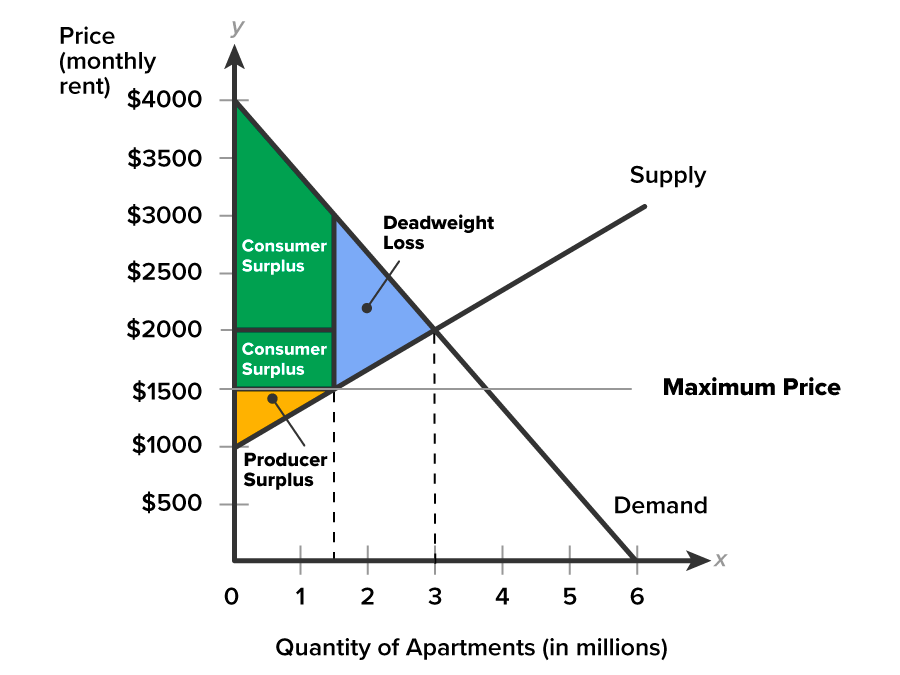
At this lower than equilibrium price, the available quantity of two bedroom apartments has shrunk from 3 million to 1.5 million. Landlords are responding in accordance with the law of supply: price decreases result in quantity supplied decreases. Government can mandate landlords to charge a certain price, but it cannot force them to rent their apartments. Landlords have removed 1.5 million rental units from the market. Only 1.5 million families will find a rental unit, while other families may leave the city, double up in an available unit, use the services of housing shelters, or become homeless.
The size of consumer surplus and producer surplus have also changed. Producer surplus, the area (yellow) below the legal maximum price and above the supply curve, is now much smaller than before the imposition of rent control. Consumer surplus, the area (green plus yellow) above the price ceiling and below the demand curve is much larger, having absorbed a portion of producer surplus. This policy intervention has made consumers better off at the expense of suppliers.
The market size has shrunk. The rent control policy intervention has introduced deadweight loss—a type of inefficiency—into the market. The triangular areas (blue) between the demand and supply curves and between 1.5 million and 3 million apartments is the decreased market efficiency. The deadweight loss represents the cost to society created by a market inefficiency, which occurs when the market equilibrium outcome is not achievable or not achieved.
Now that you have examined this information, ask yourself: Is the introduction of a legal maximum price a sound policy decision?
Let’s think about the question from the perspective of economics.
The source of the inefficiency was the imposition of a maximum rental price below the market’s equilibrium. Is that a bad thing? Not necessarily. It’s a trade-off with an opportunity cost. Some renters are made a bit better off, while some landlords and some other renters are not as well off. The opportunity cost is measured as the deadweight loss.
The intended social objective of the policy was to make housing more affordable for families in high-cost areas. The rent control policy did just that for some families. What value would you place on that? Recall from Challenge 1.1 Principle 2: All Choices have costs.
The concepts of surpluses and deadweight losses are abstract and somewhat difficult to quantify or estimate accurately. But our intention is less about accuracy and more about examining how a policy action impacts markets and buyers and sellers in that market. The economic consequences of policy intervention are often easier to grasp when we can visualize these using diagrams. The trade-offs of the policy–who benefits and who loses from certain policies–are made more apparent and the evaluation of the costs and benefits of those policies is easier to analyze using graphics based on the data. If society chooses to assist some groups, then other groups will be affected.
It’s not always going to be clear when the benefits outweigh the costs of a certain policy, or when the costs outweigh the benefits. But it is a starting point for logical and objective discussions.
Source: THIS TUTORIAL HAS BEEN ADAPTED FROM OPENSTAX “PRINCIPLES OF ECONOMICS 2E”. ACCESS FOR FREE AT https://openstax.org/books/principles-economics-2e/pages/1-introduction. LICENSE: CC ATTRIBUTION 4.0 INTERNATIONAL.
References
Prices of Illegal Goods and Services. Havocscope. (n.d.). Retrieved May 17, 2022, from havocscope.com/black-market-prices/



