Table of Contents |
In the average American diet, approximately 50 percent of the consumed carbohydrates can be classified based on their monomer content. These carbohydrates include simple sugars (monosaccharides like glucose, galactose, and fructose) and complex sugars (polysaccharides). Your digestive system efficiently breaks down disaccharides like sucrose (table sugar), lactose (milk sugar), and maltose (grain sugar), as well as polysaccharides like glycogen and starch. However, it lacks the enzymes needed to break down fibrous polysaccharides, such as cellulose.
The digestion of carbohydrates begins in the mouth. The salivary enzyme amylase begins the breakdown of food starches into maltose, a disaccharide. As the bolus of food travels through the esophagus to the stomach, no significant digestion of carbohydrates takes place. The esophagus produces no digestive enzymes but does produce mucus for lubrication. The acidic environment in the stomach stops the action of the amylase enzyme.
The next step of carbohydrate digestion takes place in the duodenum. Recall that the chyme from the stomach enters the duodenum and mixes with the digestive secretion from the pancreas, liver, and gallbladder. Pancreatic juices also contain amylase, which continues the breakdown of starch and glycogen into maltose, a disaccharide. The disaccharides are broken down into monosaccharides by enzymes called maltases, sucrases, and lactases, which are also present in the brush border of the small intestinal wall. Maltase breaks down maltose into glucose. Other disaccharides, such as sucrose and lactose are broken down by sucrase and lactase, respectively. Sucrase breaks down sucrose (or “table sugar”) into glucose and fructose, and lactase breaks down lactose (or “milk sugar”) into glucose and galactose. The monosaccharides (glucose) thus produced are absorbed and then can be used in metabolic pathways to harness energy. The monosaccharides are transported across the intestinal epithelium into the bloodstream to be transported to the different cells in the body. The steps in carbohydrate digestion are summarized in Figure 1.
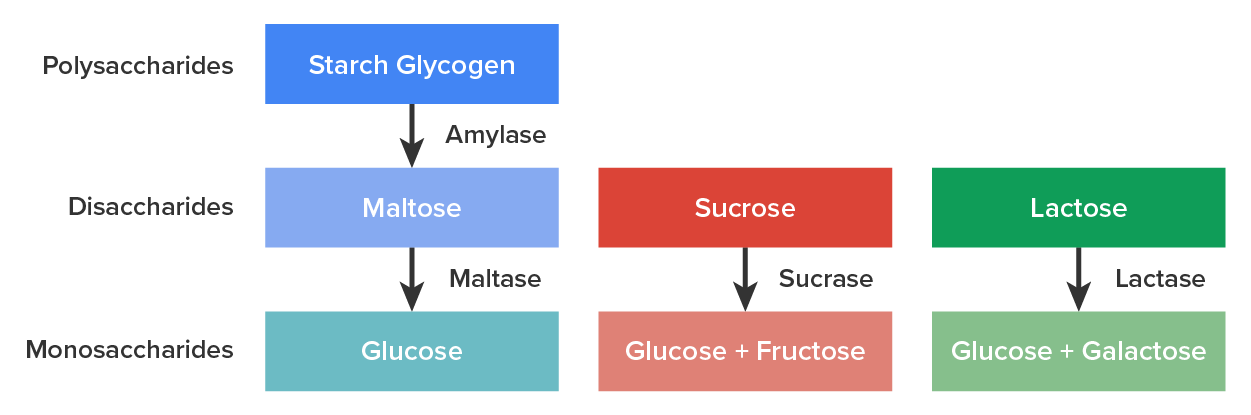
In Figure 1, digestion of carbohydrates is performed by several enzymes. Starch and glycogen are broken down into glucose by amylase and maltase. Sucrose (table sugar) and lactose (milk sugar) are broken down by sucrase and lactase, respectively.
Almost all of the carbohydrates, except for dietary fiber and resistant starches, are efficiently digested and absorbed into the body. Some of the remaining indigestible carbohydrates are broken down by enzymes released by bacteria in the large intestine. The products of bacterial digestion of these slow-releasing carbohydrates are short-chain fatty acids and some gasses. The short-chain fatty acids are either used by the bacteria to make energy and grow, are eliminated in the feces, or are absorbed into cells of the colon, with a small amount being transported to the liver. Since dietary fiber is digested much less in the gastrointestinal tract than other carbohydrate types (simple sugars, many starches), the rise in blood glucose after eating them is less and slower. These physiological attributes of high-fiber foods (i.e., whole grains) are linked to a decrease in weight gain and reduced risk of chronic diseases, such as Type 2 diabetes and cardiovascular disease.
IN CONTEXT
Simple sugars found naturally in foods and those that have been broken down from scratch digestion use an active absorption process that requires a specific carrier. Glucose and galactose are pumped into absorptive cells, along with sodium, using the active absorption process, and ATP energy is used. Fructose is different and is taken into cells by facilitative diffusion where a carrier is used, but no energy is needed. The process is slower than active absorption, so eating large amounts of fructose can lead to diarrhea. When glucose, galactose, and fructose go into the intestinal cells, glucose and galactose stay in their same form, and fructose is converted to glucose. Those single sugars are transported via the portal vein to the liver. The liver then can release the monosaccharides into the bloodstream for transport to organs, it can produce glycogen, which stores glucose for later use, or the liver can make fat.
Other starch, called resistant starch, is not digested. This resistant starch travels to the large intestine where bacteria metabolizes some of the starch, and acids or gases are produced. Anything left that is nondigestible by humans or the bacteria in our large intestine are excreted in feces.
For carbohydrate absorption, all carbohydrates are eventually absorbed in the form of monosaccharides.
Source: THIS TUTORIAL HAS BEEN ADAPTED FROM LUMEN LEARNING’S “NUTRITION FLEXBOOK”. ACCESS FOR FREE AT https://courses.lumenlearning.com/suny-nutrition/. LICENSE: creative commons attribution 4.0 international.



