Table of Contents |
The amount of energy that is needed or ingested per day is measured in calories. The nutritional Calorie (C) is the amount of heat it takes to raise 1 kg (1000 g) of water by 1 °C. This is different from the calorie (c) used in the physical sciences, which is the amount of heat it takes to raise 1 g of water by 1 °C. One calorie (cal) = exactly 4.184 joules, and one Calorie (note the capitalization) = 1000 cal, or 1 kcal. When we refer to "calorie" when we are discussing consuming food, we are referring to the nutritional Calorie.
On average, a person needs 1500 to 2000 calories per day to sustain (or carry out) daily activities (based on the U.S. standard).
As a rule, people underestimate the number of calories ingested and overestimate the amount they burn through exercise. This can lead to ingestion of too many calories per day. The accumulation of an extra 3500 calories adds 1 pound of weight. If an excess of 200 calories per day is ingested, one extra pound of body weight will be gained every 18 days. At that rate, an extra 20 pounds can be gained over the course of a year. Of course, this increase in calories could be offset by increased exercise. Running or jogging 1 mile burns almost 100 calories in many individuals.
The type of food ingested also affects the body’s metabolic rate. The processing of carbohydrates requires less energy than the processing of proteins. In fact, the breakdown of carbohydrates requires the least amount of energy, whereas the processing of proteins demands the most energy.
A human’s diet should be well balanced and provide nutrients required for bodily function and the minerals and vitamins required for maintaining structure and regulation necessary for good health and reproductive capability. A balanced diet includes a sufficient amount of all nutrients needed by the body for growth and to remain healthy. Conversely, malnutrition can occur when a person experiences nutritional deficiencies, excesses, or imbalances that result from insufficient energy and/or nutrient intake.
To help provide guidelines regarding the types and quantities of food that should be eaten every day to help promote these functions, the United States Department of Agriculture (USDA) updated its food guidelines from MyPyramid to MyPlate. They have put the recommended elements of a healthy meal into the context of a place setting of food.
MyPlate categorizes food into the standard six food groups: fruits, vegetables, grains, protein foods, dairy, and oils. The ChooseMyPlate.gov website gives clear recommendations regarding the quantity and type of each food that you should consume each day, as well as identifying which foods belong in each category. The accompanying graphic gives a clear visual with general recommendations for a healthy and balanced meal. The guidelines recommend to “make half your plate fruits and vegetables (20% fruit, 30% vegetables).” The other half is grains and protein (30% grains, 20% protein), with a slightly higher quantity of grains than protein. Dairy products are represented by a drink, but the quantity can be applied to other dairy products as well, such as cheese and cream-based foods.
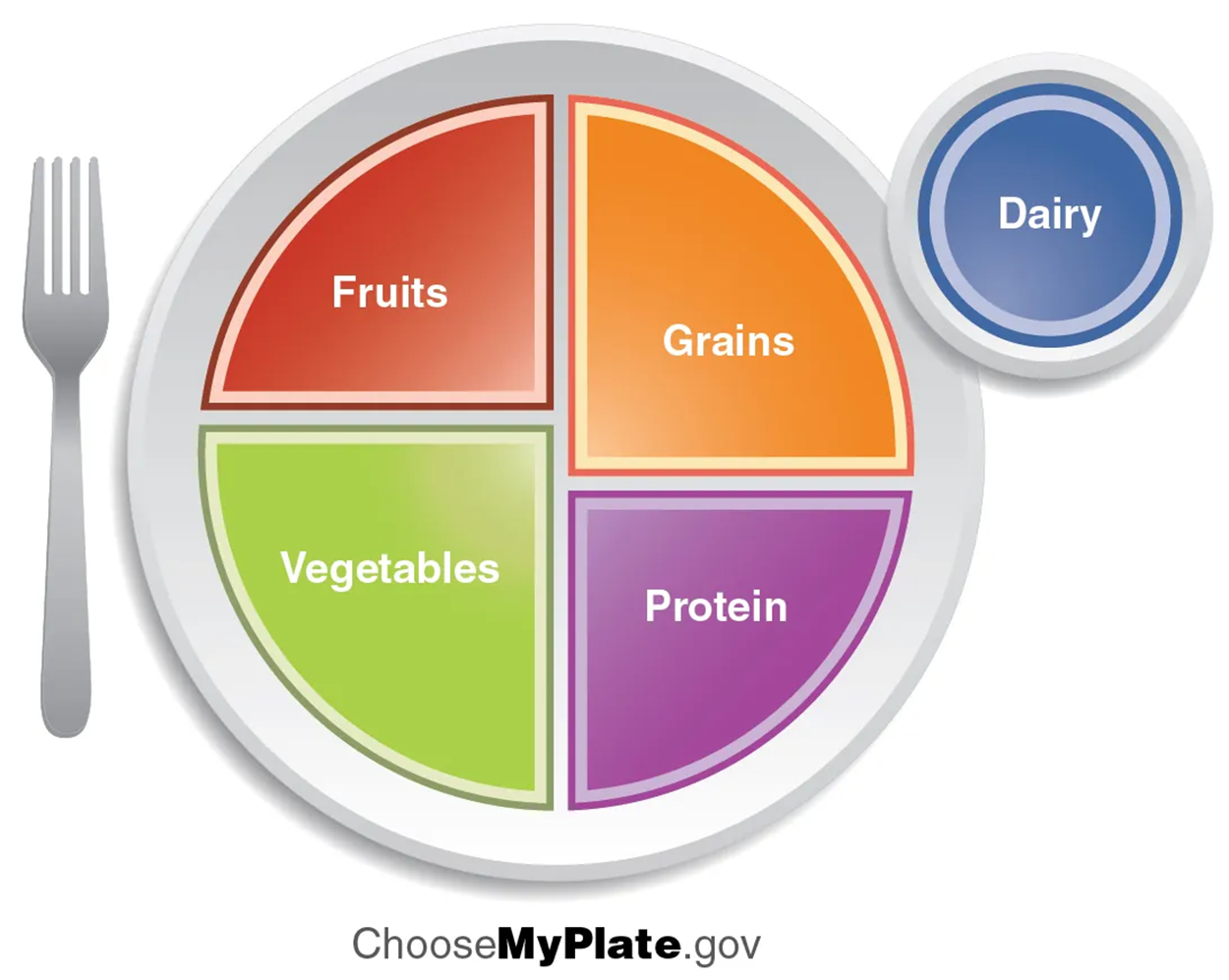
ChooseMyPlate.gov provides extensive online resources for planning a healthy diet and lifestyle, including offering weight management tips and recommendations for physical activity. It also includes the SuperTracker, a web-based application to help you analyze your own diet and physical activity.
IN CONTEXT
Career Connection
Registered Dietitian
Registered dietitians help plan nutrition programs for individuals in various settings. They often work with patients in healthcare facilities, designing nutrition plans to treat and prevent diseases. For example, dietitians may teach a patient with diabetes how to manage blood sugar levels by eating the correct types and amounts of carbohydrates. Dietitians may also work in nursing homes, schools, and private practices.
To become a registered dietitian, one needs to earn at least a bachelor’s degree in dietetics, nutrition, food technology, or a related field. In addition, registered dietitians must complete a supervised internship program and pass a national exam. Those who pursue careers in dietetics (the study of how human health is affected by food and nutrition) take courses in nutrition, chemistry, biochemistry, biology, microbiology, and human physiology. Dietitians must become experts in the chemistry and physiology (biological functions) of food (proteins, carbohydrates, and fats).
Obesity in the United States is epidemic. The rate of obesity has been steadily rising since the 1980s. In the 1990s, most states reported that less than 10% of their populations were obese, and the state with the highest rate reported that only 15% of their population was considered obese. By 2010, the U.S. Centers for Disease Control and Prevention reported that nearly 36% of adults over 20 years old were obese and an additional 33% were overweight, leaving only about 30% of the population at a healthy weight. Those studies found that the highest levels of obesity are concentrated in the southern states. They also found that the level of childhood obesity is rising.
Obesity is defined by the body mass index (BMI), which is a measure of a person's weight in kilograms divided by height in meters squared. The normal, or healthy, BMI range is between 18 and 24.9 kg/m². Overweight is defined as a BMI of 25 to 29.9 kg/m², and obesity is considered to be a BMI greater than 30 kg/m².
Obesity can arise from a number of factors, including overeating, poor diet, sedentary lifestyle, limited sleep, genetic factors, and even diseases or drugs. There are also different types of obesity. For example, regulatory obesity is caused by an error in the body’s mechanism that regulates food intake, whereas metabolic obesity occurs when there is an error in carbohydrate and fat metabolism.
Severe obesity (morbid obesity) or long-term obesity can result in serious medical conditions, including coronary heart disease; type 2 diabetes; endometrial, breast, or colon cancer; hypertension (high blood pressure); dyslipidemia (high cholesterol or elevated triglycerides); stroke; liver disease; gallbladder disease; sleep apnea or respiratory diseases; osteoarthritis; and infertility. Research has shown that losing weight can help reduce or reverse the complications associated with these conditions.
IN CONTEXT
Let’s Move! Campaign
As you have learned, obesity is a growing epidemic, and the rate of obesity among children is rapidly rising in the United States. To combat childhood obesity and ensure that children get a healthy start in life, former first lady Michelle Obama launched the Let’s Move! campaign.
The goal of this campaign is to educate parents and caregivers on providing healthy nutrition and encouraging active lifestyles to future generations. This program aims to involve the entire community, including parents, teachers, and healthcare providers, to ensure that children have access to healthy foods—more fruits, vegetables, and whole grains—and consume fewer calories from processed foods. Another goal is to ensure that children get physical activity. With the increase in television viewing and stationary pursuits such as video games, sedentary lifestyles have become the norm. You can learn more at letsmove.obamawhitehouse.archives.gov.
SOURCE: THIS TUTORIAL HAS BEEN ADAPTED FROM (1) OPENSTAX “BIOLOGY 2E”. ACCESS FOR FREE AT OPENSTAX.ORG/BOOKS/BIOLOGY-2E/PAGES/1-INTRODUCTION (2) OPENSTAX “ANATOMY AND PHYSIOLOGY 2E”. ACCESS FOR FREE AT OPENSTAX.ORG/BOOKS/ANATOMY-AND-PHYSIOLOGY-2E/PAGES/1-INTRODUCTION (3) OPENSTAX “CHEMISTRY 2E”. ACCESS FOR FREE AT OPENSTAX.ORG/BOOKS/CHEMISTRY-2E/PAGES/1-INTRODUCTION. LICENSING (1, 2, & 3): CREATIVE COMMONS ATTRIBUTION 4.0 INTERNATIONAL.
REFERENCES
The American Journal of Clinical Nutrition (Volume 9, Issue 5, September–October 1961, Pages 530-537 by MAYER JEAN D.SC., PH.D.). Obesity: Physiologic Considerations ScienceDirect. Retrieved September 20, 2023, from sciencedirect.com/science/article/abs/pii/S0002916523154736
World Health Organization (2020, April 15). Malnutrition Retrieved September 20, 2023, from who.int/news-room/questions-and-answers/item/malnutrition



