Table of Contents |
Communication is important to make sure everybody gets the right message at the right time. Communications planning is about keeping everybody in the loop. A project manager communicates with the project team, the project sponsor, organizational management, various stakeholders, vendors, and any other groups that need to know throughout the life cycle of the project. These groups can be either within the organization (internal) or outside of the organization (external).
Communications planning is a set of processes that do the following:
The communications planning processes yield a communication management plan. The communication management plan is not a single document but a set of documents that guide the project manager through the communications needs for the project. This plan is also referred to as the communications plan. The outputs from communications planning include:
As a reminder, the communication management plan is part of the project management plan (PMP).
| Planning Component | Addresses | Document | Document Purpose |
|---|---|---|---|
| Scope and scope management | The process of defining exactly what work is required (and what is not) to deliver the project’s objectives | Scope Management Plan | It outlines how the project scope will be defined, validated, and controlled to prevent scope creep. |
| Work breakdown structure (WBS) and scheduling | Breaking the project deliverables into smaller, manageable components and estimating the time needed to complete each activity | WBS and Schedule | The WBS breaks the project scope into manageable components, serving as the foundation for planning, estimating, and assigning work. |
| Identification of resources needed | Determining the people, equipment, and materials required to complete project activities | Resource Management Plan | It is created to document the type, quantity, and timing of resources so they can be acquired and managed effectively. |
| Determination of costs | Estimating the costs associated with the resources needed for the project activities | Project Budget and Procurement Management Plan | The project budget documents the costs of the project. The procurement management plan documents goods and resources needed to be obtained for the project. |
| Communication | Determining how project information will be shared among stakeholders (remember, you identified stakeholders during the initiation phase!) | Communication Management Plan | It is created to ensure the right information is delivered to the right people at the right time using the right methods. |
| Risk assessment and management | Identifying potential events that could impact the project, analyzing their likelihood and impact, and planning responses | Risk Management Plan | It is created to record identified risks, their characteristics, and planned responses so they can be monitored and managed throughout the project. |
A communication management plan is considered critical to the success of a project. It provides guidance for the project manager on how to keep stakeholders informed. This helps manage stakeholder expectations. A well-prepared communication management plan should assist the project by:
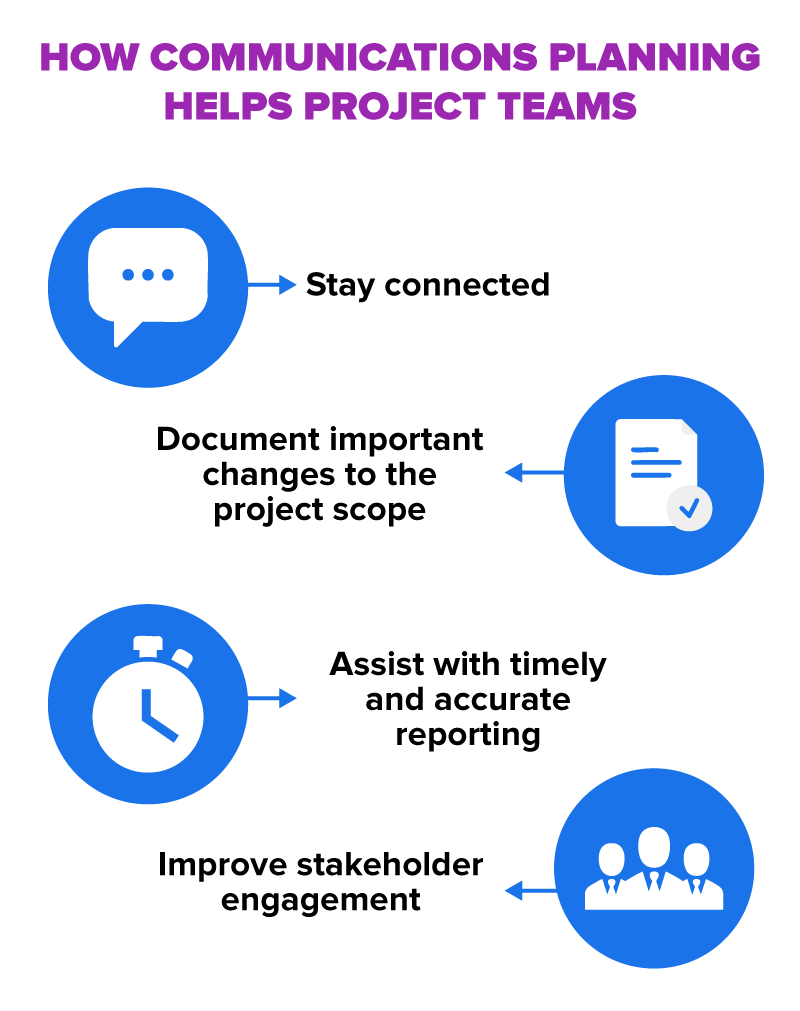
Communications planning can help teams:
The first step in the communications planning process is to gather stakeholder communication needs. You do this with a communication requirements analysis.
To define project communication, you will need to figure out what kind of communication your stakeholders need from the project so they can make good decisions. This is called the communication requirements analysis. Your project will produce a lot of information; you don’t want to overwhelm your stakeholders with all of it. Your job is to figure out what they feel is valuable. To complete this analysis, you will use the stakeholder register that was completed during the project initiation process.
In addition to learning what our stakeholders want to know about the project, the communication requirements analysis can help us know when they want to receive the information. As previously mentioned, we don’t want to overwhelm stakeholders who may have a casual interest in the project, and conversely, we don’t want to fail to keep key stakeholders informed on critical issues.
The final piece of information that the communication requirements analysis will reveal is how our stakeholders wish to receive the information, or specifically, the method or technology to be used.
You will learn more about communication methods in a future lesson.
Our communication requirements analysis should provide us with a good amount of useful information regarding the communication needs of our stakeholders. However, so that we are clear, what information are we gathering from this analysis? Let’s look at some of the goals and data gathered from the communication requirements analysis in a bit more detail.

IN CONTEXT
Let’s say that our project sponsor wants to see a project status report every month, prepared in PowerPoint and sent via email. The information the sponsor wants to know is whether the project is on schedule, on budget, and within the scope of work. Additionally, the sponsor wants a risk status report.
However, the project team has a weekly face-to-face meeting to review the project status. During their weekly meeting, individual project team members report their status on the tasks they are working on and share any concerns they may have. Here, the emphasis is on maintaining the project schedule and getting ahead of possible problems.
In both cases, the stakeholders want project status information. However, each prefers a different level of detail, frequency, and method of delivery.
The types of information you will communicate typically include:
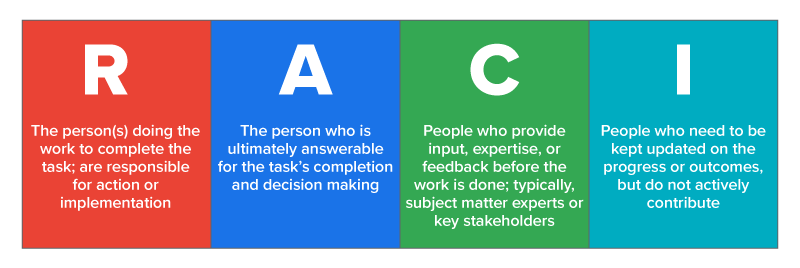
Remember, in an earlier tutorial, in the initiation phase, when we addressed stakeholder analysis? You may recall that we addressed the power interest grid, which helps us determine what types of communication we should use and how often we should communicate. Often, this is another document created during communications planning, the RACI chart. The RACI chart is a tool that describes the tasks, activities, or deliverables of a project and the roles that stakeholders take in that effort:
R: Responsibility (“I will get it done.”)
A: Accountability (“The buck stops here.”)
C: Consulted (“I want to be part of the decisions.”)
I: Informed (“I just want to know.”)
EXAMPLE
Let’s look at our spa app and how each role might occur.| Role | RACI Letter | Definition | Spa App Example | Why |
|---|---|---|---|---|
| Responsible | R | The person who does the work | The interface designer of the app would be responsible. | They are the ones actually doing the work. |
| Accountable | A | The person who is ultimately responsible for the work (but may not actually be doing the work) | The project manager is ultimately responsible for the interface design of the app. | Although the project manager is not the person actually designing the interface, they are ultimately responsible for it. |
| Consulted | C | Provides feedback and input on a project | The marketing team may have feedback or insight. | Since this team markets the spa, it may have valuable insight into the usability and design of the app. |
| Informed | I | Needs to be kept in the loop | The finance/accounting team needs to be informed. | Even though the project does not directly impact this team, updates from time to time are important. |
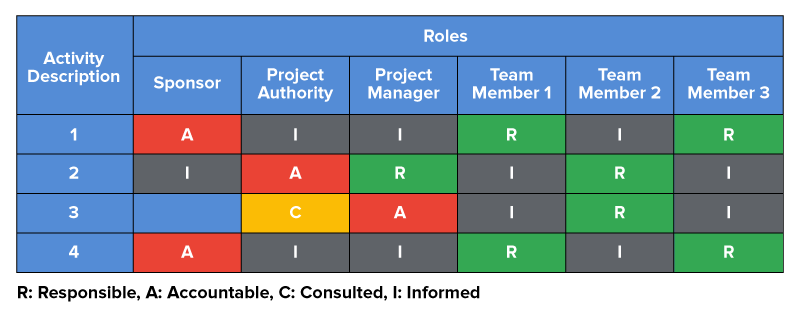
The RACI chart provides a visual representation (shown here) of the roles and responsibilities of each project stakeholder for each activity, task, or deliverable. Notice that the first column represents the activity description. The remaining columns represent each role on the project and their part in the activity. Knowing this information helps the project manager know how to focus communication related to that activity and ensure that those who need to know are informed.
EXAMPLE
Consider our spa scheduling app. One activity in the deliverables section of the scope management plan is the automated email/SMS reminders for appointments. The RACI line item for that activity might look like this:
Now, let’s look at the communication management plan document.
By now, you understand that the communication management plan is a document that lists the specific communication needs of the stakeholders of the project, as well as the frequency and method of delivery. A team member may be assigned to prepare and deliver the communication.
Since you are familiar with the RACI chart, let’s take a look at how it ties into the communication management plan.
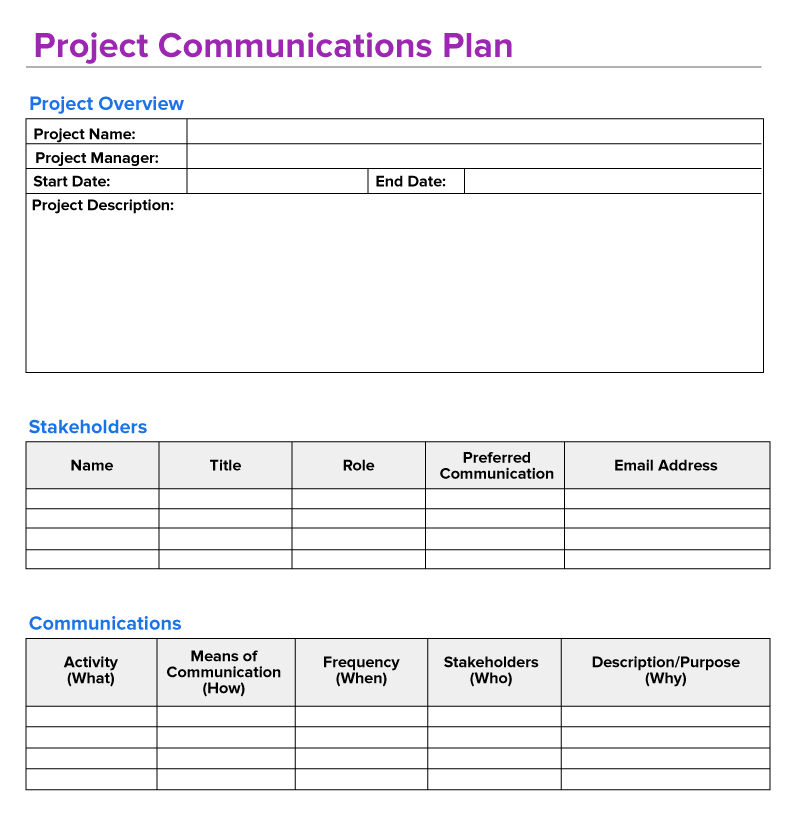
Here are two examples of what a communication management plan might look like.
EXAMPLE
| Stakeholder Name/Group | Role | Internal/ External | Interest/Influence | Communication Needs | Communication Type |
|---|---|---|---|---|---|
|
|
|||||
|
|
|||||
|
|
In our first example, the Project Overview section of the plan often contains basic information about the project, such as:
The Stakeholders section contains a list of project stakeholders with their title, their role in the project, communication preferences, and email addresses.
The Communications section contains a chart of all activities, tasks, or deliverables that require a form of communication and identifies who is to receive the information. This chart can include a variety of different columns, but some common columns include:
Now that you have an understanding of what is included in a communication management plan, let’s look back at our spa app project. Here is a communication management plan that has been developed.
| Stakeholder Name/Group | Role | Internal/ External | Interest/Influence | Communication Needs | Communication Type |
|---|---|---|---|---|---|
| Maria Lopez | Project sponsor | Internal | High—oversees project success and provides funding | Regular executive updates; milestone progress reports | Email and weekly meeting |
| James Chen | Project manager | Internal | High—responsible for project execution and timelines | Daily or weekly team meetings; status reports | Email and daily meetings |
| Marketing department | Content and branding support | Internal | Medium—needs consistent branding and timely content delivery | Weekly check-ins; review cycles for content | Twice-monthly status reports via email and weekly meeting |
| Community members | Local public audience | External | Low—may be indirectly impacted by project reach and visibility | Public announcements; press releases | At project start and finish |
As you can see, the spa owner, the project sponsor, and the project manager have high interest and influence. Because of this, we want to communicate more frequently with them. When someone has lower influence, we do not need to communicate with them as often.
There can be problems with project communication. Here are some common problems and things to consider:
SOURCE: THIS WORK IS ADAPTED FROM (1) PRESSBOOKS "NSCC PROJECT MANAGEMENT” BY ADRIENNE WATT. ACCESS FOR FREE AT WWW.PRESSBOOKS.ATLANTICOER-RELATLANTIQUE.CA/PROJECTMANAGEMENT/ AND FROM (2) SASKOER "PROJECT MANAGEMENT: A STRATEGIC APPROACH" by CARMEN REAICHE. ACCESS FOR FREE AT WWW.SASKOER.CA/STRATEGICPROJECTMANAGEMENT/. LICENSING (1 & 2): CREATIVE COMMONS ATTRIBUTION 4.0 INTERNATIONAL



