Table of Contents |
The subject of Macroeconomics is concerned with three main goals:
Fiscal policy is typically policy set by a central government authority, whereby spending and taxation by the government are adjusted to stabilize economic activity. The government can use these two tools to stabilize our economy's movement through business cycles.
In the short term, the goals of fiscal policy are full employment and price stability; in other words, managing the unemployment rate and making sure that prices are not out of control. The government uses taxation and spending to stabilize our economy when either unemployment or inflation rises.
In the long term, a third fiscal policy goal is economic growth over time. We want to make sure that our economy is producing more and becoming more efficient and productive over the years and decades. Economic growth is the measure of the change in real GDP over periods of time. It is the percentage change in the value of the sum of goods and services produced within a country's natural borders over a specified time interval.
Typically, GDP per capita is the measure that is used more commonly for comparing economies and growth between countries. GDP per capita is GDP divided by the size of a country’s population. It provides an idea of how much production is occurring per person on average.
The graph below shows real GDP per capita in the United States since 1950. As you can see, there is a growth trend, even though there are times it decreases briefly.

However, not all increases in GDP or GDP per capita actually mean that the economy has grown in a sustained, long-term way. We will look at the graphs to help us understand this in the next section.
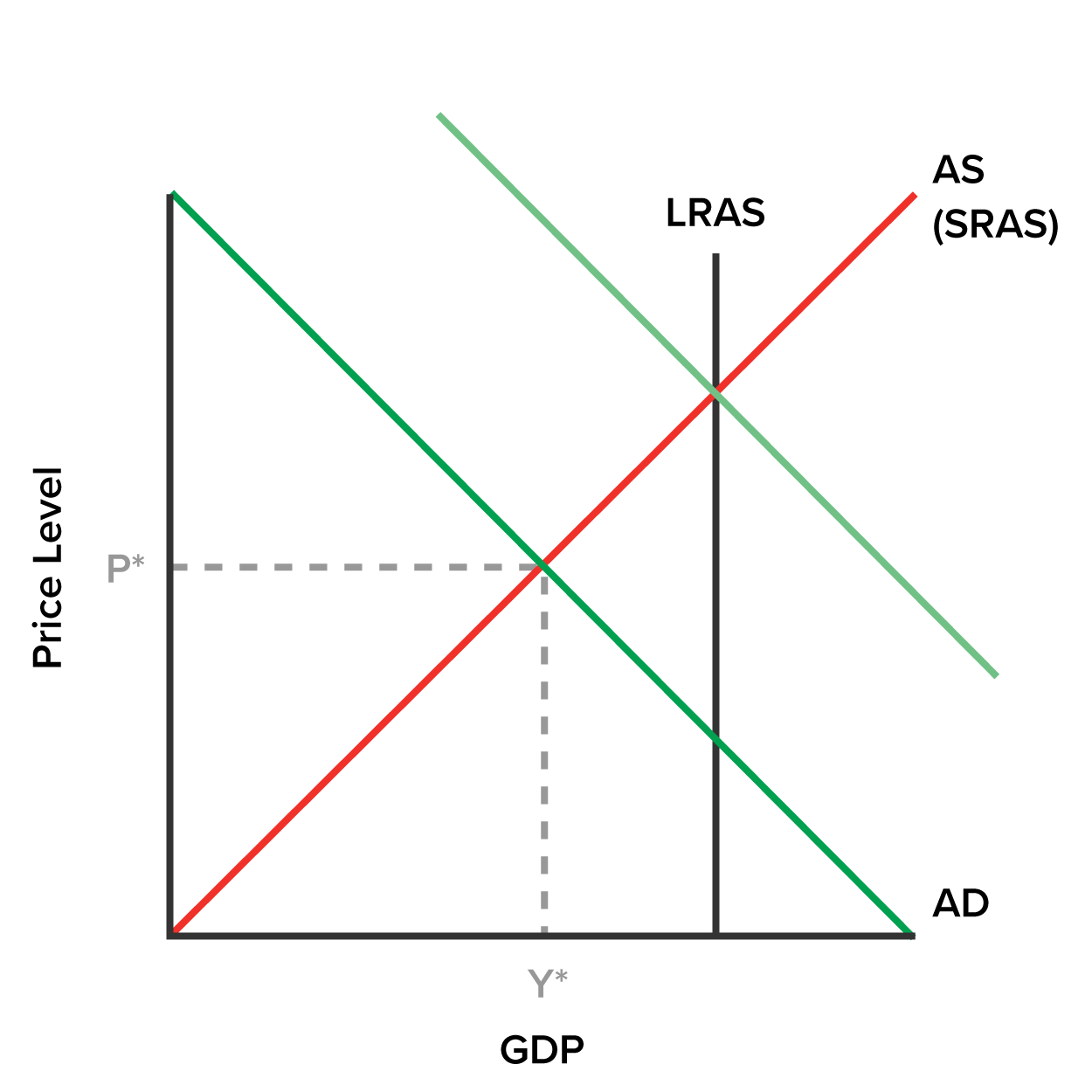
This graph reminds us of how expansionary policies can help to close a recessionary gap. When our economy is producing at Y*, it is not utilizing all of its land, labor, and capital. During a recession, the government can increase spending and/or cut taxes in order to convince people to spend more money. This will hopefully shift aggregate demand to the right as shown and help our economy produce to the level of GDP that does utilize our resources most efficiently.
However, what would happen if we continued to stimulate aggregate demand through expansionary policies at this point? Any time we push the short-run equilibrium output beyond the potential long-run output, it is unsustainable. Prices will go up, and aggregate supply will shift to the left again. This is why the long-run aggregate supply curve is where it is—because it represents our potential today, given the resources that we have.
If we are already at full employment, enacting those expansionary policies is not going to cause long-term economic growth that is sustainable. It will merely increase output in the short term.
Then, how does our economy actually grow over time and not just simply produce more in the short run? Well, we have to figure out a way for our long-run aggregate supply curve to move, which is possible. Anything that shifts the long-run aggregate supply (LRAS in the graph), as shown below, will give us the ability to produce more in the long run.
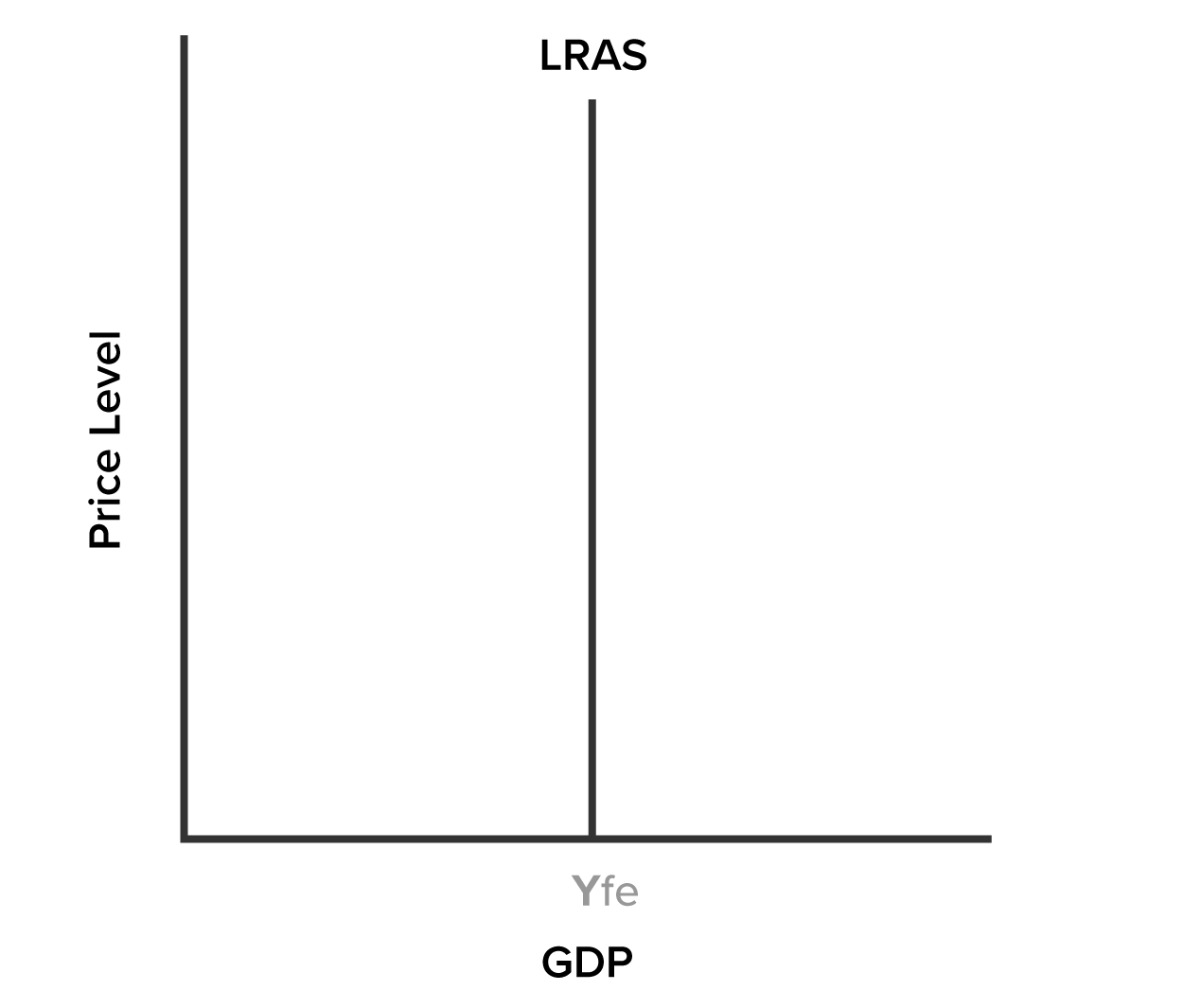
Our long-run aggregate supply curve shows us our economy’s full potential, assuming that all land, labor, and capital are utilized. Therefore, if we want to grow over time, something about these resources will have to change.
In theory, if we can find more land, labor, or capital, then the LRAS curve will shift, and we can produce more sustainably.
| Land | Finding or taking over more land more practically and discovering new resources can contribute to production. |
| Labor | Population growth through increased births or immigration can mean a greater number of people in the labor force able to work and contribute to production. |
| Capital | Advancements in technology provide more capital and enable us to produce more. |
Even if we do not have more land, labor, or capital, there are ways to improve productivity, as measured by the output per worker. Why are today’s workers more productive than workers in the past? There are three main reasons:
| Physical Capital | More physical things to help workers produce more |
| Human Capital | Better education, training, knowledge, and experience |
| Technology | Faster and better methods help workers produce more in less time |
Physical capital involves anything man-made that firms purchase in order to help them produce their output. This can include their factories, machinery, and any other types of equipment. Human capital is different, because it concerns the ability of the workers to perform their jobs in order to produce the output. Technology generally refers to the methods used in the production process.
All of these contribute to greater productivity and can help economies continually produce more over time. However, none of this comes free of cost. Spending money on physical capital, human capital, and technology for future productivity means sacrificing money spent producing today.
The key question then becomes this: how can we encourage more investment in these areas? We now turn to specific policies that countries can take to promote investment in their physical capital, human capital, and technology.
You have learned that government spending and taxation are part of fiscal policy. During recessions, the government may spend more money and cut taxes in order to encourage people to spend more. Although we will be talking about the government spending money or providing tax credits in the next three sections, notice how the goal is different. To promote long-run growth, the policies must specifically encourage investments in areas that will help companies produce more in the future. This can be done by improving physical capital per worker, human capital, or technology.
If the government spends money on ways to provide more or better physical capital, then our workers and the work they do will be more productive.
EXAMPLE
You may hear about investments in infrastructure. Sometimes the government simply spends money to make improvements to our country’s highway systems, waterways, or bridges. At other times, the government may pass legislation that provides private companies with tax credits if they invest in making these types of improvements to their own factories.Having great physical capital is important, but it will not do any good if our workers are not prepared for today’s jobs. How can our government improve the quality of our workforce? This could involve a broad range of policies.
IN CONTEXT
Investing in education at all stages of a person's life can have a big impact on their future productivity as a worker.
A lot of research suggests that children who have a preschool education experience many advantages and become much more productive workers when compared to children who do not have the opportunity of a preschool education. Therefore, some have suggested that government investment to fund access to preschool programs could help create a more productive workforce.
There is also a lot of thought about how our country can help those in a cycle of poverty receive the education and training to lead successful lives. In the 1960s, Jobs Corps was one such program, created in order to help young adults in low-income situations.
The G.I. Bill was passed in order to help World War II veterans readjust to civilian life. Over the years, this bill has helped many veterans pay for college, graduate school, and training programs.
The government has always been involved to some extent in providing subsidized loans to college students. With the rising cost of college education, many people believe that the government needs to do even more to ensure that all Americans have the ability and incentive to receive the necessary education and training for productive careers.
Technological advancement is one of the most important ways to continually promote economic growth from decade to decade. Sometimes, companies have an incentive to invest in research and development on their own, as more efficient production techniques can be profitable in the future. However, this can be extremely expensive in the short term, so the government can fund research and development, or they can provide tax credits to encourage private companies to invest in research and development.
You have seen the term sustainability several times throughout the course, and sustainability is key to ensuring long-run economic growth. Sustainability is the ability to utilize resources in the current timeframe without sacrificing the opportunity for future use and without disturbance to the ecosystem. Making sure that our current and future technologies are utilizing sustainable production methods requires continuous effort.
EXAMPLE
Reducing carbon emissions or using renewable energy requires companies to spend more money today. Again, the government can provide tax credits to encourage people and companies to make these investments.


