In this lesson, you will learn how to describe motion using reference frames, coordinate systems, and vectors. You’ll explore the difference between position, path length, and displacement, and why direction matters. Specifically, this lesson will cover:
Imagine trying to meet a friend at a concert at a large stadium, but all they say is, “I’m by the big speaker.” Without knowing where they are compared to you, that’s not very helpful. Whether you're giving directions, tracking a soccer ball, or landing a spacecraft, knowing where something is and how it’s moving, compared to something else, is super important.
In physics, a reference frame is the point of view you use to observe and measure motion. Imagine you’re sitting with the Red Team fans on one side of the soccer field, while your friend is cheering for the Blue Team on the opposite sideline. A player from midfield kicks the ball toward the goal. From your side, the Red Team's reference frame, the ball moves from left to right across the field. But your friend on the Blue Team’s side sees that same ball traveling from right to left. It’s the exact same motion, but each of you describes it differently based on your point of view. This is a great example of how reference frames shape how we perceive motion.
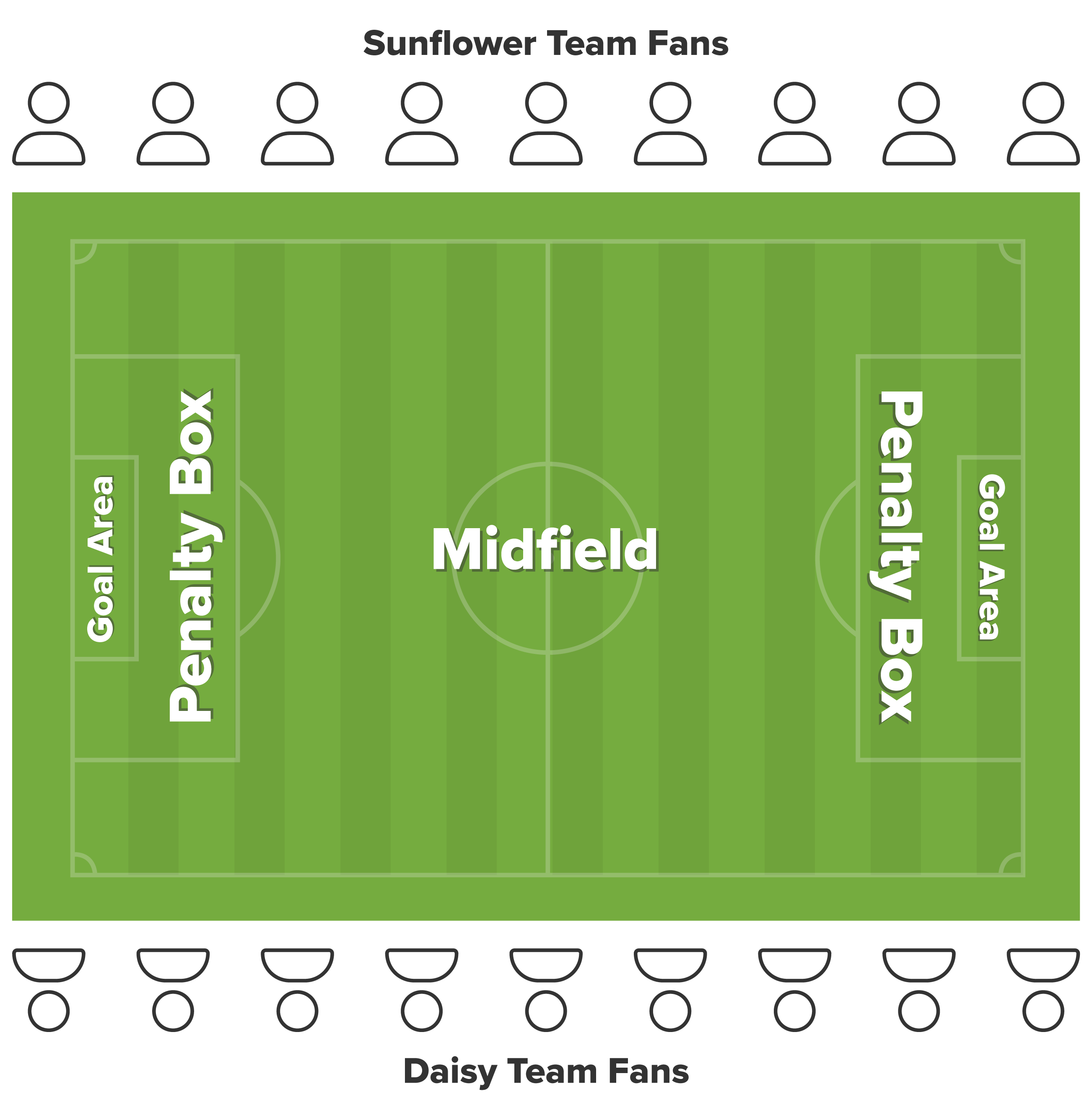
A soccer field can be our reference frame.
To describe motion more precisely, we define position as the exact location of something within a reference frame at a specific moment in time. We also use a coordinate system, which is a mathematical framework that assigns numbers with units, or coordinates, to uniquely specify the position of objects in space. Each number identified in a coordinate system includes a unit, such as meters, feet, miles, etc.
Imagine an invisible grid laid across the soccer field, where each location—like midfield, penalty box, or goal area—has its own coordinate "address." This grid lets us explain where players are, how they move, and how far the ball travels. Whether you're watching from the Sunflower Team’s sideline or the Daisy Team’s, the coordinate system provides a consistent way to track and describe motion from any point of view.
In a coordinate system, we usually have two main directions: one that goes side to side, called the horizontal (x) axis, and one that goes up and down, called the vertical (y) axis. Where they cross is called the origin, like the center of your map at position Positions to the right of the origin are positive x, and to the left are negative x. Going up is positive y, and going down is negative y. So, if someone kicks a ball, you can describe its location at any moment using this invisible coordinate grid. It’s how we turn motion into something we can picture, track, and understand, even without any complicated math.
Imagine a city laid out on a coordinate grid, and your home is located at the origin, so your location is miles. This coordinate system will allow you to describe directions and distances from your home easily using the x-axis (east-west) and y-axis (north-south).
The car wash is three miles west and three miles north of your home, so its coordinates are miles.
The grocery store is three miles east and three miles south of your home, so it’s located at miles.
A bakery is two miles west of you and two miles south of your home, so it’s located at miles.
Your favorite restaurant is four miles east and one mile north of your home, so it’s located at miles.
A coordinate system can help map out a given area.
terms to know
Reference Frame
The position or point of view you use to observe and measure motion.
Position
The exact location of something within a reference frame at a specific moment in time.
Coordinate System
A mathematical framework that assigns numbers with units, or coordinates, to uniquely specify the position of an object(s) in space.
Horizontal Axis (x-axis)
A horizontal line goes straight left and right. It represents movement or position in the side-to-side direction.
Vertical Axis (y-axis)
A vertical line goes straight up and down. It represents movement or position in the up-and-down direction.
Origin
The center point where the horizontal and vertical axes cross—your starting reference for all positions.
Positive x
Locations to the right of the origin, in the direction of increasing x-values.
Negative x
Locations to the left of the origin, in the direction of decreasing x-values.
Positive y
Locations above the origin, in the direction of increasing y-values.
Negative y
Locations below the origin, in the direction of decreasing y-values.
2. Displacement & Path Length
When describing motion, position is like marking a dot on a map to show an object’s location. Displacement measures how far and in what direction an object is from where it started; it’s the straight-line distance from the starting point to the final position. Path length, on the other hand, is the total ground covered, regardless of direction or whether the object returns to where it began.
formula to know
Displacement
Where is displacement, is the final position, and is the initial position.
IN CONTEXT Canoes, Currents, and Knowledge: Physics from the Pacific
Long before GPS or compasses, Indigenous Polynesian navigators sailed across vast stretches of open ocean using their deep understanding of the stars, ocean swells, and migratory birds. Without formal equations, they instinctively made sense of movement by estimating both distance and direction to travel thousands of miles between tiny islands scattered across the Pacific.
Polynesian navigators built rich mental maps of the sky and sea and passed this knowledge through generations. This wasn't just navigation; it was cultural brilliance in motion. Their wayfinding tradition showcases how principles now used in physics, like displacement and velocity, were long embedded in real-world problem-solving. It's a striking reminder that some of the world's most advanced insights didn't begin in textbooks. They were born in ocean canoes under starry skies.
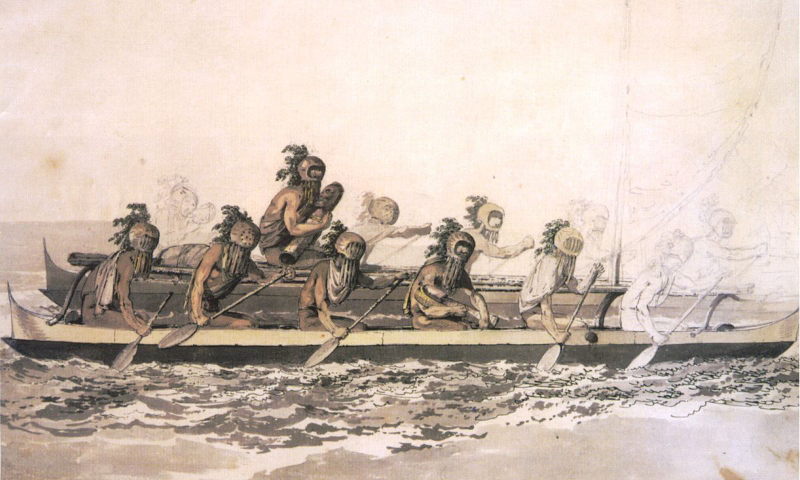
Canoers from the Cook Islands, as painted in 1778
terms to know
Displacement
The straight-line distance and direction from an object's starting point to its ending position within a reference frame.
Path Length
The total distance an object travels over the course of its motion, regardless of direction or final position.
3. Vectors & Scalars
In physics, we use two different ways to describe quantities. A scalar tells you only the size or amount of something. A vector tells you how much and in which direction. If someone says, “I walked three miles,” they’re giving you a scalar. It tells you how far, but not which way. A vector, on the other hand, gives you the “how much” and the “which way.” If they say “I walked three miles north,” that distance includes a direction, so it’s a vector.
IN CONTEXT
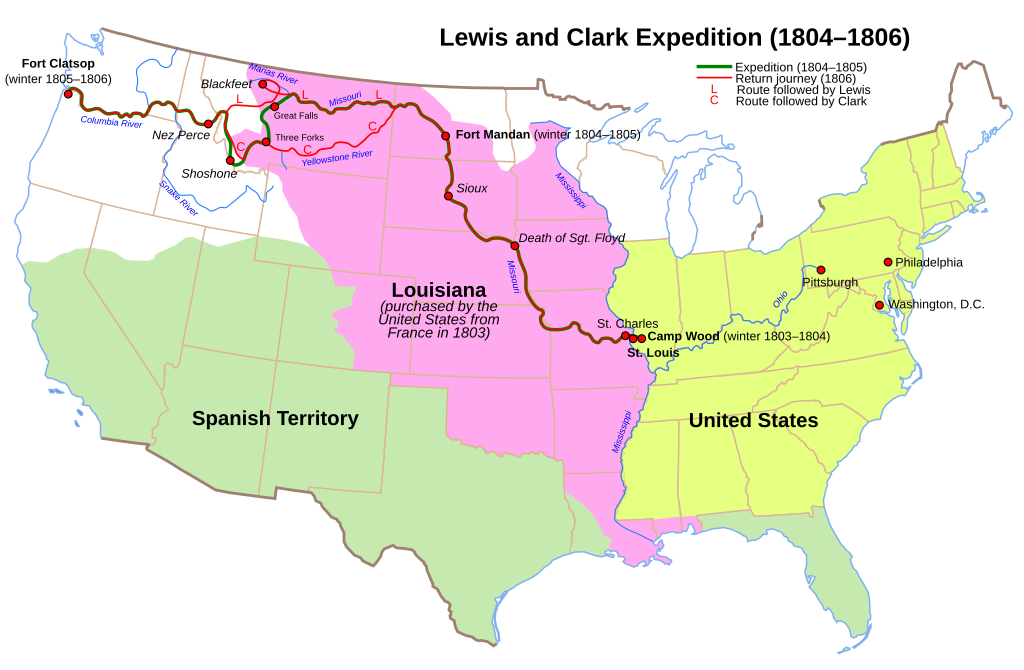
With the guidance of Sacagawea, a Shoshone interpreter, diplomat, and skilled navigator, Lewis and Clark’s epic journey from St. Louis to the Pacific coast totaled about 8,000 miles of actual travel. Every river bend, mountain pass, and backwoods detour counts toward this distance, a scalar quantity that sums the full path the group walked and paddled.
Lewis and Clark’s 8,000-mile expedition mapped as total scalar distance, capturing every hill, valley, twist, and turn from St. Louis to the Pacific Ocean.
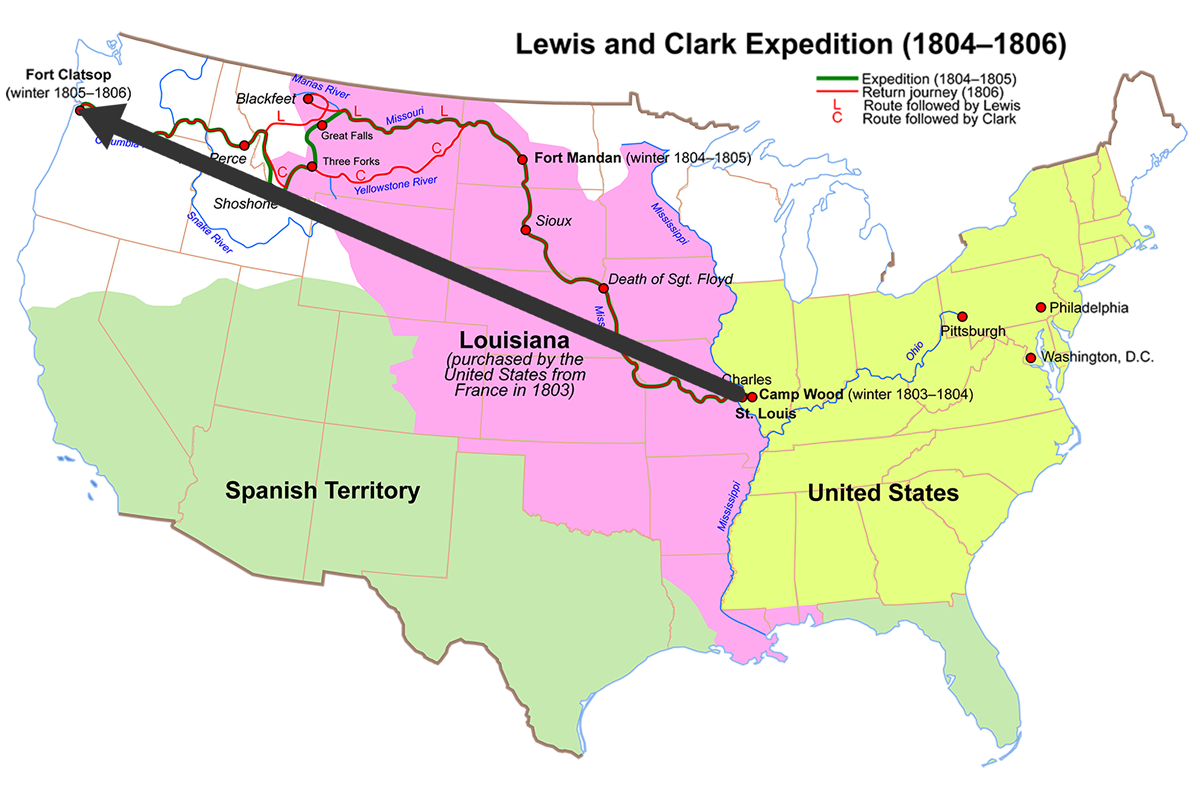
Their displacement, by contrast, is the straight-line vector from their start point in St. Louis to the mouth of the Columbia River, roughly 1,760 miles in a single direction. Can you see how distance and displacement reveal two very different perspectives about the same expedition?
Map highlighting the straight-line displacement vector from St. Louis to the Pacific coast (about 1,760 miles), illustrating the group’s total change in position.
terms to know
Scalar
A quantity that tells you only the magnitude without any reference to direction.
Vector
A quantity that includes both direction and magnitude.
summary
In this lesson, you learned how to describe motion using a variety of foundational physics concepts. In Reference Frames, you explored how motion depended on your point of view and how coordinate systems helped organize positions within that perspective. In Position & Displacement, you distinguished between where something was, how far it moved, and how much ground it covered. The section Vectors & Scalars showed how some quantities need only a magnitude, while others—like displacement—require direction as well. By the end, you had a clearer understanding of how to track 'where,' 'how far,' and 'which way' something moved.
 Positions to the right of the origin are positive x, and to the left are negative x. Going up is positive y, and going down is negative y. So, if someone kicks a ball, you can describe its location at any moment using this invisible coordinate grid. It’s how we turn motion into something we can picture, track, and understand, even without any complicated math.
 miles. This coordinate system will allow you to describe directions and distances from your home easily using the x-axis (east-west) and y-axis (north-south).
 miles.
  miles.
  miles.
  miles.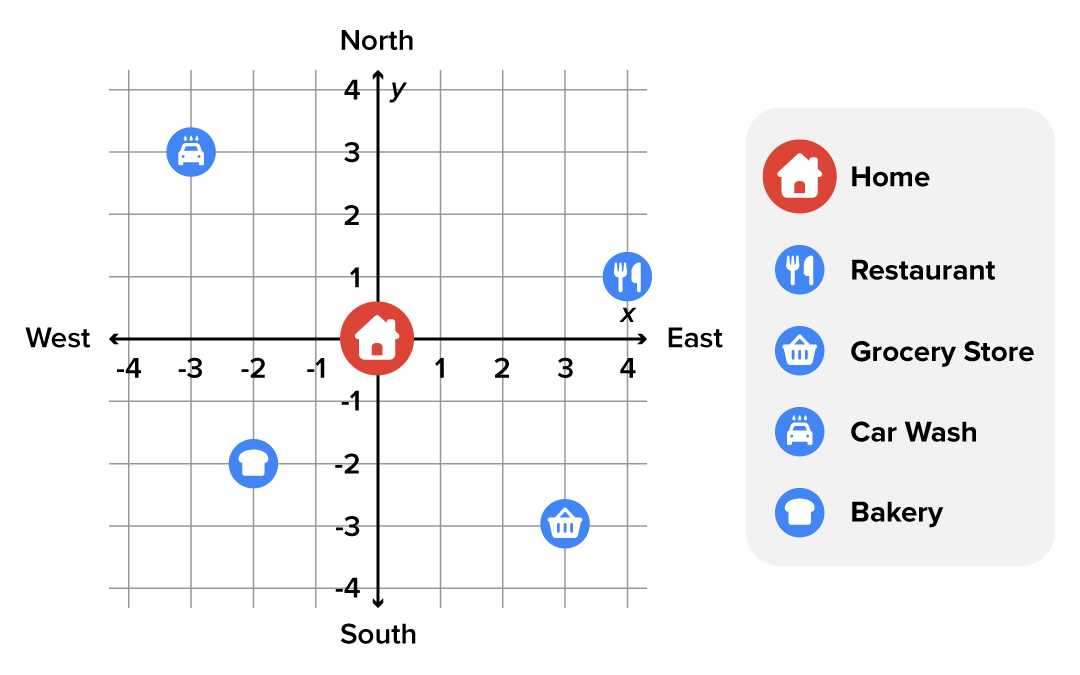

 is displacement,
  is the final position, and
  is the initial position.
 is displacement,
  is the final position, and
  is the initial position.