Table of Contents |
Markets for labor have demand and supply curves, just like markets for products. Demand reflects a buyer’s willingness and ability to purchase some good or service during a certain period of time. Demand for labor is about an employer’s willingness and ability to hire workers. Why is an employer willing to pay you for your labor? It’s not because the employer likes you or is socially conscious. Rather, it is because your labor is worth something to the employer: your work brings in revenue for the firm. How much is an employer willing to pay? That depends on the skills and experience you bring to the firm.
The decision of how many total workers a firm hires is dependent on the marginal productivity of labor (MPL), irrespective of whether the firm is producing goods and services in a perfectly competitive product market or in an imperfectly competitive product market.
A firm determines the amount of a good or service to provide based on marginal costs, and a firm makes hiring decisions about employing individuals based on the marginal productivity of their labor.
Many of the concepts you learned in Challenge 2.3.6 are applicable in this tutorial. The marginal product of labor is the additional output a firm produces by adding one more worker to the production process. Assuming workers are paid by the hour, the marginal product represents the additional output produced by one additional worker hour. Our analysis will also assume that all workers are homogeneous—that is, the employer does not differentiate between potential workers. Therefore, the marginal product of labor will depend on the physical capital and technology available to the workers. Higher levels of technology raise workers' productivity, that is, the output per worker.
Suppose a company called Super Gadgets has a fixed amount of capital, and it hires workers to produce gadgets. The table shows the additional output the firm produces by adding each additional worker to the gadget production process. This information will help us to build the firm’s demand curve for labor.
| Quantity of Labor | Marginal Product of Labor (MPL) |
|---|---|
| 1 | 4 |
| 2 | 3 |
| 3 | 2 |
| 4 | 1 |
The graph below shows the relationship between the number of workers hired and the marginal product of labor (MPL) for the production of gadgets. When we plot the points, we are presented with a downward-sloping MPL curve. Why does the MPL curve slope downward?
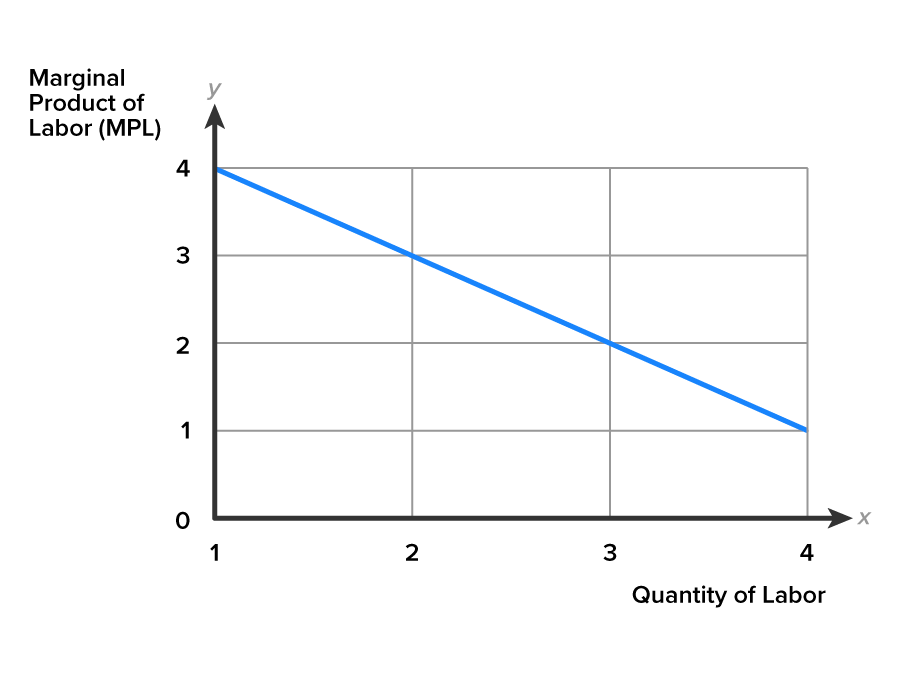
Recall that in the short run, a firm operates with a constraint, which means that at least one of the firm’s inputs to production is fixed, and it cannot be adjusted up or down as production is increased or decreased in the short run.
Marginal productivity describes what happens to a firm’s output when some inputs like labor are increased, but other inputs such as technology or capital are held constant. For example, adding another office worker to a fixed space, or adding another large piece of equipment to a crowded factory floor affects the productivity of workers.
How much is an employer willing to pay a worker? If a firm wants to maximize profits, it will never pay a worker more (in terms of wages and benefits) than the value of the worker’s marginal productivity to the firm.
For example, Super Gadgets can sell its gadgets for $6 each. Suppose the firm hires two workers. Worker 2 in the table can produce three gadgets per hour. The firm earns $18 of revenue. A profit-maximizing firm will seek to equate its margins. At most, the firm would pay the second worker $18 per hour, which is the value of the worker to the firm. The next lesson explores the relationship between MPL and a firm’s revenue and wage.
A firm’s demand for labor is based on marginal revenue product. Marginal revenue product is the additional revenue earned by hiring an additional worker. Marginal revenue product is calculated as the marginal product of labor (MPL) times marginal revenue (MR), the revenue earned from selling one more unit of output. Both MPL and MR curves are downward-sloping. The marginal revenue product curve is also downward-sloping, showing an inverse relationship between MRP and the number of workers hired. A firm’s demand for labor is the downward-sloping portion of the MRP curve. Again, a profit-maximizing firm will not pay a worker more than the value of the worker’s contribution to earnings.
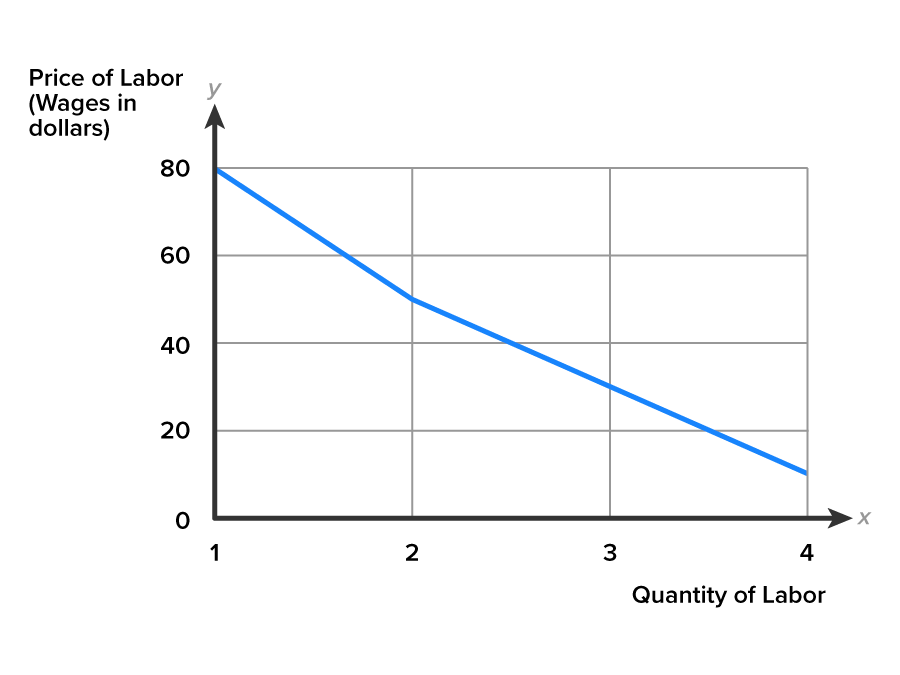
If a firm sells its products in a perfectly competitive market, it is a price taker. The firm’s product demand curve is horizontal at the market price, and the value of a unit of output is the going market price (P). You learned about this in the Challenge about market environments. Suppose that Super Gadget has information on the quantity of labor, product price, and various revenues is shown in the table below.
 .
. .
. 
|
Quantity of Labor (1) |
Marginal Product of Labor (MPL) (2) |
Price of Product ($10 per Unit) (3) |
Total Revenue (P * Q) (4) |
Marginal Revenue (MR) (Change in TR / Change in Quantity of Units (5) |
Marginal Revenue Product (in dollars) (MRP = MPL * MR) (6) |
|---|---|---|---|---|---|
| 1 | 8 | 10 | 80 | 10 | 80 |
| 2 | 5 | 10 | 50 | 10 | 50 |
| 3 | 3 | 10 | 30 | 10 | 30 |
| 4 | 1 | 10 | 10 | 10 | 10 |
) and in marginal revenue product () are the same cell entries for our perfectly competitive firm? Using the information from the table we can plot the firm’s demand for labor curve in a perfectly competitive market. The MRP curve has the typical downward-sloping shape. At lower wages, the firm hires more labor hours, but at higher wages it hires fewer worker hours, in accordance with the law of demand.
Suppose Super Gadget produced its products in an imperfectly competitive market. Recall in imperfectly competitive markets that firms are price setters. To sell an additional unit of its product, the firm must lower its price, unlike is the case for a perfect competitor. Would the marginal revenue product curve look different for an imperfectly competitive firm?
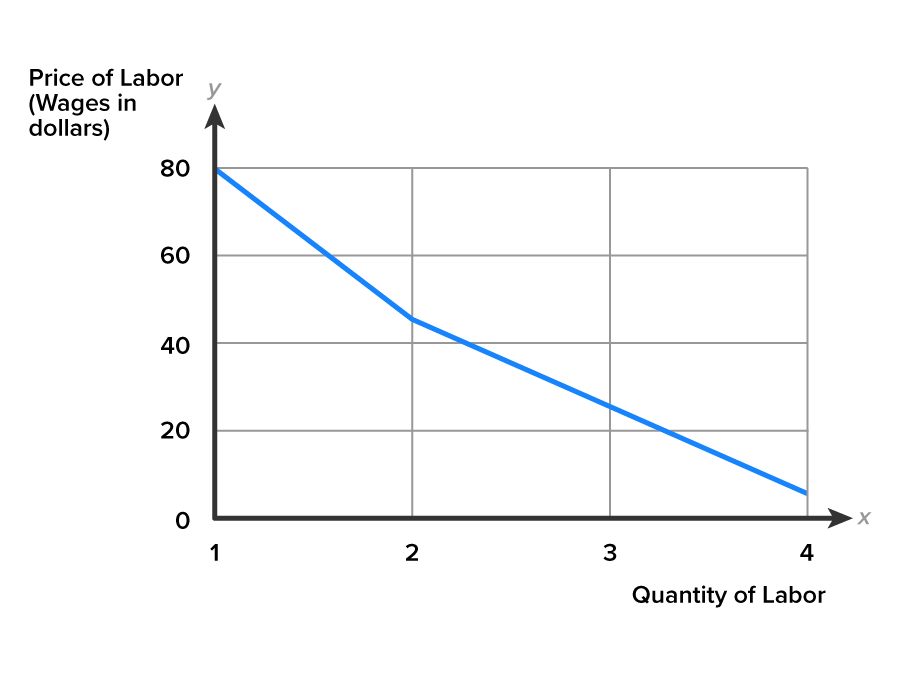
The table reflects the price-setter pricing situation. Notice that everything in the table is the same, except column 3, where the price is lowered for the sale of each additional unit of the product.
|
Quantity of Labor (1) |
Product of Labor (MPL) (2) |
Price of Product ($10 per unit) (3) |
Total Revenue (4) |
Marginal Revenue (MR) (Change in TR/Change in Quantity of Units) (5) |
Marginal Revenue Product (in dollars) (MPL * MR) (6) |
|---|---|---|---|---|---|
| 1 | 8 | 10 | 80 | 10 | 80 |
| 2 | 5 | 9 | 45 | 9 | 45 |
| 3 | 3 | 8 | 24 | 8 | 24 |
| 4 | 1 | 7 | 7 | 7 | 7 |
By plotting the relationship between the quantity of labor (column 1) and MRP (column 6) for this imperfectly competitive firm, we obtain the downward-sloping labor demand curve. This again is the typical shape for a firm’s demand curve, where at higher wages the firm purchases the labor of fewer workers.
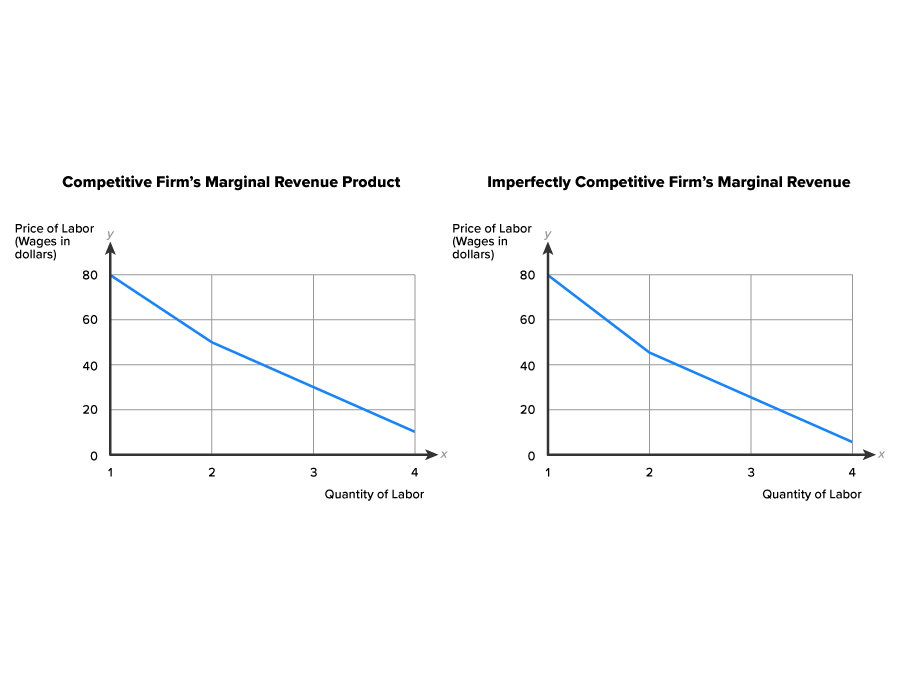
In the side-by-side comparison below, the difference in the marginal revenue curves is very slight between a perfectly competitive and an imperfectly competitive firm in hiring labor. The maximum wage of $80 per hour is the same for worker 1 in both graphs, but notice the small difference in maximum wage beginning at worker 2 in both graphs.
By definition, market demand represents the total number of workers that firms are willing and able to hire at a set of prices for labor (wage rates). The labor demand curve is downward-sloping and adheres to the law of demand. Higher prices result in lower quantity demand, and lower prices result in higher quantity demand of labor.
Price (wage per hour) is not the only factor that influences employers’ willingness and ability to hire labor. In the real world, a number of non-wage factors can influence the market demand for labor. Assuming the price of labor (wage per hour) is held constant, changes in non-wage factors can influence the demand for labor, and cause the demand curve to shift in response.
EXAMPLE
Suppose that demand for restaurant food declines, the price of the product falls, and profitability decreases for restaurants. Firms will now demand fewer workers at all wages. The demand curve for labor shifts left.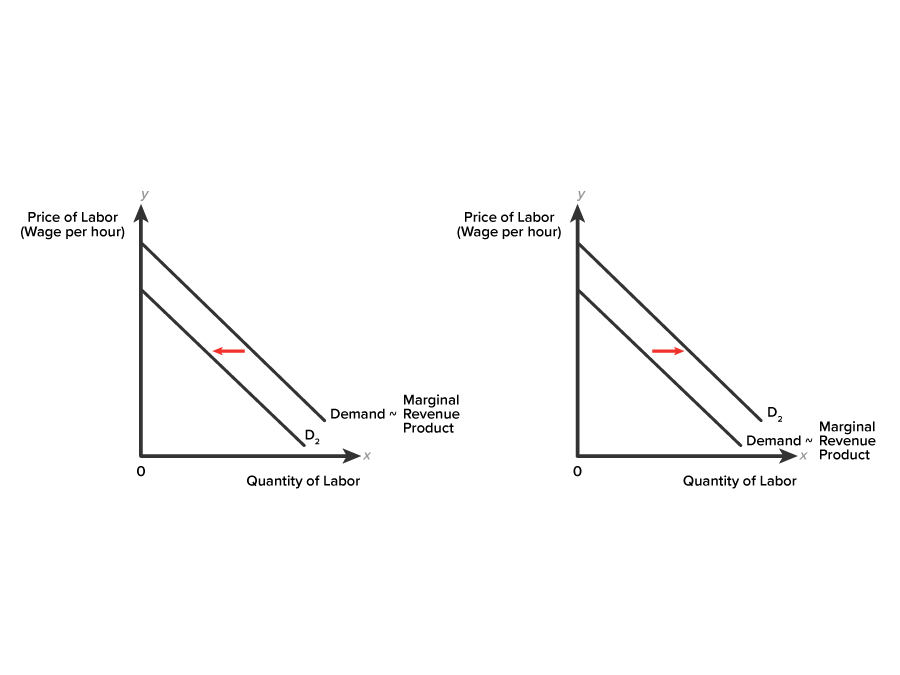
As you learned in the lesson about demand and supply in the product market, non-price factors of a product can cause a supply or demand curve to shift. The same is true for the labor market. What factors, other than the price of labor (wage per hour), affect the demand for labor? How does the demand for labor curve respond to a change in a particular non-wage factor?
A change in one of these non-wage factors will alter employers’ willingness and ability to hire labor services in a given time period and cause a shift in the demand curve.
EXAMPLE
Suppose, for example, that the demand for rooms in the hotel industry increases. The price and quantity of rooms available will go up. A higher price of hotel rooms increases the marginal revenue product of labor for cleaning staff, and also increases the demand for these workers. Likewise, a reduction in demand for particular goods or services, for example, straw brooms, will reduce the demand for workers that produce straw brooms.Availability and Price of Alternative Inputs (Complements and Substitutes)
Labor is rarely the only factor of production used when firms produce their products. Changes in the price or availability of other factors of production can change the demand for labor.
An increase in the use of one factor of production can lead to an increase in the demand for another. If two factors are used together, then the two factors are complements.
EXAMPLE
In the garment industry, sewing machines are used by seamstresses. If the price of sewing machines falls and firms buy more machines, then the demand for seamstresses will increase. The labor demand curve will shift rightward showing both higher wages and quantity of workers. Alternatively, if trucks become less available due to supply chain problems, then demand for truck drivers will shift leftward, and both wages and quantity demand will be lower.An increase in the use of one factor of production can lead to reduced demand for another. When this occurs the factors are substitutes.
EXAMPLE
The price of self-service kiosks has fallen. Many fast-food restaurants have taken advantage of the lower cost, and are substituting self-ordering kiosks for service counter workers. This decreases the demand for service counter workers.A Change in Technology
Technology evolves over time, changing the nature of the economy. In doing so, it can change the demand for labor. Some changes wipe away some jobs, while other changes introduce new ones. Jobs for pinsetters at bowling alleys are obsolete. Jobs for CEO of sustainability and climate change are emerging. Technological change, also, has a general purpose role.
EXAMPLE
The emergence of computer systems and the related software that is used broadly across the economy has increased the general productivity of workers. More productive workers reduce the cost of production, increase profitability, and firms demand more labor.Number of Firms in a Particular Market
Firms are the source of employment opportunities for workers. The larger the number of firms in a market, the greater the demand for labor. As the financial sector of the economy grows, so will the demand for workers with the requisite financial knowledge, skills, and credentials. A reduction in the number of firms in an industry, on the other hand, shifts the demand for labor curve leftward.
EXAMPLE
During COVID many local restaurants shut down and laid off staff. Demand for restaurant staff decreased, shifting the demand curve leftward.Source: THIS TUTORIAL HAS BEEN ADAPTED FROM OPENSTAX “PRINCIPLES OF ECONOMICS 2E”. ACCESS FOR FREE AT https://openstax.org/books/principles-economics-2e/pages/1-introduction. LICENSE: CC ATTRIBUTION 4.0 INTERNATIONAL.




