Table of Contents |
Whether or not you realize it, you respond to opportunities and make decisions in ways that are predictable to economists. Have you tried an unfamiliar brand of shampoo because a coupon made it cheaper than your usual brand? Have you ever gone from store to store trying to find a new appliance that fits into your budget? Or in the other direction, have you ever planned to buy a new pair of sneakers and then changed your mind because the style didn’t appeal to you? In each of these situations, you reacted to more than just the product’s price, making a decision to buy or not buy the product. In doing so, you demonstrate what economists call demand. This is because demand reflects a buyer’s willingness and ability to make a purchase of some good or service during a certain period of time. Demand for a product is about more than just price.
For demand to exist a buyer must be both willing and able to purchase a product. Your willingness or lack of it, typically, involves your preferences. In the case of sneakers, choosing not to buy a pair of bright yellow sneakers because the color doesn’t appeal to you is a statement about your willingness but not about your ability to make a purchase. After all, you are shopping for sneakers so you have the funds to spend which means you have the ability. Because you are not willing to buy the shoes due to the color of the shoes, you do not have demand for those particular sneakers.
If you make a buying decision based on affordability, then this is a statement about your ability but not your willingness to buy. The fact that you are shopping for a new appliance makes it obvious that you are willing to buy. The new appliance just needs to fit into your budget. Because you do not have the ability to buy a new appliance at any price, you do not have a demand for a new appliance above a certain price. If a coupon or discount changes your decision to purchase an unfamiliar brand of shampoo, then you have both the willingness and ability to buy. Therefore, you have demand for an unfamiliar brand of shampoo.
For demand to exist the attributes of both willingness and ability must occur together.
Let’s develop some insights into the concept of demand by examining one of several factors affecting a buyer’s willingness and ability to make a purchase of a specific good or service.
Product’s price is one of the factors that help economists understand product demand. By gathering information on the price and the quantity purchased of a product, economists build a table called a demand schedule. It is simply a table of information showing the quantity demanded at each possible price. The following is an example of a demand schedule, featuring Granny Smith apples.
| Price of Granny Smith Apples |
Quantity of Granny Smith Apples Each Week |
|---|---|
| $2.00 | 0 |
| $1.75 | 1 |
| $1.50 | 2 |
| $1.25 | 3 |
| $1.00 | 4 |
| $0.75 | 5 |
| $0.50 | 6 |
| $0.25 | 7 |
| $0.00 | 8 |
Notice that the table details the price of the apple at each respective quantity, as if you were surveying a customer to find out how many apples the customer would purchase each week at different prices.
For instance, if each apple was priced at $2, according to the schedule you would not purchase any apples. As the price goes down to $1.50, you might buy two per week and treat yourself. If the price was only $0.50 an apple, you would purchase six, and if they were $0.25, you'd purchase seven. Now, if the apples were free, you would take eight, just over one per day in a given week.
Did you also notice that as the price drops, you have an incentive to buy more apples?
We can use the information from the demand schedule to plot a demand curve, by putting the price on the y-axis--in this case, the price per apple--and the quantity you are willing to purchase on the x-axis.
Once the points from the demand schedule are plotted on a graph, we are presented with a downward-sloping demand curve.
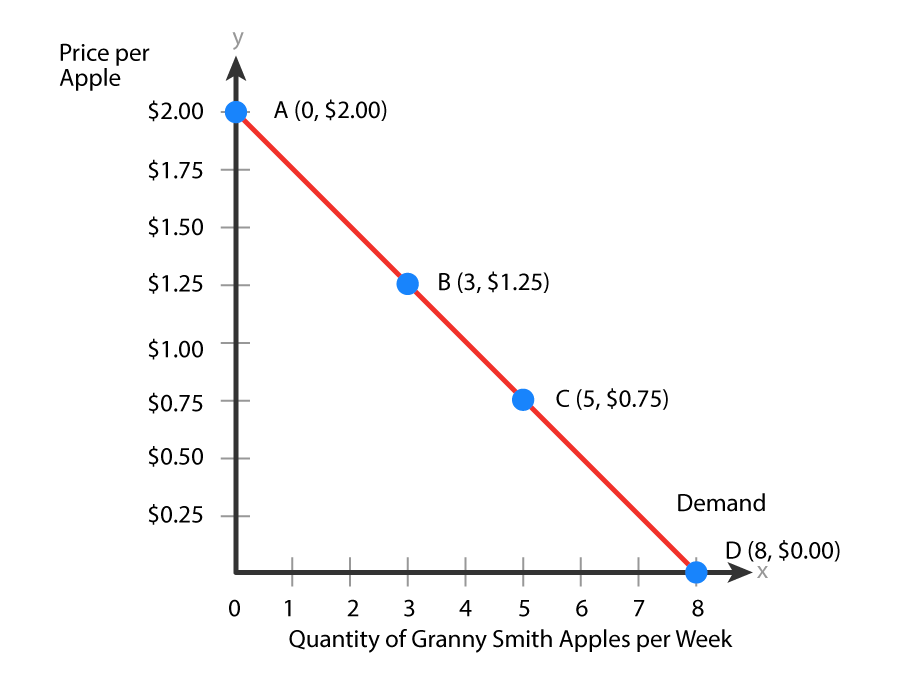
A price change acts as an incentive for shoppers to adjust their buying decision. As the price of Granny Smith apples drops, you buy more--or, in economic terminology, as the price falls, the quantity demanded increases. The two variables move in opposite directions. The reverse would also be true; as price rises, quantity demanded decreases. When two variables move in opposite directions of change—(as one goes up the other goes down)—the relationship between the variables is called inverse.
The image below illustrates the inverse relationship between price and quantity demanded. For demand, when the price goes down, the quantity demanded goes up, and when the prices goes up, the quantity demanded goes down.

Let’s examine what happens when price changes. Suppose the apples are currently priced at $2.00 (point A on the graph above). If the grocer lowers the price, this is shown as a movement down along the demand curve to $1.25. Notice that at $1.25 quantity demanded is higher (3 apples).
Why is the demand curve downward sloping? Logically, it makes sense. When a product’s price falls, buyers either make a first purchase or buy larger quantities of a product. Let's explore this in more detail.
Suppose Granny Smith apples are currently priced at $1 each, and you have already purchased four of them for the week. Do you need a fifth? Well, now that you've already have four, the price will need to be lowered in order to give you enough incentive to buy a fifth. Similarly, if you buy a fifth, you will only purchase the sixth apple if the price is even lower, at $0.50.
As you are purchasing each additional apple, the price of apples will need to be lowered in order to influence your willingness to purchase the additional one. This inverse relationship between price and quantity demanded is a fundamental principle in economics known as the law of demand.
So, why does the law of demand work? First, be reminded that the law of demand only works as long as we assume nothing else changes for the buyer—ceteris paribus. This idea of allowing only one thing to change at a time was introduced in Challenge 1.2. In this situation, what you like and don’t like doesn’t change. You like Granny Smith apples. The number of dollars in your budget doesn’t change. Only the price of a product you are purchasing is allowed to change. When the price of an apple changes, this is the price factor causing the buyer to adjust his/her decision about how many apples to purchase.
You purchase things because you derive pleasure from the product(s). If you didn’t you would be unwilling to pay any dollar amount for them. Maybe, you’re not a beer drinker, so no matter how the price changes, you won’t buy it. Because a product brings you pleasure, you will make your first purchase. With each purchase of the identical product, our pleasure or sense of satisfaction for the dollar spent slips a bit.
EXAMPLE
Imagine that on a hot summer day you purchase your favorite ice cream bar for $5. You eat it and it satisfies you. Now that it is finished, you’re considering eating a second ice cream bar. Are you willing to pay $5 for the second one? Maybe not, but if you could get a second bar for $4 you might buy it. You’ll notice that your sense of pleasure dropped a bit with the second ice cream bar. This is expected. Would you consider having a third ice cream bar? Probability not, if it cost another $5. You will likely not get “5 dollars” worth of pleasure from the third one. Eating that much ice cream might even make you feel ill.Because our overall pleasure decreases as we buy more and more of the same product, that is, as our quantity demanded increases, we are less willing to pay the same price. A price reduction causes us to reconsider the pleasure per dollar spent on the product. It influences our willingness to buy additional units of the same product. This demonstrates the law of demand at work.
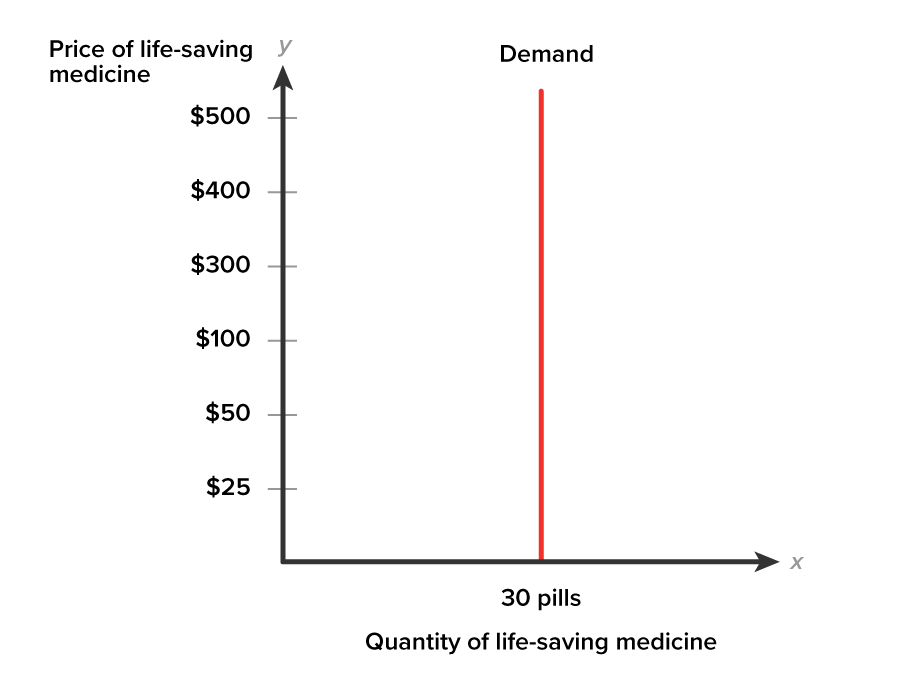
Do you think that all demand curves are downward sloping or might there be exceptions? Are there any instances where the quantity demanded does not vary with a price change? The answer is “yes.” There are a few exceptions where the relationship between price and quantity do not move in opposite directions. In such cases the demand curve is not downward-sloping. These exceptions typically involve special circumstances, such as medically necessary medications or equipment required for survival. Consumers who need such products will purchase the product regardless of price and are restricted to a fixed quantity.
EXAMPLE
Imagine that you need a pacemaker to control your heartbeat, daily kidney dialysis, or insulin to treat diabetes. These are all examples of purchases that the buyer makes regardless of price.In the examples described, the demand curve will be a vertical line at a set quantity. The graph below illustrates the case of a patient buying a month's supply of a life-saving medicine--a fixed quantity of 30 pills total, regardless of how expensive it is. If the price goes up, you buy the fixed quantity of 30 pills total. If the price goes down, you buy the fixed quantity of pills total. A price change doesn’t cause you to buy more or less than the quantity of 30 pills total.
The opposite case is a situation in which a shopper is able to buy any quantity he or she wants at the same price.
EXAMPLE
Suppose you are at a farmers market where there are 30 vendors, and all 30 vendors are selling green bell peppers. From your perspective as a customer, a green bell pepper is a green bell pepper; that is, you don’t make any distinction among the various vendors’ stock of green bell peppers and, therefore, you don’t care from whom you buy. With so many vendors selling green bell peppers in such close proximity, all vendors will have little choice but to sell green bell peppers at the same price, if they want any sales. Any vendor attempting to charge more would end up without sales as buyers simply walk to the next stand. So if the going price is $0.50 for a pepper, shoppers can buy as many or as few as they wished for the same price.The graph below illustrates the case of a fixed price for a product. The demand curve is a horizontal line at a set price. Notice that any attempt to raise the price above $0.50 drops the quantity demanded to zero.
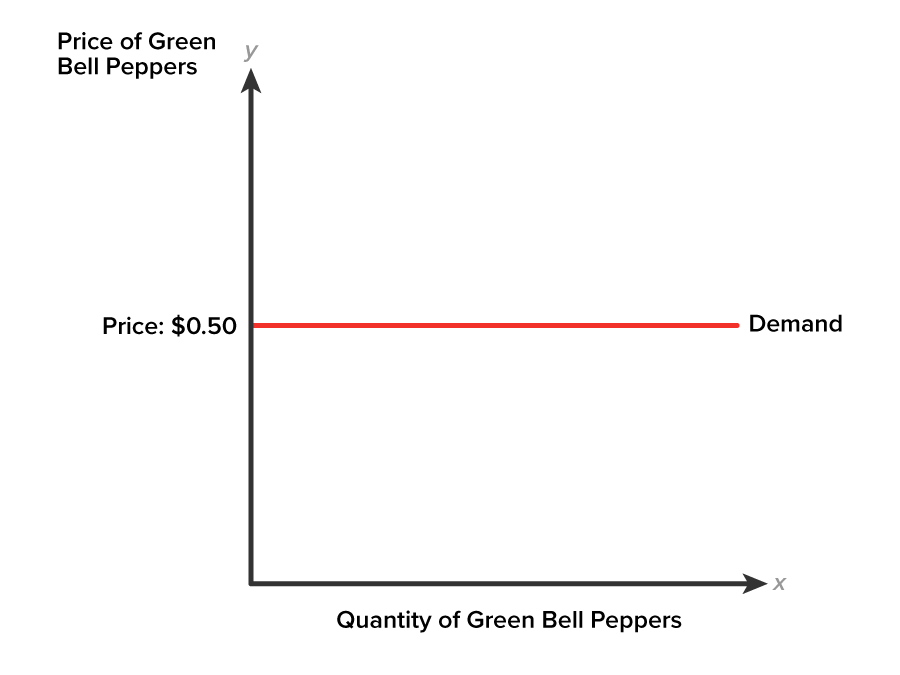
Both vertical and horizontal demand curves are exceptions to the law of demand. The law of demand states that as prices change, the quantity demanded moves in the opposite direction. But like most things in life, these exceptions are due to special circumstances. The horizontal demand curve will be explained in more detail in Unit 3 Market Environment.
Source: THIS TUTORIAL HAS BEEN ADAPTED FROM OPENSTAX “PRINCIPLES OF ECONOMICS 2E”. ACCESS FOR FREE AT https://openstax.org/books/principles-economics-2e/pages/1-introduction. LICENSE: CC ATTRIBUTION 4.0 INTERNATIONAL.



