Table of Contents |
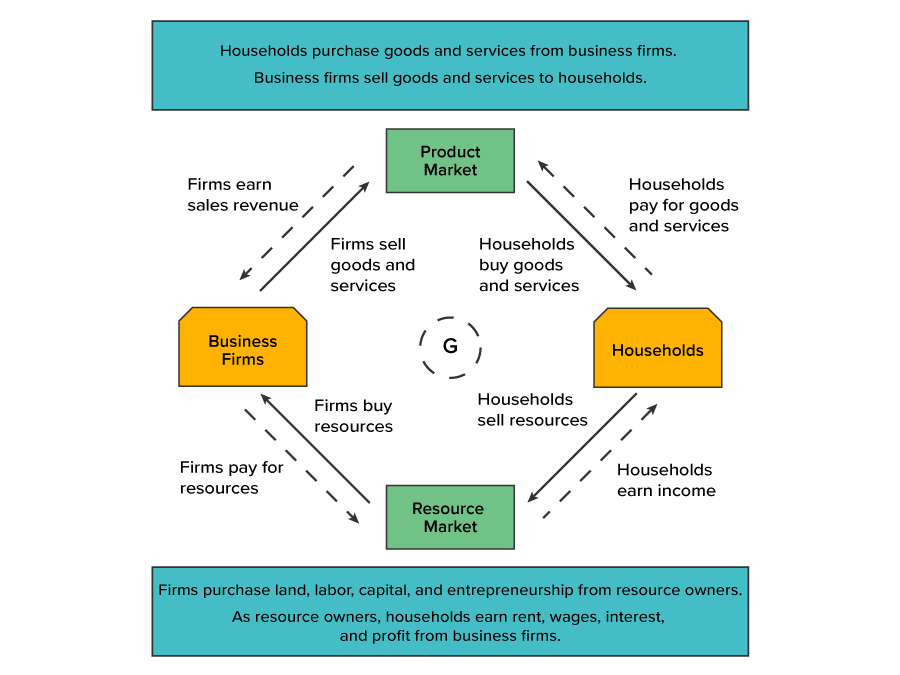
You learned in unit 1 that the main task of an economy is to coordinate interaction between decision-makers about the use of society’s scarce resources. As such, an economy’s resources serve the particular interests of society. What goods and services are provided in an economy will depend on what resources are available. The natural, capital, and human resources used to produce goods and services are known as productive resources. These resources are sold by households and purchased by firms, in each of their respective resource markets.
Natural resources refer to resources supplied by nature, such as trees, water, plants, minerals, and soil. These resources are not produced by people, but can be transformed into economic goods and services. Examples include tangible goods like bottled water, or intangible goods like the services provided by a wildlife conservation reserve. Society benefits directly from nature. Natural resources often remain unused before a purpose has been identified.
EXAMPLE
Many homeowners consider dandelions a nuisance, but the plant can be used to produce a variety of valuable medicines. One source documented eleven possible health benefits derived from dandelions. Dandelions are used as diuretics and they have antioxidant properties. They are used medicinally to regulate cholesterol and blood pressure. They are also known to boost the immune system. The use of dandelions for productive purposes, whether for at home consumption, or their natural beauty, or use in manufacturing processes makes dandelions a natural resource.There are three different ways for the available stock of natural resources to be expanded:
EXAMPLE
Natural gas and oil are natural resources. In recent decades, advancements in shale drilling have made the extraction of substantial untapped natural gas and oil deposits economically viable, boosting oil and gas supplies. This is important for the economy, which depends on natural resources. Texas produces nearly a quarter of the nation’s natural gas. Pennsylvania comes in second with 21%. In Pennsylvania, the Marcellus Shale oil fields cover approximately 65 million acres, or 2/3 of the state. The process of shale drilling involves drilling horizontally through the earth and fracking, or hydraulic fracturing, which involves injecting fluid and chemicals into the porous shale rock at high pressure to release petroleum resources. A large amount of water is needed, raising concerns about another very important natural resource, especially where water resources are limited or being stressed.Some natural resources are renewable, but others are not. Once non-renewable resources are used up, they can’t be readily replaced. For example, energy generated by wind farms is a renewable resource as long as there is sufficient wind, but energy derived from crude oil, a naturally occurring petroleum product, is not readily renewable, because once all the oil on the planet is harvested, more oil can’t be naturally created at the current rate of consumption.
The quantity and quality of human effort directed toward producing goods and services is known as labor. This human effort is supplied as manpower or expertise. Labor can be classified as unskilled or skilled:
An economy can expand its stock of labor by increasing either the quantity or the quality of its workers. Higher birth rates and open immigration policies are two means of increasing the number of potential workers. Investment in health, education at all levels (pre-K through post-secondary), and job training are ways to increase the stock of human capital among workers. The advantage of investment in human capital is that it is a key source of raising worker productivity.
Human-made resources are known as capital. Office and factory buildings, tractors and forklifts, and roadways are examples of physical capital. Capital also includes human capital, which is the accumulated knowledge, skills, and experience of labor that affects productivity.
EXAMPLE
Infrastructure like highways, mass transit, aviation, bridges, and solid waste plants are forms of capital. Capital includes buildings, physical goods, infrastructure, as well as intellectual discoveries, such as new software and artistic works that can be used to produce other goods and services.To clarify, one thing that is not a capital resource is money. A firm cannot use money directly to produce other goods and services. However, it is not unusual for individuals to confuse money with capital. Money is a form of financial asset, but it is not a capital resource. Financial assets include money and other “paper” assets, such as stocks and bonds. These financial assets are not capital resources, but they can be used to finance the purchase of resources.
Capital uses technology to produce goods and services. Technology refers to the process or processes for producing a product. Technology is not about gadgets or devices, but rather refers to the alternative methods of combining inputs to produce outputs. Given different levels of technology, a firm will search for the production technology that allows it to produce a desired level of output that achieves both technical and economic efficiency.
EXAMPLE
A large lawn can be cut using different levels of technology—goats nibbling on the grass, a person pushing a motorless lawn clipper, or a person riding a tractor. From the standpoint of time, cutting a lawn using a riding tractor mower is the most efficient. It uses less time to produce the same outcome, a mowed lawn, but likely also involves higher financial costs.Advances in technology, in the traditional sense of the word, also have an impact on the alternative methods of combining inputs, as well as on the technical and economic efficiency of capital resources. Changes in technology come in waves. Before the 1800s, production involved local materials and products transported using waterways. The advances in engineering helped in the production of machines, which could be used to produce other goods and services transported overland by trains. Developments in chemistry and physics aided in developing the production of electricity, which modernized factories and led to mass production. We are living in a time where the evolution of electronics and computers has led to the development of robotics and artificial intelligence software.
The following example illustrates how technology evolves over time, as individuals find applications for scientific knowledge, and then improvements on those applications push these innovations into new fields of development.
IN CONTEXT
The mobile phone you use today came to be after over a century of improvements in scientific knowledge and technological development. The creation of modern-day cellular telephones was supported by the development of information theory, radio communications, electrical engineering, and cellular technology.
The first step toward creating the modern-day cellular telephone occurred in 1876, when Alexander Graham Bell patented the telephone. In the 1890s, radio communication was invented by Scottish lighthouse engineer Charles Stevenson for the purpose of communicating with offshore lighthouses. In 1908, Nathan B. Stubblefield applied to the U.S. Patent Office for a wireless telephone that could operate with strings. During the 1920s, European trains began using radio telephone technology. At the time radio telephones had a very limited capacity, and conversations were not private. During the 1940s, two-way radios called walkie-talkies were invented. The military and police were the first users.
In the 1960s, Bell Labs developed technology for designing cellular networks, and in the 1970s Motorola invented the first cordless handheld cellular phone, which is similar to the cell phones that we use today. That phone was released for sale to the public in 1984, and quickly became a status symbol and an icon of wealth. The first touchscreen phone, the IBM Simon, came out in 1992, and in 2007, the iPhone was released by Apple.
Were it not for the efforts and technological advancements that occurred over a hundred years, cellular telephones would not exist today.
Entrepreneurial resources are a form of labor, but unlike other labor resources, entrepreneurial resources are involved in the organizing and risk-taking activities of operating a business. An entrepreneur is a person engaged in organizing, operating, and risk-taking for a business. Entrepreneurs are themselves resources. Wennekers and Thurik (1999) describe the economic role of entrepreneurship:
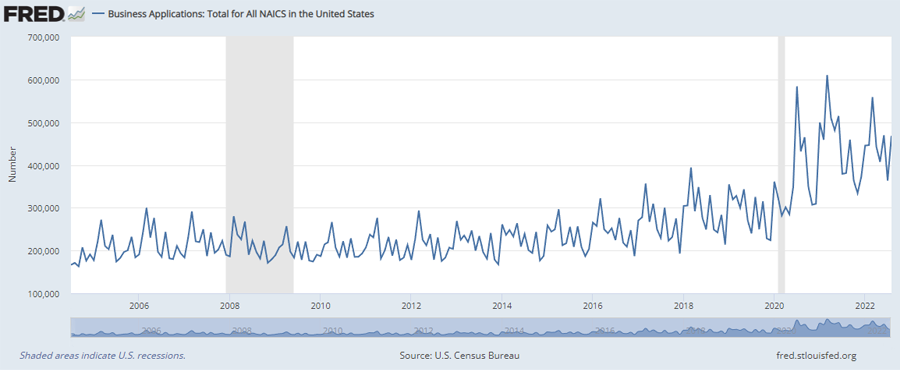
The graph above shows the number of applications for new businesses in the United States from 2006 to 2022. As you can see in the graph, the number of new business applications was relatively consistent from 2006 to 2016 but then began to rise. In 2020, the number of new business applications increased dramatically in the wake of the COVID pandemic. Notice the gray areas in the background between 2008 and 2009 and during 2020. These indicate periods of recession. Following the 2008-2009 recession the number of business applications remained constant, but following the COVID recession of 2020 new business applications increased significantly. The economic disruption caused by the COVID pandemic led entrepreneurial minded people to pursue new opportunities outside those available in the labor market.
Source: THIS TUTORIAL WAS AUTHORED BY SOPHIA LEARNING. PLEASE SEE OUR TERMS OF USE.
REFERENCES
Arthur, W. B. (2011). The nature of technology: What it is and how it evolves. Free Press.
Decker, R. A., & Haltiwanger, J. (2022, June 5). Business entry and exit in the COVID-19 pandemic: A preliminary look at official data. Board of Governors of the Federal Reserve System. Retrieved September 6, 2022, from
www.federalreserve.gov/econres/notes/feds-notes/business-entry-and-exit-in-the-covid-19-pandemic-a-preliminary-look-at-official-data-20220506.html
Duke University. (2018, August 15). Water use for fracking has risen by up to 770 percent since 2011. Nicholas School of the Environment. Retrieved September 5, 2022, from
nicholas.duke.edu/news/water-use-fracking-has-risen-770-percent-2011
Federal Reserve Bank of St. Louis. (2022, August 11). Business Applications: Total for all NAICS in the United States. FRED. Retrieved September 13, 2022, from
fred.stlouisfed.org/series/BABATOTALNSAUS
González-Castejón, M., Visioli, F., & Rodriguez-Casado, A. (2012, September 1). Diverse Biological Activities of Dandelion. Oxford University Press Nutrition Reviews. Retrieved September 5, 2022, from
academic.oup.com/nutritionreviews/article/70/9/534/1835513
Library of Congress. (n.d.). Renewable Energy Industries: A Research Guide: Wind Energy Industry. Research Guides. Retrieved September 6, 2022, from
guides.loc.gov/renewable-energy/wind
Thurik, Roy and Sander Wennekers. 1999. "Linking Entrepreneurship and Economic Growth."
Small Business Economics 13: 27–55.
personal.eur.nl/thurik/Research/Articles/Linking%20entrepreneurship%20and%20economic%20growth.pdf
U.S. Energy Administration . (n.d.). Natural Gas Explained: Where our natural gas comes from. EIA U.S. Energy Administration . Retrieved September 5, 2022, from
www.eia.gov/energyexplained/natural-gas/where-our-natural-gas-comes-from.php



