Table of Contents |
In this lesson, we will extend our analysis of demand and supply to include a measurement of by how much quantity changes when price changes.
The law of demand tells us that buyers respond predictably to price changes. If the price of socks goes down, buyers will predictably purchase more packages of socks, holding all other factors constant (such as the price of related products or income). If the price goes up for chocolate ice cream, buyers will predictably purchase fewer cartons of chocolate ice cream. Similarly, the law of supply tells us that sellers respond predictably to price changes. If the price of hand calculators goes down, sellers will predictably offer fewer hand calculators, holding all other factors constant (such as input prices or technology). If the price of cell phones goes up, sellers will predictably offer more cell phones.
What the laws do not tell us is how sensitive buyers and sellers are to a price change for a particular product.
Suppose you have two rubber bands in your hand; one thin and narrow and the other thick and wide. If you pulled each rubber band with the same strength, what would be the effect? The thin narrow rubber band is likely sensitive to your pull, stretching easily. On the other hand, tugging on the thick wide rubber band is likely a struggle—very insensitive to your pull. We can apply the same idea of “stretchiness” to buyer and seller responsiveness. Some products will stretch generously like a thin rubber band, and others will be less responsive like a thick rubber band. Just as the thickness of the rubber band affects its elastic properties like its stretchiness, elasticity is how we measure the "stretchiness" of a product's demand or supply.
In general, elasticity is a measure of the sensitivity of one variable to a change in another variable. There are several ways we can measure the sensitivity of these variables to better understand a product's elasticity:
Measuring elasticity requires calculation and the use of a formula. Elasticity is a ratio of two variables. You will learn how to use the following formula to calculate different types of elasticity in the next three tutorials.

The equation for elasticity (E) is the percentage change in variable B divided by the percentage change in variable A. The solution is a value, or coefficient, that lies along a number line. An elasticity coefficient of zero is interpreted as “highly unresponsive,” while a large positive number is interpreted as “highly responsive.” You will learn how to do the math involved in the equation for elasticity after you learn more about the concept of elasticity, including the fact that elasticity is not the same as slope.
The interpretation of any particular elasticity will be relative to the type of elasticity we are measuring, whether a product’s own-price, the price of related products such as big brand name soda versus a store brand soda, or income.
Before we proceed further, we must clarify the difference between slope and elasticity. As you have learned, elasticity is a ratio of percentages that measures the sensitivity between two variables that are changing such as price and quantity. Slope is a value that describes both the direction and steepness of a line. A line can vary in steepness from being horizontal (flat) to being vertical (upright) or being something in-between. The direction of the slope can be positive or negative. A positive slope goes uphill and a negative slope goes downhill.

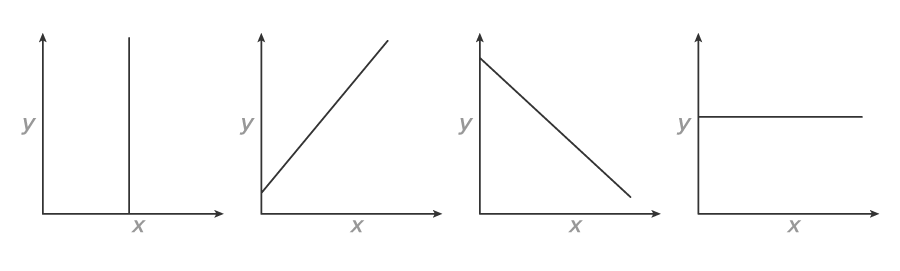
Let’s review the different types of slope. In the diagram below, there are four examples of lines, each with a different slope or steepness.
The first example shows a vertical line, and its slope is undefined because there is no change in the variable X on the horizontal axis.

In the fourth example, the line is horizontal and its slope is zero, indicating the line has no slope because there is not a change in the variable Y on the vertical axis.

The two middle examples show slope as something in-between the vertical and horizontal cases. The difference is simply the direction of the line. The second line is upward-sloping. When you calculate the slope its value will be positive (+). The third is downward-sloping. When you calculate the slope, its value will be negative (-).
Source: THIS TUTORIAL WAS AUTHORED BY SOPHIA LEARNING. PLEASE SEE OUR TERMS OF USE.