Before we begin this discussion of credits, it is important to review the difference between credits and deductions again.
While both credits and deductions help taxpayers reduce the tax they must pay, they do so in different ways. Deductions, such as the standard deduction or itemized deductions, lower the tax by reducing the amount of income that would otherwise be taxable on Form 1040. Lower taxable income results in a lower tax liability.
Deductions
Unlike deductions, credits do not come into play until after taxable income has been computed and the tax determined. Then, credits may be used to reduce the amount of tax dollar for dollar.
Credits
Some credits are nonrefundable, and some are refundable.
Nonrefundable means that the combined amount of these credits cannot reduce the taxpayer’s tax liability below zero. Some examples of nonrefundable credits include the Child and Dependent Care Credit, the Saver’s Credit, the Child Tax Credit, and the Foreign Tax Credit.
Refundable credits may reduce the taxpayer’s tax liability below zero, and the difference is refunded to the taxpayer. Refundable credits are included in the Payments section of Form 1040. Examples of refundable credits include the Earned Income Credit and the Additional Child Tax Credit.
Sometimes a credit can be nonrefundable and partially refundable, such as the American Opportunity Tax Credit, which will be discussed in a later chapter.
2. Child and Dependent Care Credit
Single parents and two-career couples must find ways to care for their young children while they work. The Tax Code provides a way for these parents to recoup some of their expenses for child care through a tax credit called the Child and Dependent Care Credit.
The IRS refers to the credit as either the Child and Dependent Care Credit or the Credit for Child and Dependent Care Expenses. These can be used interchangeably.
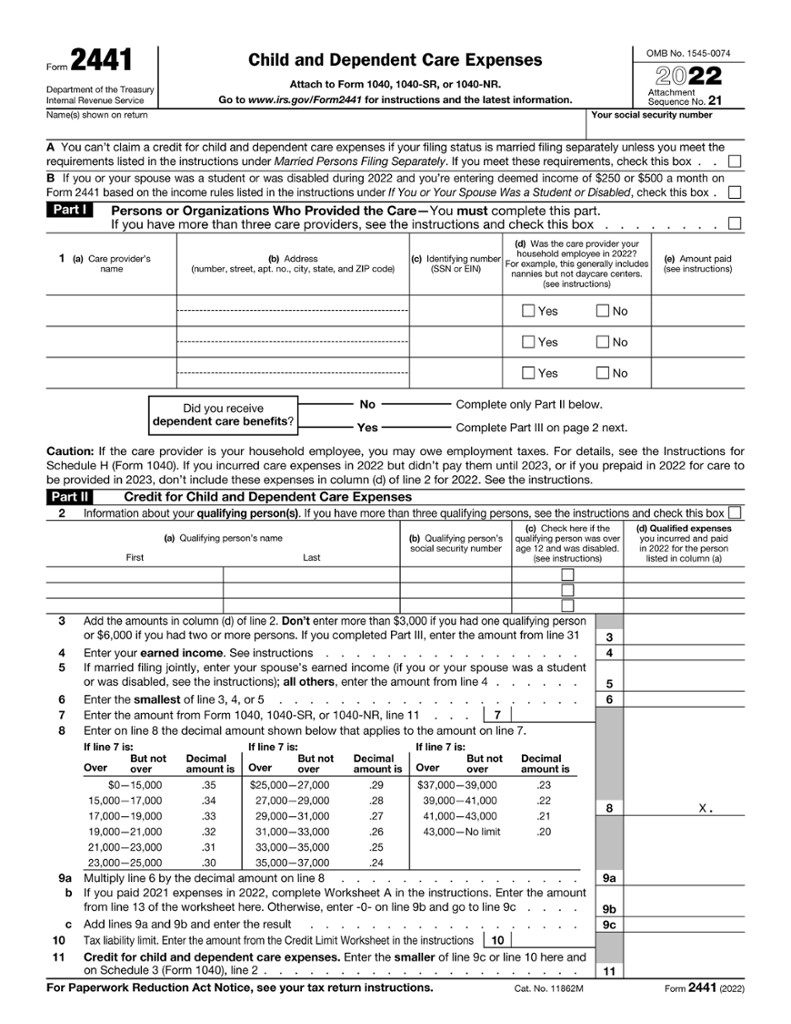
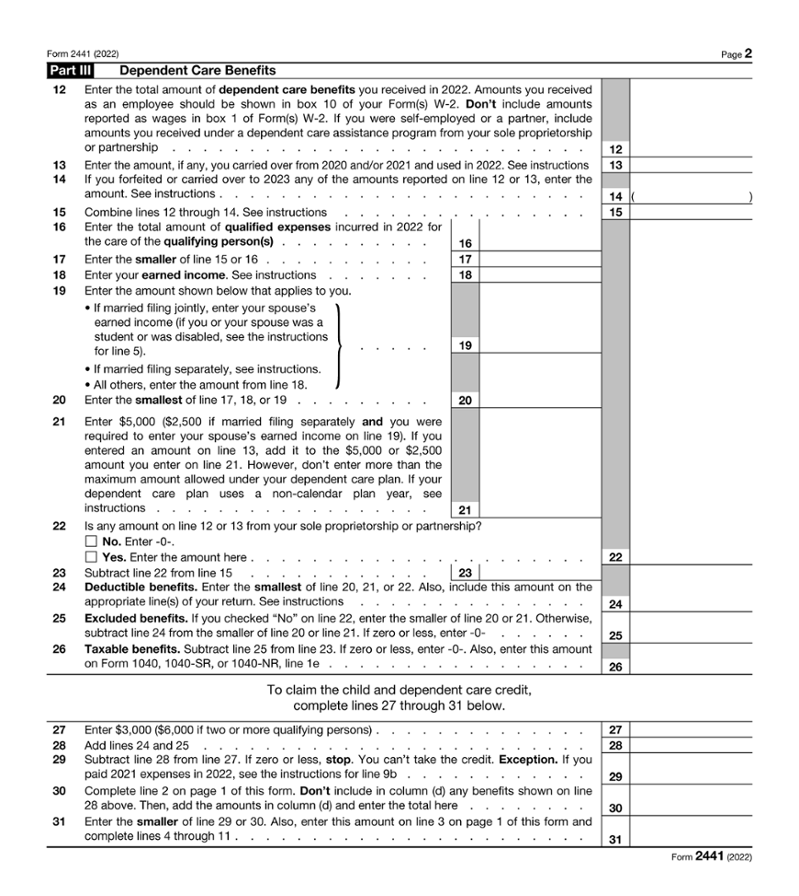
This credit is also available to taxpayers caring for disabled dependents and spouses or who incurred and paid expenses for the care of a qualifying person while they worked or searched for work. The credit is based on one of three factors which we will look at in a later section. The credit is claimed using Form 2441, Child and Dependent Care Expenses, as shown below.
2a. Requirements
To claim the Child and Dependent Care Credit, the taxpayer must meet the following requirements:
The taxpayer’s filing status must be single, head of household, qualifying surviving spouse, or married filing jointly. (See Taxpayers Filing Married Filing Separately below for an exception.)
The care must have been provided so the taxpayer (and the spouse, if married) could work or look for work. (There is an exception if the taxpayer or spouse are full-time students or disabled.)
The care must be for one or more qualifying persons. This is explained in detail in the Qualifying Persons section below.
The taxpayer must have some earned income. Taxpayers who are married and are living together must both have earned income, unless one spouse was a student or disabled, as explained later. We will discuss earned income in greater detail in a later section.
The person who provided the care must not be the taxpayer’s spouse, the parent of the qualifying person, or someone the taxpayer can claim as a dependent. Services provided by the taxpayer’s child under age 19 do not qualify, even if the provider is not a dependent. If the taxpayer’s child is age 19 or older and cannot be claimed as a dependent, the services would be eligible.
Form 2441 must be completed with the care provider identified.
2b. Qualifying Persons
To claim a credit for qualified expenses (defined below), the care must have been provided for one or more qualifying persons. Qualifying persons include any of the following:
A qualifying child dependent who can be claimed as a dependent and has not reached their 13th birthday when the care was provided. For this credit, the child can be a qualifying person for the part of the year they were under age 13.
did you know
For purposes of this credit, the child is considered to have attained the age of 13 on their birthday, not the day before. The taxpayer must be entitled to claim the child as a dependent, unless an exception was applied for children of divorced, separated, or unmarried parents.
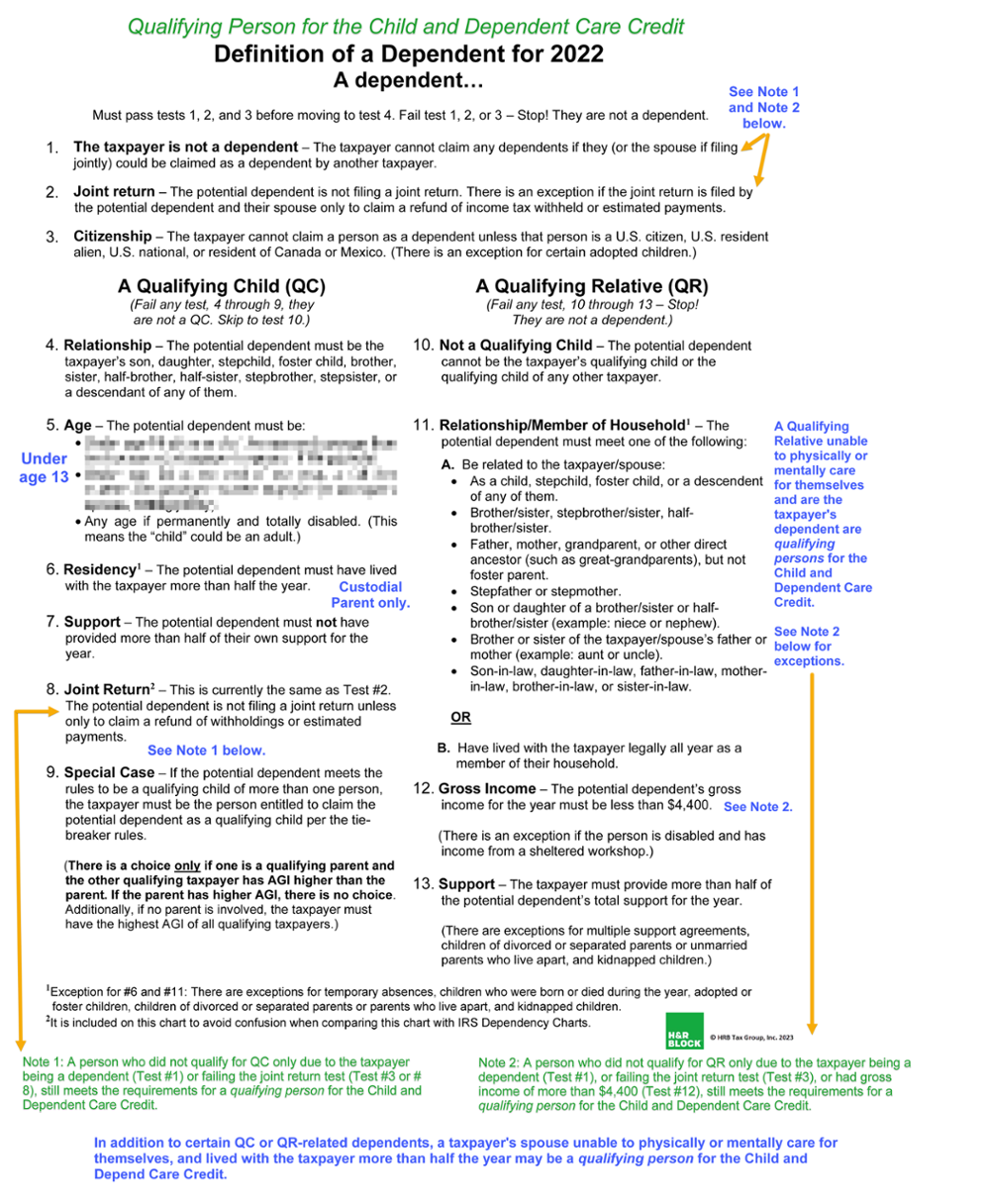
The taxpayer’s spouse, who is physically or mentally incapable of self-care and lived with the taxpayer for more than half of the tax year the credit is claimed.
A disabled person of any age who is physically or mentally incapable of self-care, who lived with the taxpayer for more than half of the tax year in which the credit is claimed, and who the taxpayer claims as a dependent or could claim as a dependent except that:
The disabled person had gross income of $4,400 or more, or
The disabled person filed a joint return, or
The taxpayer (or their spouse if filing jointly) could be claimed on another taxpayer's return.
Below is a visual reminder of the Definition of a Dependent chart. It has been altered to show the differences between the dependency requirements and the qualifying person requirements for the Child and Dependent Care Credit.
Taxpayers filing married filing separately who meet the following requirements may be considered unmarried for purposes of claiming the credit even if not filing a joint return:
The taxpayer paid over half the cost of maintaining a household for the year.
The home was the principal residence of both the taxpayer and a qualifying person for more than half the tax year.
During the last six months of the tax year, the taxpayer’s spouse was not a member of the household.
IN CONTEXT: “Considered Unmarried”
Being considered unmarried for purposes of the Child and Dependent Care Credit is different from being considered unmarried for purposes of the head of household filing status.
In order for a married taxpayer to be considered unmarried for the head of household filing status, they must have a qualifying child dependent. For the Child and Dependent Care Credit, they must have a qualifying person, which could include a qualifying relative dependent. See 2022 Instructions for Form 2441, page 3 for more information.
EXAMPLE
Christy separated from her spouse in March. She isn’t separated under a decree of divorce or separate maintenance agreement and uses the married filing separately filing status. Christy paid for 75% of the cost of keeping up the home she maintains for herself and Larry, her disabled father. Larry is permanently and totally disabled and unable to care for himself.
Because Larry earns $5,600 in interest income, Christy can’t claim him as a qualifying person dependent (his gross income is greater than $4,400). Christy is unable to claim the head of household filing status because she does not have a qualifying person. Therefore, Christy’s filing status is married filing separately; however, Larry is a qualifying person for the Child and Dependent Care Credit.
Because of the following facts, Christy is able to claim the Credit for Child and Dependent Care Expenses even though she uses the married filing separately filing status.
Christy didn’t live with her spouse for the last six months of the year.
Her father met the requirements of a qualifying person and he lived with her for more than half of the year.
She maintains her own household and provides more than half of the cost of maintaining that home for herself and Larry.
Christy pays an adult daycare center to care for Larry to allow her to work.
2c. Qualified Expenses
Qualified child or dependent care expenses are those incurred for the primary purpose of assuring the wellbeing and protection of a qualifying person while the taxpayer works or looks for work.
Expenses for care provided outside the home for the child, disabled dependent, or disabled spouse can be counted, provided the qualifying person regularly spends at least eight hours each day in the taxpayer’s home. If the care is provided in a dependent care center (one that cares for more than six persons for a fee), the center must comply with all relevant state and local laws.
Certain expenses do not qualify for the Child and Dependent Care Credit. The cost of transportation to and from the child care facility by someone other than the care provider does not qualify, and neither do overnight camp expenses. Also, any expense allocable to the education of a child in kindergarten or higher does not qualify. The total cost of schooling below kindergarten qualifies only if the cost of schooling cannot be separated from the cost of care.
EXAMPLE
June and Henry Stark both work. Their son, Harry, attends first grade at a private school. After school, the Starks pay a separate service to have Harry transported to a child care center, where they pick him up after work. The expenses for the private school and the transportation do not qualify for the Child and Dependent Care Credit. The amount they pay the child care center does qualify.
The Starks have a younger child, William, who was in an all-day preschool setting where educational activities are part of the child care service. The entire cost qualifies for the credit. William is picked up by the child care center Harry attends and brought to their facility. This transportation qualifies as an expense since the care provider provided the transportation.
Expenses for in-home care of a child, disabled dependent, or disabled spouse also qualify for the credit.
Qualified expenses for in-home care may include:
Amounts paid for cooking and light housework related to the care of a qualifying person, as well as actual care. Amounts paid for chauffeur or gardening services do not qualify.
Gross wages paid for qualified services, plus the cost of meals and lodging furnished to the employee, plus the employer’s share of the Social Security, Medicare, FUTA (federal unemployment), and any other payroll taxes paid on the wages. A taxpayer who hires a household worker and pays wages of $2,400 or more during the year to that worker must pay the employer’s share of Social Security and Medicare taxes. This threshold can change from year to year.
Remember, payments to any of the following do not qualify for the credit:
A person who either the taxpayer or the spouse may claim as a dependent.
The taxpayer’s spouse or parent of the qualifying person under age 13.